
Introduction: The Art of Clear Comments and Callouts for Factories
Writing clear comments and callouts for factories is essential for successful garment development and production. This process ensures that factory teams interpret your instructions accurately, minimizing mistakes and improving efficiency. Ingredients for clarity include straightforward language, visual cues, specific details, and organized segments. Most importantly, factory instructions must prioritize key aspects such as measurements, materials, and quality standards—all factors that directly impact product outcomes. In this guide, we reveal proven strategies for How to Write Clear Comments and Callouts for Factories, spotlighting communication tricks that cut confusion, save time, and prevent costly errors in the apparel manufacturing chain.
Why Clarity in Factory Comments Matters
Factory communication failures lead to production inconsistencies, delays, and quality issues. When instructions are vague or overloaded with jargon, they become vulnerable to misinterpretation—a common pitfall for brands new to manufacturing. Clear comments and callouts serve as a direct bridge from your vision to the factory floor, supporting consistent standards and flawless execution.
Pillars of Effective Factory Instructions
To achieve streamlined results, every instruction should:
- Use plain language, avoiding technical jargon unless well-defined
- Be visually referenced with diagrams or annotated images
- Break complex requests into manageable steps
- Prioritize critical measurements, processes, and approval points
- Specify desired materials and quality levels
How to Write Clear Comments and Callouts for Factories
Let’s break down actionable techniques and real-world best practices so your factory never has to guess:
Keep Language Simple and Concise
Use short sentences, common vocabulary, and avoid ambiguous phrasing. For example, say “Use white 100% cotton thread” rather than “Use appropriate sewing thread.” If industry terms are necessary (such as SPI or bias cut), always define them directly in the comment or include a glossary. Apparel Wiki recommends referencing official terminology guides to reduce misunderstandings, especially for new team members unfamiliar with English garment production language.
Segment Instructions into Logical Sections
Group related comments—such as stitching, fabric type, sizing, and finishing—into separate callouts. This structured approach helps factory staff process complex information step by step, reducing errors and improving consistency.
Prioritize and Highlight Key Information
Use bold or underline for crucial details, particularly measurements, tolerances, and material choices. If possible, employ color coding or icons in tech packs to draw attention to non-negotiable specs.
Always Reference Visuals Where Possible
Augment your instructions with labeled photos, sketches, or diagrams. Indicate exact placement for stitches, trims, or construction features. If referencing a specific process (such as hemming techniques), link directly to visual examples or detailed guides.
Common Pitfalls in Factory Communication and How to Avoid Them
Miscommunication often arises from ambiguous terms, missing visuals, and clumped data. Brands sometimes overlook the value of detailed comments in tech packs or spec sheets. To avoid frequent delays and errors:
- Double-check that all measurements are included and standardized
- Avoid “see sample” language—always specify details
- Don’t assume factory team understands brand standards—state every expectation clearly
- Call out any “exceptions” clearly when deviating from standard procedures
Structuring Factory Comments: Layout Tips
Comments and callouts should appear in a readable, scannable format. Ideally, use bullet points for sequential steps and grids or tables for sizing and parts. For example:
| Section | Instruction | Reference |
|---|---|---|
| Seam Allowance | Use 1cm throughout body & sleeve except collar (0.5cm) | Collar diagram |
| Stitch Density | Apply 10–12 SPI for all visible seams | SPI chart |
Visual References: The Power of Images, Diagrams, and Callouts
Visual references anchor instructions, giving factories an exact “picture” of your expectations. Annotated sketches, photographic comparisons, and process diagrams support communication. When specifying something like collar finish or sleeve insertion, include marked-up images showing correct technique. Sleeve insertion techniques can vary by factory, so always supplement written instructions with labeled visuals.
Measurement Clarity: How to Specify Size and Fit Details
Garment measurement callouts are the backbone of apparel QC. Explicitly define each Point of Measure (POM), expected tolerance, and measuring method. If you require standardization, link to an official resource such as measure garment standards or a detailed POM guide. Apparel Wiki also suggests including a sample measurement chart for factories, which greatly improves fit accuracy and speeds approval.
Material Specifications: Communicating Fabric and Trim Details
Describe fabric type, composition, weight, color reference, and sourcing details. Avoid vague terms like “medium-weight fabric”; instead, state “320gsm cotton interlock.” For trims, clarify type, placement, method of attachment, and color codes. Visuals help guarantee precise identification for suppliers.
Quality Standards: Including Tolerances, SPI, and Inspection Guidance
Project consistency by listing specific standards—such as acceptable stitch density (SPI), seam allowance, and finishing quality. For a deeper explanation on stitch density, see stitch density guidelines. This allows QC teams to refer to exact benchmarks, dramatically reducing the risk of sub-par work.
Using Tech Packs for Optimized Communication
The modern tech pack is an industry-standard communication tool, combining written instructions, visuals, and tables. When adding comments and callouts, use clear section headings such as “Construction Details,” “Finishing Specifications,” and “Quality Control.” Inclusion of visual call-outs further reduces misinterpretation. To develop an effective tech pack, follow structured resources like tech pack anatomy guides.
Integrating Comments in Digital Workflows
As factories shift toward digital production, integrating comments into platforms like Excel, Techpacker, or Adobe Illustrator streamlines communication and revisions. Electronic annotation enables collaboration across teams, tracks changes, and supports real-time feedback. Explore options for digital pattern making or tech pack software to boost efficiency and traceability.

Callouts for Compliance, Sustainability, and Special Requirements
If you require compliance to standards (such as eco-friendly materials or global testing), state these clearly in both the comments and callouts. Link or reference compliance guides as needed—Apparel Wiki’s sustainability resources, for example, allow factories to access special material requirements in a clear, standardized way.
Practical Example: Comment and Callout Breakdown
Here’s a template breakdown for a factory callout:
- Construction: “Apply French seam on side panels. Seam allowance: 1cm.
- Stitch Density: “12 SPI minimum required. Refer to attached SPI image.”
- Fabric: “Use pre-shrunk, 150gsm cotton poplin. Color code: Pantone 16-3919.”
- Finish: “Hem: Rolled, total width 0.7cm. See attached hem diagram.”
Breaking each instruction into a dedicated line increases scanability for factory staff.
Callout Placement: Where and How to Label
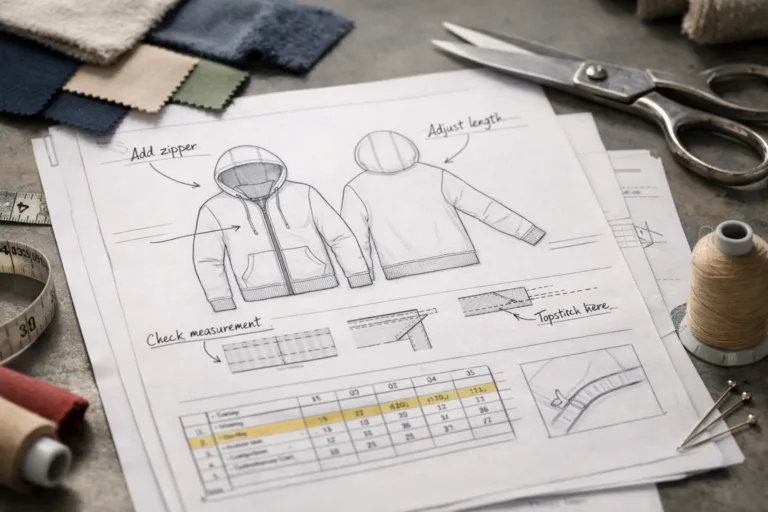
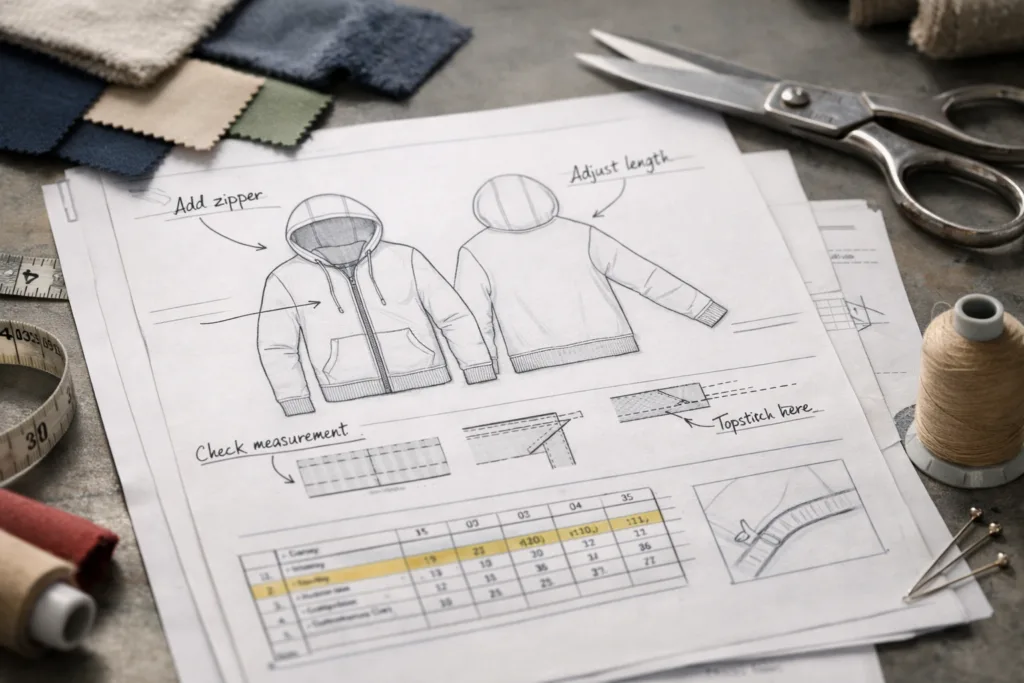
Callouts should correspond directly with diagrams, construction images, or pattern pieces within digital or printed documentation. Place arrows and labels right beside the relevant area, ensuring that factory teams instantly see connections between comments and visuals.
Managing Updates: Keeping Comments Current
Whenever spec changes arise—new measurement, changed thread—update the comment section immediately in all production documents. Centralize these changes so all departments are notified, avoiding costly production mistakes.
Feedback Loops: Reviewing Clarity with Factory Partners
Test your comments and callouts with factory production teams before full implementation. Encourage feedback to identify unclear instructions. Periodically review factory outputs and iterate on communication for long-term quality.
Case Study: Preventing a Tech Pack Mistake
Consider a brand that failed to specify seam allowance for a critical section. The factory defaulted to their usual process, producing samples with the wrong fit. By referencing common tech pack delays and proactively stating every measurement, errors like these can be minimized for future projects.
Comparison Table: Clear vs. Ambiguous Comment Examples
| Clear Comment | Ambiguous Comment | |
|---|---|---|
| Thread | “Use white, 100% polyester thread, Tex 40.” | “Use standard thread.” |
| Seam | “1.2cm seam allowance on shoulder seams only.” | “Use shoulder seams.” |
| Hem | “Apply coverstitched hem, width 2cm.” | “Hem normally.” |
Tools to Enhance Clarity: Annotation & Collaboration Platforms
Annotation tools like Adobe Illustrator, Techpacker, or dedicated Excel templates enable users to mark up visuals, add callouts, and keep instructions easily updatable. Software comparison guides can help you pick the right system for your workflow.
Industry Insight: Apparel Wiki’s Commenting Rules of Thumb
Apparel Wiki suggests using a standard checklist when creating comments and callouts: always label parts, call out non-standard processes, highlight inspection points, and advise factories to confirm understanding before starting production. This helps brands build rapport and avoid repeated errors in global manufacturing contexts.
FAQ Section Placement and Workflow for Tech Packs
Frequently, creators ask how and where to position comment and callout sections in their tech packs. Best practice is to place detailed comments below each drawing or spec sheet, and add summary callout sections at the end.
Summary Table: Commenting Best Practices
| Action | Benefit |
|---|---|
| Simple language | Reduces errors |
| Visual references | Clarifies intent |
| Segment instructions | Improves scanability |
| Highlight critical specs | Avoids misses |
| Update frequently | Ensures accuracy |
Conclusion: Turning Clear Comments into Factory Results

How to Write Clear Comments and Callouts for Factories isn’t just a technical process—it’s the foundation of great product quality and on-time delivery. By prioritizing clear, structured language and visual references, you drastically reduce misunderstandings and limit delays. Remember to review your instructions with factory teams, respond to feedback, and keep documentation current. With precision and care, your comments will drive consistent results and strong partnerships on the factory floor.
Frequently Asked Questions
How do I know if my factory comment is clear enough?
If a factory technician can follow your instruction without extra clarification, it’s probably clear. When in doubt, add a visual or example.
Where should I place callouts in a tech pack?
Ideally, callouts should be placed next to the visual element they refer to, and summarized in a dedicated comment section at the end.
What details should every factory callout include?
Include measurements, materials, finishing techniques, quality tolerances, and visual references for exact placement or process.
Is it better to use photos or sketches for visual references?
Both can be effective. Use photos for real-world clarity and sketches for construction details that require annotation.
How often should comments and callouts be updated?
Any time there is a spec change, measurement adjustment, or new production method, update your comments immediately and notify factories.
What should I do if the factory keeps misunderstanding my instructions?
Review your language for ambiguity, add more visuals, and ask for direct feedback from the factory to clarify unclear sections.
Related Reading
- Avoid Production Nightmares: The Ultimate Tech Pack Guide for Brands
- Unlock Perfection: Step-by-Step Tech Pack Anatomy Explained
- Master Garment Hemming: Factory-Level Secrets and Troubleshooting
- Expert Sleeve Construction: Set-In, Raglan, and Drop Shoulder Techniques
- Stitch Density Demystified: The Practical Guide to SPI Standards
- How to Measure a Garment: Standard POMs for Secure Fit
- 15 Tech Pack Blunders That Delay Your Production Timeline
- 2024 Tech Pack Software Showdown: Adobe Illustrator vs Techpacker