Understanding Pattern Making: Foundations for Garment Design Excellence
Pattern making is the blueprint for turning design ideas into actual garments. Whether you’re a student, an aspiring designer, or an experienced professional, mastering pattern construction is essential. The two major techniques—flat pattern drafting and draping—sit at the heart of fashion development, each with distinct processes, applications, and outcomes. This article will guide you through their core principles, advantages, disadvantages, and practical usage, so you can confidently choose the right method for your next project.
What is Pattern Making?
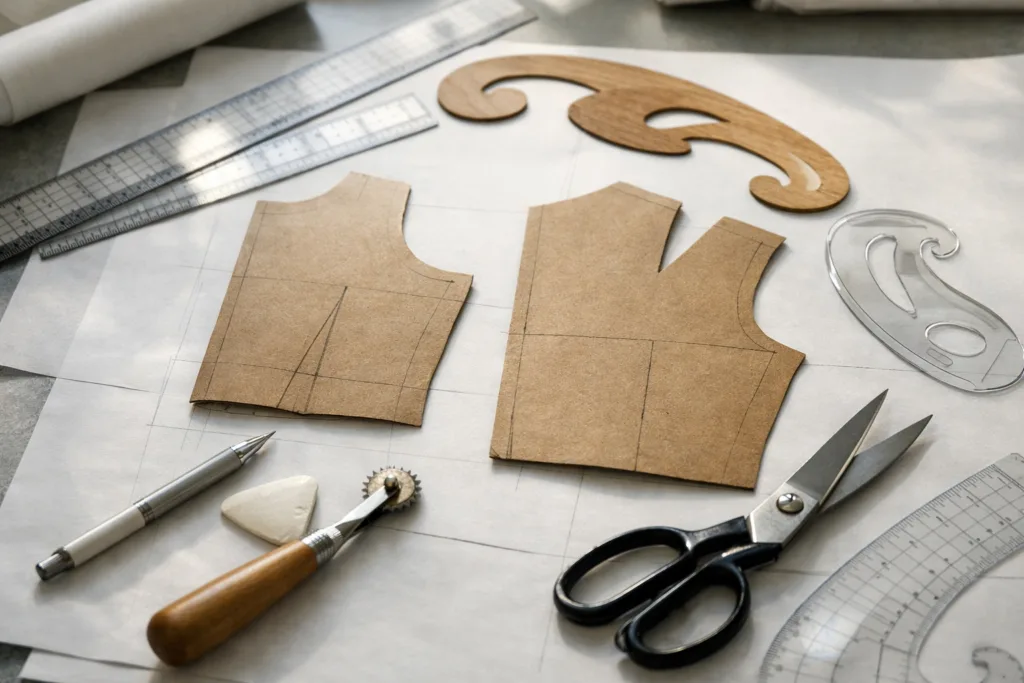
Pattern making involves creating templates that define the shape and fit of a garment. These patterns direct fabric cutting and sewing, ensuring that the constructed apparel matches the design intent. Techniques vary, but all aim to bring sketches to life with precision.
The Importance of Pattern Making in Fashion
Without careful pattern making, even the best design can result in poor fit, incorrect proportions, or unexpected construction challenges. Accurate patterns streamline development, reduce errors in production, and create consistency across sizes and styles.
Introduction to Flat Pattern Drafting
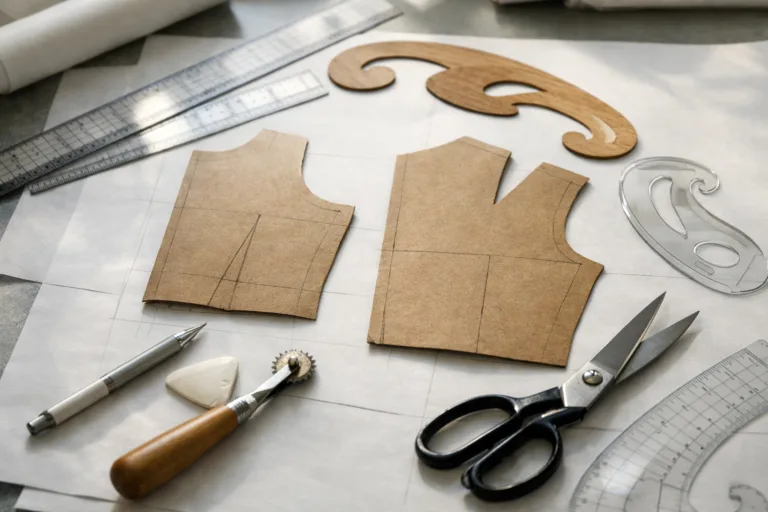
Flat pattern drafting is the process of designing patterns on a flat surface, using measurements and fundamental pre-existing pattern “blocks.” This method relies on mathematical precision, geometry, and tools to craft garment shapes.
Tools and Materials for Flat Pattern Drafting
- Pattern paper or card
- Hip and straight rulers
- French curves
- Notcher, tracing wheel
- Pencils, erasers, scissors
- Measurement tape
- Base pattern blocks (bodice, skirt, sleeve, etc.)
How Flat Pattern Drafting Works
Designers start with basic blocks and alter them—adding style lines, adjusting darts, and incorporating ease to create new looks. The process is iterative and requires an understanding of garment fit and style.
Advantages of Flat Pattern Drafting
- Precision: Ensures consistent sizing and standardized shapes.
- Efficiency: Ideal for mass production and replicating designs.
- Documentation: Easy to archive and scale patterns for future use (Learn about grading rules here).
Disadvantages of Flat Pattern Drafting
- Challenging for highly sculptural or unconventional shapes.
- May require multiple fittings if the body shape varies significantly from standard blocks.
- Flat surfaces can’t always predict 3D fit issues (see ease in pattern making for more).
Introduction to Draping
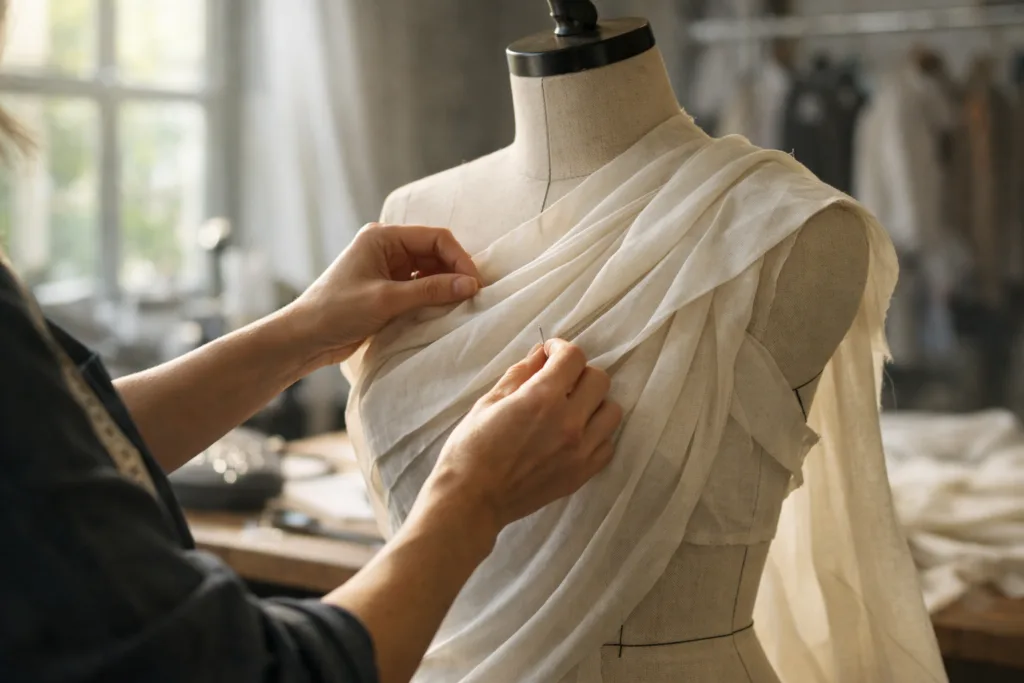
Draping is a tactile, creative approach—fabric is pinned and shaped directly onto a dress form or mannequin. Unlike flat pattern drafting, draping brings immediate feedback in 3D, letting designers visualize proportions, volume, and flow instantly.
Tools and Materials for Draping
- Dress form/mannequin (matching the required body size)
- Muslin fabric or any inexpensive, stable fabric
- Pins, scissors, tape
- Measuring tape
- Pencils, tailor’s chalk
How Draping Works
Designers manipulate fabric on the form, adjusting fullness and structure until the garment matches the desired shape. Markings and lines are transferred to flat paper to produce reusable patterns.
Advantages of Draping
- Visual immediacy: See shape and style real-time on a 3D body.
- Freedom: Ideal for asymmetrical, complex, or experimental silhouettes.
- Creativity: Encourages intuitive corrections and design exploration.
Disadvantages of Draping
- Requires more fabric and time up front.
- Difficult to archive or replicate exactly, especially for production.
- Technical skill and spatial awareness needed; challenging for beginners.
Flat Pattern vs. Draping: A Head-to-Head Comparison
| Feature | Flat Pattern Drafting | Draping |
|---|---|---|
| Approach | Mathematical, 2D, uses blocks | Physical, 3D, on a form |
| Best For | Standardized, repeatable designs | Complex, sculptural, custom shapes |
| Time | Efficient with experience | Can be time-consuming |
| Archiving | Easy to document & grade | More difficult |
| Required Skills | Math, geometry, patience | Spatial, creative, hands-on |
| Cost | Lower upfront | Requires more sample fabric |
When to Use Flat Pattern Drafting
Flat pattern is ideal for everyday basics, tailored garments, and production-oriented apparel where fit and repeatability matter. For instance, T-shirts, tailored shirts, trousers, and other staple pieces are almost always drafted flat. Read about real-world examples in tech pack examples for T-shirts, hoodies, and denim.
When to Use Draping
Draping shines in couture, evening wear, bridal gowns, or any project demanding sculptural finesse and organic shapes. Designers opt for draping to create dramatic gathers, bias effects, or asymmetric lines that are hard to sketch out in two dimensions alone. To learn more about bias cuts and their impact, visit What Is “Bias Cut”?.
Choosing the Right Technique for Your Project
Ask These Key Questions
- Is the design basic or architectural?
- Is mass production required?
- Are precise fit and grading important?
- Does the shape demand organic, creative handling?
Practical Decision-Making
For newly developed block patterns or updating tech packs after sampling, flat pattern methods save time. In contrast, unique silhouettes and experimental collections gain from draping’s tactile creativity.
Skills Needed for Flat Pattern Drafting
- Comfort with measurements and calculation
- Ability to visualize fit as a 2D drawing
- Attention to detail for symmetry and balance
- Familiarity with grading rules
Skills Needed for Draping
- Strong spatial awareness
- Quick hands-on problem solving
- Knowledge of fabric behavior
- Creativity and willingness to experiment
The Role of Pattern Making in Final Garment Design
A successful pattern bridges the gap between design sketches and finished clothing. Missteps in pattern work often lead to fit issues, wasted materials, or delays in production. For practical solutions to common garment fit problems, see Common Fit Issues & How to Fix Them.
Examples: Flat Pattern vs. Draping in Real Projects
Flat Pattern Example
Draft a shirt using a bodice block, add front placket, adjust collar, and grade sizes for scalability. Efficient for business shirts and uniform production.
Draping Example
Shape muslin on a dress form to invent a unique cocktail dress with asymmetrical gathers and drape—ideal for limited editions or bespoke orders.
Essential Tools Checklist for Both Techniques
| Purpose | Flat Pattern | Draping |
|---|---|---|
| Measurement | Measuring tape, rulers | Measuring tape |
| Marking | Pencil, ruler, notcher | Pins, tailor’s chalk |
| Surface | Table, flat paper | Dress form, mannequin |
| Material | Pattern paper, card | Muslin fabric |
How Your Choice Impacts Construction and Fit
The technique shapes how the garment is constructed and how it fits the wearer. Flat patterns facilitate consistency and are easier to manufacture at scale, but can miss subtleties of body curvature. Draping offers fit perfection and visual experimentation but is difficult to standardize for bulk production.
Common Mistakes When Selecting Pattern Making Methods
- Choosing flat pattern for complex, sculptural designs—may cause fit and style loss.
- Using draping for highly standardized basics—creates inefficiency.
- Ignoring fabric properties—different textiles drape and stretch uniquely (read Developing Patterns for Knits vs Wovens).
The Role of Digital Tools in Modern Pattern Making
Cutting-edge software allows for digital drafting, simulation, and rapid iteration—even blending both flat and draped approaches virtually. To explore modern methods, see Digital Pattern Making: CAD Tools.
Understanding Ease, Grading, and Balance
“Ease” refers to the extra room included in a pattern for comfort and movement (What is Ease in Pattern Making?). “Grading” scales a pattern to fit multiple sizes. Balancing a pattern ensures it hangs evenly—critical for fit and factory production.
Industry Insights: Editor’s Notes from Apparel Wiki
Apparel Wiki frequently observes that many beginners struggle most with translating 2D pattern adjustments into accurate fit. For new designers, hands-on testing—whether by flat pattern or draping—remains essential. If a factory reports fit errors, check for overlooked ease or balance issues before redrafting entire blocks. Understanding these fundamentals helps brands avoid costly delays.
Integrating Pattern Making with Tech Packs
Integrating precise, clear patterns into your tech pack ensures the factory understands shape, proportion, and construction intent. Strong pattern instructions—in both methods—are key to manufacturing success. For a step-by-step approach, reference how to create a tech pack in Excel.
Conclusion: Making Confident Decisions in Pattern Making
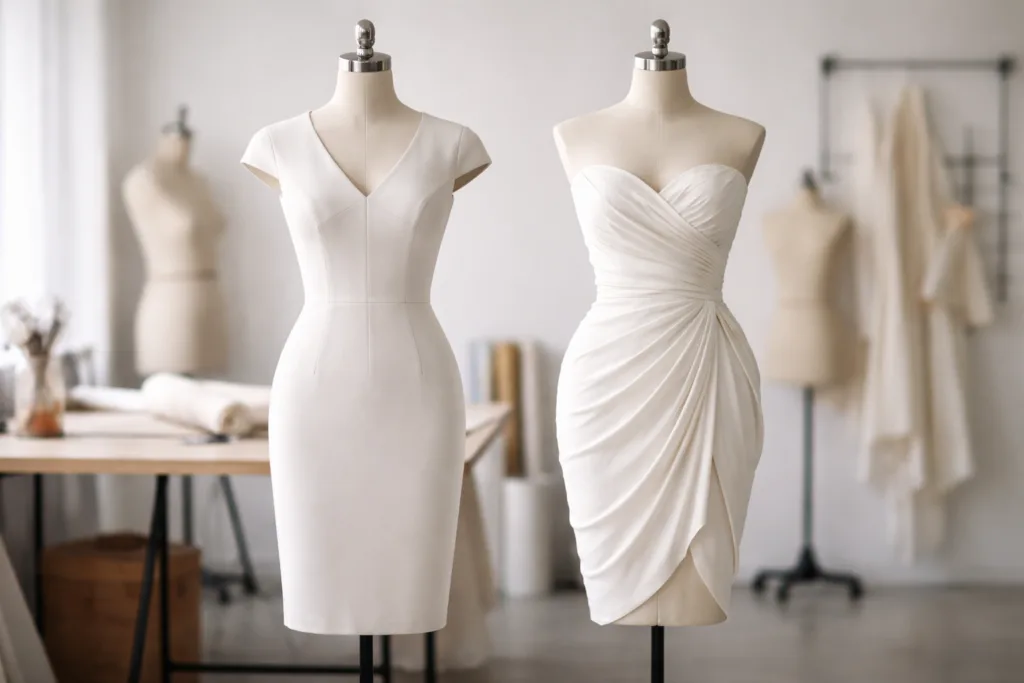
Flat pattern drafting and draping stand as the cornerstones of pattern making. Your choice depends on design goals, technical skill, available time, and intended production process. By understanding each method’s strengths and constraints, fashion creatives can confidently craft garments with the perfect blend of fit, innovation, and efficiency. For every project, clear pattern work leads to better outcomes and fewer production frustrations.
Frequently Asked Questions
Should beginners start with flat pattern or draping?
Beginners often find flat pattern drafting easier since it uses clear measurements and guided steps. Draping can be more intuitive but requires spatial awareness and confidence with fabric handling.
Which method is better for complex gowns?
Draping offers more flexibility and control for complex gowns, especially those with unique lines, gathers, or volume that are difficult to visualize with flat pattern drafting.
Do professionals use both flat pattern and draping?
Yes, most experienced designers use both methods depending on the garment, blending flat drafting for basics and draping for artistic or challenging projects.
What is a block pattern?
A block pattern is a basic, standardized template (like a bodice or skirt) used as a starting point in flat pattern drafting. It can be modified for different styles and fits.
How does pattern making affect tech pack quality?
Accurate pattern making ensures tech packs clearly communicate fit and construction details to factories, reducing production errors and improving efficiency.
Can pattern making be done digitally?
Absolutely—CAD and digital pattern-making software streamline both flat draft and virtual draping, making collaboration and adjustments much faster.