Most fabric consumption costing mistakes come from four problems: unclear scope, incorrect input data, duplicated allowances, or failure to reconcile the estimate with the actual cutting plan. Fabric consumption is not one universal number. It is a project-specific estimate that may move from pattern usage to marker usage, cutting loss, fabric defects, and finally purchasing quantity.
Apparel Wiki is an independent educational publication, not a factory, testing laboratory, certification body, or service provider. Our manufacturing knowledge work is editorially independent; information about supporting that work is available on the Sponsor page. The definitions below describe general industry concepts, while the correct allowance or review method depends on the garment and production conditions.
What fabric consumption costing mistakes are, and why they change the order cost
A fabric consumption estimate states how much material a garment or order is expected to require. That estimate can have several layers. Net pattern usage refers broadly to the material represented by the pattern pieces. Marker usage reflects how those pieces are arranged within a particular marker. Cutting, spreading, defects, processing changes, and purchasing decisions may introduce further quantities or losses.
These layers should not be treated as interchangeable. A marker can show one result for a particular fabric width, size ratio, style version, and direction rule, while the purchase quantity may include separately documented production conditions. If a per-garment estimate is slightly wrong, the difference can be repeated across the order quantity and change the material required and the resulting cost. The financial effect is project-dependent, so no universal impact should be assumed.
An early costing estimate is useful for development, pricing discussion, or comparing design options. It may rely on incomplete patterns, an assumed width, a representative size, or a provisional allowance. A production-ready consumption figure should be tied to approved or final graded patterns, the relevant component list, the actual order mix, the usable fabric width, and the marker assumptions used for cutting.
For that reason, reviewing garment fabric consumption requires more than checking a single decimal value. Confirm the fabric construction, directionality, width, size range, marker plan, style revision, and order ratio. Then trace which quantity is being measured at each stage. An estimate that does not state its denominator and included losses is difficult to compare with a purchase record or cutting report.
Mistake 1: treating net pattern usage as the fabric quantity to purchase
Pattern pieces describe the shapes needed to construct a garment, but the material enclosed by those shapes is not automatically the amount of fabric that must be purchased. The pieces need to be positioned on a marker, and that arrangement must follow the fabric-direction and construction rules for the style.
Marker fabric consumption therefore depends on the specific setup. Grain direction can restrict how pieces are rotated. A one-way print or nap may require all pieces to face the same direction. Stripes, checks, repeats, and other matching requirements can create additional layout constraints. These are common project considerations, not fixed allowances that apply to every garment.
Marker efficiency describes the relationship between the pattern area and the area used by a particular marker. It is not a universal constant for the garment. A change in usable width, size ratio, pattern revision, or matching rule can produce a different result even when the garment name remains the same.
For a simple hypothetical example, a set of paper pattern pieces might appear to occupy less material than the rectangular marker area needed to arrange them while preserving grain direction. The example illustrates the distinction only; it is not a production quote or a recommended consumption value.
To make a net fabric consumption estimate traceable, record the marker width, style version, size ratio, size range, and fabric-direction rules. Also state whether the figure represents pattern usage, marker usage, or a later purchasing quantity. That small amount of documentation prevents a pattern-area estimate from being mistaken for a production commitment.
Mistake 2: using the nominal fabric width instead of the usable width
Fabric width is a critical input for marker making, but several width descriptions may appear in the same project. Nominal width is a stated or labeled dimension. Actual width is what is observed on the material. Usable width is the portion available for the relevant marker after considering selvages, edges, construction features, or areas that cannot be used for that layout.
Using the nominal width without confirming the usable width can make the marker look more efficient than the production material allows. A narrow change may force a different arrangement, reduce the number of pieces that fit across the fabric, or require a longer marker. The correct result depends on the pattern and fabric, so a width convention should not be applied automatically across all materials.
Width may also need to be checked for the specific fabric lot and approved process. Relaxation, washing, finishing, or other processing steps can affect the dimension available for cutting. The relevant question is not simply what a supplier specification says, but what width is approved and available for the intended marker after the applicable process.
Keep the width used in the marker consistent with the width stated in the costing and purchasing records. If the estimate uses an assumed width, label it as an assumption. If the width is measured or approved for production, retain the supporting record and identify the fabric lot, finish, and direction rules. Do not invent a tolerance or treat one company’s measurement procedure as a universal industry requirement.
Mistake 3: adding the same loss twice
One of the most common apparel costing errors is adding a loss that has already been included in another quantity. Net usage, marker loss, cutting loss, fabric defects, end loss, shrinkage allowance, and rejected material may be tracked separately, but they do not automatically belong in one undifferentiated percentage.
The safest approach is to draw the material flow from the pattern or marker result to the production quantity and then to the purchase quantity. For every addition, state what it covers, what denominator it uses, whether it is already included, and who owns the approval. An allowance applying per garment is not necessarily interchangeable with one applying per marker, roll, or order.
| Stage | Question to record |
|---|---|
| Pattern or marker usage | What style version, width, size ratio, and direction rules produced the base figure? |
| Spreading and cutting | Which cutting or end conditions are included, and are they measured separately? |
| Fabric defects | Are defects a known material condition, a provisional assumption, or already reflected in the purchase quantity? |
| Purchasing quantity | Which prior losses and allowances are already included in the final number? |
This table is a documentation framework, not a universal waste allowance. A hypothetical costing worksheet might list each category with a placeholder value, but those values must be confirmed against the fabric, marker, process, and production records. Adding every available percentage without checking its scope can inflate the estimate; omitting a separately required condition can understate it.
When an estimate changes, compare the old and new material flow line by line. That makes it easier to identify whether the difference came from a revised marker, a width assumption, a defect category, or a duplicated allowance. The goal is not to force every project into one formula, but to ensure that each quantity has a clear meaning and appears only where it belongs.
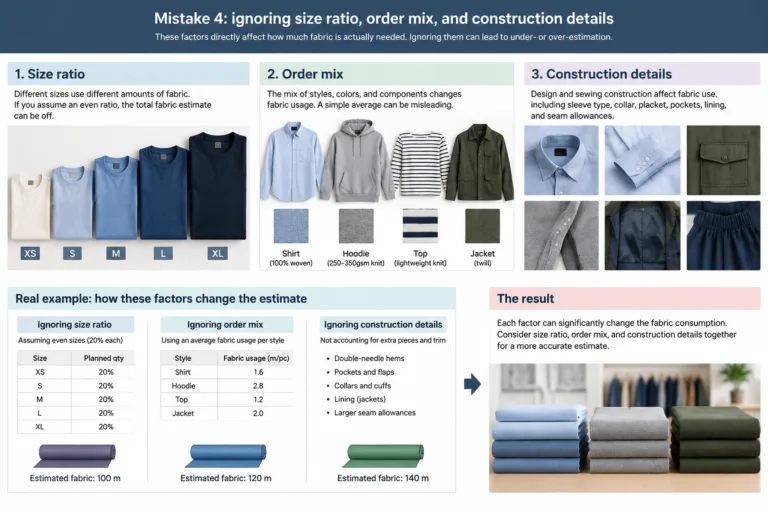
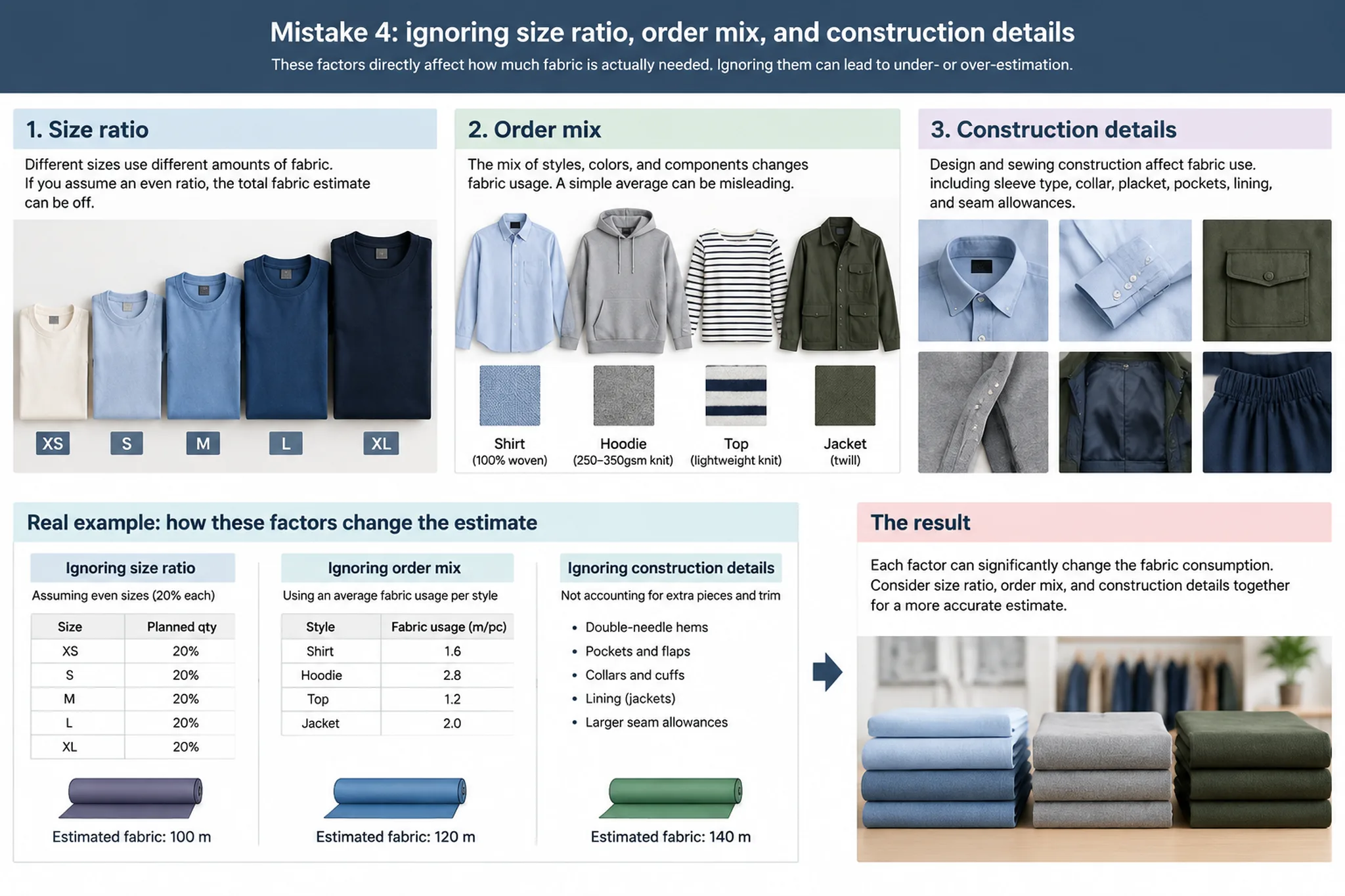
Mistake 4: ignoring size ratio, order mix, and construction details
A consumption figure taken from one sample size can misstate the material required for an entire order. The order may contain a different distribution of sizes, and larger or smaller graded pieces may not fit the marker in the same way as the development sample. For this reason, size ratio fabric consumption should be reviewed against the actual order mix rather than multiplied from one representative garment without checking.
Construction details also change the material scope. Long sleeves, larger body panels, pockets, facings, linings, cuffs, collars, and self-fabric components may require separate pieces or additional markers. One-way fabric direction, colorway separation, panel matching, and other design restrictions can further limit how pieces are arranged. These are project inputs, not fixed adjustments that apply equally to every garment.
Keep the early development estimate separate from a marker-based estimate made with the final graded patterns. When the style changes, record the style revision, size range, order ratio, component list, fabric direction rules, and marker assumptions. This documentation makes it possible to identify whether a later change came from the garment design, the size mix, the fabric, or the marker plan.
Mistake 5: failing to verify fabric behavior and production conditions
A fabric can behave differently before and after approved processing, relaxation, washing, or finishing. Shrinkage, skew, bowing, distortion, and other dimensional changes may affect the usable cutting conditions or require a project-approved allowance. The correct response depends on the material and process; there is no universal fabric relaxation allowance that can be applied to every order.
Separate a pre-production assumption from a result measured after testing or processing. When comparing estimated and actual consumption, record the fabric lot or specification, finish, width, directionality, and relevant defect information. A shortage or an unexpected visual result does not prove one root cause. Measurement error, changed patterns, marker inefficiency, fabric defects, processing effects, and genuine cutting waste can produce similar symptoms.
Use a structured diagnosis: describe the discrepancy, list competing causes, gather the available evidence, and run the smallest useful verification. Comparing material records with approved patterns, marker files, inspection notes, and cutting records is more reliable than assigning blame from a single observation.
How to audit a fabric consumption estimate before ordering
An audit should clarify what the estimate includes and which assumptions still need approval. It does not require one formula for every garment. It requires a traceable path from the style information to the quantity that will be purchased.
- Freeze the inputs. Record the style revision, size range, order ratio, fabric specification, colorway, and component list.
- Verify the usable width. Confirm the actual or approved width available for the relevant marker, including fabric-direction and matching rules.
- Review the marker basis. Inspect the marker where available, or document its width, size ratio, piece restrictions, and other assumptions.
- Trace each quantity. Show how pattern or marker usage becomes a production quantity and then a purchasing quantity. Identify spreading, cutting, end, defect, shrinkage, or rejected-material categories separately when they are used.
- Check the result independently. Compare it with a second calculation, sample marker, or relevant historical production record where available.
- Document uncertainty. Mark unresolved assumptions and test the variables most likely to change the order. Treat sensitivity scenarios as assumptions, not forecasts.
A compact review record can include these fields:
| Review field | Question to answer |
|---|---|
| Source data | Which patterns, width records, fabric specification, and order data were used? |
| Denominator | Is the figure stated per garment, marker, roll, lot, or order? |
| Allowance owner | Who defined each allowance, and what condition does it cover? |
| Included losses | Which losses are already included, and which remain separate? |
| Approval status | Which inputs are measured, approved, provisional, or unresolved? |
This type of checklist can support work by designers, developers, merchandisers, sourcing teams, and manufacturers while keeping their responsibilities distinct. Apparel Wiki is an independent educational publication, so this process guidance should be adapted to the project records and approval system used by the responsible team.

What to do when estimated and actual fabric consumption do not match
First define whether the comparison is valid. Check the same style version, fabric lot or specification, size ratio, marker rules, usable width, processing condition, and loss categories. Comparing an early estimate with a production result from changed inputs can make a normal revision appear to be a costing error.
Next, separate the competing explanations. Review measurement records, approved patterns, marker files, roll inspection notes, cutting reports, and purchase quantities. The result may require a corrected source width, a revised marker, a changed allowance, a documented defect condition, or a technical review of the cutting process. Historical consumption can help inform the next estimate, but one order does not establish a universal allowance for another fabric or construction.
Close the investigation with a written decision: revise the estimate, correct the source data, revise a project-specific allowance, or retain the estimate and explain the variance. Recording the evidence and the decision improves future traceability without promising a fixed percentage reduction in material use.
For continued learning, compare this review process with the relevant Apparel Manufacturing Tools and keep a project worksheet that preserves each assumption. A clear record helps teams revisit the estimate when patterns, fabrics, order ratios, or production conditions change.
FAQ
What is the difference between net fabric consumption and purchase quantity?
Net consumption describes the material represented by the pattern or marker basis. Purchase quantity may also reflect approved production, defect, processing, or other project-specific allowances. The included categories must be stated so the same loss is not added twice.
Why can the same garment have different fabric consumption estimates?
Estimates can change with fabric width, size ratio, pattern revision, fabric direction, matching requirements, construction details, processing effects, and the loss categories included. The garment name alone does not define one universal consumption figure.
How does usable fabric width affect a consumption calculation?
The marker must use the width actually available for the pattern layout, not automatically the nominal width. Selvage, edge conditions, defects, direction rules, or processing changes may reduce the usable area for a specific marker.
Which fabric losses should be listed separately instead of added together?
Pattern or marker usage, spreading and cutting loss, end loss, fabric defects, shrinkage allowance, and rejected material may be separate categories. Whether they apply depends on the project, but each category should state its scope and whether it is already included.
Should fabric consumption be estimated from one sample size or the full order size ratio?
Use the sample size for an early estimate only, then review the result against the full order size ratio and final graded patterns. The appropriate method depends on the available pattern and order information.
What records help explain a difference between estimated and actual fabric consumption?
Useful records include the approved patterns, style revision, marker file, usable-width information, fabric lot or specification, roll inspection notes, cutting reports, order ratio, and purchase quantity. They help distinguish changed inputs from measurement or production issues.