A color change cost is the incremental cost created when a production process must prepare, switch, clean, test, or handle materials for a different color or colorway. In an apparel cost sheet, the Sponsor relationship does not determine the calculation: Apparel Wiki is an independent educational publication, not a factory, manufacturer, testing laboratory, certification body, or sourcing service provider.
The practical color change costs calculation starts by separating this increment from the garment’s base material cost and from the full cost of developing a new style. A charge may arise during fabric dyeing, yarn or trim production, printing, washing, finishing, cutting, sewing, packing, or color approval, depending on the product and the operation. There is no universal color-change charge. The result depends on the process, supplier quotation, minimums, equipment, batch structure, and loss assumptions.
What Is a Color Change Cost in an Apparel Cost Sheet?
A color change cost represents the extra work or resource consumption associated with adding, switching, or processing a colorway. For example, a supplier may need to prepare equipment, clean a system, flush residual material, run a trial, adjust a shade, or complete additional approval work. The relevant cost is the increment caused by the color decision, not every cost associated with producing the garment.
This distinction matters when building an apparel cost sheet. The base fabric, standard trims, normal sewing labor, and ordinary packing cost may apply to every colorway. A color change cost is added only when a particular color or production arrangement creates an additional, identifiable cost. The total cost of developing a new style is broader and may include design, pattern, sample, fitting, grading, and testing work that is not caused specifically by changing color.
Color change costs can occur at several stages:
- Material and wet processing: fabric, yarn, or trim dyeing may require separate preparation, batch handling, shade adjustment, or cleaning.
- Surface treatment: printing, washing, coating, and finishing may create extra setup, purge, trial, or approval activity.
- Garment operations: cutting, sewing, packing, or handling may require color-specific separation, additional sorting, or different component coordination.
- Approval workflows: lab dips, strike-offs, shade bands, testing, administration, or sample review may be charged separately from bulk production.
The cost may be one-time for a production run or recurring for each color, order, lot, batch, or unit. A single equipment setup could affect one run, while a supplier surcharge could be applied to every purchased unit. Treating both as the same type of cost can distort the comparison between colorways, especially when planned quantities differ.
Which Cost Components Should Be Included?
Before calculating an apparel color change cost, map the possible components and mark each one as confirmed, estimated, conditional, or not applicable. The supplier’s quotation, purchase order, production records, or internal costing policy should determine whether a component belongs in the calculation. A process description alone does not prove that a charge applies to a particular order.
- Setup and changeover: additional labor, machine preparation, line preparation, cleaning, purging, or process consumables when the operation requires them.
- Process and material loss: material used for sampling, flushing, trial runs, shade adjustment, rejected output, or unusable remnants when the relevant process actually creates those losses.
- Color approval: lab dips, strike-offs, shade bands, testing, sample handling, and administrative work that is separate from bulk production.
- Commercial conditions: a minimum batch, minimum dye lot, minimum print run, or supplier-specific surcharge if the quotation or agreement includes it.
- Excluded landed-cost layers: freight, insurance, duties, taxes, and related charges should remain separate unless the costing model explicitly allocates them to the color-change line.
Keep three quantities separate: net material required for the garment, process loss, and purchased quantity. If the purchased quantity already includes an approved loss allowance, adding the same allowance again as a separate color-change cost double-counts it. The same check applies when a supplier has already built setup or approval work into a quoted unit price.
A Practical Formula for Calculating Color Change Cost
A reusable framework is:
Total incremental color-change cost = setup and changeover cost + additional labor and consumables + material or process loss + testing and approval cost + applicable minimum or surcharge effects.
This is a costing structure, not an industry-mandated accounting formula and not a substitute for a factory quotation. Each term should be supported by a supplier document, validated production record, or clearly labeled internal assumption. If a term does not apply to the operation, record it as not applicable rather than forcing a zero-value estimate without explanation.
Next, identify the correct allocation denominator. A run-level cost can be converted into a colorway or unit amount only after the cost trigger is clear:
- Allocate a one-time setup across the affected colorway’s planned quantity when that colorway causes the setup.
- Allocate a shared run cost across multiple colorways when the commercial agreement or internal policy treats the run as the cost object.
- Keep a recurring per-unit or per-batch surcharge attached to its stated unit or batch basis.
- Use the purchase order, batch, lot, or production run as the denominator when that is how the supplier incurs and quotes the cost.
Record the assumptions beside the calculation: planned quantity, number of colorways, number of batches, loss percentage if applicable, approval count, and whether the quoted material quantity already includes loss. This makes the cost sheet auditable when quantities or color selections change. It also prevents a run-level amount from being mistaken for a universal per-garment charge.
How to Allocate One-Time and Recurring Costs Across Colorways
Allocation is the main judgment in colorway costing. The appropriate basis should follow the operational trigger and the commercial agreement, not simply the easiest spreadsheet formula. A small colorway may show a high per-unit impact when it absorbs a fixed setup cost, even though the supplier’s total charge is unchanged.
| Cost type | Likely trigger | Possible allocation basis | Evidence to check |
|---|---|---|---|
| One-time setup | Equipment or line preparation | Affected colorway, batch, or run | Supplier quotation and production plan |
| Process loss | Trial, flushing, adjustment, or rejected output | Relevant batch or purchased material | Process record and quantity basis |
| Approval work | Samples, testing, or shade review | Colorway, order, or development project | Quotation, approval record, or internal policy |
| Recurring surcharge | Supplier’s stated color or batch charge | Unit, lot, batch, or order | Current commercial terms |
Distinguish a supplier’s separate color surcharge from an internal allocation of shared development or production costs. They may appear on the same cost sheet, but they represent different claims. A supplier-confirmed charge describes a quoted commercial condition; an internal allocation describes how the business distributes a shared cost for comparison or margin analysis.
Combining colors into one order, changing planned quantities, or consolidating compatible production may alter the allocation basis. It does not guarantee a lower supplier charge. Recalculate the scenario using the revised colorway quantities, batch structure, and quotation terms, and retain the original case for comparison.
Worked Cost-Sheet Example Using Explicit Assumptions
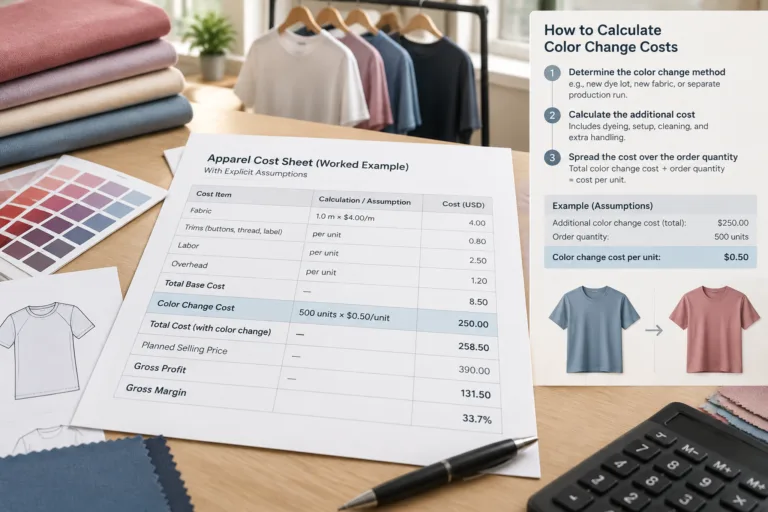
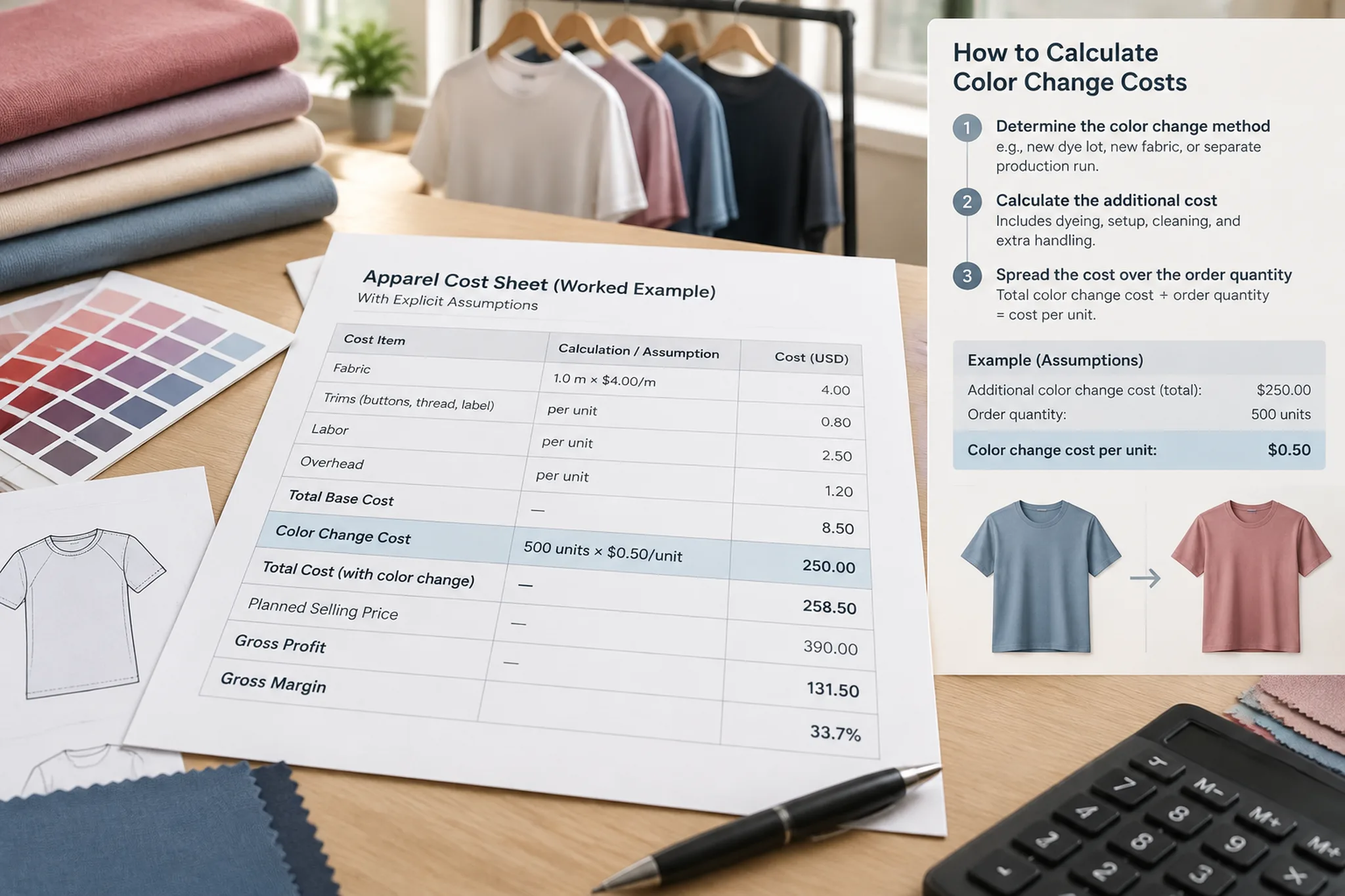
Consider a hypothetical base style with one added colorway. The figures below are teaching inputs, not a factory quotation. Assume the added color requires a run-level setup amount of 240 currency units, an approval amount of 60, and a process-loss allowance of 100. The planned quantity for the colorway is 1,000 garments. No recurring per-unit surcharge has been confirmed.
The first step is to identify the trigger. In this example, the setup amount relates to preparing the process for the added color, the approval amount relates to color review, and the loss allowance relates only to material or output that the relevant process actually makes unusable. The hypothetical incremental cost is therefore 400 currency units for the colorway before any freight, duty, tax, or other landed-cost layer.
To allocate that run-level amount across the planned colorway quantity, divide 400 by 1,000 garments. The resulting internal comparison amount is 0.40 currency units per garment. This does not mean the supplier must invoice 0.40 per garment. It means the business has distributed a fixed colorway cost across the quantity used in its planning model.
Now compare that result with a different commercial condition. If the supplier instead quotes a recurring color surcharge of 0.30 currency units per garment, the cost for 1,000 garments would be 300 currency units. If the quantity changes, the two models behave differently: the fixed 400-unit run-level amount stays unchanged unless the production structure changes, while the recurring surcharge changes with every garment. Keep these lines separate in the cost sheet.
| Item | Basis | Quantity | Unit cost | Total | Allocation and status |
|---|---|---|---|---|---|
| Setup | Added colorway | 1 run | 240 | 240 | Colorway; hypothetical |
| Approval work | Color review | 1 activity | 60 | 60 | Colorway; awaiting confirmation |
| Process loss | Relevant process output | 1 allowance | 100 | 100 | Batch; assumption to validate |
| Recurring surcharge | Per garment | 1,000 | 0.30 | 300 | Unit; hypothetical alternative |
A working garment costing worksheet should also record the source of each input, the currency, the quotation or estimate date, and whether the number is supplier-confirmed, internally estimated, or unresolved. If the purchased material already includes the relevant loss, do not add the same allowance again. When quantity, batch count, or the number of colors changes, revise the affected denominator and retain the previous scenario for comparison.
How to Check a Color Change Calculation Before Approval
Begin by naming the operation that creates the cost. Is it fabric dyeing, yarn or trim production, printing, washing, finishing, or a combination of stages? A charge that applies to fabric should not automatically be copied into a finished-garment line. Confirm whether the quotation covers one operation or several.
- Match the number of colors, lots, batches, samples, approvals, and planned garments to the current production plan.
- Check whether setup, cleaning, purging, trial output, shade adjustment, or rejected material is already included elsewhere.
- Separate net material use, purchased quantity, process loss, and unusable remnants before applying an allowance.
- Read the supplier terms for one-time, recurring, conditional, refundable, or minimum-run charges.
- Record the quotation currency, validity period, version date, and any tax or duty treatment relevant to the costing model.
- Mark missing confirmation as pending instead of converting an unknown charge into a silent estimate.
The arithmetic review and the commercial review are different tasks. A calculation can be mathematically correct while using the wrong allocation basis or an outdated quotation. A supplier-confirmed amount supports that specific commercial claim; it does not establish a universal apparel rate. Where tax, customs, or regulatory treatment affects the result, verify the applicable market separately.

When a Colorway Should Be Repriced, Consolidated, or Reconsidered
Use the calculated increment as decision support, not as an automatic reason to remove a color. Compare it with the planned quantity, selling context, target margin, customer demand, and strategic importance of the colorway. A small colorway may carry a noticeable per-unit impact because it absorbs a fixed setup cost, while a larger colorway may spread that cost more widely.
Next, identify the commercial or technical cause. A minimum batch, approval requirement, process-loss allowance, or supplier-specific surcharge may call for different responses. Possible scenarios include changing the quantity, reducing the number of colors, consolidating compatible production, selecting another material or process, or accepting the added cost. None of these options guarantees a saving; each must be checked against the supplier’s current terms and the product brief.
Run sensitivity cases when the decision is uncertain. Change one assumption at a time, such as planned quantity, process loss, exchange rate, or defect allowance, and then consider a clearly labeled combined scenario. These are planning exercises rather than forecasts. Keep color, shade, quality, safety, and legal requirements within the applicable product and market requirements, even when a lower-cost option appears attractive.
For a repeatable review, record the final assumptions in the relevant Apparel Manufacturing Tools workflow or cost-sheet system, then seek sourcing or production confirmation for unresolved charges before approval.
FAQ
What does color change cost mean in an apparel cost sheet?
It is the incremental cost caused by preparing, switching, cleaning, testing, approving, or handling a different color or colorway. It is separate from the garment’s base material cost and may be fixed, recurring, or conditional.
What costs should be included when adding a new garment colorway?
Include only applicable setup, changeover labor, consumables, process loss, approval work, minimum-run effects, and supplier surcharges. Keep freight, duties, insurance, and other landed-cost layers separate unless the model explicitly allocates them.
How do you calculate a color change charge per garment?
First total the relevant run-level increment, then divide it by the correct planned quantity if an internal per-garment comparison is appropriate. A supplier’s recurring per-unit charge should remain separate from that allocation.
Should a one-time dyeing or printing setup cost be allocated by color, batch, or unit?
Use the basis that reflects the operational trigger and commercial agreement. Allocate by colorway, batch, order, or unit only after confirming how the supplier incurs and quotes the charge.
How can you avoid double-counting fabric loss in a color-change calculation?
Trace the material quantity from net use to purchased quantity and identify where loss is already included. Add an allowance only when it represents a distinct, documented loss that is not already priced elsewhere.
Does adding more colorways always increase apparel production cost?
No. It may add setup, approval, minimum-run, or recurring costs, but the effect depends on the process, quantities, batch structure, supplier terms, and whether some work is shared. Confirm each scenario rather than applying a universal rule.