A useful metal button purchase specification describes more than the loose accessory. It identifies the button, its intended garment position, material and appearance, attachment method, approval basis, and the conditions that may affect its suitability. Apparel Wiki is an independent knowledge publication; its Sponsor information does not change that editorial role. The field map below is planning guidance for a reviewable purchasing document, not a supplier quotation or universal industry template.
The central principle is simple: a button is part of a garment system. A component that looks acceptable by itself may behave differently after attachment, laundering, pressing, handling, or contact with the garment fabric. Good metal buttons specifications therefore connect the component with the fabric, construction, use, care context, and evidence needed for any higher-risk claim.
What metal buttons specifications should cover
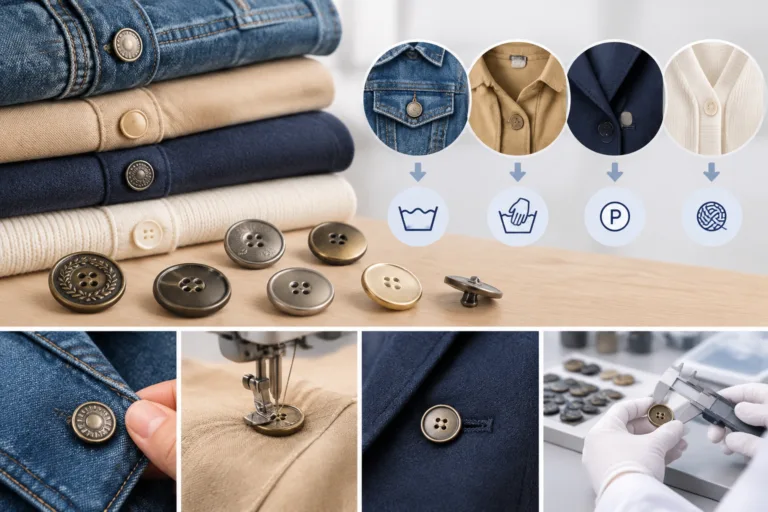
A metal button purchase specification should control the description of the item being requested and the basis on which it will be reviewed. Start with the button type and intended position, such as a front closure, cuff, pocket, or decorative location. Add a style or reference designation, appearance description, attachment method, size convention, and a drawing or approved sample reference where words cannot fully define the design.
These documents have different jobs. A product sketch communicates geometry and construction. A supplier quotation states what a supplier proposes, including any commercial details. An inspection record documents a comparison against an agreed basis. The purchase specification establishes that basis. None of these documents should silently replace the others, because a quotation or inspection record may omit design decisions that the garment team still needs to control.
Some fields may be fixed for the project, while others need confirmation. A logo layout, button position, or approved face appearance may be fixed. Reverse construction, attachment hardware, care exposure, packaging, and appearance criteria may depend on the fabric, garment process, market, or approval sample. The checklist should identify those decisions without pretending that every field has one correct answer.
| Observable input | Purchasing implication | Initial choice | Variables that can change it |
|---|---|---|---|
| Face appearance, color, gloss, texture, and marks | Defines what the reviewer compares | Describe observable features and reference an approved sample | Lighting, fabric pairing, branding, and market presentation |
| Garment location and opening function | Links the button to the garment operation | Record the position and whether it opens or decorates | Fabric thickness, movement, buttonhole design, and user handling |
| Attachment method and reverse construction | Determines sewing or installation needs | State hole, shank, or other agreed attachment detail | Thread path, reinforcement, clearance, and construction sequence |
| Care route and process exposure | Identifies conditions for compatibility review | Record planned care and relevant finishing exposure | Washing, heat, moisture, chemicals, and garment use |
| Approval status and controlling reference | Sets the basis for later comparison | List the drawing, sample, or documented reference | Design changes, revised samples, and unresolved deviations |
This field map is an editorial planning aid, not a claim that every project must use identical purchasing fields. The practical test is whether another person can identify the intended button, understand how it will be installed, compare supplied parts with the approved basis, and see which decisions remain open. That is the purpose of a metal button specification checklist.
Define the button’s material, finish, and appearance
Describe material identity separately from visual finish. The specification may need to identify the base material or material construction, surface treatment or coating, color, gloss, texture, edge appearance, reverse-side appearance, and any intentional branding or marks. Keep these as distinct fields because a color description does not explain the underlying material, and a material description does not define the appearance the buyer expects to receive.
Color names alone can be ambiguous. A specification can instead point to an approved physical sample, controlled artwork, or another documented color reference agreed for the project. The reference should make clear which surfaces are being compared and whether the reverse side or edge is included. Do not add a universal color tolerance unless the project has established the reference and measurement basis.
Appearance requirements work best when they use observable language. Depending on the design, the review may consider consistency of coverage, unwanted exposed substrate, scratches, pits, burrs, sharp edges, stains, uneven texture, or unintended marks. The final acceptance wording still needs project agreement. An editorial checklist can identify what to discuss, but it cannot set a universal acceptance limit.
A visual finish requirement is not automatically a durability requirement. Asking for a dark, low-gloss surface does not by itself establish resistance to washing, abrasion, perspiration, chemicals, or corrosion. Those are separate performance questions requiring suitable material information, a defined method, or other project evidence. Avoid naming a metal, coating, chemical restriction, or finish test unless the applicable documentation has been verified.
For example, a dark metal button on a frequently washed garment should prompt a joint review of the finish description, planned care exposure, and approval method. The loose button may match the intended appearance while the installed assembly presents different questions about finish change, fabric contact, or attachment. The appropriate decision can change with the material, coating, garment process, use, and target market.
Specify dimensions, construction, and attachment
Dimensions make a metal button specification actionable for design, pattern, sewing, and inspection teams. Identify the face diameter or shape, thickness, edge profile, hole or shank arrangement, reverse construction, and attachment clearance when those features affect the garment. A drawing or approved sample is useful when a written description cannot fully communicate curvature, profile, placement, or branding.
Do not assume that a nominal size label has the same meaning across suppliers. State how the dimension is defined and identify the drawing, sample, or other reference that controls approval. Keep design dimensions separate from acceptance tolerances. A tolerance belongs only when it has been established for the specific component, measurement method, and approval process; this editorial guide does not supply universal values.
Attachment details should describe the relationship between the button and the garment. Buttonhole dimensions, thread path, shank clearance, fabric thickness, reinforcement, spacing, and placement can all affect whether a design is workable. The suitable reverse construction may differ even when the visible face remains unchanged. Record the construction decision rather than relying on a broad label such as “standard button.”
Consider two garments using a similar face appearance: a thick outerwear fabric may need different clearance or reverse construction from a lightweight knit. The outerwear assembly can require room for fabric bulk and thread movement, while the knit may raise different concerns about distortion or local reinforcement. These are project decisions to review in the actual construction, not universal rules derived from the face size alone.
A metal button specification checklist can therefore identify the dimensions and attachment features that need control without approving the construction itself. Review the button with the intended buttonhole, fabric, reinforcement, and sewing method. Where the words remain ambiguous, let the approved drawing or physical sample control the design, and document any unresolved measurement or attachment question before release.
Match the button to garment use and care
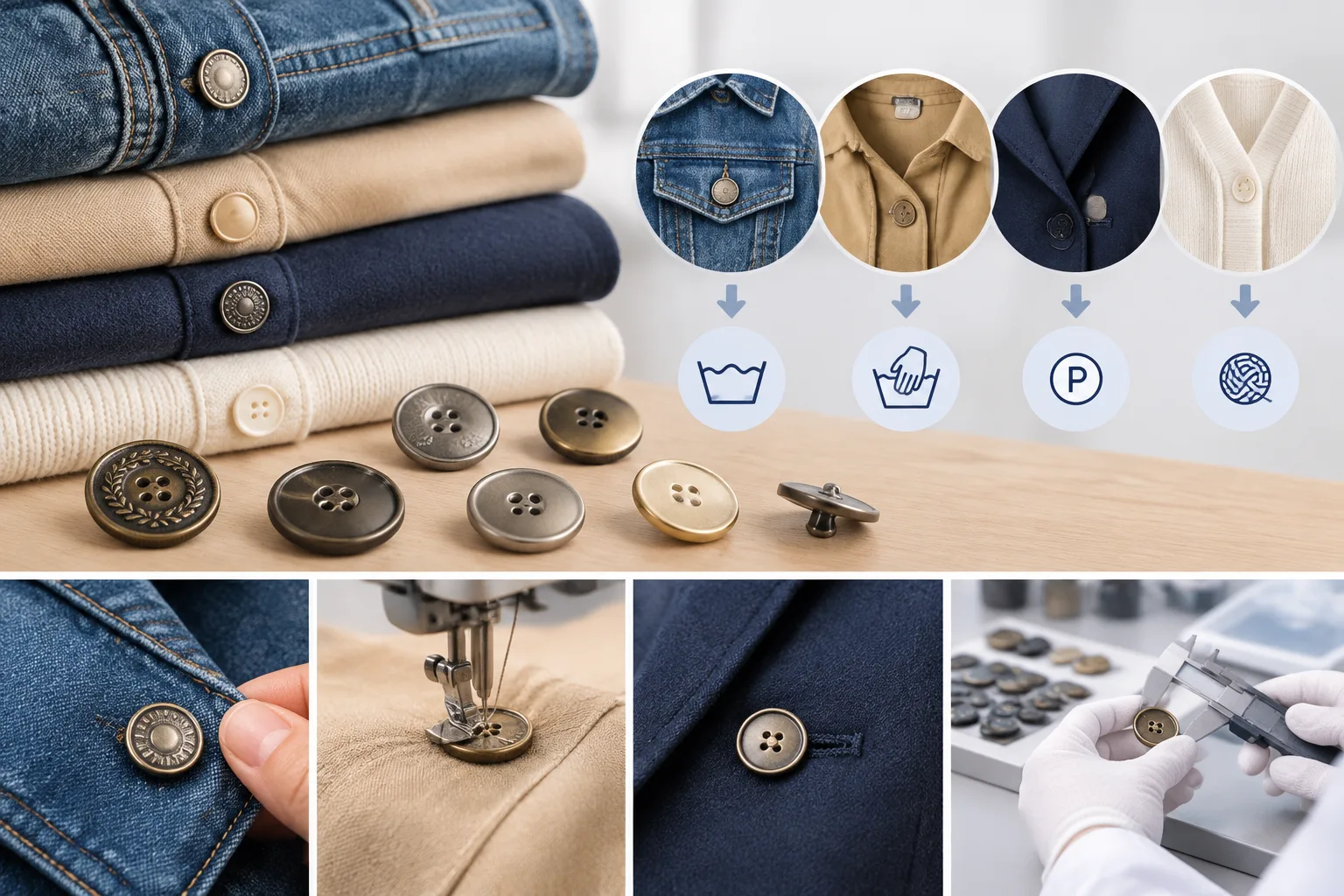
A metal button purchase specification should describe the garment environment in which the component will be used. Record the garment category, fabric type and thickness, button location, opening function, expected handling, care route, pressing or finishing exposure, and whether the button may contact skin or another accessory. These fields turn a component description into a compatibility review.
The button’s stated composition and appearance describe the loose component. They do not, by themselves, describe its behavior after installation. Thread, reinforcement, fabric movement, buttonhole construction, laundering, heat, moisture, and chemicals can all influence the installed assembly. A button that appears acceptable before sewing may create fabric damage, movement, finish change, or attachment concerns after use or care processing.
Record the applicable care instructions as inputs for review. A care label describes the intended care route for the garment; it is not automatic proof that a particular button and construction will remain suitable through that route. The specification should identify relevant process exposure without converting an assumption into a performance guarantee.
A useful approval loop has several stages:
- Review the button against its material, finish, dimensions, reverse construction, and approved reference.
- Install it in representative fabric with the intended buttonhole, thread, reinforcement, spacing, and sewing method.
- Expose the installed assembly to the planned use or care process when that review is relevant and appropriately defined.
- Record the observations, limitations, unresolved variables, and decision for the specific garment application.
For example, a dark metal button on a frequently washed garment may need its finish, care exposure, and approval method reviewed together. The suitable review can change with the base material, surface treatment, garment process, and market. A loose-button appearance check cannot replace evaluation of the installed assembly where attachment, fabric damage, finish change, or user contact matters.
For children’s garments, close-to-skin applications, or special-function products, first identify the age group, sales market, and intended use. Then check the applicable official requirements, care-process documentation, supplier evidence, and defined evaluation method. One check should not be treated as proof of complete compliance.
Set approval, inspection, packing, and change controls
A purchase specification becomes easier to review when it separates the approved reference from the inspection record. A physical sample, drawing, artwork, or documented reference controls what the component is intended to be. An inspection checklist records what was checked on supplied buttons and how the result was judged. Neither document should silently replace the other.
The approval reference may establish identity, appearance, dimensions, reverse construction, branding, and attachment features. The inspection record can then state which characteristics were compared, how they were observed or measured, and what action follows when a deviation is found. Use observable language such as inconsistent coverage, an unintended mark, a changed reverse feature, damaged packing, or an appearance difference from the approved reference. Do not insert acceptance numbers unless the project has established them with a defined method and responsible owner.
Identification and packing fields help prevent mix-ups during handling. Depending on the project, the records may identify the style or color reference, the size definition, an agreed quantity basis, lot or batch information where used, protective packing, and labeling information needed by the buyer’s workflow. These are planning fields, not universal requirements. Include only the controls that support traceability and correct use in the particular process.
Change control is equally important. A change to the material, coating, tooling, dimensions, reverse construction, packaging, or production location can affect the component or its relationship with the garment. Such a change may justify renewed sample review, especially when the original approval depended on a specific appearance, clearance, attachment method, or care context.
Supplier documents and inspection records support a defined decision. They do not automatically prove legal compliance, durability, or suitability in every garment. If a project names an inspection standard, sampling plan, acceptance limit, traceability obligation, or packaging regulation, verify it against the applicable standard owner, regulator, or buyer-controlled quality document. Otherwise, describe the required review without presenting an unverified obligation as a general rule.

Review the specification before release
Before releasing the document, mark each field as fixed, project-dependent, sample-controlled, or requiring external verification. Compare the draft with the approved reference, garment construction, care context, and installed assembly. Document unresolved variables instead of filling them with assumed universal values, and check the applicable method or official requirement when a higher-risk claim is involved.
Frequently Asked Questions
Which details are essential in a metal button purchase specification?
Identify the button type, garment position, reference, material, finish, appearance, size definition, construction, attachment method, care context, approval basis, inspection basis, packing details, and change controls relevant to the project. Not every field is fixed for every garment, so mark project-dependent choices clearly.
Should a metal button specification include a physical approval sample?
It should include an approved sample when words, drawings, artwork, or measurements cannot fully communicate the intended appearance or construction. The sample should be identified and controlled. It does not replace an inspection record or prove performance in the installed garment.
How should button dimensions be described when supplier size labels differ?
State the dimension being controlled and how it is defined, such as the relevant face dimension, thickness, shape, or reverse feature. Link the description to an approved drawing or sample where needed. Do not assume that a nominal size label has the same meaning across suppliers.
Why does the garment fabric and attachment method belong in the button specification?
The button works as part of an installed garment system. Fabric thickness, movement, buttonhole construction, thread path, reinforcement, spacing, and reverse clearance can change the suitable design. Reviewing the loose component alone cannot resolve those construction relationships.
What is the difference between a visual finish requirement and a durability requirement?
A visual requirement describes what should be seen, such as color, gloss, coverage, texture, edge condition, or an intentional mark. A durability requirement concerns behavior during defined use or exposure. An approved appearance does not, by itself, establish resistance to care processes, abrasion, moisture, chemicals, or corrosion.