

A certification allocation calculation estimates how applicable certification-related costs may be assigned to a clothing order or unit. Start by recording the relevant scheme or claim, product scope, destination market, order quantity, review period, and responsible payer. Then separate costs tied directly to the order from shared costs and unrelated business expenses. This produces a preliminary budgeting figure, not proof that a garment is certified, legally required to carry a certification, or approved for a consumer-facing claim. Apparel Wiki is an independent educational publication; its Sponsor information does not turn this guidance into a certifier, manufacturer, or service quotation.
The estimate cannot be universal because certification programs can differ in scope, billing unit, review cycle, documentation, testing, and payment responsibility. Before using a result, compare the worksheet with current information from the applicable scheme owner, authorized certifier, accreditation body, or market authority.
How to Build a Certification Allocation Calculation
Define certification allocation as assigning relevant costs to a stated clothing-order scope and cost basis. The calculation may include an order-specific assessment, a share of a wider activity, or both. It should show which inputs are source-supported facts, which are internal recommendations, and which remain assumptions awaiting confirmation.
First identify the certification scheme or claim, the products or materials covered, the destination or market, the quantity being considered, the validity or review period, and the organization responsible for each payment. A fee paid for one order should not be allocated again as a shared fee under another label. Similarly, a recurring cost should remain distinct from a one-time order cost unless the worksheet explains the chosen treatment.
| Cost item | Observable input | Allocation basis | Initial treatment | Variable that could change it |
|---|---|---|---|---|
| Direct assessment or application fee | Fee line, payer, and covered order | One order or defined application | Assign directly if confirmed | Scheme, scope, or billing unit |
| Shared assessment cost | Covered styles, units, sites, or period | Documented shared driver | Allocate provisionally | Who and what the assessment covers |
| Sample or documentation work | Samples, records, or staff time requested | Actual covered activity | Separate by order or shared scope | Evidence format and responsible party |
| Retesting or corrective action | Confirmed trigger or open requirement | Affected scope | List separately until verified | Test result, review, or program rule |
| Unrelated overhead | Marketing, financing, or broad operations | None in the certification model | Exclude unless a wider internal model is stated | Purpose of the costing exercise |
This table is a planning structure, not a fee schedule. If the applicable program’s published schedule or authorized quotation does not confirm a fee category, retain it as an item to investigate rather than presenting it as a known charge. The same applies to validity periods, retesting, and review costs. A clothing order certification cost estimate becomes more defensible when every line has a scope, payer, basis, date, and verification status.
Define the Certification Scope Before Counting Costs
Scope determines what the estimate is actually describing. Before counting costs, state whether the subject is one style, several styles, a material family, a production site, a shipment, or a recurring certification period. A broad activity may support several products, while a product-specific review may attach more closely to one order. The allocation basis should follow the confirmed scope, not simply the garment’s unit count.
Investigate possible dimensions separately. A program may address a product, material, facility, transaction, market, chain of custody, or documentation activity, but these are categories to examine rather than universal structures. Record the dimensions that are known and mark the rest as unknown. For example, “material scope not confirmed” is more useful than silently assuming that a fabric approval covers every style using that fabric.
Also separate questions that are often grouped under the word certification. Eligibility concerns whether the product or organization can enter a program. Assessment concerns the review activity. Testing concerns evidence about a sample or material. Documentation concerns records and traceability. Logo or claim use concerns how an approved status may be represented. These questions may involve different owners, fees, and evidence requirements, so they should have separate worksheet lines until the applicable program confirms their relationship.
Record the status being estimated, such as an initial application, renewal, transfer, extension, corrective action, or retest. These labels help identify the question being priced, but they should not be treated as stages used by every program. Likewise, record the market and destination because a claim, review process, or payment treatment may be market-specific. Do not fill an unknown market with a global assumption.
For apparel teams, useful scope notes connect the estimate to style numbers, material references, production sites, order quantities, shipment groupings, and available documentation. They should also identify who is paying: a brand, supplier, facility, material provider, or another party. Payment responsibility affects cost allocation, but it does not establish who holds certification status.
Finally, keep the boundary visible: a certification cost estimate does not prove compliance, approval, scope coverage, or permission to make a consumer-facing claim. It only organizes the costs being considered. Confirm the exact scope, claim-use conditions, application status, and review period with the responsible scheme owner or authorized certifier before treating any estimate as a committed clothing-order cost.
Map Direct, Shared, and Excluded Costs
Build the cost map as separate, traceable lines. Possible questions include whether the selected program confirms an application or assessment fee, required testing or sample handling, documentation work, travel or site-related charges, retesting, corrective action, maintenance, or renewal. Do not assume that every program uses these categories. If a fee category cannot be verified through an official schedule, contract, or authorized quotation, keep it as an open question or omit it from the current total.
Direct costs are attributable to the defined order or scope. Shared costs relate to an activity covering more than one order, style, site, or period. For a shared line, name the allocation driver explicitly: covered styles, certified units, production sites, or period of use are possible choices, but no single driver is universally correct. The driver should match the scope and the internal cost-responsibility decision.
Keep general marketing, unrelated quality work, financing, and broad operating overhead outside the certification allocation unless the worksheet clearly labels them as a separate internal costing model. Including them can be reasonable for a wider business analysis, but it changes the question from certification cost allocation to total order costing. Do not let a broad internal model look like a certifier’s invoice.
Consider a clothing order containing several styles that use a common material. If an assessment covers all of those styles, an internal worksheet might spread the shared amount using a documented style or unit driver. A material review that applies only to one style may remain attached to that style. If the certifier defines the assessment at the production-site level instead, the initial treatment changes. The scenario illustrates why scope confirmation comes before choosing the denominator.
Keep quantity layers distinct. Net quantity, loss allowances, and purchased quantity are not interchangeable inputs. If the purchased quantity already includes a stated loss allowance, adding that allowance again can distort the unit basis. Certification cost per garment should therefore identify whether it is assigned against ordered units, expected good units, or another documented basis. That choice is an internal costing decision, not a universal certification rule.
A practical cost map should show the original amount, the proposed share, the driver, the covered period, the payer, and the verification status. It should also flag any amount that could be charged elsewhere so the same documentation, testing, or administration cost is not counted twice. The result is a transparent apparel certification cost breakdown, while the actual fee categories and amounts remain dependent on the selected program’s current information.
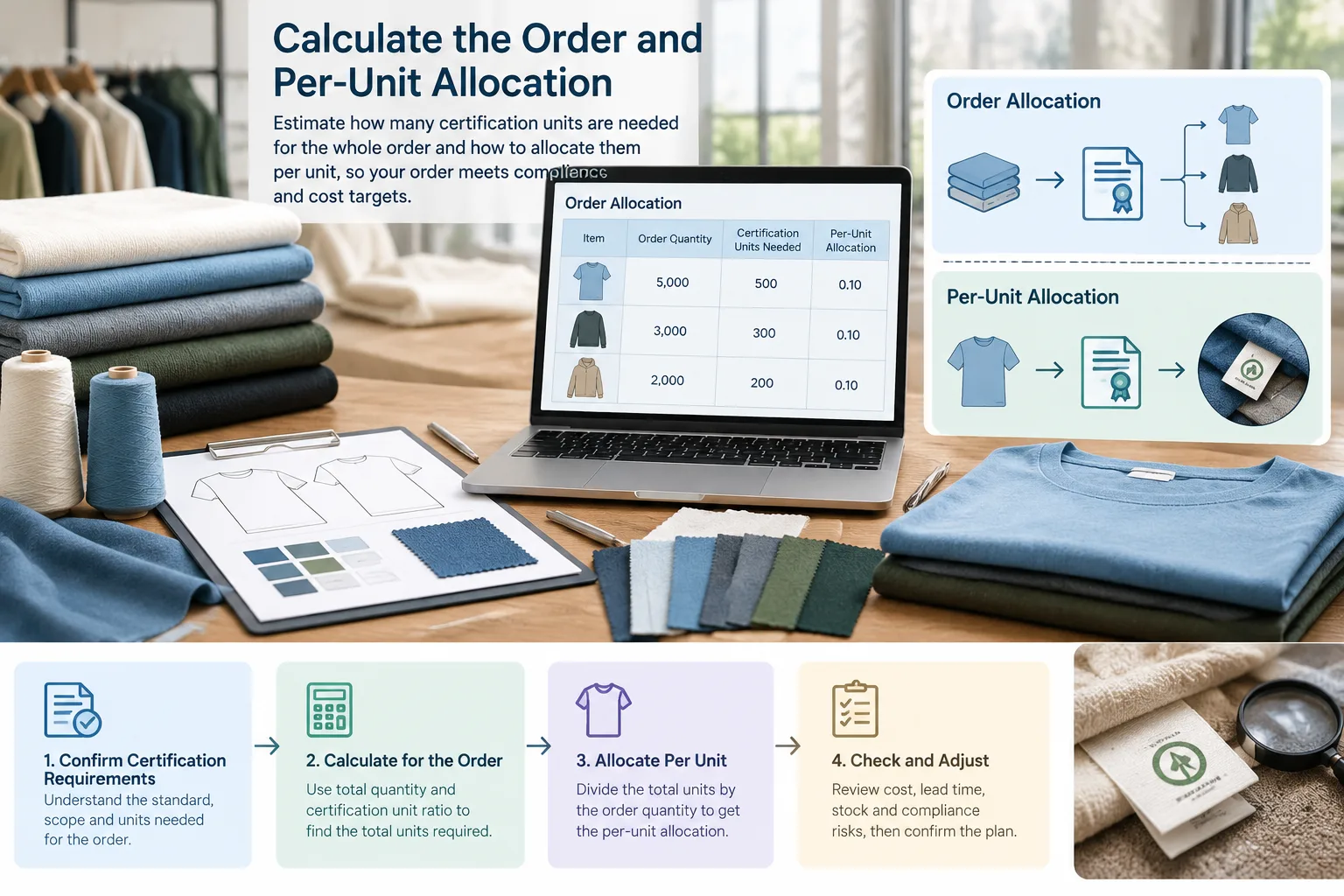
Calculate the Order and Per-Unit Allocation
Once the scope and cost map are recorded, calculate the amount assigned to the clothing order. Keep direct costs and the selected share of common costs visible as separate lines. The numerator is the order-attributable certification-related total. It may contain verified amounts, internal assumptions, or both, but each item should show its source or assumption status.
The denominator must be chosen before the result is interpreted. Possible bases include ordered units, expected good units, covered styles, production sites, or another documented driver. The correct basis depends on the confirmed scope and the purpose of the internal costing file. Ordered quantity, purchased quantity, net quantity, and expected good quantity are not interchangeable.
A simple planning expression is:
Allocated certification cost per unit = order-attributable certification total divided by the stated unit basis
This is an internal allocation calculation, not a certification rule or a fee charged by every program. For an auditable worksheet, record the numerator components, denominator, currency, allocation period, payer, scope, source or assumption, and date checked. If a fee schedule is unavailable, use a variable or blank field rather than inserting a guessed amount.
Mixed-style orders require an explicit treatment. One approach assigns shared costs using a documented driver, such as covered units or styles, while keeping style-specific work attached to the relevant style. Another approach presents more than one internal allocation treatment when the final scope is unresolved. Do not average unlike scopes without explaining why the comparison is reasonable.
Expected retesting or corrective-action costs should remain separate from confirmed direct fees. They can be shown as an unresolved planning line when the applicable program or contract indicates that such costs may apply, but the estimate should not present them as certain charges. The same principle applies to renewal or recurring costs: match them to the period being allocated rather than attaching a full recurring amount to a single order without explanation.
Preserve unrounded working values and round only at the reporting stage selected for the costing file. Do not add a universal minimum, maximum, percentage, tax treatment, or fee estimate. The applicable scheme owner or authorized certifier must confirm actual billing units, charges, currency, taxes, rounding, and payment responsibility.
Stress-Test the Estimate Before Using It
A planning estimate is more useful when its sensitive inputs are visible. Review the variables that can change the scope or denominator first: covered units, number of styles, production sites, certification period, required tests, retest status, and whether the order shares an activity with other products. A quantity change may alter a per-unit result even when the total activity cost does not change.
Use low, central, and high internal cases only when each case has a defensible assumption. These cases describe alternative costing treatments, not approval probabilities, measured performance, sales outcomes, or profit forecasts. For example, a worksheet might compare a shared-cost allocation by covered units with one based on styles. The result should identify which assumption caused the difference.
Check the commercial inputs separately. Currency conversion, taxes, duties, and local charges vary by market and transaction. They require current information from the responsible scheme owner, certifier, contract, or competent authority. Do not hide an unverified charge inside a general percentage or treat a local practice as a global formula.
Run a duplication check before accepting the result. Confirm that documentation, sample handling, testing, loss, and administration costs have not been entered under more than one label. Also check that the allocation period matches the certification period and that a purchased quantity already containing a stated allowance has not received the same allowance again.
A short review record should answer these questions:
- What scheme, claim, product, market, and certification status does the estimate cover?
- Which amount is direct, which amount is shared, and what driver assigns the shared amount?
- What denominator is used, and does it represent ordered units, expected good units, styles, sites, or another basis?
- Who pays each listed cost, and where did the amount or assumption come from?
- When was the information checked, and what is the fallback action if the fee or requirement remains unverified?
Keep uncertainty beside the affected line instead of placing every limitation in a final note. A retest assumption should be marked on the retest line; an unresolved market charge should be marked on that charge. The completed worksheet is a budgeting input until current program information confirms the applicable commercial amount.

Use the Estimate as a Documented Planning Input
Save the scope, inputs, denominator, allocation driver, date, payer, and verification status with the clothing-order costing file. Compare the worksheet with the applicable scheme owner’s or authorized certifier’s current information before treating the estimate as a committed cost. The next useful educational step is to compare alternative allocation bases and identify the unresolved input with the largest effect on the result, then update the calculation when quantity or certification status changes.
Frequently Asked Questions
What does certification allocation mean in a clothing order cost calculation?
Certification allocation is an internal method for assigning applicable certification-related costs to a clothing order or unit under a stated scope and cost basis. It does not prove certification, compliance, approval, or permission to make a product claim.
Which certification-related costs should be assigned directly to one clothing order?
Assign a cost directly when the confirmed scope connects it to that order, such as order-specific documentation, testing, sample handling, or a stated direct fee. Keep shared assessment or recurring costs separate until a documented allocation driver assigns the appropriate share.
Should a shared certification fee be divided by garments, styles, sites, or another basis?
Use the basis that matches the confirmed scope and the purpose of the internal costing model. Covered units, styles, production sites, or the period of use may be relevant in different cases. The chosen driver should be recorded rather than treated as universal.
Can certification cost per garment be calculated before the certifier provides a fee schedule?
Yes, as an internal planning estimate using variables or clearly labeled assumptions. The result cannot be treated as a confirmed commercial amount. Actual fees, billing units, taxes, currency, and payment responsibility require current information from the applicable program or authorized certifier.
How should retesting or renewal costs be handled in a certification allocation estimate?
List retesting and renewal separately from confirmed direct costs, identify the relevant period, and mark the amount as unverified when no current fee information is available. Do not present an assumed retest or renewal charge as certain or allocate it twice.