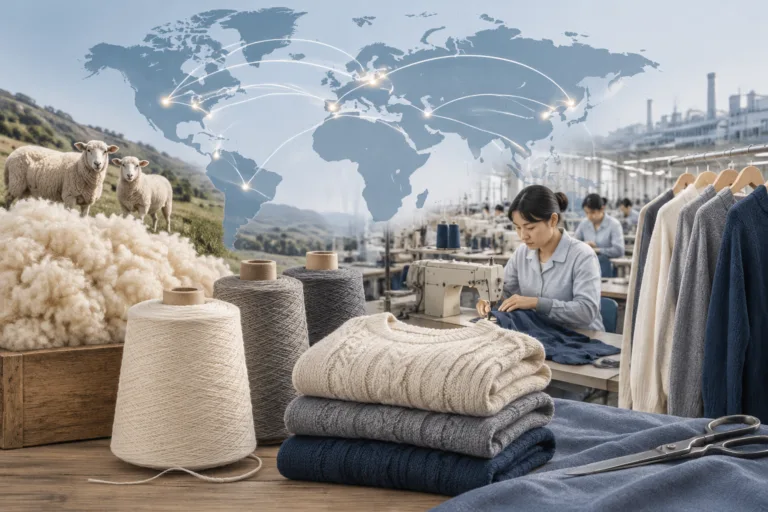
Wool became part of the clothing industry through connected changes in production, exchange, processing, labor, technology, and demand. A wool trade network was not simply a route from a sheep-producing area to a clothing shop. It was a changing system of relationships that linked fiber suppliers, collectors, merchants, financiers, transporters, processors, garment makers, and wearers. This wool trade networks history also requires separating raw-fiber movement from finished-clothing sales. As an independent Apparel Wiki publication, we explain those distinctions under an editorial policy described on the Sponsor page.
The network developed in stages rather than through one decisive invention or trade center. Wool’s need for sorting, cleaning, spinning, fabric formation, and finishing created points where different skills, institutions, and locations could become connected. The result varied by period and region: some communities kept several activities close together, while others relied on longer-distance exchange and specialized intermediaries.
What a Wool Trade Network Included
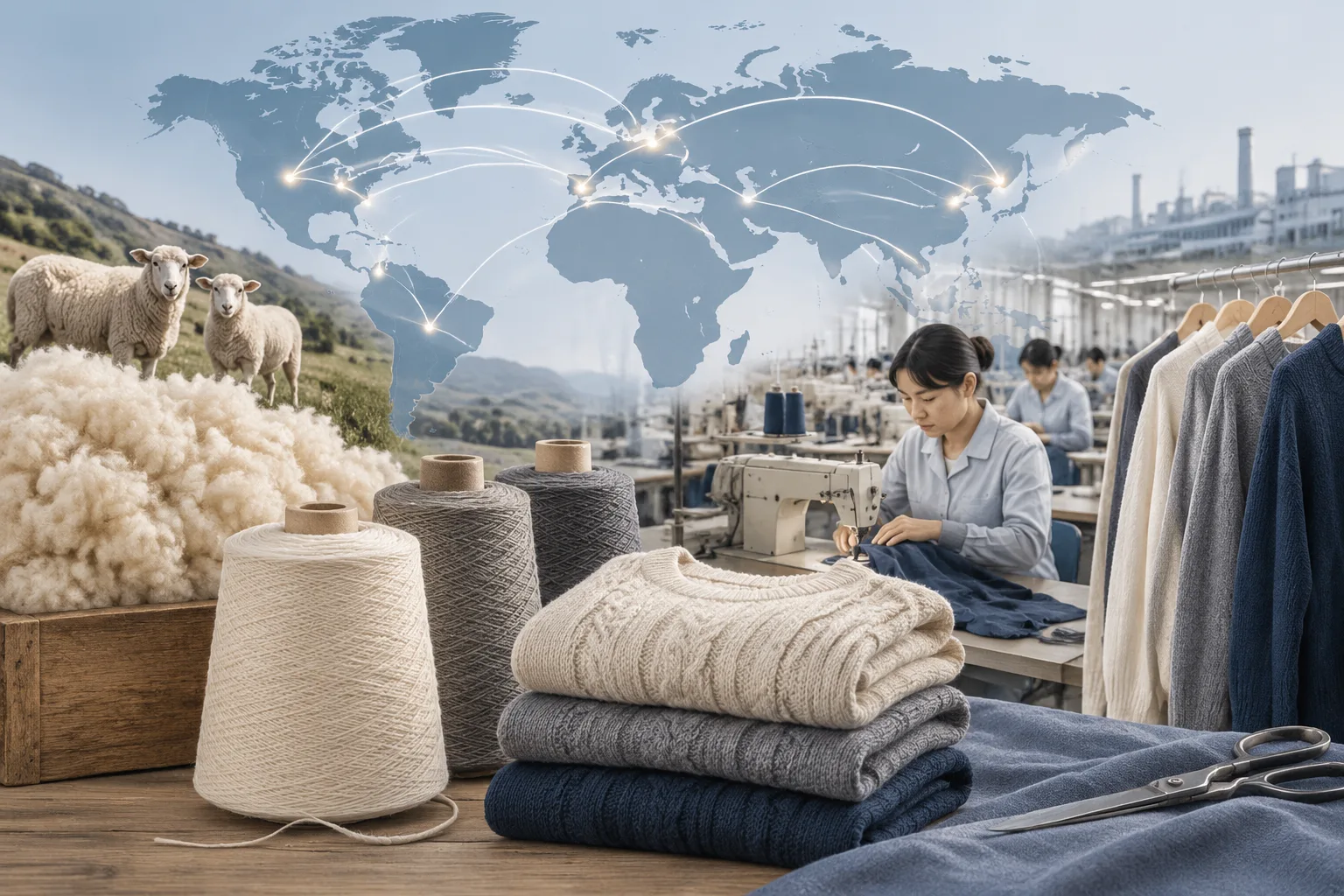
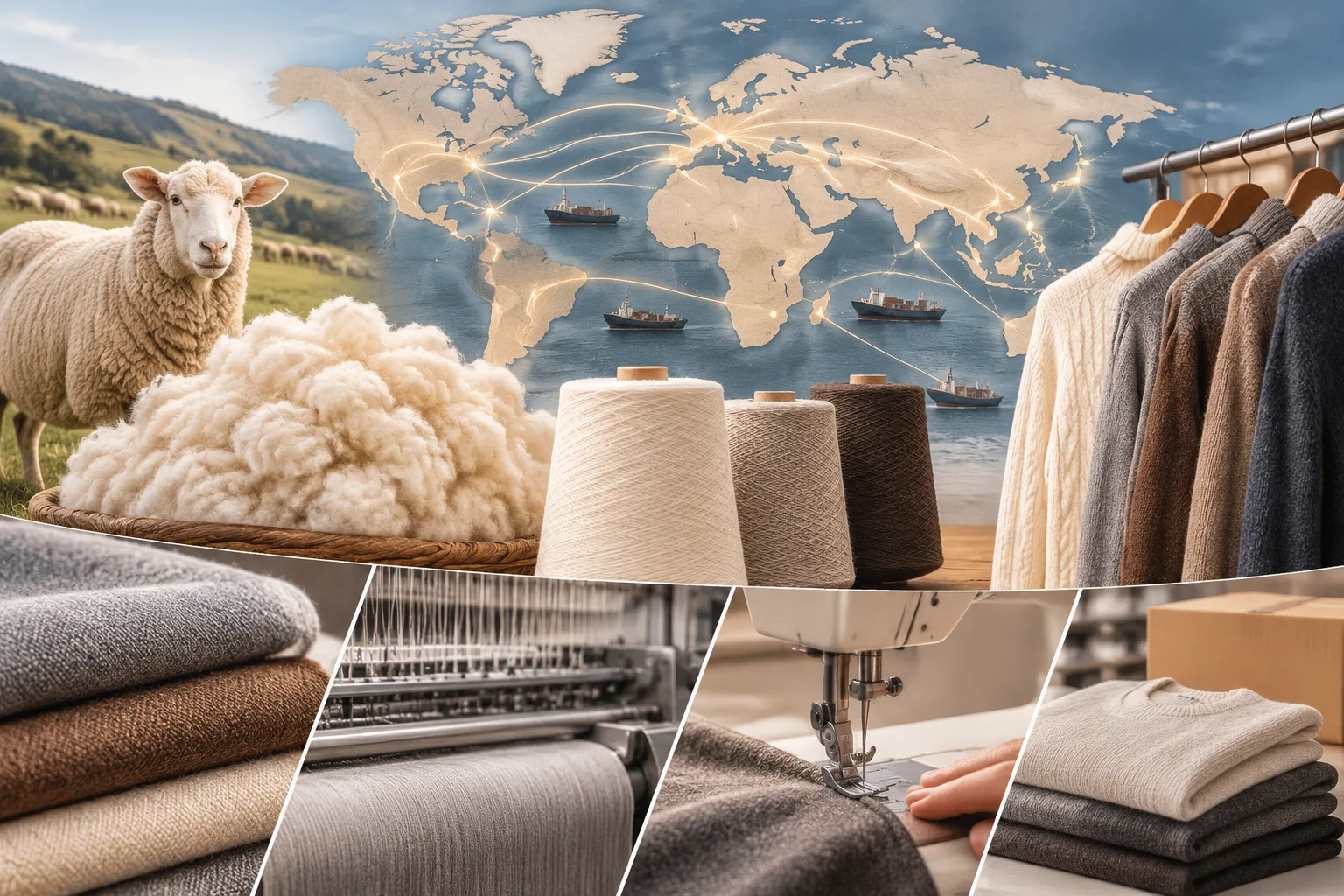
A wool trade network included the material and organizational steps that moved wool toward clothing. Production began with raising animals and obtaining fleece. Collection and grading then grouped fiber according to observable qualities. Merchants or other coordinators could arrange purchases, credit, storage, transport, and resale. Processors washed and prepared the fiber before spinning it into yarn. Weaving or knitting formed textile structures, while finishing altered their handle, appearance, or suitability for particular uses. Garment makers eventually converted fabric or knitted material into clothing that had to reach a market.
This sequence was not always linear or centralized. A local supply chain may have connected nearby producers, processors, and sellers through repeated short-distance exchanges. A regional market linked several local areas through a common place or group of intermediaries. A wider trade network connected distant production, processing, finance, transport, and consumer markets. These categories describe relationships, not fixed borders. Geography, political authority, technology, labor organization, and transport conditions could change the pattern.
| Network stage | Observable activity | Clothing-industry implication | Variables that could change the pattern |
|---|---|---|---|
| Production and collection | Fleece is obtained, gathered, stored, and sorted. | Material consistency and available fiber influence later processing. | Animal husbandry, geography, seasonal work, and local labor. |
| Coordination and finance | Merchants connect sellers, buyers, credit, contracts, and information. | Producers and processors can be linked even when they are far apart. | Trust, market institutions, regulation, and access to capital. |
| Processing and fabric formation | Fiber is cleaned, prepared, spun, woven or knitted, and finished. | Specialized work creates material suitable for different garments. | Equipment, energy, skills, scale, and local production capacity. |
| Garment making and demand | Textiles become clothing and are distributed to wearers. | Product types and market demand influence which earlier stages expand. | Consumer preferences, purchasing power, distribution, and fashion. |
Wool’s physical variation made sorting and preparation important. The fiber could not simply move unchanged from producer to garment maker and still represent a finished textile. Each transformation introduced decisions about quality, use, timing, and responsibility. A delay in collection could affect processing schedules; limited cleaning or spinning capacity could restrict fabric output; weak transport or credit could prevent material from reaching a buyer.
For this reason, the network was also a set of institutions and expectations. Contracts, credit, market information, storage arrangements, and transport coordination could matter as much as the visible route. Their precise form differed across historical settings. A change in one stage could create pressure elsewhere, but that connection does not prove that every network was controlled by one merchant or organized around one center.
From Regional Wool Markets to Long-Distance Exchange
Long-distance exchange developed when production, processing, and demand could be connected at a workable cost and level of coordination. The basic mechanisms were collection, sale, processing, transport, and resale. A producing area did not need to perform every later operation. It could exchange fiber with a place that had stronger processing skills, better equipment, more accessible markets, or more effective commercial institutions. Other regions retained several stages locally because local labor, demand, or infrastructure made that arrangement practical.
This distinction is central to the history of the wool trade. Evidence that wool was bought and transported shows commercial activity, but it does not by itself show a transformation into mechanized apparel production. A large market for raw fiber may support processors without proving that clothing manufacture became factory-based or that consumption became widespread. To establish a clothing-industry effect, historians must also connect the trade activity with changes in textile production, garment making, distribution, or documented demand.
Market access depended on more than physical distance. Merchants could coordinate collection and resale, while finance made it possible to purchase material before later transactions were complete. Transport infrastructure affected timing and cost. Political authorities could shape access through boundaries, permissions, duties, or other rules. Conflict could interrupt routes, and changing demand could redirect material toward different processors or consumers. These influences interacted rather than producing one universal path.
When a producing region is distant from processing or consumer markets, transport costs and coordination become more important. A network may favor sending raw fiber to a processing center if that center has suitable skills, equipment, or buyers. It may instead retain early processing locally if transport is difficult or if local workers can prepare material more economically. The viable arrangement can change when roads, energy access, labor organization, commercial institutions, or consumer demand change.
Regional specialization could therefore separate fiber production from textile processing and clothing manufacture. Separation allowed each location to focus on particular capabilities, but it also increased dependence on communication, finance, reliable transport, and agreed material expectations. A disruption at one point could affect later stages even when those stages were geographically distant.
Trade arrangements were also period-specific. A rule or institution that shaped exchange in one historical setting should not be treated as proof that the same restrictions, permissions, or market structure continued afterward. Likewise, the appearance of a famous market center or an important commercial route does not mark automatic adoption everywhere. Network expansion was uneven, and older local arrangements could persist beside newer long-distance connections.
Technology, Processing, and Industrial Integration
Technology changed wool networks by altering how fiber was prepared, spun, formed into fabric, finished, and organized as work. The historical sequence should be separated into four stages: technical invention, workable commercial use, wider adoption, and displacement or persistence of older methods. A machine or process could exist before businesses could operate it reliably, and commercial use could remain concentrated in particular regions before becoming more widespread.
Processing improvements affected the network beyond the workshop or factory. More predictable preparation could help producers, spinners, weavers, knitters, finishers, and garment makers coordinate their work. Greater capacity could increase the need for raw-material collection, transport, finance, storage, and distribution. At the same time, a technical improvement in one stage did not automatically solve limitations in another. Fabric formation might expand while finishing remained a bottleneck, or production capacity might increase without equivalent consumer demand.
Woolen and worsted-type processing illustrate why process distinctions matter when the historical evidence supports them. They involve different approaches to fiber preparation and different fabric objectives, so they can require different skills, equipment, material flows, and market relationships. The distinction should not be used as a timeless label for every wool product. Its meaning depends on the period, terminology, and process being studied.
Mechanization also changed organization unevenly. Some tasks became more standardized or concentrated, while other work continued to depend on experience, inspection, adjustment, or specialized judgment. The effect on employment and skill varied by process and region. It is therefore inaccurate to describe industrial integration as the simple disappearance of all manual work. A better explanation asks which task changed, who controlled it, what work remained, and how the surrounding network responded.
A useful cause-and-condition chain is:
- A technical method becomes workable for a defined material and task.
- Capital, energy, labor, and equipment make repeated commercial use possible.
- Transport, finance, and market distribution connect the increased capacity to suppliers and buyers.
- Demand, institutions, and competing methods influence whether adoption spreads, remains limited, or declines.
This chain shows why industrial integration was not caused by machinery alone. Raw-material access, infrastructure, labor arrangements, capital, and demand had to support one another sufficiently for a process to expand. Older methods could persist where they served different products, used available skills, or fit local conditions. The history of wool manufacturing is therefore a history of interacting capabilities, not a single date when the clothing industry suddenly became industrial.
Global Networks, Labor, and the Expanding Clothing Market
Wool trade networks connected more than raw fleece with distant buyers. They could move raw wool to a first processor, semi-processed material to another specialist, finished fabric to clothing makers, and completed garments to sellers. These flows are related, but they are not interchangeable evidence. Trade in raw fiber shows material exchange; it does not by itself prove expanded garment production or mass clothing consumption.
As markets widened, industrial organization could relocate particular tasks while leaving other stages established in older regions. A place with suitable labor and skills might retain spinning, weaving, or finishing even when fiber came from elsewhere. Another location might gain garment work because it had capital, transport connections, market access, or established distribution. The resulting geography depended on interacting conditions rather than on national borders alone.
Labor changed within these arrangements, but not in one uniform direction. Machinery could standardize selected operations, concentrate work in larger workplaces, or alter the judgment required from workers. Other tasks still depended on inspection, adjustment, material knowledge, or specialized handling. The effect on jobs and skills varied by process, period, and region. A claim about “mechanization” therefore needs to identify which operation changed and whose work was affected.
Consumer interest in wool garments also needs careful interpretation. Evidence that merchants traded wool textiles or that sellers offered wool clothing indicates market activity. It does not automatically establish mass consumption across social groups. Stronger claims require period evidence about sales, households, trade, or population. Without that evidence, it is more accurate to describe demand as a documented tendency or an influence on network organization.
Consider a clothing market seeking more standardized wool fabric. Coordinated processing and distribution may become more useful because buyers need consistent material and dependable access. The preferred geography could still change when energy access, labor conditions, transport, or trade rules change. The same market goal can therefore produce different network structures under different historical conditions.
These patterns also show why globalization was not a single straight path. Producers, processors, merchants, workers, and wearers could experience the same expanding network differently. A broader market might create opportunities for some participants while increasing dependence on distant suppliers or exposing local work to new competition. Historical comparison is most useful when it traces relationships, responsibilities, and processes rather than judging a network by its size or commercial status.
How Wool Trade Networks Shaped the Clothing Industry
The central historical question is not simply whether wool was traded. It is whether a change in the network improved or redirected the conditions for making and distributing clothing. A transport link could enable exchange without creating apparel demand. A processing improvement could increase capacity without spreading beyond one region. A market could expand while older skills and local production continued.
Use five questions to evaluate a claimed milestone in wool trade history:
- What material moved? Identify raw wool, prepared fiber, yarn, fabric, or finished clothing.
- Which process changed? Separate preparation, spinning, fabric formation, finishing, garment making, and distribution.
- Who coordinated it? Look for producers, merchants, manufacturers, institutions, financiers, or other organizers.
- Which market responded? Specify the buyers, users, or clothing segment connected to the change.
- What evidence links it to clothing? Trade activity is relevant, but clothing effects need evidence about manufacture, distribution, use, or demand.
This framework separates enabling conditions from direct causes. Wider transport access may lower coordination barriers, but it does not independently create a factory system. A trade arrangement may connect suppliers and buyers, but technology, labor, capital, infrastructure, and demand still influence whether that connection becomes durable.
| Network structure | Observable inputs | Likely clothing implication | What could change the interpretation |
|---|---|---|---|
| Local craft network | Nearby fiber, skills, tools, sellers, and users | Several stages may remain close together, with products shaped by local materials and knowledge | Seasonal supply, available skills, transport, local demand, and production scale |
| Merchant-coordinated regional network | Separated producers and processors connected through exchange and information | Specialization can increase while merchants coordinate material movement and resale | Credit, contracts, political boundaries, market access, and transport reliability |
| Industrial or internationally linked network | Distributed materials, specialized facilities, larger markets, and organized production | Capacity and market reach may expand, while coordination and dependence also increase | Energy, labor organization, infrastructure, policy, technology, and consumer demand |
Each structure involves trade-offs. Specialization can improve process focus but increase dependence on distant suppliers. Larger markets can support more product differentiation but require more coordination. Higher labor productivity can coexist with disruption to established skills. These are analytical relationships, not guarantees that a particular historical arrangement produced the same result everywhere.
Wool became part of the clothing industry through cumulative coordination among material supply, processing, technology, institutions, labor, and demand. Wool trade was one enabling part of that development, not a complete explanation by itself. Historical cases can reveal mechanisms, but they do not prove that identical conditions will produce the same commercial result today.
Reading Wool Trade History Without Oversimplifying It
Wool trade networks became part of the clothing industry through linked changes in material movement, processing, technology, labor, institutions, and demand that unfolded unevenly. To study a historical claim, ask: What period? What region? What network stage? What changed? What evidence connects it to clothing? Compare a documented case by tracing its fiber source, processing stages, coordinators, markets, and clothing impact. Historical arrangements are not current apparel conditions, so present-day decisions require current, topic-specific evidence.
Frequently Asked Questions
What is a wool trade network in clothing-industry history?
A wool trade network is a system of material flows and relationships connecting fiber production, collection, processing, transport, finance, manufacture, selling, and demand. It is broader than a single route because institutions, contracts, labor, information, and local capabilities also shape how wool reaches clothing markets.
Did the growth of wool trade automatically create a mass clothing industry?
No. Trade growth shows that materials or products were exchanged, but it does not automatically prove mass clothing production or consumption. Those conclusions require evidence about processing capacity, garment manufacture, distribution, consumer use, and the period and population involved.
How did mechanization change wool-processing trade networks?
Mechanization could standardize selected tasks, increase capacity, reorganize workplaces, and change the skills needed for particular operations. Its effects varied by process and region. Invention, commercial use, widespread adoption, and the persistence or decline of older methods were separate stages.
Why did wool production, textile processing, and clothing manufacture often occur in different places?
Different stages required different combinations of raw-material access, skills, labor, energy, capital, transport, market access, and institutional support. A region might retain one stage while sending material elsewhere for another. The exact arrangement depended on historical conditions rather than one universal network model.
How should readers distinguish a historical wool trade fact from an interpretation about its effect on clothing?
Separate the documented observation from the explanation. A record may show that wool, yarn, or fabric moved through a market. An interpretation argues that this movement affected clothing production or demand. Test that argument against evidence about the relevant process, actors, market, period, and region.