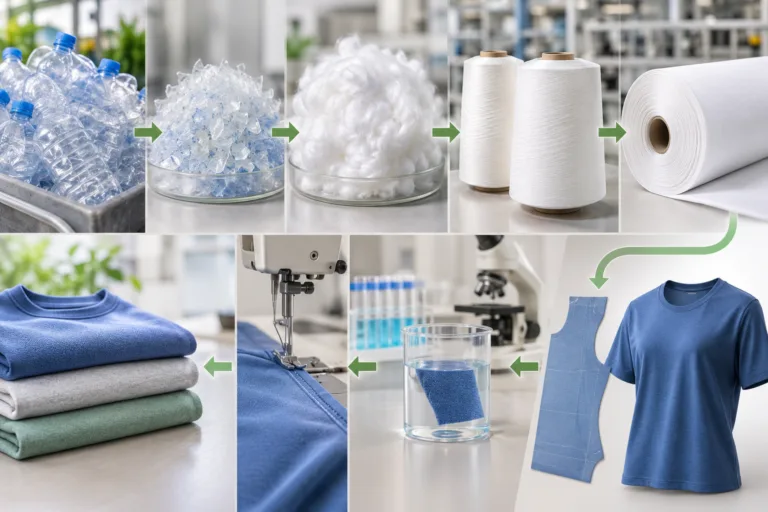
Chemically recycled polyester traceability is a documented connection between a defined material claim and the relevant input, processing stages, custody or allocation method, and downstream product. It requires more than a recycled-content statement on a finished garment. If identifiable records do not connect the claimed material flow at each relevant handoff, treat that link as unresolved. As an independent educational publication, Apparel Wiki separates editorial analysis from commercial influence, as described on its Sponsor page.
The review should follow the material through the supply chain, while distinguishing supplier statements from records that have been checked under an applicable external system. Traceability supports a bounded sourcing conclusion; it does not automatically establish product quality, environmental benefit, or compliance.
What chemically recycled polyester traceability should prove
Start by defining exactly what the claim covers. It might concern the declared feedstock, recycled polymer, filament or staple fiber, yarn, fabric, or finished garment. These are different claim boundaries. Evidence for one material form does not automatically extend to every later form or to the complete product.
The term chemical recycling describes a processing route involving chemical transformation. Technologies and resulting material routes can differ, so the term should not be treated as one universal process specification. It is also separate from the generic fiber name, a commercial brand, recycled-content wording, and statements about environmental benefit. Each of those claims needs its own definition and appropriate support.
Useful evidence may include a supplier declaration, material specification, transaction or batch record, chain-of-custody information, or documentation reviewed through an applicable independent system. These categories have different functions. A declaration records what its issuer states. A material specification identifies described attributes. Transaction or production records may help connect a transfer or conversion. Independent review may add assurance within its stated scope. No category should be assumed sufficient without examining what material, organization, transaction, and product it actually covers.
At minimum, the documentation should form an understandable relationship among four elements: the declared recycled input, the processor or converter, the material transferred to the next node, and the apparel product under review. Names, dates, references, quantities, or defined scopes can help establish that relationship when they are available and relevant.
A finished-garment label usually describes the product at a downstream point. By itself, it does not identify every upstream processor or show how the material changed hands. The practical decision rule is simple: accept only the scope that connected records support. Mark missing connections as unknown instead of extending a recycled polyester material claim through assumption.
Map the polyester journey from input to finished garment
A garment supplier represents one node, not the entire chemical recycled polyester supply chain. Upstream activity may involve separate raw-material, chemical-conversion, polymer, fiber, yarn, fabric, dyeing, and finishing organizations. Garment assembly and any subcontracted operations add further nodes. These participants may operate in different regions and under different commercial relationships.
Because technologies and product configurations vary, use a general route as a starting framework rather than a fixed sequence:
- declared input or feedstock;
- chemical conversion and resulting polymer or intermediate;
- filament or staple-fiber production;
- yarn production and any blending or combining;
- fabric formation, dyeing, and finishing;
- garment assembly and relevant subcontracting; and
- the finished product linked to the intended claim.
Draw the route for the specific material, order, batch, or claim scope being assessed. Mark every node as confirmed, declared, subcontracted, or unknown. A first-tier factory address should not be presented as the location of upstream polymer, yarn, fabric, or processing activity unless supporting records establish that connection.
At each handoff, look for information that relates the outgoing material to the incoming material at the next node. Useful items to request can include material identity, supplier and processor identity, dates, lot or transaction references, quantity information, and the next material form. Whether any item is required or sufficient depends on the applicable claim system and review scope.
Give special attention to transformation points. Chemical conversion, fiber formation, spinning, blending, fabric production, and finishing can change material form, introduce mixing, or affect how a claim is allocated. A warehouse transfer or invoice handoff may not transform the material, but its records can still help preserve continuity.
One product family can also use parallel suppliers or alternative routes. Therefore, a generic corporate diagram cannot substitute for a recycled polyester supply chain map tied to the material and product being assessed.

Evaluate the evidence behind a chemically recycled polyester claim
Evaluate documentation by what can be observed, not by the document title alone. The following framework supports an initial sourcing decision; it does not create automatic approval.
| Evidence type | Observable input | Implication | Initial decision | Variables that could change the decision |
|---|---|---|---|---|
| General marketing statement | Broad recycled or sustainability wording | Shows the claim being communicated, but not its material path | Follow up; do not treat as traceability evidence | Exact wording, product scope, underlying records |
| Supplier declaration with defined scope | Issuer, named material, and covered product or stage | Provides an attributable statement, while upstream links may remain unproven | Provisionally record as declared | Material form, supplier tier, dates, allocation method |
| Connected transaction or production records | References linking material transfers or transformations | Can support continuity across the covered nodes | Accept provisionally for the connected scope | Uncovered processors, quantities, lots, or downstream products |
| Records under applicable independent verification | Defined checked scope, parties, materials, and relevant documentation | Adds assurance only within that system’s stated boundaries | Assess against the intended claim and applicable rules | System scope, claim eligibility, supplier tier, product coverage |
Terminology should remain consistent across the evidence set. Compare the declared recycled input, polymer or fiber description, yarn and fabric specifications, product composition, and proposed final wording. A silent change in material identity or claim scope creates a gap that needs explanation.
Maintain an evidence log with the document date, issuing party, covered material, quantity or stated scope, linked node, unresolved gap, and next action. Leave unavailable values blank or mark them unknown rather than reconstructing them.
Finally, keep traceability separate from performance evaluation. Connected records do not establish equivalence in strength, dyeability, hand, durability, or other garment properties. Those questions require suitable specifications and performance evidence for the product being developed.
Where traceability breaks and how to handle uncertainty
A traceability gap does not have only one meaning. An unknown node indicates that the reviewed records do not identify part of the route. It does not, by itself, disprove the material claim. Contradictory records are different: they require escalation, clarification, or a fresh review before the claim can be relied upon.
Key risks to review include missing upstream processors, undisclosed subcontracting, inconsistent material names, unexplained mixing or allocation, incomplete quantity reconciliation, and documents covering a company rather than the assessed product. These are review risks, not claims about how frequently problems occur across the industry.
A company name, factory address, or finished-garment composition identifies only limited facts. None necessarily reveals where the recycled input originated, who processed it, or how it reached the stated yarn, fabric, or garment. Likewise, documentation for an approved supplier may not cover every material, facility, order, or subcontractor associated with that supplier.
Terminology changes deserve close attention. If one record identifies recycled polymer, another names a branded yarn, and the final claim refers broadly to chemically recycled polyester, the evidence set must explain how those descriptions connect. A change may be legitimate, but it cannot be resolved by assuming that the terms are interchangeable.
Mixing and allocation also require bounded language. First identify whether the claim concerns material kept physically identifiable or material represented through an accounting approach. Different models can follow different rules. Without validated rules for the applicable system, do not assume they establish identical facts about the material inside a particular garment.
For each gap, ask focused questions:
- Which material form does the record cover?
- Which processor handled or transformed it?
- What quantity, transaction, or lot is within scope?
- Which downstream fabric, product, or order is linked?
- Were subcontractors involved at any relevant stage?
- What changed between the source record and the proposed final claim?
Record the answer and its source. If no answer is available, use a bounded conclusion such as upstream origin was not documented in the reviewed records. This accurately describes the evidence gap without making unsupported allegations about fraud, environmental impact, or noncompliance.
A practical review workflow for sourcing teams
A repeatable review starts with the intended statement, not with a folder of documents. Write the exact proposed claim and define its product scope. Specify whether it concerns feedstock origin, recycled content, a yarn, a fabric, or the finished garment. Reviewing a narrower evidence set against a broader claim creates avoidable ambiguity.
- Define the claim boundary. Record the material form, product, order, and wording under assessment. Separate chemical recycling as a processing route from fiber identity, recycled-content wording, commercial names, and environmental statements.
- Build the node map. List the relevant suppliers, processors, transformations, and subcontractors. Mark each node as confirmed, declared, subcontracted, or unknown.
- Register the evidence. Match each document to its issuing party, date, covered material, stated quantity or scope, transaction or lot reference where available, linked node, and downstream handoff.
- Check continuity. Compare composition information, material specifications, relevant invoices or transfer records, supplier declarations, subcontracting disclosures, and proposed product wording. Note unexplained changes in material identity or scope.
- Classify the result. Use supported for the stated scope, provisionally supported pending a defined gap, or not supported by the reviewed evidence. Add the reason instead of applying an unsupported universal pass threshold.
- Assign follow-up. Record the unresolved question, responsible party, evidence requested, and review date. Reopen the assessment if the route, supplier, product, or claim wording changes.
Consider a lightweight polyester knit supported by a declaration covering its yarn. If the proposed statement concerns chemically recycled input in the finished fabric, yarn-level coverage may leave the fabric conversion and product link unresolved. The initial decision would be provisional rather than fully supported for the broader scope.
That decision could change if additional records connect the declared yarn to the assessed fabric and the applicable claim rules support the wording. Conversely, inconsistent fabric references or an unidentified knitting subcontractor could create another gap. The conclusion should follow the connected evidence, not the number of documents collected.
This workflow is an editorial review method for sourcing and product teams. It is not a certification, audit, laboratory assessment, or legal compliance determination. Requirements for a particular program or market must be checked against current authoritative rules for that program or jurisdiction.

Use the traceability record to make the next sourcing decision
Traceability strength comes from connected evidence for the stated scope, not from a recycled-material label alone. Compare the exact proposed wording with the mapped nodes, then choose the narrowest scope the records can defend. Preserve the map and distinguish verified facts from declarations, unknowns, and assumptions. Before publishing a claim, check the applicable method, scheme rules, and market requirements with authoritative sources. As the next step, review one product’s specifications and evidence register together, document every unresolved handoff, and repeat the assessment whenever its material route or wording changes.
Frequently Asked Questions
What does chemically recycled polyester traceability mean in apparel sourcing?
It means connecting a defined material claim to identifiable supply-chain nodes and records. The scope might cover an input, polymer, fiber, yarn, fabric, or garment. The evidence should show how the declared material moves or is accounted for within that scope.
Which supply-chain stages should be included when tracing chemically recycled polyester?
Include the stages relevant to the specific claim and product route. These may involve declared input, chemical conversion, polymer, spinning, yarn, fabric formation, dyeing or finishing, garment assembly, and subcontracting. Do not treat a generic corporate map as product-specific evidence.
Does a supplier declaration prove that a finished garment contains chemically recycled polyester?
Not by itself. A declaration can support review when its material and product scope are clear, but it may leave upstream processing or downstream product links unresolved. Compare it with connected records and any rules applicable to the proposed claim.
How should a sourcing team handle missing upstream records or unknown subcontractors?
Record each missing node as an evidence gap and request the specific processor, material form, scope, and downstream link. Do not fill the gap with assumptions. If records conflict rather than merely remain absent, escalate the discrepancy and reassess the claim.
What is the difference between tracing a material and verifying a recycled-content claim?
Tracing follows a defined material or accounting path through supply-chain nodes. Verifying a recycled-content claim also requires checking the claim’s definition, scope, evidence, and applicable rules. A visible route alone does not establish that every proposed statement is eligible or accurate.
Can traceability evidence confirm the performance or environmental benefits of a polyester garment?
No. Traceability evidence can support conclusions about material identity, movement, or allocation within its stated boundaries. Performance attributes require suitable specifications and test evidence. Environmental claims require separate definitions, methods, data, and support appropriate to the exact statement.