Two-and-a-half-layer fabric garment care starts with one rule: identify the actual garment construction and follow its care label before applying general cleaning advice. A 2.5-layer fabric generally combines an outer textile with a functional membrane or coating, plus a lightweight protective print, pattern, or partial layer on the inner side. That inner layer helps reduce direct contact with the membrane or coating, but it is not necessarily a full fabric backing.
This construction can make a garment lighter and less bulky, but the name does not guarantee one fixed performance level or one universal washing method. Water resistance, waterproof protection, breathability, moisture management, and insulation describe different functions. For background on Apparel Wiki’s independent editorial role, see the Sponsor page. The garment label and product-maker instructions remain the controlling reference for cleaning.
What Is Two and a Half Layer Fabric, and Why Does Its Surface Need Care?
In a typical two-and-a-half-layer structure, the outer textile provides the visible face, handle, and much of the garment’s abrasion environment. Beneath it, a membrane or coating may contribute to a barrier against liquid water or wind and may influence water-vapor transfer. On the inner side, a light printed or patterned protective layer limits direct exposure of that functional component without adding the complete lining used in a conventional three-layer construction.
The construction description is useful, but it is not a complete material specification. Different face fabrics, membrane or coating chemistries, protective prints, seam treatments, and trims can produce different care requirements. A two-and-a-half-layer jacket may be a lightweight shell, an insulated garment, or part of a mixed-material product. Its finished performance also depends on seams, closures, pocket construction, hood design, and other garment details.
The inner functional surface deserves particular attention because it may be more exposed than the inside of a fully lined garment. Repeated rubbing, aggressive mechanical action, unsuitable chemicals, uncontrolled heat, and poor support during drying can affect the printed protection, coating, seam construction, or face finish. These observations identify possible risks; they do not prove that a particular membrane has failed.
For that reason, do not treat “waterproof,” “water-repellent,” and “breathable” as interchangeable terms. An outer water-repellent finish changes how water behaves on the face fabric. A membrane or coating may perform a different barrier function. Insulation addresses heat retention, while moisture management concerns how liquid or vapor moves through the garment system. Cleaning advice should be matched to the function and construction being protected.
Check the Care Label and Garment Construction Before Washing
Before cleaning, record the instructions printed on the garment label and any care information supplied with the product. Check the permitted cleaning method, closures, removable parts, and warnings concerning heat, solvents, bleach, fabric softener, or dry cleaning. The U.S. Federal Trade Commission’s Care Labeling Rule explains why accurate care instructions matter for textile apparel. That rule does not turn one general routine into a universal method for every technical garment.
Inspect the garment while it is dry and before applying stain remover or water. Look at the face fabric, inner printed or protective surface, seam tape, pocket openings, cuffs, hood, elastic, zipper areas, drawcord channels, and decorative transfers. Note existing cracking, peeling, lifting, bubbling, abrasion, residue, puckering, or distortion. Taking photographs can help distinguish pre-existing wear from a change caused by cleaning.
Next, identify the garment format. A lightly constructed shell, an insulated item, a laminated product, and a mixed-material garment may require different handling even when all are described as two-and-a-half-layer products. The presence of seam tape, bonded edges, stretch panels, leather or synthetic trims, transfers, or delicate elastic can change which cleaning method is acceptable.
Separate ordinary dirt from localized stains. General soil may be addressed through the full cleaning method allowed by the label, while a stain may require a limited spot treatment. Do not assume that a stronger chemical will be safer or more effective on a functional surface. The Drycleaning & Laundry Institute’s garment and fabric care guidance also emphasizes that cleaning choices should reflect the material and garment construction.
If the label is missing, contradictory, or unclear, pause before choosing a stronger method. Seek instructions from the garment maker, fabric supplier, or another technically responsible source. A care recommendation is not the same as a validated performance test, so uncertainty should be documented rather than filled with an assumed temperature, detergent, or cycle.
A Conservative Cleaning Procedure for Two and a Half Layer Garments
Once the permitted method is known, prepare the garment carefully. Empty all pockets, close zippers and fasteners, secure loose cords, and remove detachable parts only where the instructions allow it. Follow any documented pre-treatment direction. If the label permits machine washing, use the product, program, water condition, and temperature specified by the label or product maker. A detergent marketed for technical clothing is not automatically suitable for every membrane, coating, print, trim, or mixed-material construction.
- Use only the cleaning product and cleaning method supported by the garment instructions.
- Keep the load and mechanical action appropriate to the garment so the face and inner functional surface receive no unnecessary rubbing, compression, or entanglement.
- Follow the stated rinsing instructions and check the garment for visible residue after cleaning.
- Handle the wet garment with enough support to avoid excessive pulling at seams, openings, bonded edges, or trims.
Spot cleaning or hand cleaning may be more appropriate when the soil is localized, when the care label limits full washing, or when the garment includes components that should not be immersed or heavily agitated. Professional cleaning may be relevant only when the product instructions permit it and the cleaner understands the construction. Do not substitute a familiar household routine for documented instructions.
After cleaning, cleanliness can make later inspection more consistent, but it does not restore worn water repellency, repair delamination, or reverse structural damage. If the garment looks different after washing, record the cleaning method and the observed change before deciding that the functional barrier has failed.
Drying, Heat, and Mechanical Stress: Where Care Can Go Wrong
Drying is another construction-dependent decision. Follow the label for line drying, flat drying, tumble drying, or another permitted method, particularly when the garment is laminated, coated, insulated, or seam-taped. Keep it away from direct heat sources unless the product instructions specifically allow that method. Uncontrolled heat, excessive agitation, hard contact surfaces, and poor support can create risks that vary with the materials and bonding used.
While the garment dries, inspect it rather than relying only on its appearance once fully dry. Look for pooling water, residue, peeling, bubbling, lifting at bonded edges, distortion, or changes around seams and openings. These are useful inspection observations, but appearance alone generally cannot establish the exact failure mechanism or confirm loss of waterproof performance.
Do not infer that the garment has failed solely because the outer face wets out. Surface wetting means that water is spreading into or across the face fabric rather than beading in the expected way. Water penetration, seam leakage, coating damage, and delamination are separate observations that may require product-specific assessment or formal testing. A careful two-and-a-half-layer jacket cleaning process can reduce avoidable stress, but it cannot guarantee that every garment will retain its original condition.
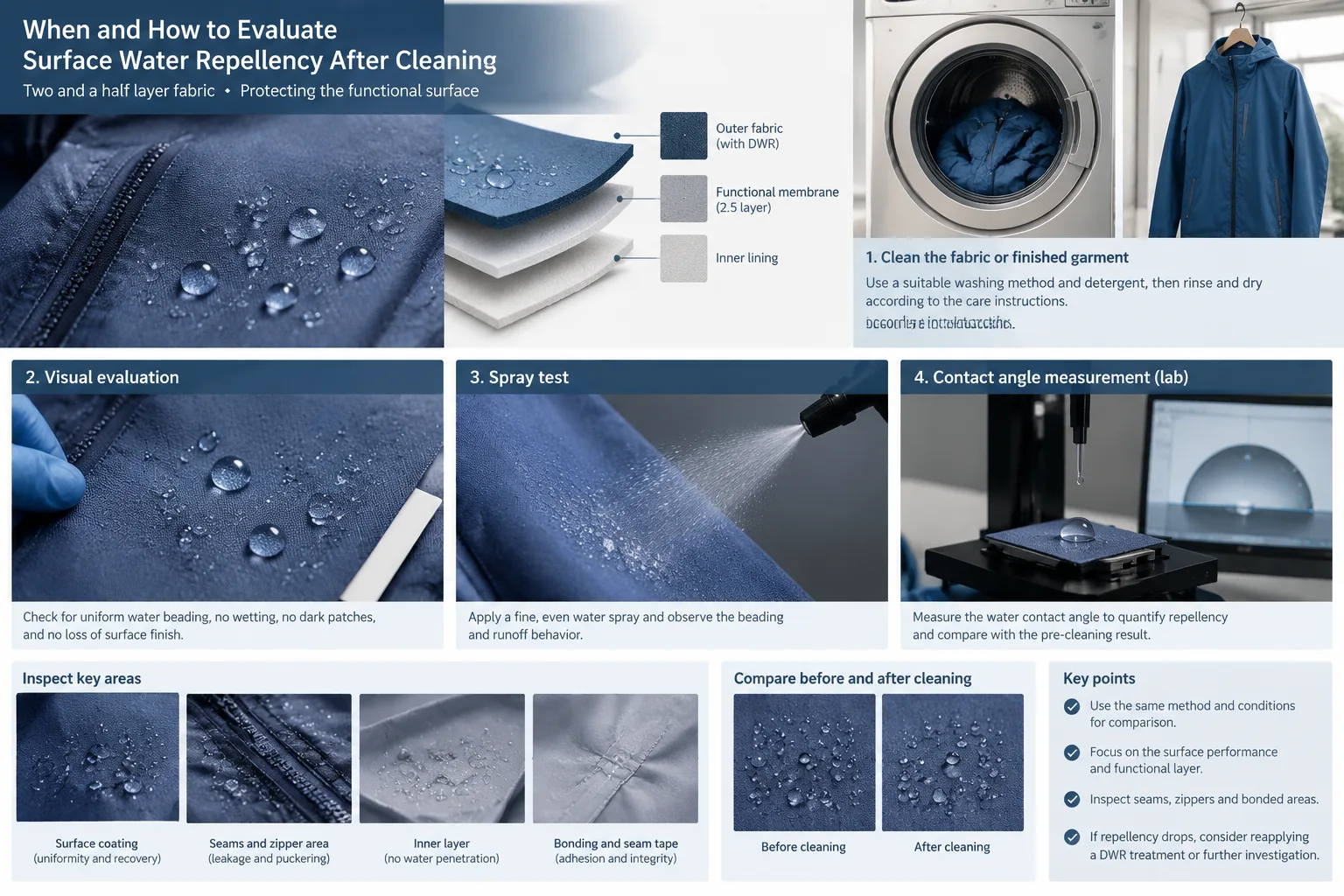
When and How to Evaluate Surface Water Repellency After Cleaning
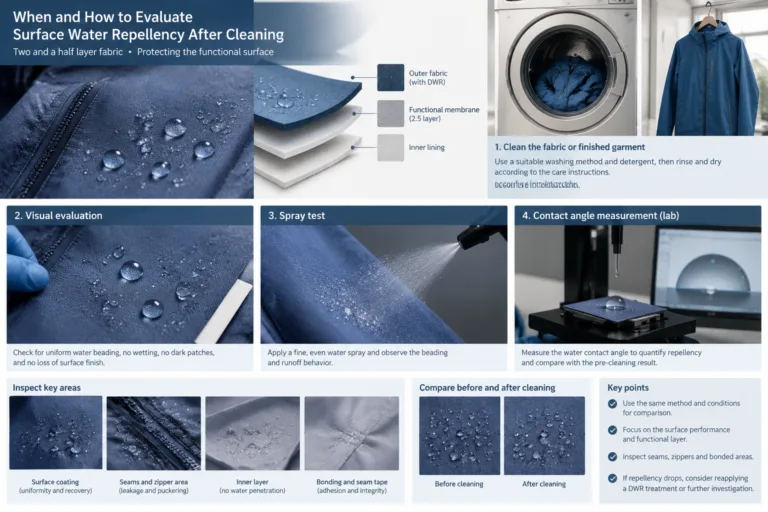
After cleaning, first separate the outer face fabric from the garment’s underlying barrier. A durable water-repellent finish, when present, helps water bead or run off the face fabric. It is not the same as the membrane, coating, seam construction, or other feature responsible for limiting water penetration. A jacket can lose some surface beading without automatically losing all of its barrier performance.
Use a clean, dry garment as the starting point for a simple visual screen. Observe whether water spreads across the face fabric, forms isolated beads, or is absorbed unevenly. This kind of home observation can help identify a change, but it is not a standardized laboratory result and cannot establish a waterproofness or breathability rating. Avoid treating a visual change as proof of one specific failure mechanism.
Comparison is more useful when you have a reference. Pre-cleaning photographs, an approved sample, or notes about the garment’s earlier behavior can help distinguish ordinary contamination from a change associated with laundering, abrasion, age, or repeated use. For product teams, record the cleaning method and inspect the same zones before and after cleaning rather than relying on a general impression.
Reproofing should be considered only after the garment is clean and dry and the product instructions have been checked. A compatible treatment may be appropriate for some face fabrics, while another construction may require a different method or no treatment at all. Do not apply a finish over dirt, damaged fabric, incompatible treatments, or visible peeling. Improved beading after treatment does not prove that the whole garment is waterproof or breathable.
A Practical Inspection Checklist for Garment Owners and Quality Teams
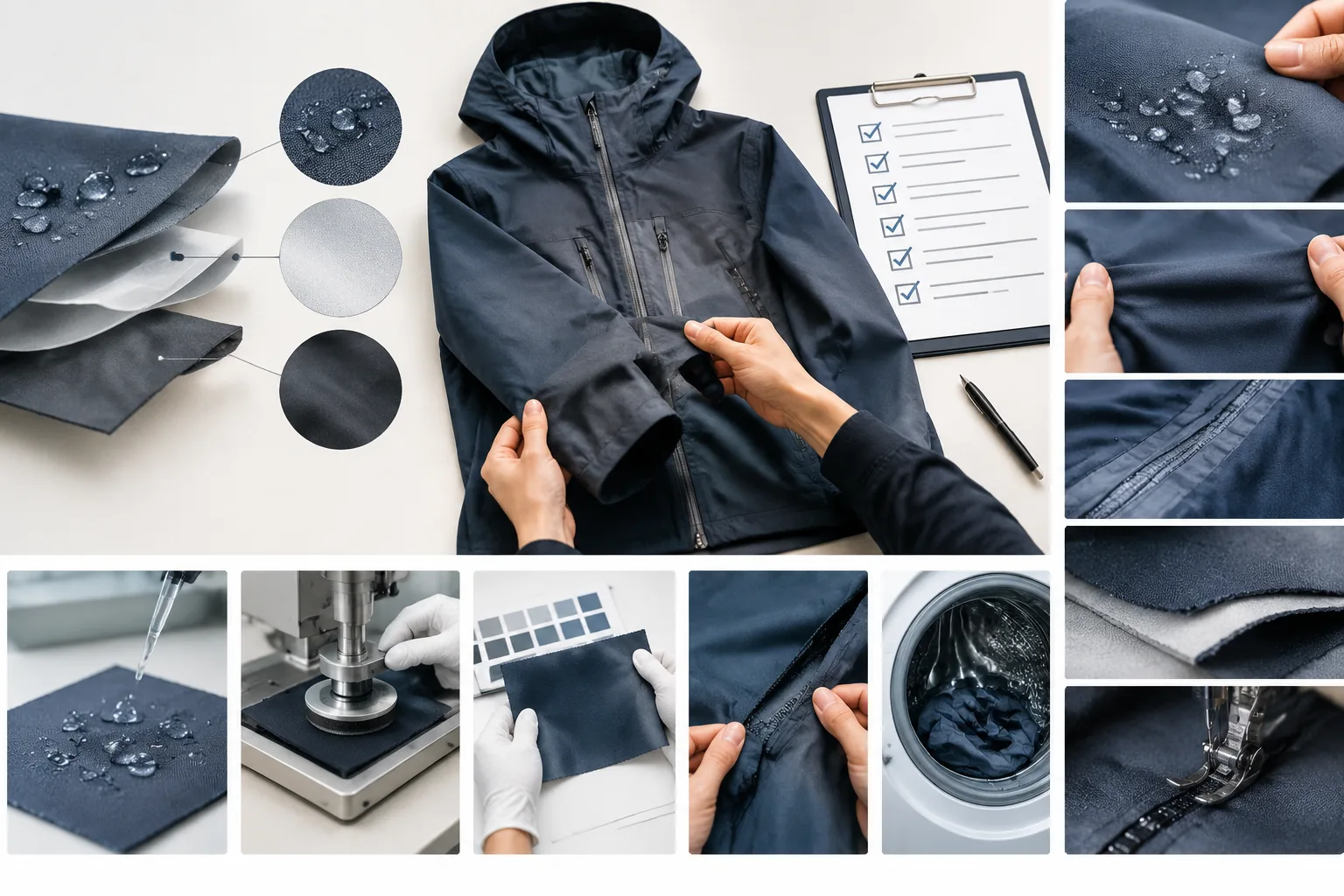
A post-wash inspection should begin with the face fabric and proceed toward the inner functional surface and construction details. The purpose is to document observations consistently, not to diagnose a membrane, coating, or adhesive failure from appearance alone. For an individual garment, a phone photograph and short written record may be enough. For product development, use the garment’s documented requirements and approved samples as the comparison point.
- Face fabric: Look for remaining stains, abrasion, gloss changes, puckering, color shifts, residue, and areas that wet unevenly.
- Inner functional surface: Check for cracking, peeling, flaking, transfer, sticky residue, or newly exposed areas in the protective print or coating.
- Seams and bonded areas: Examine seam tape, bonded edges, hems, pocket openings, zipper zones, and drawcord channels for lifting, distortion, or separation.
- High-flex zones: Pay attention to elbows, shoulders, cuffs, hood openings, seat areas, and other places exposed to repeated folding or rubbing.
- Before-and-after record: Compare photographs, observations, measurements, or approved samples when evaluating a production garment or a repeated care process.
For consumers, persistent leakage, bubbling, peeling, or visible separation is a reason to pause further washing and contact the brand or supplier. For quality teams, suspected barrier loss or delamination should be escalated to the responsible technical contact or a qualified testing laboratory. A visual inspection can identify where to investigate, but it does not replace a validated test when performance is disputed.
Limits of Home Cleaning Advice and the Next Best Action
There is no single universal care routine for every two-and-a-half-layer garment. Fabric composition, coating chemistry, membrane type, protective print, seam construction, trims, insulation, prior wear, and the garment’s care history can all change the outcome. This is why a general cleaning article should support, rather than replace, the label and product-maker instructions.
Seek supplier or professional guidance when the care label is missing or contradictory, the garment has been exposed to an unknown chemical, or cleaning has been followed by peeling, bubbling, persistent leakage, or extensive distortion. Document the garment’s condition, cleaning product, wash method, drying method, and observed change before requesting help. Specific records make it easier to separate contamination, surface-treatment wear, structural damage, and a possible care-process problem.
Brands and manufacturers should connect consumer instructions to the actual tested garment construction. Generic shell-fabric language may be unsuitable when a product includes a delicate inner print, mixed materials, bonded trims, insulation, or unusual seam treatment. Routine dirt can usually be managed through documented care instructions, while suspected construction damage should be investigated separately and tested when the claimed performance matters.
For practical garment development work, the Apparel Manufacturing Tools area can support a broader record of materials, construction details, and quality observations. The key decision rule remains simple: follow documented instructions for routine cleaning, inspect changes systematically, and use qualified technical support when appearance and expected performance no longer agree.
Can I machine-wash a two and a half layer garment?
Only when the garment care label and product-maker instructions permit machine washing. Close fasteners, prepare detachable parts as instructed, and use the approved product and cycle. A two-and-a-half-layer construction name alone does not determine a universal machine-washing method.
Should I use regular detergent on two and a half layer fabric?
Use the cleaning product specified or permitted by the care instructions. Do not assume that a standard detergent or a product marketed for technical clothing is suitable for every membrane, coating, print, trim, or mixed-material garment.
How should I dry a two and a half layer jacket after washing?
Follow the permitted drying method on the label. Line drying, flat drying, and tumble drying are construction-dependent choices. Avoid uncontrolled heat and direct heat sources unless the product instructions specifically allow them, and inspect the garment as it dries.
Does washing remove the garment’s water-repellent finish?
Washing, abrasion, contamination, age, and repeated use may change how water behaves on the face fabric, but the result depends on the garment and its care method. Reduced beading does not by itself prove that the underlying waterproof barrier has failed.
How can I tell whether washing damaged the membrane or coating?
Look for changes such as cracking, peeling, flaking, bubbling, residue, lifting at bonded areas, or distortion around seams and high-flex zones. These observations indicate a need for investigation, but they do not confirm the exact failure mechanism without appropriate technical assessment.
Can reproofing restore a two and a half layer garment’s waterproof performance?
A compatible reproofing treatment may improve surface water behavior on some garments, but it cannot repair a damaged membrane, coating, seam tape, or bonded construction. Check the product instructions first, and do not equate improved beading with confirmed waterproof or breathable performance.