Polyester membrane fabric garment care begins with one rule: follow the finished garment’s care label and the membrane or garment manufacturer’s instructions before applying general cleaning advice. A polyester membrane garment is a layered textile system, not simply “polyester fabric.” Cleaning should remove soil while limiting unnecessary stress on the face fabric, membrane, seam treatments, lining, bonded components, and surface finish. For broader context on Apparel Wiki’s independent editorial position, see the Sponsor page.
The safest general approach is to identify the garment’s construction, inspect it before washing, use only a permitted cleaning method and cleaner, rinse as directed, and handle heat and abrasion cautiously. This can protect the garment’s intended functions, but no universal wash routine can guarantee waterproofness, breathability, or long-term durability across every laminate and garment design.
What Is Polyester Membrane Fabric, and What Does Cleaning Need to Protect?
What is polyester membrane fabric? In garment use, the term usually describes a system in which a polyester face fabric is combined with a membrane and other construction elements. The face fabric provides the visible outer surface and may contribute to hand feel, appearance, abrasion resistance, and surface wetting behavior. The membrane is a separate functional layer. It may be joined to the face fabric, lining, or both, depending on the product construction.
These layers should not be treated as interchangeable terms. Polyester identifies a fiber or polymer component; it does not by itself describe a membrane, laminate, coating, seam treatment, or commercial fabric name. A complete description may need to distinguish fiber content, woven or knitted face-fabric construction, membrane type, adhesive or bonding method, seam tape, lining, printed details, and surface finish. Similar product names can therefore conceal meaningful differences in care tolerance.
How membrane fabric works also depends on the whole garment system. Waterproofing, surface water repellency, moisture-vapor transfer, air exchange, and wearing comfort are related but different performance goals. A membrane may contribute to resistance to liquid-water penetration or vapor movement, while the face fabric and surface finish affect how water spreads, beads, or wets the garment. Seam construction and seam tape can also influence whether water enters through stitched or joined areas.
For that reason, reduced water beading after cleaning is not automatically proof that the membrane has failed. The outer face fabric may have lost some surface water repellency while the barrier layer remains intact, or the garment may have a separate issue involving seams, coatings, damage, or fit. Conversely, a garment that still beads water at the surface is not automatically verified as waterproof or breathable.
Cleaning should therefore be planned around the complete layered system. General textile education can explain the risks and decision points, but the care label and product-specific manufacturer instructions take priority. They are the controlling references for permitted washing, detergent restrictions, drying, ironing, professional cleaning, and any recommended method for renewing a surface finish.
Before Washing: Read the Care Label and Inspect the Garment
Before washing a membrane jacket or other laminated polyester garment, record the care instructions. Check the permitted washing method, water temperature, cycle, detergent restrictions, bleach or softener warnings, drying method, ironing limits, and professional-cleaning instructions. If the label is missing, contradictory, or difficult to interpret, pause and seek product-specific guidance rather than treating the garment as ordinary polyester.
Inspection is part of quality control, not just a household laundry step. Empty pockets and check zippers, hook-and-loop closures, drawcords, detachable trims, printed graphics, seam tape, and bonded details. Construction varies, so a trim or bonded component that is stable on one product may require different handling on another. Close or secure components only when the garment instructions direct you to do so.
Look for conditions that cleaning may expose or worsen: heavy soil, oil, sunscreen, mud, peeling or bubbling layers, cracked coatings, detached seam tape, existing seam leaks, holes, or unusual stiffness. Separate removable surface contamination from structural damage. Washing may remove dirt, but it cannot be assumed to repair delamination, a failed bond, a puncture, or a damaged waterproof barrier.
Use the inspection to choose the next action:
- Routine cleaning: The garment is intact and the care instructions are clear.
- Permitted spot treatment: Soil is localized and the product instructions allow targeted cleaning.
- Technical or manufacturer guidance: The label is unclear, the construction is specialized, or bonded components appear compromised.
- Repair evaluation: Peeling, seam-tape failure, persistent leakage, or other structural symptoms are already present.
A small test on an inconspicuous area may be useful only when the care instructions permit it and the material or cleaner is uncertain. Document the location, method, and result. Such a test can reveal an obvious color, appearance, or compatibility problem, but it is not proof that the entire garment will retain its performance after washing.
A Low-Risk Cleaning Procedure for Polyester Membrane Garments
The following sequence is a general framework for cleaning polyester membrane fabric. The care label overrides it whenever the two differ, and the garment or membrane manufacturer may specify a different procedure.
- Remove loose soil. Gently remove dirt from the surface using the method permitted by the garment instructions. Avoid scraping or aggressive brushing that could stress the face fabric, finish, graphics, or bonded areas.
- Prepare the garment. Empty pockets and handle closures, drawcords, detachable trims, and other components according to the product instructions. Do not assume that every fastener or trim should be treated identically.
- Use the permitted washing method. Select machine or hand washing, water temperature, cycle, and load conditions only within the limits stated on the care label. Do not substitute a familiar routine simply because the garment contains polyester.
- Choose an approved cleaner. Use a cleaner the garment manufacturer permits. Avoid adding unverified detergents, fragrances, softeners, bleach, or other additives as universal solutions; compatibility depends on the construction and the instructions.
- Control the wash load. Do not combine the garment with heavily soiled, lint-shedding, abrasive, or color-bleeding items unless compatibility has been confirmed. Mechanical contact and contamination from other items can matter as much as cleaning chemistry.
- Rinse as directed. Follow the specified rinse procedure. Where the instructions permit thorough rinsing, it can help limit residual cleaning product that may affect handle, surface wetting, odor, or wearing comfort.
Cleaning removes soil; it does not automatically restore a worn surface finish or repair a damaged laminate. For apparel teams developing a care recommendation, document the exact garment construction, cleaner, wash method, loading conditions, and drying method so results can be compared under repeatable conditions.
Detergent, Heat, and Abrasion: The Main Cleaning Trade-Offs
Detergent selection should be considered in terms of manufacturer approval, residue, fragrance, additives, and compatibility rather than a single product being declared universally safe. A cleaner that is suitable for one membrane garment may not be suitable for another because the face fabric, coating, seam tape, print, lining, or bonding system can differ.
Cleaning chemistry is only one part of the risk. Excessive heat, aggressive agitation, abrasion, or unsuitable ironing may affect the face fabric, surface finish, seam tape, printed areas, elastic components, or bonded layers. These are conditional construction risks, not proof that every membrane garment will be damaged by any particular action. The permitted temperature and handling method must come from the product-specific instructions.
A compatible cleaner does not make excessive mechanical stress safe. Likewise, a gentle wash does not make an unapproved chemical additive appropriate. When a garment is being evaluated for product development or quality work, record the cleaning conditions and examine the layers and joined areas afterward rather than judging performance from appearance alone.
Finally, keep surface observations in perspective. Less water beading may indicate a change to the face fabric’s surface repellency, but it does not by itself establish that the membrane no longer resists liquid-water penetration. Dampness, leakage, vapor comfort, and surface wetting describe different observations and should not be treated as interchangeable test results.
Drying and Restoring Surface Water Repellency
Drying is part of the care process, not an automatic final step. Follow the garment’s permitted drying method, temperature, duration, and handling instructions. A membrane garment may combine a polyester face fabric with seam tape, coatings, insulation, lining, elastic components, prints, or bonded trims. These parts can have different tolerances, so assuming that every waterproof breathable garment should be air-dried or tumble-dried can create an avoidable risk.
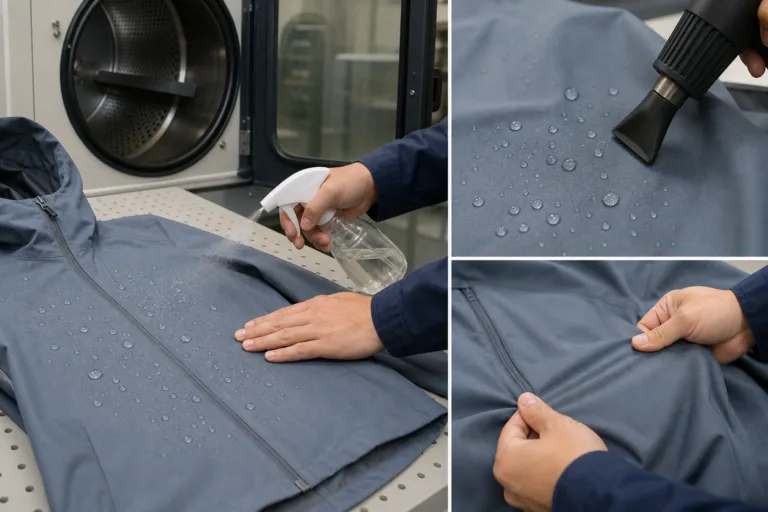
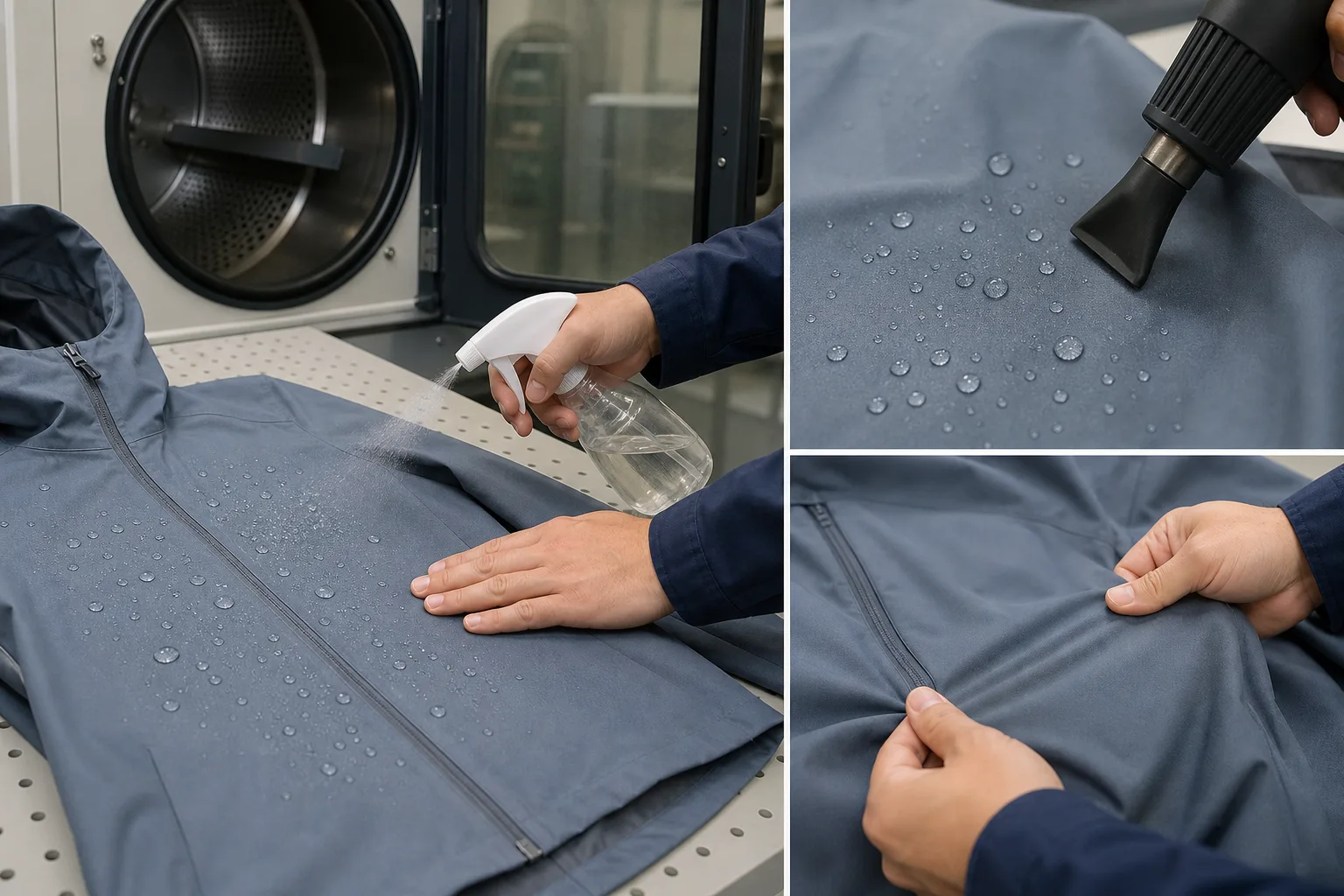
Once the garment is fully dry, assess the outer surface separately from the barrier system. Water beading describes surface water repellency: the behavior of liquid on the face fabric. It does not, by itself, prove that the membrane has failed to resist liquid-water penetration. Likewise, a change in beading does not establish how moisture vapor transfer or wearing comfort will perform in every condition.
Reproofing is a separate action from cleaning and drying. It may be appropriate when the garment maker recommends a compatible product and process for the specific construction. Follow those instructions for application, preparation, and any permitted heat or drying step. Do not treat a general reproofing product as a universal solution for every polyester laminate or finished garment.
Surface treatment cannot be presented as a repair for delamination, detached seam tape, punctures, worn fabric, cracked coatings, or a failed membrane. If the garment shows structural damage, further treatment may complicate assessment without addressing the underlying problem. Keep the care history and product instructions available before deciding whether the next step is routine use, manufacturer support, or repair evaluation.
How to Evaluate the Garment After Cleaning
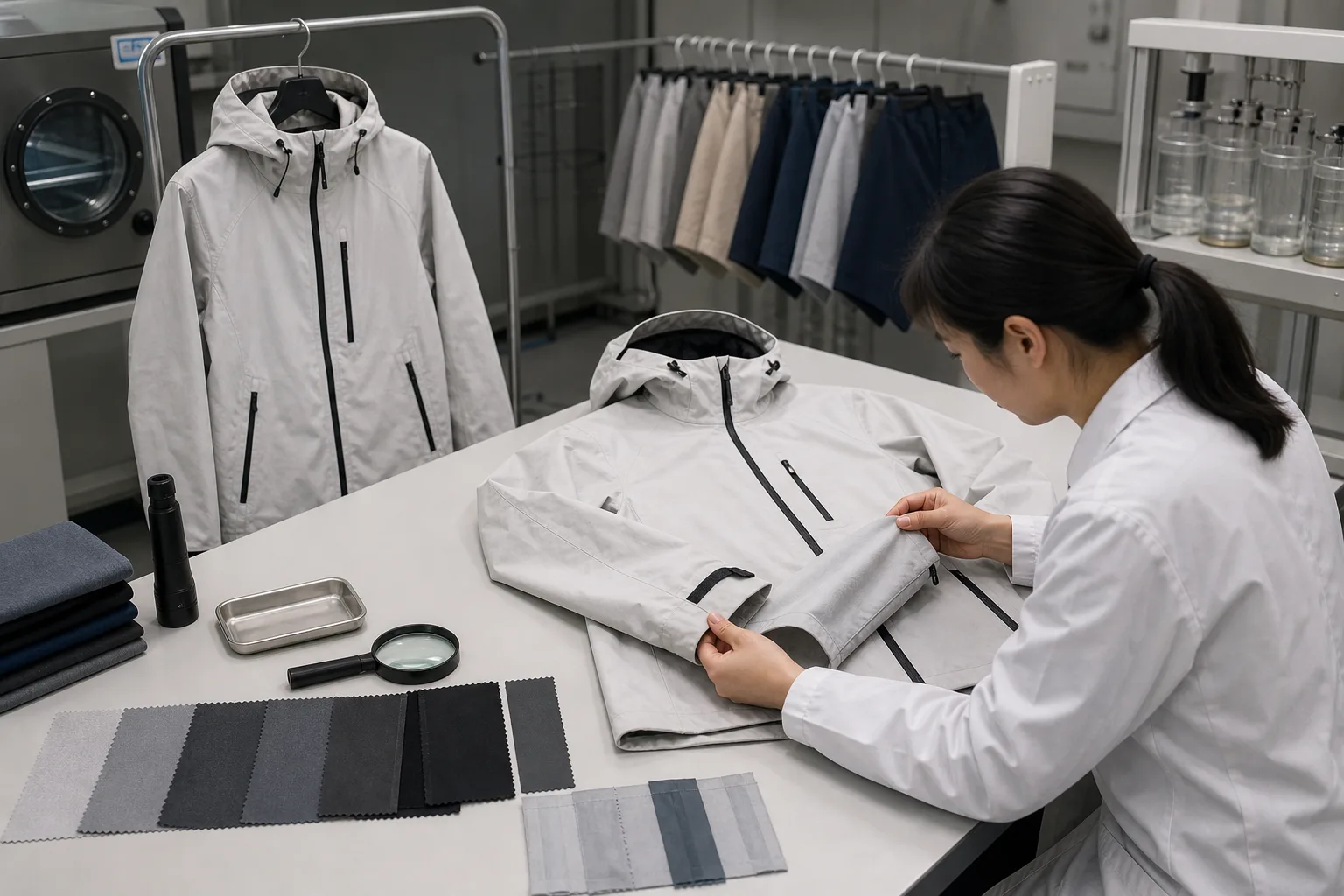
Inspect the garment only after it is fully dry and has returned to its normal handle. Check for remaining soil, odor, detergent residue, unusual stiffness, color change, distortion, and areas that feel different from the rest of the garment. Examine seam tape, bonded panels, closures, printed details, hems, and high-flex areas for lifting, bubbling, cracking, or separation.
A practical before-and-after checklist can organize the review:
- Cleanliness: Has the visible soil or odor been removed without leaving residue?
- Surface wetting: Does the face fabric handle water differently from before, and is that observation limited to surface behavior?
- Leakage: Are there any new or persistent leakage observations at seams, panels, or damaged areas?
- Comfort: Does the garment feel unusually clammy or less comfortable during comparable use?
- Structure: Are the laminate, seam treatments, trims, and closures visibly intact?
These observations are screening evidence, not laboratory results. A home water check cannot establish a universal waterproof rating, vapor-transfer result, seam-integrity result, or care-durability claim. Dampness, surface wetting, leakage, and vapor comfort can have different causes and should not be treated as interchangeable measurements.
For product development, sourcing, or quality work, document the garment construction, care-label instructions, wash conditions, drying method, visible condition, and post-cleaning observations. Comparing the same construction before and after repeated care is more informative than judging one garment from appearance alone. Teams can organize related inspection and development work with Apparel Manufacturing Tools, while keeping any performance conclusion tied to an appropriate validated method or qualified test facility.
When Cleaning Is Not the Solution: Limitations and Next Steps
Stop routine cleaning and seek product-specific guidance when you find peeling or bubbling layers, detached seam tape, cracked coatings, holes, persistent leakage, or a care label that conflicts with the garment’s observed construction. These signs may indicate a problem with the laminate, coating, joining method, or fabric rather than removable dirt. Stronger washing, extra detergent, or repeated reproofing is not a reliable substitute for diagnosis.
A damaged membrane or laminate may require repair, replacement, or assessment by the brand, supplier, repair service, or qualified technical facility. The appropriate option depends on the garment design and the location and extent of the damage. Apparel brands and manufacturers should validate the final care label on the completed garment, including its seams, trims, prints, and bonded areas, rather than relying only on a face-fabric swatch.
When requesting support, provide the garment’s care instructions, construction information if available, treatment history, cleaning and drying conditions, photographs of affected areas, and a clear description of the symptoms. This record helps separate a surface-finish change from a structural failure and avoids presenting an informal observation as a confirmed performance diagnosis.
Apparel Wiki is an independent apparel knowledge publication, not a manufacturer, factory, laboratory, certifier, or repair provider. Its general guidance cannot replace the instructions for a named garment or membrane system. The practical decision path is straightforward: follow the label, clean within its stated limits, dry as directed, assess the relevant surface and structural condition, then seek technical guidance when damage or unusual performance loss remains.
For ongoing polyester membrane fabric garment care, keep the care label and product documentation with the garment, record unusual changes after cleaning, and treat repair decisions as construction-specific. A careful record is useful for both individual garment owners and product teams refining finished-garment care instructions.
FAQ
Can I machine-wash a polyester membrane fabric garment?
Only when the care label permits machine washing. Use the stated temperature, cycle, load guidance, and cleaner restrictions. Polyester content alone does not determine whether the complete membrane garment is machine-washable.
What detergent should I use for a polyester membrane jacket?
Use a cleaner permitted by the garment or membrane manufacturer. Do not assume that a detergent, fragrance, additive, or softener is universally suitable for every face fabric, seam treatment, lining, or bonded construction.
Does washing remove the membrane from a waterproof garment?
Routine washing does not automatically mean that the membrane has been removed. However, unsuitable heat, abrasion, chemistry, or handling may affect other components, and existing delamination may become more apparent after cleaning.
Why does a membrane garment stop beading water after washing?
The face fabric’s surface water repellency may have changed. Reduced beading alone does not prove that the membrane has stopped resisting liquid-water penetration, so inspect the garment and follow the manufacturer’s guidance before reproofing.
Can reproofing repair a damaged polyester membrane?
No. Reproofing may address a face-fabric water-repellency issue when the manufacturer recommends it, but it is not a universal repair for delamination, damaged seam tape, punctures, cracked coatings, or membrane failure.
How should I dry a polyester membrane garment?
Follow the garment’s specific drying instructions for method, temperature, duration, and handling. The correct approach depends on the complete system, including the face fabric, membrane, seam tape, lining, insulation, and trims.