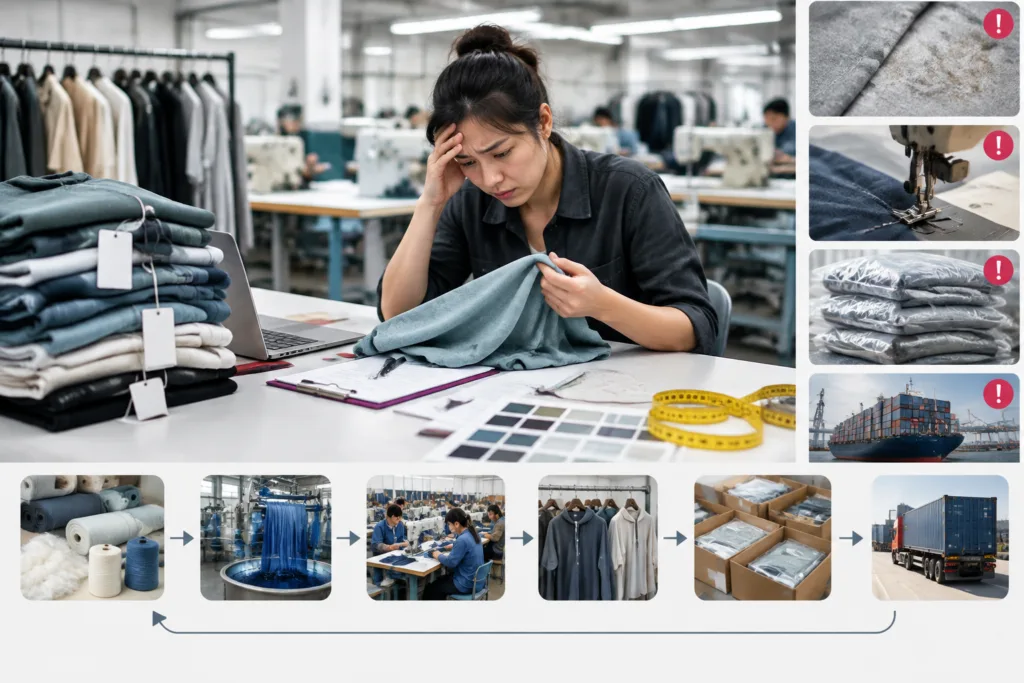
quality control

cutting room showing sleeve asymmetry, garment symmetry issue

Why are the left and right sleeves different lengths?

Introduction to Sleeve Asymmetry and Garment Symmetry Issue Sleeve asymmetry is a common garment symmetry issue that disrupts both the appearance and function of clothing. If you’ve ever noticed your left and right sleeves are different lengths, you’re not alone. For manufacturers, designers, and quality controllers, understanding why sleeve asymmetry occurs—and how to fix it—is […]

Macro shot of a shirt collar point with perfect stitching and sharp edge

How to Sew a Clean Collar: Factory-Level Techniques

How to Sew a Clean Collar: Factory-Level Techniques Sewing a perfectly clean collar is one of the hallmarks of professional shirt collar construction. Whether for fine dress shirts, uniforms, or casual polos, mastering collar sewing means every edge is crisp, every seam aligns, and the collar stands evenly without twisting. This article shares step-by-step collar

Sewing line with fleece garment production and in-process QC

How to Find a Clothing Manufacturer: A Complete Buyer’s Guide

How to Find a Clothing Manufacturer: A Complete Buyer’s Guide For fashion startups, brand managers, or apparel buyers new to manufacturing, navigating the labyrinth of supplier selection, due diligence, and contract structuring can be daunting. This comprehensive guide reveals the essentials of how to find a clothing manufacturer—from defining your product needs to vetting factories

Woven shirt on table with measurement points, ruler, and spec sheet

How do I measure a garment correctly?

How do I measure a garment correctly? Accurate garment measurement is the foundation of apparel quality control, fit consistency, and professional communication between buyers, factories, and pattern makers. A well-prepared garment measurement guide ensures every T-shirt, shirt, or jacket produced matches the intended fit, minimizes returns, and builds trust along the supply chain. This in-depth

Garment factory worker setting markers on fabric lay for cutting process

How to Cut Fabric Correctly in Garment Production

How to Cut Fabric Correctly in Garment Production Mastering fabric cutting is a cornerstone of quality garment production. In apparel factories and workshops, correct cutting room skills ensure consistent fit, desired drape, and minimal fabric waste. This guide breaks down the essential techniques—including grainline alignment, marker strategy, fabric spreading, and precision tool handling—any practitioner must

Medical mask production line using nonwoven meltblown and spunbond fabrics

Non-Woven Fabrics: Construction & Industrial Usage

Non-woven fabrics have reshaped the textile landscape for both technical and everyday applications. Combining versatility, efficiency, and exceptional functionality, nonwoven textiles are foundational in industries such as filtration, medical, automotive, construction, and apparel padding. This in-depth guide explores manufacturing processes—especially meltblown and spunbond methods—the diverse industrial uses of non woven fabric, and essential technical parameters

QC staff reviewing demo boards of seam quality and alignment during training

Inline Inspection (IPQC): Purpose & Process

Understanding Inline Inspection (IPQC) in Apparel Manufacturing Inline inspection (IPQC) stands as a critical quality control checkpoint in the fast-moving world of garment production. It’s not performed after all sewing is complete, but actively—right on the production line—where garments take shape stitch by stitch. In factories experienced in exporting to strict markets, this process plays

Macro detail of sewing puckering on a fabric seam under a factory machine

Why do seams pucker on my clothing?

Why do seams pucker on my clothing? Seam puckering is a common garment defect that undermines both appearance and function. Whether seen on a brand-new shirt or after the first wash, puckered seams signal underlying sewing issues. Understanding why this happens—and how to fix and prevent it—can save time, money, and reputation in apparel production.

Mannequin displays polo shirt with measured tolerance points

What Is a Production Tolerance?

Production tolerance is a set of allowed variations in garment sizes and specifications during manufacturing. In apparel, garment tolerance refers to the permissible differences between the intended measurements (as stated on the spec sheet) and the actual measurements of finished garments. Garment measurement tolerance is critical to ensuring quality, consistency, and fit across large production

Scroll to Top