

Understanding Grading Rules: How Sizes Expand from a Base Pattern
Pattern grading is the unsung hero of modern garment manufacturing: it allows a base pattern to be methodically scaled into a full suite of sizes while maintaining the designer’s original intent. Without proper grading rules, you’d end up with inconsistent fits, distorted silhouettes, and dissatisfied wearers. If you’ve ever wondered why sizes feel different between brands—or why children’s, men’s, and women’s garments expand in distinctive ways—grasping grading rules is the key. In this authoritative guide, you’ll discover how sizes grow both vertically and horizontally, how proportions are protected, and the essential differences across demographic groups.
What is Pattern Grading?

Pattern grading is the systematic process of enlarging or reducing a base (sample) pattern to create additional sizes. The goal is to scale a pattern so each resulting garment fits the target customer as intended, preserving both comfort and style. Accurate grading ensures that design details, such as pocket placement or armhole shape, remain consistent from one size to the next.
The Importance of Grading Rules
Grading rules define the amount and direction by which each measurement is increased or decreased for different sizes. These crucial rules provide the roadmap for every increment and help maintain size consistency throughout a collection. Apparel Wiki often highlights that clear, well-defined grading rules save tremendous time during both sampling and large-scale production runs, reducing costly fit rejects.
Base Pattern: The Starting Point
The process begins with a base pattern—usually the middle or most popular size in your target range (such as size M for adults, or size 8 for kids). The base size acts as the anchor, from which all other sizes expand or contract. This pattern must be perfected before any grading begins, as errors will be replicated and amplified in all subsequent sizes.
Grading Points: Where Changes Occur
Grading points are specific spots on a pattern—shoulder tip, side seam, bust, knee, hem, and so forth—where expansions or contractions happen. Each point is assigned a grade value, dictating how much it moves when creating a larger or smaller size. Using precise grading points helps keep design proportions and maintains seam alignment between pattern pieces.
Vertical vs. Horizontal Grading Increments
There are two main types of grading increments: horizontal (width) and vertical (length). Horizontal increments affect chest, waist, hips, and shoulder widths, while vertical increments apply to garment length, rise, and sleeve length. Grading rules dictate how these changes are distributed, which often depends on gender, age group, and intended garment style.
Standard Grading Rule Charts
Most manufacturers rely on standardized grading rule charts, which define the typical increments for each measurement by size and demographic. These charts differ for men, women, and children’s apparel, reflecting varied growth and body proportions. For example, women’s garments typically add 2.5 cm to bust circumference per size step, while men’s grading often focuses on shoulder and chest width.
Customized Grading Rules by Brand
While industry standards provide a starting point, many brands develop custom grading rules to fit the specific needs of their target audience. For instance, premium menswear brands might use smaller increments between chest sizes to permit a more tailored fit, while athletic brands often include additional ease at key movement points. Smart customization separates off-the-rack garments from truly well-fitting fashion.
Protecting Garment Proportions During Grading
Maintaining consistent design proportions is paramount. If grading is too aggressive or not precisely mapped, critical features like collar width, pocket size, or button spacing can look oversized or undersized on extreme sizes. Successful grading keeps these and other style elements aesthetically true on every size in the range.
Grading for Men’s Wear
Men’s grading prioritizes chest and shoulder width, as men’s bodies tend to scale wider rather than vertically. Length increments are usually small—about 1.25 cm per size—while circumference expands by 5 cm per full size step. Special attention is given to maintaining sleeve proportion and armhole size as men’s arm and torso dimensions grow consistently with chest increases.
Grading for Women’s Wear
Women’s body shapes add complexity to grading. Bust, waist, and hips all expand at different rates, and curves need careful handling. Pattern graders may apply larger increments at the bust than at the waist, and both vertical and horizontal grading must account for the diverse ways women’s bodies change between sizes. For dresses or tops, dart positions and bust points must also shift for ideal shaping.
Grading for Children’s Wear
Children’s grading requires extra flexibility. Children grow rapidly and non-uniformly—torso length might not keep pace with overall height, and proportions shift dramatically between age groups. Grading rules for kids focus more on vertical increments, especially for pants and sleeves, and less so for circumference, compared to adult garments.
Size Grading for Plus Sizes
Expanding into plus sizes demands grading rules that go beyond simply continuing standard increments. Plus sizes should reflect the reality that not all parts of the body grow at the same rate. For example, increases in arm circumference must be greater to maintain comfort and fit, while length increments may remain moderate. Failure to adapt grading rules for plus sizes often results in awkward fits and poor aesthetics.
Intermediate Sizes and Unisex Grading
Intermediate sizes (like 1X, 2X or between M and L) and unisex garments require blended grading logic. Here, increments are often smaller and compromise between standard men’s and women’s charts. Designers must keep these strategies flexible, especially when serving diverse or international markets.
Digital Grading: CAD and Automation
Today, most pattern grading is handled digitally using CAD (computer-aided design) systems. These platforms let graders input custom grading rules or select from standard ones, automate complex grade rules, and visualize how increments affect the whole pattern. CAD tools help prevent manual errors and ensure repeatable results.
Manual Grading Techniques: Still Relevant?
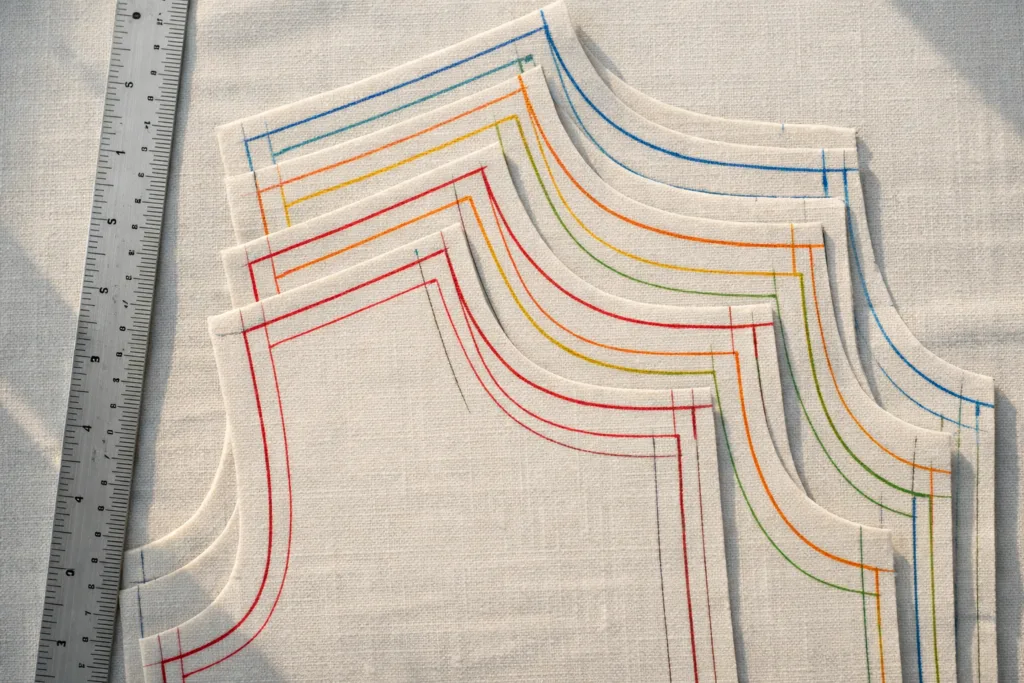
Though digital methods dominate, manual grading with rulers, notches, and pattern blocks is still taught and occasionally practiced in smaller ateliers. Manual grading shines when working with non-standard patterns, specialty apparel, or for learning the foundational logic underlying automated systems.
Maintaining Seam Alignment Across Sizes
Precise grading is critical to keep seam lines matching up across all sizes. Misaligned seams lead to production headaches and unsightly garments. Graders use careful grading points—and often custom CAD rules—to ensure that side seams, armholes, collars, and panel joins stay congruent at each size increment.
Key Measurements and Grading Table Example
| Measurement | Horizontal Increment | Vertical Increment |
|---|---|---|
| Bust/Chest Circumference | 2.5 cm per size | — |
| Waist Circumference | 2.0 cm per size | — |
| Hip Circumference | 3.0 cm per size | — |
| Body Length | — | 1.25 cm per size |
| Sleeve Length | — | 1.25 cm per size |
Notches and Labeling: Guiding Production
Properly graded patterns should have clearly marked notches, drill holes, and grain lines for each size. These guides guarantee that during the cutting and sewing process, pieces join accurately and measurements are respected across the full size run.
Balancing Style and Sizing in Fashion Collections
When designers create multi-size collections, they must balance signature style elements—dart placement, pleats, embellishments—with the practical limits of grading. Extreme size jumps might require design tweaks, or even separate base patterns for petite, regular, and plus. Apparel Wiki notes that seasoned graders often collaborate closely with sample makers to keep both sizing accuracy and overall garment charisma intact.
Common Pitfalls and Factory Variations
Many fit problems trace back to poor grading execution—such as using one-size-fits-all increments, ignoring body landmarks, or overlooking style-specific elements. Factories sometimes substitute internal grading tables, so it’s vital for brands to communicate their rules clearly and inspect production samples from every size.
International Sizing and Cross-Market Grading
Sizing conventions differ globally, necessitating region-specific grading rules and size charts. US, EU, and Asia-Pacific markets may interpret increments and body proportions differently, pressing brands to develop flexible global strategies.
Documenting and Revising Grading Rules
Brands should keep comprehensive records of their grading rules and update them as trends, fabrications, or target markets evolve. Good documentation aids new collections and reduces errors when onboarding new manufacturing partners.
Grading Rules: How Sizes Expand from a Base Pattern
Grading rules put your sizing strategy into motion. Whether you start from horizontal or vertical increments, pay attention to style, market, and real-world wearer feedback. The ideal grading rules reflect the needs of your customers, honor the designer’s original vision, and set the tone for a successful fashion line.
Conclusion: Achieving Consistent Fit and Style Across Sizes

Successful pattern grading balances technical precision with creative vision. By applying clear grading rules—tailored for gender, age, and market—you ensure every garment fits as beautifully in size XS as in XL (or beyond). Consistent proportions, smart use of digital tools, and an awareness of common industry pitfalls will elevate your entire production cycle. Remember: every great collection begins and ends with patterns refined by intelligent, experience-driven grading.
Frequently Asked Questions
What is the primary purpose of grading rules in apparel?
Grading rules ensure consistent fit and style when scaling a base pattern across multiple sizes, allowing manufacturers to produce garments for a wider range of customers while preserving design integrity.
How are plus size grading rules different from standard ones?
Plus size grading requires larger and sometimes uneven increments for specific measurements, such as arms or thighs, ensuring comfort and accurate proportions that simply extending standard increments cannot achieve.
Why do men’s and women’s grading rules differ?
Men’s and women’s bodies expand differently as sizes increase. Men’s grading focuses more on width, while women’s rules accommodate changes in bust, waist, hips, and shape, with tailored adjustments for curves.
Can I use the same grading rules for children’s and adult patterns?
No, children’s bodies grow in different proportions, often requiring greater focus on vertical increments. Childrenswear grading charts reflect these differences distinctly from adult grading tables.
How does digital grading improve accuracy?
Digital CAD systems automate the grading process, minimize manual errors, allow real-time adjustments, and ensure all resulting sizes remain proportional and aligned across the full range.
Is it necessary to adjust grading rules for different markets?
Yes, international markets have varied size standards and body proportions, so brands may need to revise grading rules for regional expectations and fit preferences.