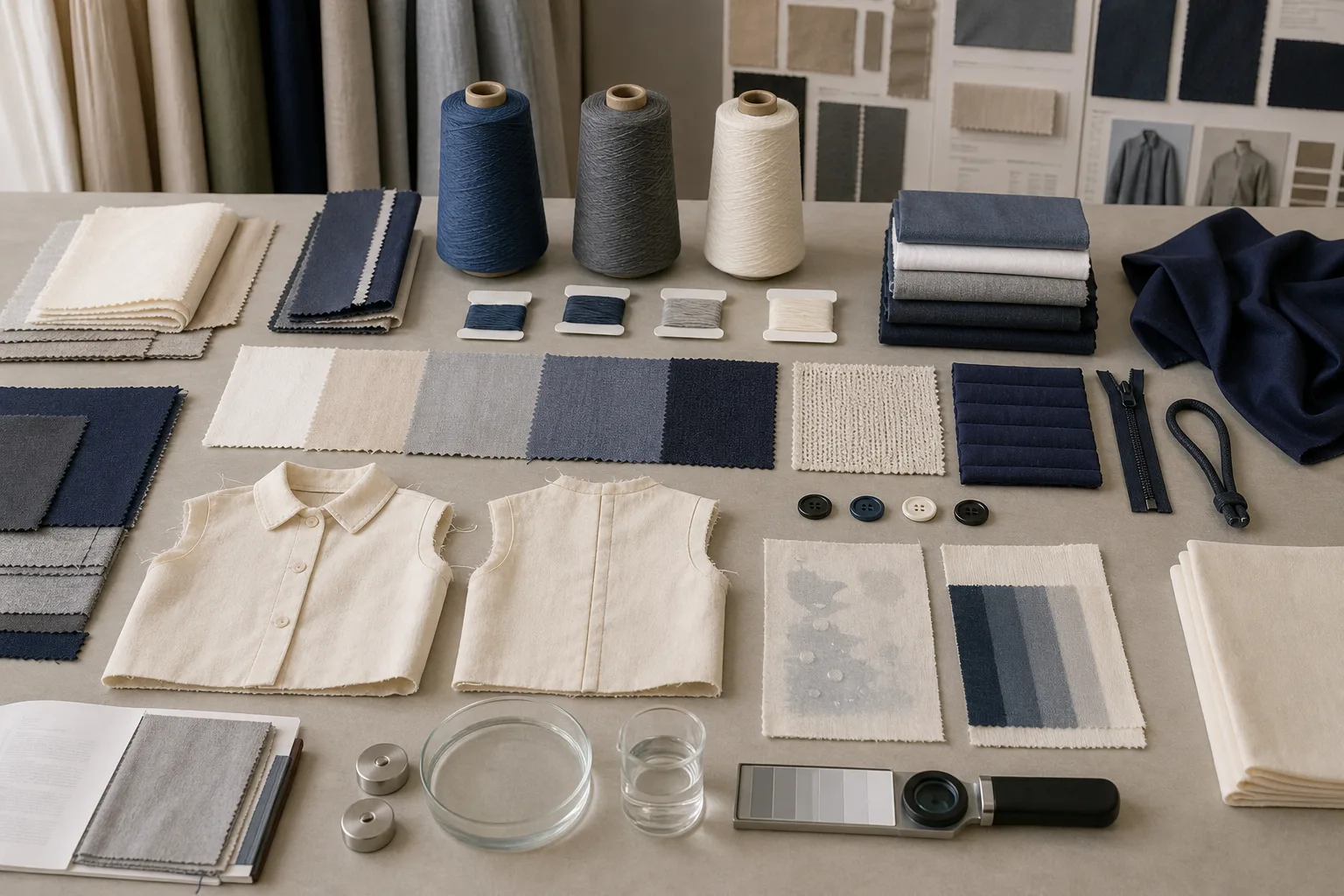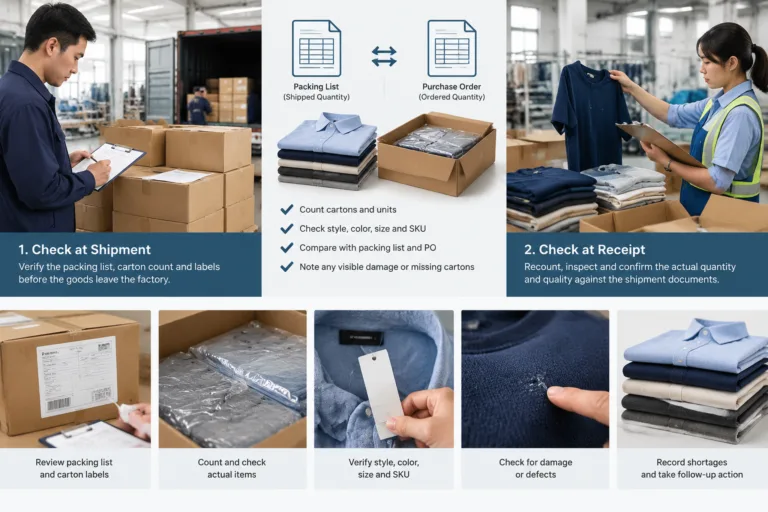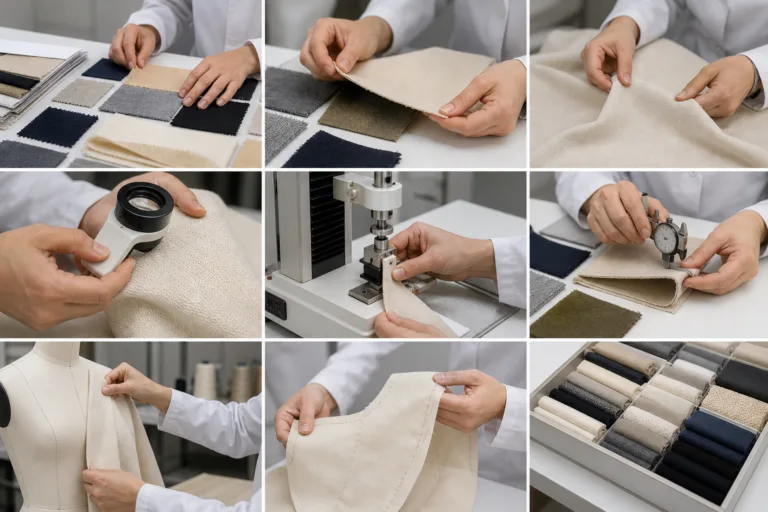
Fabric swatch analysis materials include a clearly identified fabric sample, documented reference swatches, simple observation tools, and a reliable way to record findings. Fabric swatch analysis is the preliminary examination of a fabric piece to describe its fiber clues, yarn, construction, surface, and finishing. A practical learning kit can support design, sourcing, classroom study, or early development decisions; it cannot by itself prove every performance, safety, compliance, or production claim. Apparel Wiki is an independent educational publication; its Sponsor information does not make the site a manufacturer, laboratory, or testing service.
Start with a representative swatch whose identity can be preserved. Add reference samples with known or documented information, a clean inspection area, consistent lighting, a ruler or measuring tape, a magnifier or pick glass, and a camera or phone. A notebook, worksheet, or digital log is equally important because an observation separated from its sample, direction, date, or source quickly loses value. Optional equipment may support a specific controlled investigation, but basic tools should not be presented as substitutes for validated testing.
What Materials Do You Need for Fabric Swatch Analysis?
Organize the kit by the question each material helps answer. The swatch supplies the object of study; reference samples provide comparison; observation tools reveal visible structure and dimensions; recording aids preserve what was seen; and specialized equipment may answer a narrower analytical question. Keep these roles separate. A magnifier can help reveal loops or interlacement, for example, but it does not automatically establish fiber composition. A scale can support a documented mass comparison when measurement conditions are controlled, but a single reading does not define the fabric’s full production behavior.
- Primary swatch: Use a representative, undamaged piece when possible. Preserve the sample’s identifier, source, date, supplied composition, and any stated construction, width, weight, or finish.
- Reference samples: Select documented or known examples for comparison, including woven and knitted structures or visibly different surfaces. Treat them as comparison anchors, not universal benchmarks.
- Observation tools: Prepare a clean surface, neutral lighting where practical, a ruler or tape, magnifier, and camera. These support visual, structural, dimensional, and photographic observations.
- Recording aids: Use labels, removable tags, a worksheet, and a digital folder that keeps photographs and supplied documents with the physical sample.
- Optional test support: Use specialized analytical equipment only for a defined question and with suitable technical competence, safety controls, and interpretation. A university laboratory manual describes fabric analysis methods such as ATR-FTIR and dye-related analysis as methods that answer specific analytical questions, not as universal visual identification.
Describe the material through four layers: fiber, yarn, fabric construction, and finishing. A commercial name may vary by market and should not be treated as a complete technical identity. “Satin,” for instance, can describe a surface or construction category, while “silk” identifies a fiber source; the terms should not be treated as interchangeable. Similarly, knitted describes a looped construction, not a particular fiber.
Keep the purpose visible. Preliminary analysis helps a team form and document useful observations. Controlled testing uses defined methods and conditions to answer narrower questions. Production approval requires project-specific evidence and responsible technical review. One small swatch is not automatically evidence that an entire roll, lot, garment, or finished product will behave in the same way.
Build a Reliable Swatch Reference Set Before You Compare Fabrics
Comparing one unidentified swatch with memory or a product photograph is weak evidence. A reference set gives the observer physical examples that can be examined under the same conditions. When available, collect samples with documented fiber content, construction, finish, weight, width, and supplier information. Mark each item as documented information rather than independently verified fact unless an appropriate test or technical record supports it.
Choose references according to the question. To study construction, compare a woven sample with a knitted sample or with another woven sample that changes one structural feature. To study surface effects, include samples with different visible hairiness, luster, texture, or finishing indications. To explore a supplier or process relationship, change one comparison variable at a time where practical. This makes the difference easier to describe, although it does not eliminate the influence of other unknown variables.
Each sample should retain a practical identity trail. Use an identifier, source, date received or recorded, observed face and back, lengthwise direction when it can be established, and supplied specifications. Keep the original label, data sheet, or message with the swatch and photographs. Do not create a universal retention period or mandatory label system; the useful fields depend on the project and the level of traceability required.
| Reference record | What it helps preserve |
|---|---|
| Sample identifier and source | Which physical piece was examined and where its information came from |
| Date, photographs, and orientation | When and how the sample was observed, including face, back, and direction |
| Supplier specifications | Documented claims that can be compared with direct observations |
| Open questions | Unknowns that may require more documentation or appropriate testing |
A matching trade name does not guarantee matching construction, composition, finishing, or performance. Reference samples are learning aids and comparison tools. They are not automatically standards, approval samples, or proof that a new fabric is equivalent to an older one.
Essential Tools for Observing a Fabric Swatch
Begin with a clean, flat inspection surface and lighting that allows samples to be viewed consistently. Record the lighting context when it affects color, luster, transparency, or surface visibility. A camera or phone can preserve the overall appearance and close details, but photographs are most useful when the distance, orientation, and framing are reasonably consistent between samples.
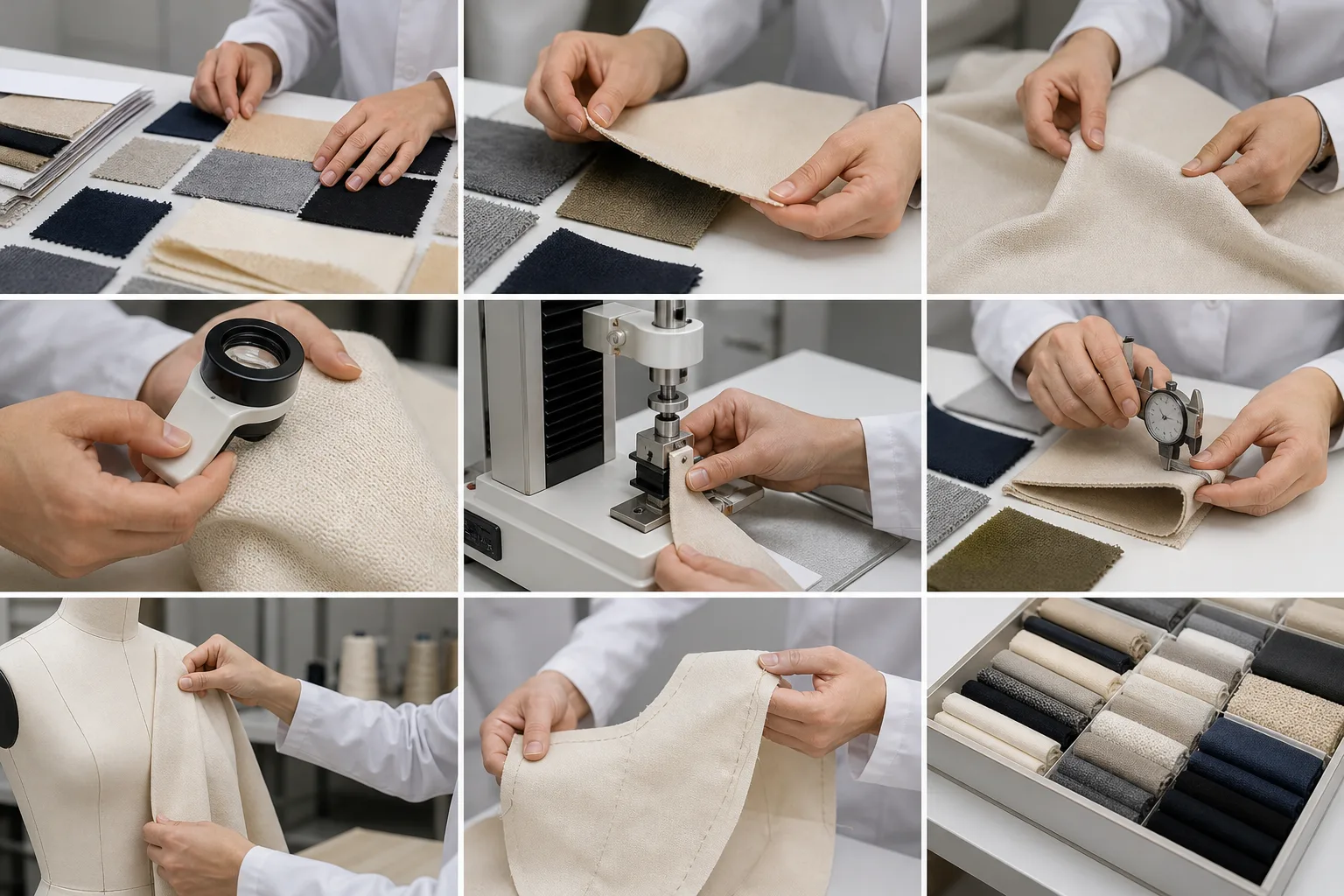
Use a ruler or measuring tape to record dimensions, direction, or a visible feature. Always include the unit and explain which area or direction was examined. A magnifier or pick glass can help show yarn paths, loop formation, apparent twist clues, surface hairiness, and defects that are difficult to see unaided. It may reveal structure; it does not, by itself, prove the fiber or finish.
Observe the face and back, yarn direction, weave or loop clues, density patterns, transparency, luster, surface texture, and visible damage. Note hand, drape, apparent stretch, and recovery as observations rather than complete performance results. Do not infer fiber identity from color, shine, softness, or drape alone. Likewise, do not equate a smooth satin-like appearance with silk or assume that every knitted fabric has the same stretch response.
A scale or other measurement equipment is optional when a documented mass or dimensional comparison matters and the measurement conditions can be controlled. Specialized instruments belong to a different level of analysis. For example, educational laboratory guidance on Raman spectroscopy describes collecting spectra from fabric samples and standards for comparison. Such output is analytical evidence for a defined method, not a replacement for sample documentation or a general-purpose guarantee of identity.
Record the Fabric in Four Layers: Fiber, Yarn, Construction, and Finish
The four-layer record prevents an attractive commercial name or isolated sensory impression from becoming an incomplete material description. Write what is supplied, what is directly observed, and what remains uncertain. Useful wording includes “supplier states,” “appears to,” and “not verified.” This makes the evidence level visible to the next person who uses the record.
Fiber
Record supplied composition separately from visual or tactile impressions. A swatch may suggest characteristics worth investigating, but appearance alone cannot establish exact fiber content. If identity matters to sourcing, safety, labeling, or performance decisions, request appropriate documentation or consult a qualified testing resource.
Yarn
Note apparent thickness, texture, twist clues, novelty effects, and whether the yarn appears continuous or spun when the sample allows those observations. Use cautious language because a small or tightly finished swatch may conceal important yarn details.
Fabric construction
Distinguish visible woven interlacement, knitted loops, or another apparent structure. Record face and back, direction, density clues, and dimensional behavior observed in the sample. Construction provides performance clues, but it does not independently determine stretch, breathability, durability, or comfort.
Finish and physical description
Record surface effects suggested by appearance or hand, while separating a suspected finish from a documented finish. Add color, pattern, surface, hand, drape, apparent stretch and recovery, transparency, and visible defects. These notes support comparison and follow-up; they are not universal performance ratings.
A Repeatable Step-by-Step Fabric Swatch Analysis Procedure
Begin by defining the question you need the swatch to answer. You may be checking a visual match, investigating apparent construction, comparing hand and drape, reviewing preliminary suitability, or preparing questions for formal testing. A clear purpose keeps the analysis focused and prevents basic observation from being mistaken for a complete material approval.
Inspect and photograph the unused swatch before handling it extensively. Mark or record the face, back, lengthwise direction, crosswise direction, and any visible damage or irregularity. Review the supplier information separately, including any stated composition, construction, finish, dimensions, or weight. When the documentation and the physical sample disagree, record the disagreement rather than silently choosing one version.
Use the same inspection order for each sample: overall appearance, face and back, direction, yarn or loop clues, surface, hand, drape, apparent stretch and recovery, dimensions, and visible defects. Compare the target swatch with selected references only after making the initial record. When learning or investigating one relationship, change one comparison variable at a time where practical. This makes differences easier to interpret.
Record what you observed, how you observed it, and what remains uncertain. A worksheet or digital log can include photographs, measurements with units, reference identifiers, supplier statements, and follow-up questions. Preserve the original sample with its record. A classroom exercise or preliminary sourcing review can organize evidence, but it cannot automatically predict every lot, garment, production condition, or end-use result.
How to Interpret Observations Without Overclaiming Performance
Make the evidence level visible in every conclusion. Label a statement as an observation, supplier-documented information, an independent test result, a project-dependent judgment, or an editorial recommendation. For example, “appears to have a brushed surface” describes an observation, while “the supplier states that the fabric contains…” identifies supplied information. Neither statement alone proves the complete material identity or expected service performance.
Hand, drape, luster, opacity, and apparent stretch are useful screening clues. They are not complete performance results. Fiber content, yarn arrangement, construction, finishing, fabric weight, garment design, and use conditions can interact. A satin appearance does not establish silk content, and a knitted structure does not by itself determine how much a fabric will stretch or recover.
When the decision matters, identify the missing evidence. Questions about dimensional stability, colorfastness, abrasion, strength, stretch and recovery, flammability, chemical safety, or another project-specific concern may require documentation or relevant testing. Analytical methods can also answer narrower identity questions than visual inspection alone. For example, the University of North Texas fabric analysis manual presents analytical approaches for selected fiber and dye investigations; an instrument result should be treated as evidence for its defined method, not as a universal substitute for evaluation.
Use four practical decision categories: suitable for preliminary concept review; needs supplier documentation; needs comparative or project-specific testing; or not enough evidence for a production decision. The correct category depends on the end use and jurisdiction. A fabric swatch analysis is a decision aid, not a product specification, laboratory report, certification, legal determination, or production approval.
A Practical Swatch Analysis Record and Next-Step Checklist
A useful fabric sample analysis report separates facts, observations, and unknowns. Record the sample identifier, source, date, stated composition, construction description, dimensions, observed face and back, visual and tactile notes, photographs, comparison samples, open questions, and evidence level. Keep supplier claims and laboratory results in distinct fields so a later reviewer can see where each conclusion came from.
A simple comparison table can use rows for identity, construction, surface, hand, dimensional behavior, documented specifications, unknowns, and next action. For each row, write a concise observation and indicate whether it is observed, documented, tested, or unresolved. Do not turn the table into a pass-or-fail judgment unless the project has an applicable requirement and appropriate evidence.
Choose the next step based on the gap. You might request a technical data sheet, obtain a larger or more production-representative sample, compare a controlled reference set, commission relevant testing, or consult qualified technical support. Retain the original swatch and revision history when the decision may later need to be explained. Apparel Wiki is an independent educational publication, not a factory, manufacturer, testing laboratory, or OEM/ODM supplier; its apparel manufacturing tools and guides should be used as learning resources.
For your next analysis, start with one clearly labeled swatch, one defined question, and one written evidence record. That small discipline makes it easier to compare materials responsibly and to recognize when professional testing or technical review is necessary.
Can a fabric swatch analysis identify the fiber content with certainty?
Usually not through appearance and handling alone. A swatch may provide clues, while documented composition or an appropriate analytical method may be needed when identity affects labeling, safety, sourcing, or performance decisions.
What is the minimum set of materials needed to analyze a fabric swatch?
Use a clearly identified swatch, a clean inspection surface, consistent lighting, a ruler or tape, a magnifier, a camera, and a record sheet. Add reference samples or measurement equipment when the comparison requires them.
How should woven and knitted swatches be compared?
First describe the structure separately: woven fabrics show interlaced yarns, while knitted fabrics show looped structures. Then compare relevant features while noting differences in fiber, finishing, weight, and use conditions.
Which fabric observations require laboratory testing rather than visual inspection?
Visual inspection cannot establish every property. Fiber identity, regulated safety characteristics, colorfastness, abrasion, strength, dimensional stability, and other performance questions may require suitable documentation or validated testing.
How should fabric swatches be labeled and recorded for future comparison?
Use a unique identifier and record the source, date, direction, face and back, supplied specifications, photographs, observations, reference samples, open questions, and evidence level. Keep the record with the physical sample.
Can a small swatch predict how the full fabric roll or finished garment will perform?
It can support preliminary comparison, but it cannot represent every lot, finishing variation, garment construction, or use condition. Production decisions should consider representative samples and project-relevant evidence.