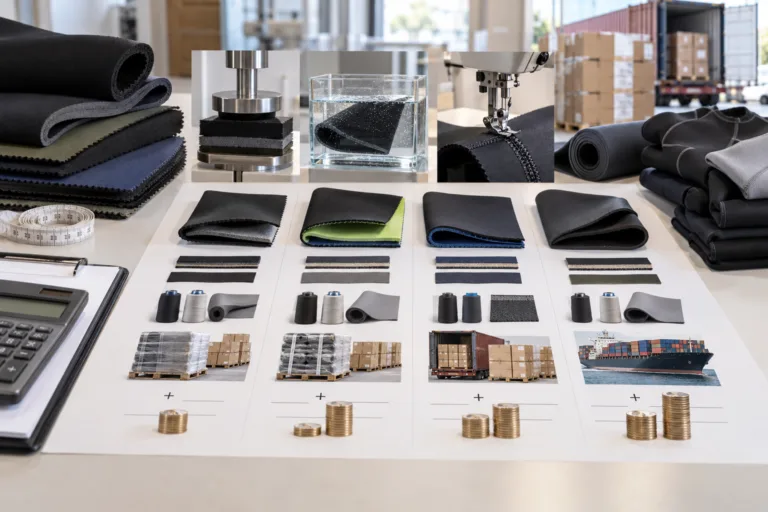
A swatch can show color, surface appearance, and limited hand feel, but it cannot by itself establish full-roll consistency, finished-garment behavior, bonding durability, care response, or production reliability. Effective neoprene fabric supplier evaluation therefore combines a defined specification, construction details, traceable samples, comparable commercial information, and evidence that addresses the risks of the intended product. Apparel Wiki is an independent educational publication; its editorial work is separate from manufacturing or supply services, as explained on its Sponsor page.
“Neoprene fabric” is a commercial description, not necessarily a complete material specification. Depending on the product and market, it may refer to a layered construction involving face and backing fabrics, a foam or rubber layer, lamination, coating, or finishing. Buyers should evaluate what the supplier has documented, what they can verify themselves, and what remains an editorial recommendation or project decision.
What evidence should a neoprene fabric supplier provide beyond a swatch?
Ask each supplier for a written material description that corresponds to the exact sample being offered. The description should identify the face fabric, backing fabric, foam or rubber layer where applicable, lamination or bonding method, coating, finishing, nominal thickness or weight, total width, usable cutting width, and sample status. It should also state whether the sample represents a standard stock construction, a development sample, a production lot, or an approved alternative.
These details matter because two materials sold under the same product name can behave differently when their layers, structures, finishes, or measurement conditions differ. A swatch does not show whether the same construction will be reproduced across a full roll or later lot. It also cannot establish how the material will respond to cutting, stitching, pressing, bonding, washing, drying, flexing, or the specific pattern and finishing methods used in the garment.
- Construction evidence: layer sequence, fabric structures, polymer or fiber information where supplied, lamination, coating, and finishing.
- Commercial evidence: unit basis, width information, quantity basis, packaging assumptions, and clearly identified alternatives.
- Traceability: sample reference, color reference, lot or roll information, date, and the related technical document.
- Performance evidence: relevant test reports that identify the tested construction, specimen, method, conditions, and result.
Treat supplier statements as supplier-provided information until they are checked against the sample, technical documents, or qualified testing. A report can support a claim about the tested specimen, but it does not automatically prove every color, roll, layer combination, or finished garment will perform identically.
Which neoprene fabric specifications should be fixed before suppliers are compared?
Before requesting comparable quotations, create one RFQ and sample brief for all suppliers. Start with the intended product and end use, including relevant contact conditions, expected stretch or recovery behavior, color, surface finish, care expectations, and any construction or appearance constraints. The required criteria should be separated from optional descriptive information so that suppliers do not quietly replace a requested construction with a different material.
Keep the information layers distinct. Fiber or polymer content, fabric structure, foam or backing construction, lamination method, finishing, and commercial product name are not interchangeable descriptions. A name may help identify a product family, but it should not replace the construction information needed for a sourcing decision.
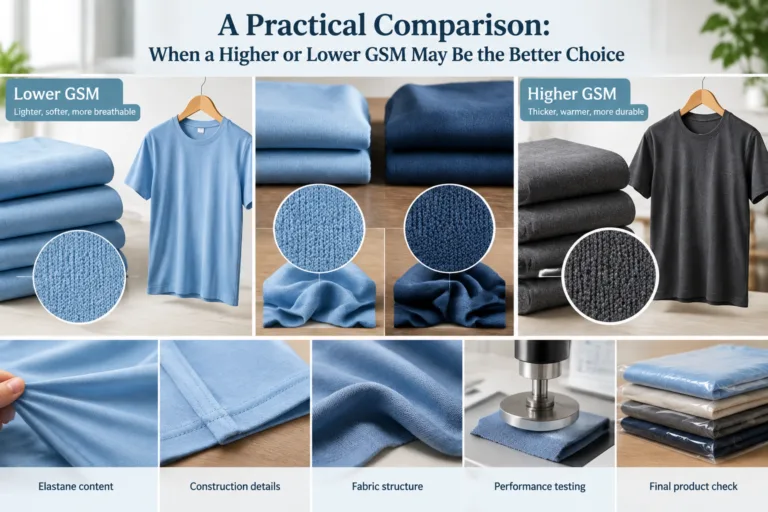
For each supplied value, request the measurement condition and method where relevant. This is especially important for GSM, thickness, width, stretch, recovery, and color assessment. GSM means mass per unit area; it does not by itself prove thickness, quality, durability, or suitability for a finished product. Similarly, total width and usable cutting width may differ because of edges, defects, or construction limits, so they should be reported separately.
A buyer-ready brief can ask for:
- Intended garment or product, use conditions, and care expectations.
- Required color reference, surface appearance, finish, and backing appearance.
- Requested construction, including layers, bonding, coating, and finishing.
- Target or required thickness, GSM, total width, and usable cutting width, with measurement conditions.
- Expected stretch and recovery behavior where those properties affect fit or function.
- Sample identity, color or lot reference, available technical documents, and proposed alternatives.
Do not present one universal GSM, thickness, width, or stretch value as correct for every neoprene fabric application. Acceptance criteria should come from the project’s technical requirements and intended use. Suppliers should list any alternative construction separately, with the differences clearly stated.
How should you compare neoprene supplier samples and test evidence?
Use the same brief for every supplier and request equivalent sample sizes, color references, construction descriptions, and traceability information. Record the supplier’s wording alongside your own observations. This separates documented facts from buyer verification and prevents a polished sample presentation from being mistaken for complete technical evidence.
Begin with a controlled visual and handling review. Check face and backing appearance, surface defects, edge condition, unevenness, odor where it is relevant to the intended product, and visible signs of delamination or inconsistent bonding. Note how the material folds, stretches, recovers, cuts, and handles during the operations the garment will actually require.
Then select testing according to project risk. Depending on the product, relevant questions may concern dimensional change, stretch and recovery, seam or bonding behavior, layer adhesion, abrasion, colorfastness, or care response. The objective is not to order an exhaustive laboratory program for every project. It is to test the properties most likely to affect fit, appearance, durability, safety, or customer use.
Compare samples after representative handling, cutting, stitching, pressing, bonding, washing, drying, or flexing steps when those operations are part of production or care. A layered material can behave differently at seams, folds, bonded areas, and washed edges than it does as an untouched swatch. When supplier evidence is incomplete or a failure would be costly, independent or otherwise qualified testing may be proportionate.
For each sample, record the identity, construction description, test condition, method, result, acceptance decision, and unresolved questions. A test report should identify the specimen and conditions well enough for the result to be interpreted. It supports a decision about that tested sample and method; it does not automatically establish full production performance.
Which supplier questions reveal production and quality-control risk?
Ask how the supplier identifies lots, controls color and construction variation, retains an approved standard, handles defects, and communicates deviations. Request information about preproduction approval, bulk submission, inspection, nonconformance handling, and replacement or corrective action. The purpose is to understand how the approved material would be controlled, not to assume that a written answer proves future consistency.
Clarify whether each test result represents the quoted construction and lot, a different production lot, or a substitute material. Ask how changes to the face fabric, backing, foam, adhesive, finish, or process will be disclosed and approved. A change that appears minor in a product name may alter hand, weight, bonding, recovery, care response, seam behavior, or fit.
Evaluate the completeness and consistency of the response. Clear sample references, matching documents, and direct answers to technical questions are useful evidence of sourcing discipline. Vague, conflicting, or incomplete information is a risk signal, although it does not by itself prove poor quality. Supplier claims about factories, equipment, capacity, minimum quantities, prices, or lead times should not be treated as established facts without direct verification.
How can neoprene fabric quotations be compared on true delivered cost?
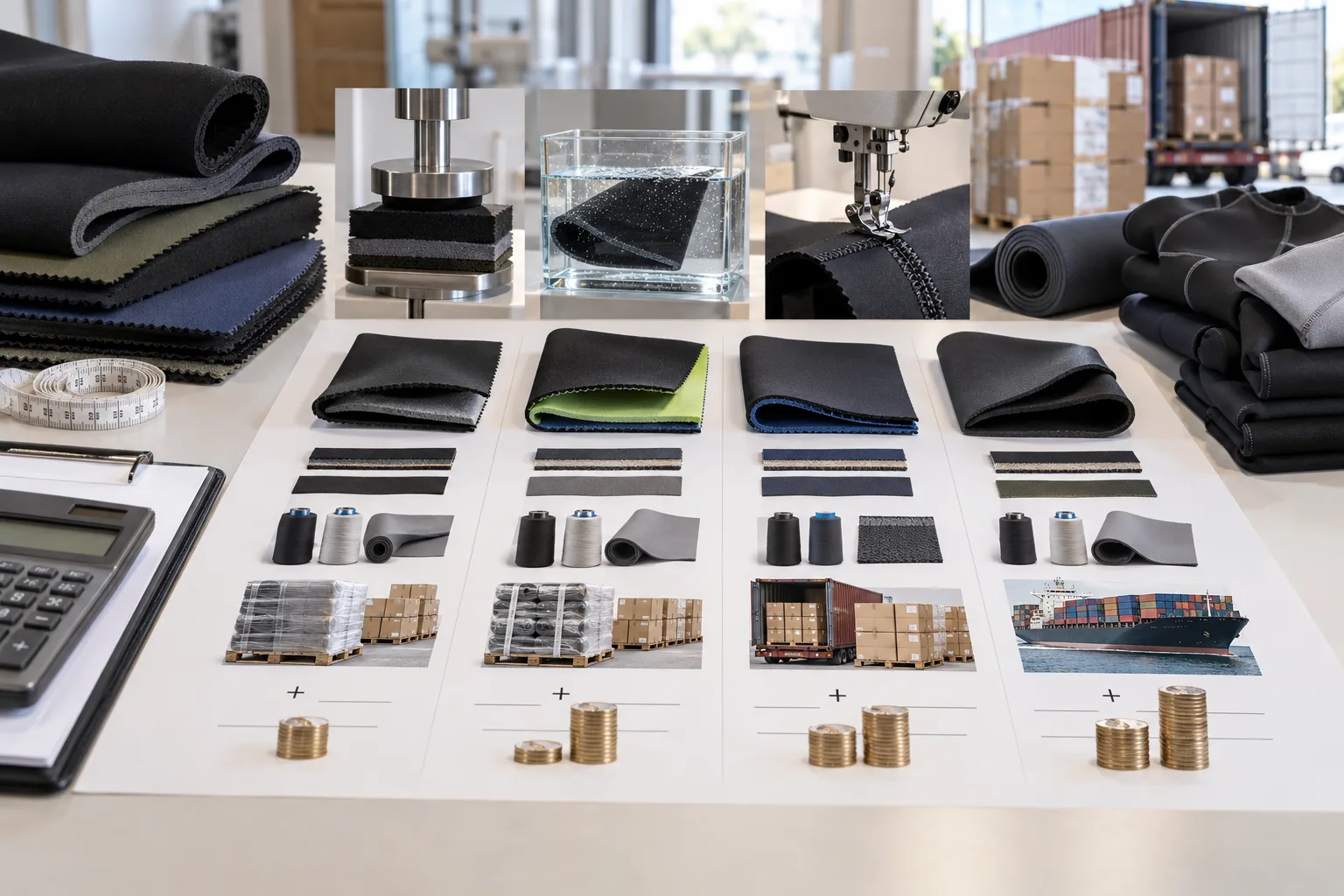
Send every supplier the same RFQ and sample brief before comparing prices. The request should identify the required construction, intended use, sample requirements, quantity basis, packaging expectations, inspection needs, delivery terms, and requested documentation. A quotation for a different face fabric, backing, foam, finish, or substitute material is not a like-for-like quotation, even when the seller uses the same general product name.
Normalize the unit basis first. Confirm whether each offer is priced by kilogram, linear meter, yard, or another unit, and record the stated width and measurement condition. Total width and usable cutting width should appear as separate fields because yield depends on what can actually be placed and cut. GSM can help connect mass and area, but it does not independently establish thickness, quality, durability, or suitability for the finished product.
Record what is included and excluded: defects or usable yield, sample charges, testing, packaging, freight, duties, taxes, currency assumptions, and any other commercial condition stated in the quotation. Do not fill missing values with market assumptions. A simple comparison matrix can include specification match, evidence completeness, unit basis, usable width, included costs, commercial risk, and open actions.
The cheapest quoted unit price is therefore not automatically the lowest project cost. A lower figure may relate to a narrower usable width, a different construction, incomplete documentation, or costs that appear later in the buying process. Keep supplier-provided prices separate from editorial guidance, and ask each supplier to identify proposed alternatives rather than silently pricing them as equivalent.
How should a buyer approve, substitute, or reject a neoprene fabric supplier?
Use project-specific outcomes such as pass, conditional approval, and reject. A pass means the documented construction, identified sample, commercial terms, and required evidence meet the buyer’s criteria. Conditional approval can be appropriate when the material appears suitable but a defined evidence gap remains. Rejection should identify the unmet requirement or unresolved risk rather than relying only on a general impression of supplier quality.
Approve the exact construction and sample identity, not simply the words “neoprene fabric” or a claim of matching composition. A substitute may alter color, weight, hand, stretch, recovery, bonding, seam behavior, care response, or fit. Require the supplier to disclose changes to the face fabric, backing, foam, adhesive, finish, or processing route, and review the replacement against the original brief before production use.
Material approval also needs garment-level context. Pattern geometry, seam construction, stitching, bonding, pressing, finishing, and care instructions can change how a material behaves in the actual product. Fabric evidence alone cannot prove finished-garment appearance, fit, durability, or care performance. For higher-risk products, a pilot garment, independent testing, or production inspection may be proportionate to the consequences of failure.
Set recheck triggers in the approval record. These may include a changed lot, construction change, failed or inconsistent test, customer complaint, visible deviation from the approved sample, or a supplier-proposed replacement. This framework is an Apparel Wiki editorial recommendation, not a universal legal or industry requirement. The acceptance criteria should remain tied to the product brief and target market.
What are the limits of supplier evidence and swatch-based evaluation?
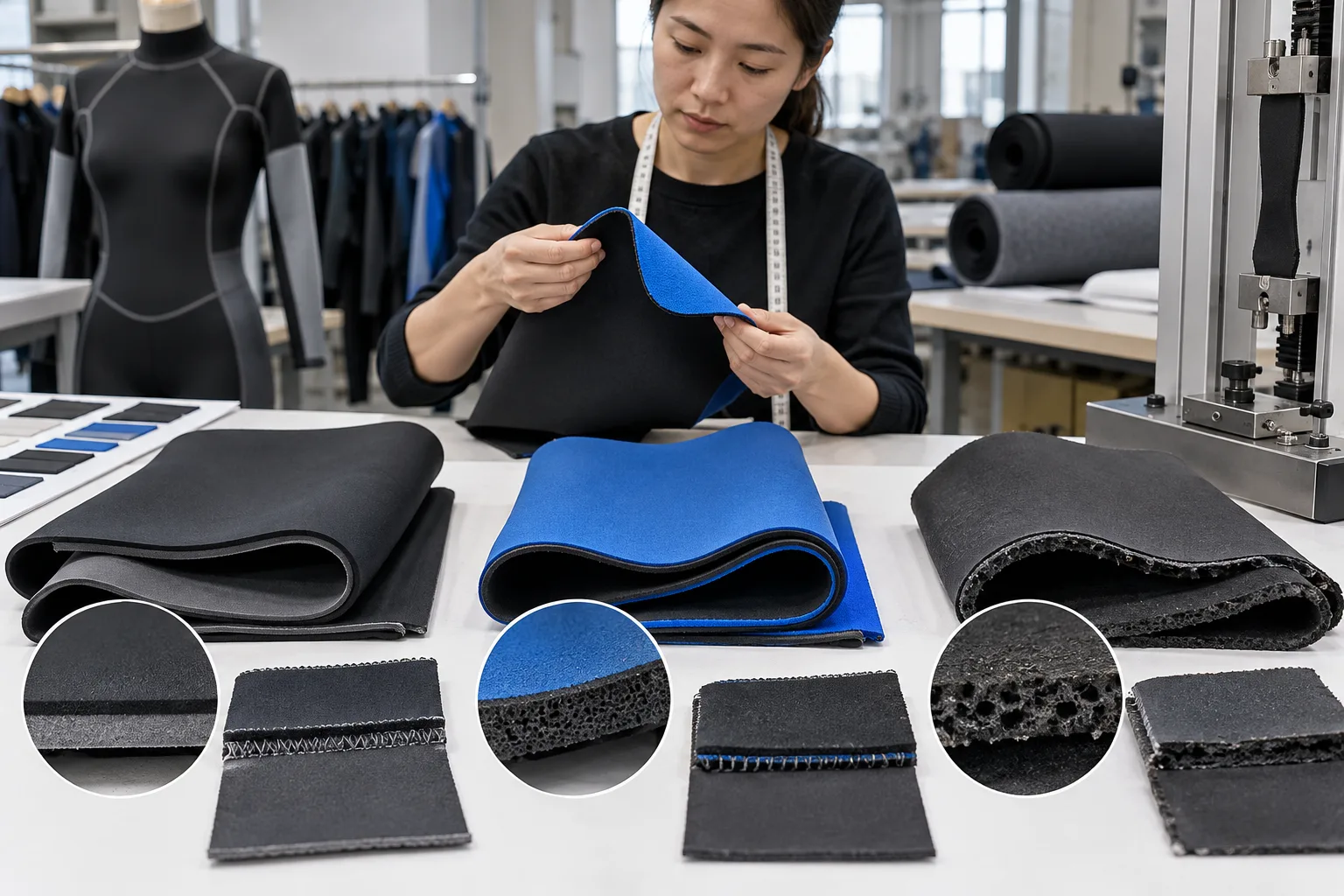
A swatch is useful for an initial review of appearance, hand, surface condition, and visible construction, but it represents only the submitted piece. It cannot establish the behavior of every roll, color, layer combination, production condition, or finished-garment operation. The same caution applies when a commercial name covers multiple constructions.
A laboratory report is also bounded by its specimen, construction, method, conditioning, and reported result. It supports a conclusion about what was tested under the stated conditions; it does not automatically prove that every production roll will perform identically. Before relying on a report, check the sample identity, lot or roll reference, test method, conditioning information, result, and relationship to the quoted material.
A supplier questionnaire can reveal missing information and show how clearly a company communicates, but it cannot independently verify every production, quality, or compliance statement. Treat supplier claims as supplier-provided information until checked against appropriate records or qualified testing. Vague or conflicting answers are risk signals, although they do not by themselves prove poor quality.
Use proportionate verification. A lower-risk project may need documented specifications, comparable samples, and targeted checks. A product with demanding fit, bonding, care, or appearance requirements may justify a pilot run, independent testing, or production inspection. The practical sequence is to define, request, compare, test, approve, and monitor, while recording what remains unknown at each decision.
For a disciplined neoprene fabric sourcing process, keep one record linking the RFQ, sample identity, quotation, test evidence, approval decision, and later changes. This makes supplier evaluation easier to revisit when a material is reordered or a substitute is proposed.
Frequently asked questions
What should I ask a neoprene fabric supplier besides requesting a swatch?
Ask for the construction, composition, width, usable width, weight or GSM, thickness where relevant, finish, sample identity, lot traceability, quotation basis, test evidence, and change-control process. Request that alternatives be listed separately from the requested material.
Can GSM alone tell me whether neoprene fabric is suitable for a garment?
No. GSM measures mass per unit area, but it does not by itself prove thickness, quality, stretch, recovery, bonding, durability, care response, or finished-garment suitability. Interpret it with construction details and relevant testing.
How do I compare neoprene fabric samples from different suppliers fairly?
Use the same written brief, equivalent sample information, comparable color references, and traceability requirements. Compare construction, width, surface condition, handling, and end-use processing under consistent conditions, then record results in one matrix.
Which neoprene fabric tests are relevant before bulk approval?
Choose tests according to project risk. Depending on the product, relevant checks may include dimensional change, stretch and recovery, layer adhesion, seam or bonding behavior, abrasion, colorfastness, or care response. The method and acceptance criteria should be defined for the project.
How should I control a supplier’s proposed neoprene fabric substitute?
Require disclosure of the substitute’s construction and sample identity, then compare it with the approved material. Reassess any property that could affect color, weight, hand, stretch, recovery, bonding, seams, care, fit, or appearance before approval.
Does a supplier test report prove that every production roll will perform the same way?
No. A report applies to the tested specimen, method, conditioning, and stated construction. Use lot traceability and proportionate verification to determine whether later production remains consistent with the approved sample.