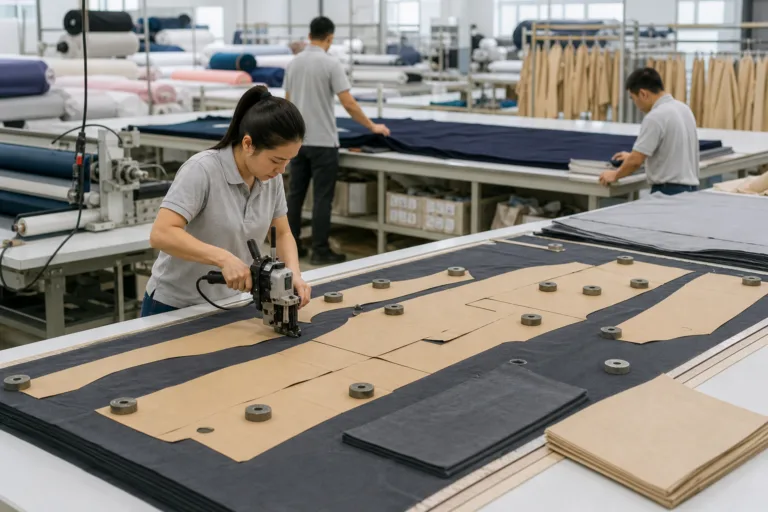
Yes, you can move into a cutting room manager role from another apparel job, but the transition depends on the work you can demonstrate rather than your current title alone. A cutting room manager coordinates the people, information, materials, workflow, and quality controls involved in preparing fabric and cut components for sewing. Because responsibilities differ between factories and production systems, build your case around decisions, deliverables, and reliable handoffs. Apparel Wiki is an independent apparel knowledge blog; it is not a factory, recruiter, testing laboratory, or service provider. You can learn more about its editorial independence on the Sponsor page.
What Does a Cutting Room Manager Do, and Can You Move Into the Role From Another Apparel Job?
In practical terms, an apparel cutting room manager helps turn approved product information and fabric into correctly identified, controlled cut components that can move into sewing. The role may include coordinating staff, checking that the correct materials and versions are being used, organizing work priorities, reviewing cutting-room quality issues, and communicating with pattern, technical, planning, sewing, quality, and warehouse teams.
That description is deliberately broad. One employer may emphasize floor supervision and daily output, while another may expect stronger involvement in planning, marker review, material control, quality escalation, or production reporting. A small operation may combine several of these responsibilities in one position. The title therefore does not provide a universal job description, and it should not be used to assume a particular salary, qualification, authority level, or team structure.
The cutting room manager career path can begin from production coordination, pattern making, garment technology, quality, sourcing, merchandising, or related technical work. A person who understands how specifications move through a product process may already have useful experience, even without having held a cutting-room title. The important question is whether that experience shows control of information, materials, decisions, and risks at a scale relevant to the opening.
For example, a production coordinator may have evidence of sequencing work and resolving unclear instructions. A pattern maker may understand component relationships, marker information, and the consequences of version changes. A quality professional may bring inspection discipline and corrective-action experience. Someone in sourcing or merchandising may understand material identity, approvals, timing, and cross-team follow-up. These are possible transition routes, not fixed equivalencies or hiring rules.
One industry career guide from Fashion Textiles New Zealand describes progression from table hand or trainee cutter toward Cutting Room Manager or Head Cutter, while also noting that skills may be learned on the job. That is useful evidence that formal title progression is not the only route, but it reflects one industry body’s guidance rather than a universal requirement for every employer or region.
Map Your Related Apparel Experience to Cutting Room Responsibilities
Start by translating your previous work into cutting-room deliverables. A job title tells an employer where you worked; a clear example shows what you controlled, what decision you made, who depended on it, and how you checked the result. The strongest transferable skills for a cutting room manager are usually demonstrated through resolved problems, controlled versions, reduced ambiguity, documented decisions, and dependable handoffs.
| Previous responsibility | Related cutting-room task | Evidence available | Capability still to develop |
|---|---|---|---|
| Production coordination | Organizing workflow, priorities, and cross-team handoffs | Schedules, escalation records, clarified instructions, completed handoffs | Direct understanding of cutting-room sequencing and floor constraints |
| Pattern making or garment technology | Checking component relationships, versions, and marker information | Revision history, specification reviews, resolved fit or component issues | Practical exposure to spreading, cutting, numbering, and bundling |
| Quality control | Inspecting cut parts, investigating causes, and coordinating corrective action | Inspection records, investigation notes, verified follow-up | People leadership and real-time production prioritization |
| Sourcing or merchandising | Tracking material identity, approvals, quantities, and timing | Material records, approval trails, supplier communication, issue resolution | Hands-on knowledge of cutting equipment and floor controls |
Use the table as a self-assessment, not as a promise that one background automatically qualifies you. The strength of a transferable skill depends on the scale, complexity, and ownership of your previous work. Coordinating a small sample process is useful evidence, but it may not prove readiness to manage a larger production operation without additional supervised exposure.
Software familiarity can support the transition, especially when the work involves patterns, markers, production records, or material information. It does not, by itself, demonstrate operational judgment. A stronger example explains how you identified the correct version, confirmed the relevant input, communicated the decision, and checked that the next team could act without ambiguity.
Close the Skill Gaps: Fabric, Markers, Cutting Quality, and Production Control
Before claiming readiness for management responsibility, develop an overview of the technical controls that connect fabric to cut components. These may include fabric behavior, relaxation and spreading considerations, shade or lot control, lay planning, marker information, cutting sequence, numbering, bundling, and panel identification. The correct procedure can vary with the fabric, equipment, factory layout, customer requirement, and production system.
You do not need to treat every process as identical across apparel businesses. Instead, learn what information must be confirmed before work starts, which records identify the material and version, how cut components remain traceable, and how exceptions are communicated. Ask how the cutting room works with pattern, technical, sewing, quality, planning, and warehouse teams. This builds operational understanding without assuming that one factory’s documents or terminology apply everywhere.
Errors in specifications, versions, quantities, material identity, or component identification can create downstream confusion. Sewing teams may receive parts that do not match the approved information, quality teams may need to investigate an unclear source, and planning may have to respond to missing or reworked components. The consequence depends on the product and process, so avoid claiming universal defect rates, savings, tolerances, or financial impact.
Technical competence is only one part of the role. Management readiness also involves assigning work, recognizing when information is incomplete, escalating a risk, maintaining records, supporting operators, and communicating a decision clearly. A person may operate software or understand a cutting machine yet still need development in planning, people management, or cross-functional control.
Build these skills through supervised production exposure, documented practice, and review of real cases where confidentiality permits. Simulated exercises can also help, but label them clearly as simulated. Review how a material discrepancy, version change, panel-identification problem, or quality concern would be recorded and verified. Treat testing methods, quality limits, and tolerances as project-specific unless the relevant employer or technical source defines them.
Build a Work Portfolio That Proves You Can Manage Cutting-Room Decisions
A formal portfolio is not required for every application, but a concise set of work cases can make a career transition easier to evaluate. Each case should explain the problem, inputs, decision process, verification method, result, and follow-up. A final image or a job title alone cannot show whether you understood the risk or coordinated the people and information needed to resolve it.
Useful case topics include a controlled handoff, a material or version discrepancy, a quality issue investigated, a workflow risk identified, or an unclear cross-team instruction clarified. State your role precisely. Explain whether you made the decision, supported it, gathered information, or verified the outcome. Include measurable results only when they come from your documented work; do not create productivity, fabric-saving, defect-reduction, or throughput figures.
- Describe the original problem and the information available at the time.
- Identify the decision, people involved, and controls used.
- Show how the result was checked rather than merely asserting that it worked.
- Record follow-up actions, remaining risks, or lessons for the next handoff.
- Anonymize customer, supplier, factory, style, pattern, and production information.
- Label academic or simulated projects as simulated and never present them as client work.
Protect confidential information through permission and careful anonymization. You can describe the decision structure without revealing proprietary patterns, customer data, factory records, or commercially sensitive details. This evidence-based approach helps an employer assess your judgment while keeping the focus on transferable cutting-room management experience rather than on unsupported claims.
Learn the Cutting Room Workflow Before Taking Full Manager Responsibility
Before taking full responsibility, learn how work moves through the cutting room and how its decisions connect to the rest of production. The exact sequence and records vary by factory, but a useful starting point is to follow one order from its initial information through to the handoff of cut components.
- Trace the order and instructions. Find out which approved order details, patterns, specifications, and schedule information teams use, and how changes are communicated.
- Follow materials and versions. Observe how fabric lots and relevant documents are identified, checked, and kept aligned with the work being prepared.
- Understand planning and approvals. Ask who confirms the lay plan, marker information, quantities, and any customer- or factory-specific requirements.
- Observe spreading and cutting controls. Learn what checks apply to the materials, equipment, and process in that workplace. Do not assume one factory’s method or limits apply elsewhere.
- Follow numbering, bundling, and handoff. See how cut components are identified and transferred so downstream teams can distinguish the parts and instructions they need.
- Review exceptions. With appropriate access, study how the team records rework, discrepancies, quality concerns, and issues requiring escalation.
Ask for supervised exposure to the functions that exchange information with cutting: pattern or garment technology, planning, sewing, quality, and the warehouse. The goal is to understand what each handoff needs and where an unclear instruction, outdated version, or missing identification could disrupt the next step. Keep notes on recurring information gaps, unclear ownership, and decisions that need a manager’s approval.
Choose a learning route that fits the gap you have identified. Shadowing can help you see the whole process; a floor assignment can build practical familiarity; a supervisor-level responsibility or internal project can test coordination and follow-through. Formal training may help with specific knowledge, but its relevance depends on the role and workplace. Check any training or safety requirements with the employer and the applicable local rules; no single route guarantees promotion.

Prepare for the Promotion or Job Search: Show Management Readiness
Describe your experience through scope and decisions, not a broad claim such as “managed the cutting room.” Explain what work you were responsible for, which people or teams you coordinated with, what information or controls you maintained, what decision you made, and how the result was checked. Use outcomes only when they are supported by your records and accurately represent your contribution.
Prepare examples that show how you handle the situations the role may involve: competing priorities, a material or version discrepancy, a quality concern, a specification change, or an operator needing clear support. Explain how you established the facts, communicated with the relevant teams, followed the workplace’s approval process, and escalated issues outside your authority. Be clear about what you decided yourself and what you referred to someone else.
Before accepting an opening, clarify what the title means in that organization. Ask who the role reports to, which teams and processes it covers, what decisions the manager can make, and who owns quality and documentation. Find out which equipment and records are in scope and how the team handles changing priorities during busy periods. These questions help you compare the advertised title with the work you will actually be expected to deliver.
Job descriptions can help you understand the language employers currently use, but requirements differ across regions and change over time. Compare several current openings relevant to your location, then verify important details directly with the employer. Apparel Wiki is an independent educational publication, not a recruiter or training provider; application guidance here is practical advice, not a promise of selection or advancement.

How to Judge Your Readiness and Choose the Next Step
Use this readiness check as an editorial decision aid, not a formal qualification or universal competency standard. Consider whether you can explain the local workflow; track material, components, and document versions; recognize when quality or identification needs review; communicate changes across teams; support people doing the work; and escalate decisions beyond your authority. Look for examples of completed work and feedback that support each area, rather than relying on confidence or software familiarity alone.
- Ready to apply: You can discuss relevant technical and coordination experience, explain your decisions, and provide credible evidence of follow-through.
- Ready with a supervised transition: Your related experience is strong, but you need support with specific cutting-room processes or manager-level decisions.
- Needs more exposure: Important parts of the workflow, quality control, or cross-team handoff remain unfamiliar. Seek a focused assignment or supervised opportunity to build evidence.
Choose the smallest next responsibility that gives you useful practice without asking you to claim expertise you have not yet developed. Agree on what you will own, what needs approval, and how your work will be reviewed. Revisit the assessment after gaining experience and feedback; a credible cutting room manager career path is built through demonstrated judgment and growing responsibility, not a title alone.
For a practical next step, review current openings alongside your organization’s workflow, then identify one responsibility or handoff you can learn under supervision. Record what you observe, what decisions you can support, and what remains outside your authority.
Frequently Asked Questions
Can I become a cutting room manager without starting as a cutter?
Possibly. Related experience in production, pattern making, garment technology, quality, sourcing, or merchandising can transfer, but you will still need to demonstrate relevant cutting-room knowledge and judgment. One apparel industry organization describes on-the-job progression from table hand or trainee cutter to cutting room manager; that example does not establish a universal route.
Which apparel jobs provide the strongest experience for a cutting room manager career path?
The most relevant experience depends on the employer’s role. Production can develop workflow coordination, pattern work can build familiarity with markers and components, quality can strengthen investigation and corrective action, and sourcing or merchandising can develop material and schedule coordination. Assess the actual responsibilities you have handled, not just your job title.
What skills should I demonstrate before applying for a cutting room manager role?
Show that you can understand the workflow, control information and versions, track materials and components, recognize quality concerns, communicate across teams, support operators, and escalate appropriately. Use specific, honest examples of your decisions and follow-through.
Do I need a degree, certificate, or specific software experience to become a cutting room manager?
Requirements vary by employer, location, and role scope. The information available here does not establish a universal degree, certificate, or software requirement. Check current job descriptions and ask employers which qualifications and systems matter for the position.
How can I prove cutting-room management ability if my previous job had a different title?
Explain relevant responsibilities through concrete examples: the problem, information available, your role and decisions, how you verified the outcome, and any follow-up. Use documented results when available, protect confidential information, and label simulated work clearly.
What should I ask an employer before accepting a cutting room manager position?
Ask about reporting lines, team and process scope, decision authority, equipment, documentation, quality ownership, and how priorities are managed. Clarify what outcomes the employer expects and which decisions require approval so you can judge the real role behind the title.