Yes, care and repeated use can affect abrasion resistant workwear, but the significance of any change depends on the garment construction, care process, exposure, and performance being evaluated. Laundering, rubbing, flexing, contamination, stretching, and surface changes can affect fibers, yarns, fabrics, coatings where present, seams, and fit. Apparel Wiki’s independent editorial position is described on its Sponsor page.
Abrasion resistance is a specific performance characteristic: it describes how a material or garment responds to a defined rubbing challenge under stated conditions. It does not guarantee unlimited durability during every task. An initial claim and performance after a recorded care or use history are different pieces of evidence. To compare care for abrasion resistant workwear, identify the work activity, care route, garment area, and evidence condition first.
Abrasion Resistant Workwear Care: What Changes With Use
A material that resists one abrasion challenge may still be vulnerable to other stresses. General durability can also involve tearing, tensile loading, snagging, seam strain, dimensional change, or damage to a closure. The label “abrasion resistant” therefore describes one relevant property, not the complete behavior of a work garment.
Care and use can create several pathways for change. Washing may involve water, detergent, agitation, heat, drying, ironing, and repeated dimensional movement. Work activity may add rubbing against a surface, repeated flexing at a joint, stretching over the body, contact with contaminants, or pressure at a tool or harness interface. These are variables to investigate; their direction and rate of effect should not be assumed without evidence for the particular material and conditions.
The fabric is only one part of the system. Panels, seam constructions, closures, reinforcements, trims, hems, fit, and localized contact points may respond differently from the main fabric. A fabric-level result does not automatically establish whole-garment performance. A favorable initial result also cannot be extended indefinitely to later use unless the care and wear history is known.
Before comparing abrasion resistance after washing or repeated wear, record what was tested and under which condition. A useful comparison connects the intended task with the relevant garment area, stated care route, and evidence type. Broad descriptions such as “high-tech fabric” are less useful than a defined performance claim matched to the work activity.
How Laundering and Care Processes Can Alter the Garment
Workwear laundry care should be treated as part of the performance history. Record the available care instruction and, when evaluating a change, note the water and detergent conditions, agitation, heat, drying, ironing, chemical exposure, and frequency. The exact settings are garment-dependent, so no universal wash recipe or cycle limit should be inferred from a general abrasion claim.
Care can affect more than the face fabric. Surface finishes may change, and a lamination or coating, where present, may require separate consideration. Seam areas, reinforcement zones, trims, and closures can experience different movement or heat exposure. Dimensional changes can also alter fit and contact geometry, which may change where rubbing occurs during work. These possibilities identify what to inspect; they do not prove that a particular process caused a particular result.
A manufacturer care instruction defines a permitted route for maintaining the garment. It is not, by itself, an independently verified durability result. Following the label does not establish how many cycles the garment will withstand, nor does it show that every component will retain the same performance. A supplier’s care specification and a controlled before-and-after evaluation answer related but different questions.
For a useful abrasion resistant fabric care comparison, preserve the garment label or technical care specification and record any deviation. Note unusual chemical exposure, drying conditions, visible finish changes, dimensional changes, or repairs. Compare garments or material samples only when the care history is sufficiently clear. If the underlying test condition is unavailable, describe the observed change without assigning it a universal cause or numerical rate.
Product teams can connect care instructions, construction details, and intended use when reviewing a claim. For example, a care route may be acceptable for the main fabric while still requiring inspection of a coated panel, seam, reinforcement, or trim. The relevant question is whether the garment retains the function required for its task under the stated conditions, not whether it matches an abstract promise of permanent durability.
Repeated Use: Contact Points, Motion, and Work Environment
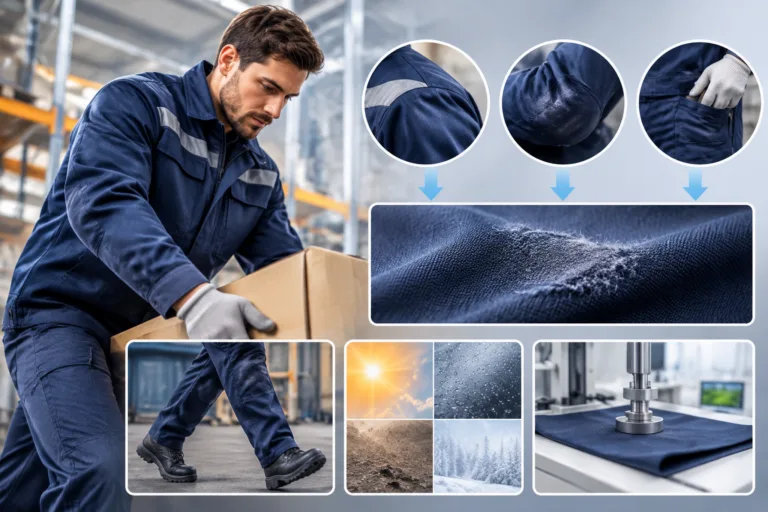
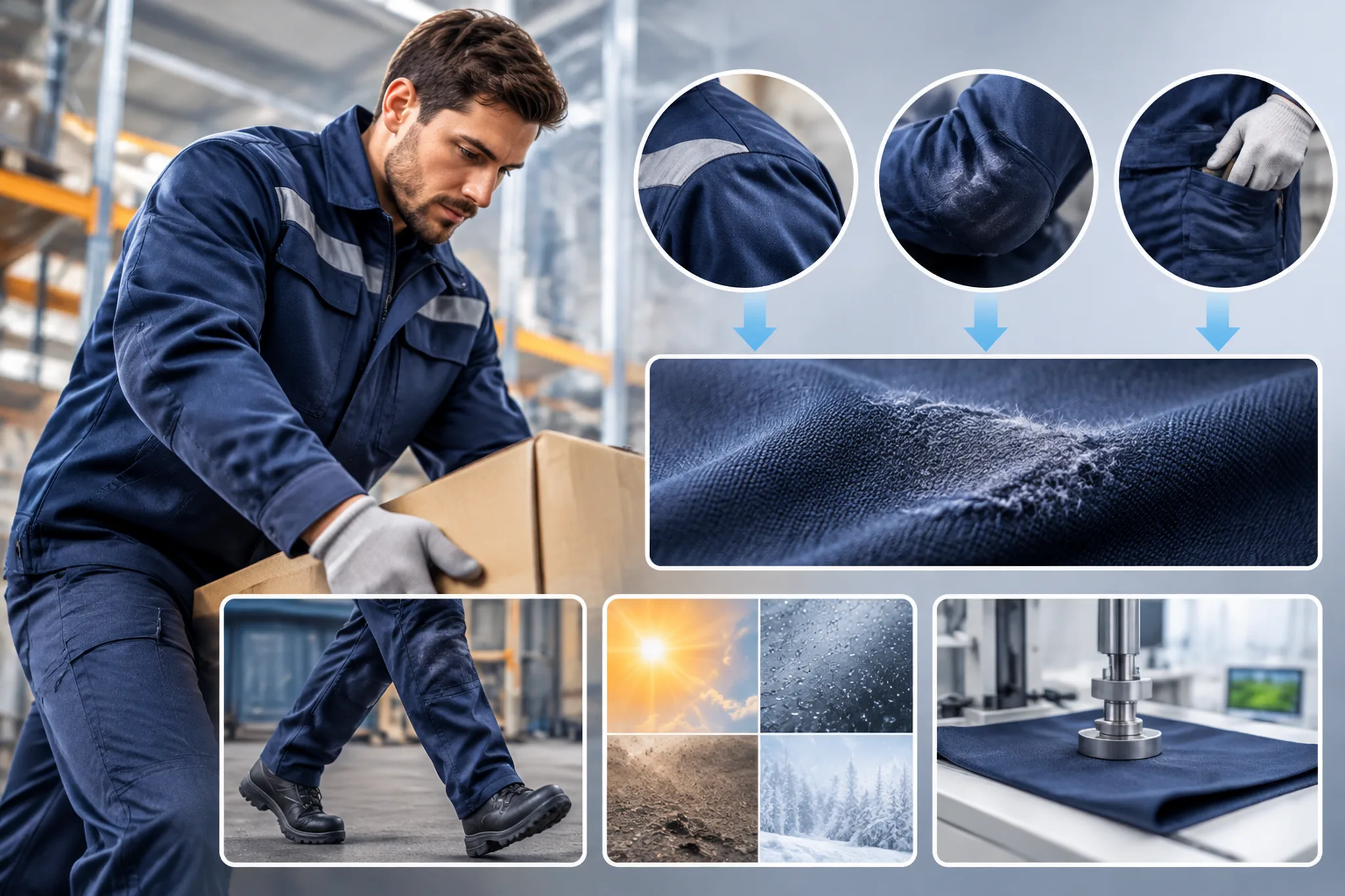
Repeated wear is not one exposure. Knees, elbows, seat areas, pocket edges, hems, harness interfaces, and tool contact points may experience different combinations of rubbing, flexing, pressure, and tension. One garment can therefore show localized wear while other areas remain in better condition. The visible location is an inspection clue, not proof of a single failure mechanism.
Separate the stressors before drawing a conclusion. Rubbing involves surface contact, while flexing repeatedly bends a construction. Tensile loading pulls the material, snagging can catch a component, and contamination may alter the contact or cleaning history. These factors can interact. Fit, seam placement, reinforcement layout, layering, tools, work surfaces, activity level, and environment can all change which area needs attention first.
| Observable input | Likely implication to investigate | Initial evaluation choice | Variable that could change the choice |
|---|---|---|---|
| High-contact zones | Localized surface wear or pressure-related change | Inspect the contact area, reinforcement, and surrounding seam | Contact geometry, fit, and work posture |
| Frequent laundering | Care history may be relevant to surface, dimensions, or trims | Compare recorded care conditions with the garment specification | Detergent, heat, agitation, drying, and deviations |
| Flex-heavy work | Repeated bending may concentrate strain at joints or seams | Inspect flex zones through the garment’s range of movement | Pattern shape, fit, layering, and activity level |
| Contamination | Residue may affect contact, cleaning, or the condition being reviewed | Record the contaminant and examine cleaning history | Contaminant type, duration, and removal process |
| Seam or trim concerns | The limiting issue may be construction rather than face fabric | Review seam, closure, hem, and reinforcement condition | Load direction, attachment detail, and repeated movement |
For a lightweight work knit used with frequent kneeling, examine the knee construction and care history rather than relying only on the fabric label. For a reinforced woven garment used around rough equipment, examine contact geometry and seam or trim condition. Either decision can change with fit, task, surface, contamination, or the way the garment is cleaned. This practical review supports abrasion resistant clothing durability decisions without promising a predictable lifespan.
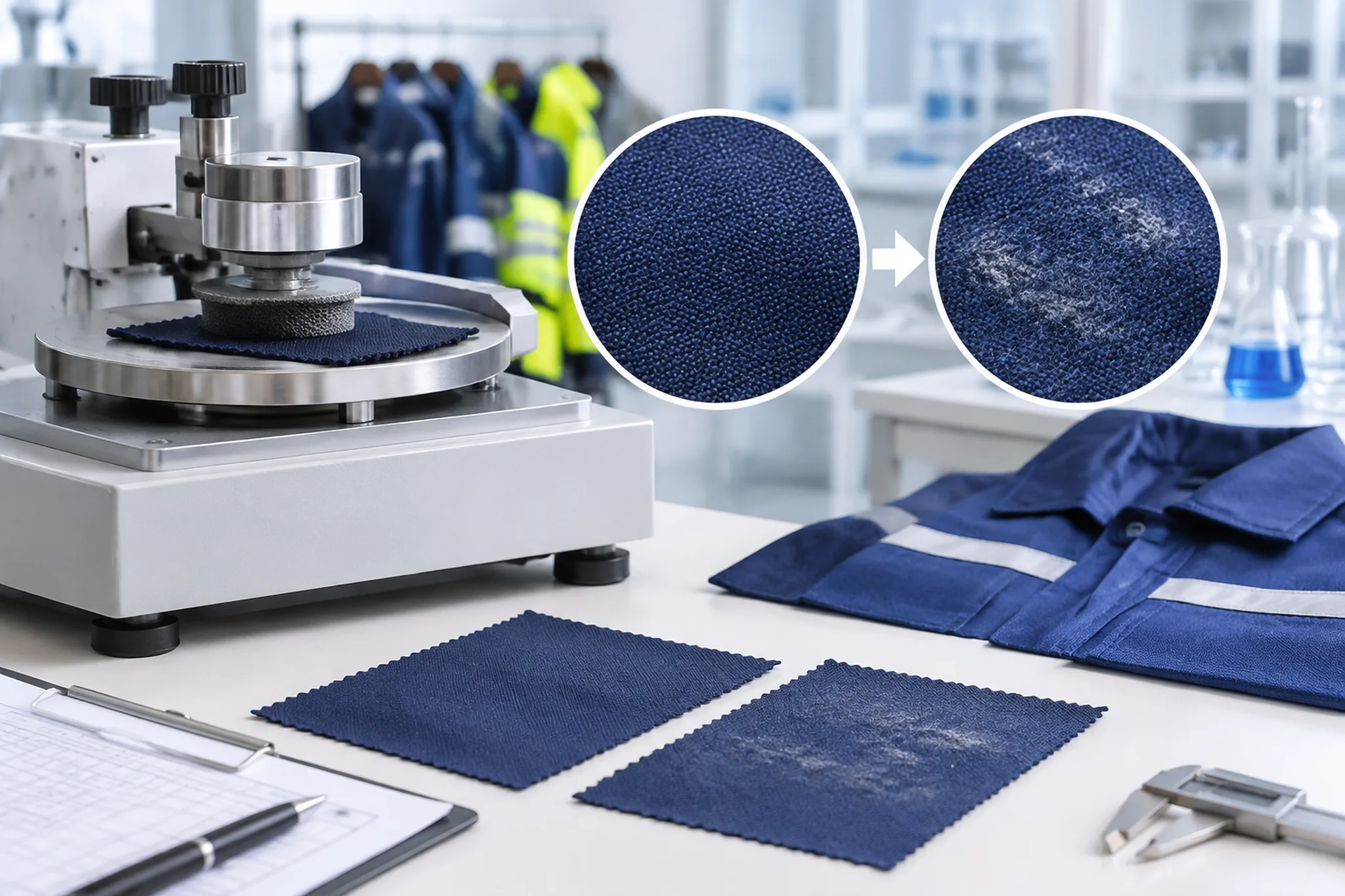
How to Evaluate Abrasion Performance Before and After Care
A useful comparison begins with a record, not with a conclusion. Identify the garment or material, the construction area being examined, the care history, the use exposure, and the condition under which the performance was assessed. Include relevant contamination or environmental context when it may affect interpretation.
Keep the comparison boundaries visible. A fabric or material result may describe a defined abrasion challenge under controlled conditions. An inspection of worn workwear answers a different question: where has the garment changed during actual use? A real-use trial adds information about movement, fit, contact surfaces, cleaning, and task conditions. These forms of evidence complement one another, but one should not be substituted for another.
For a before-and-after comparison, hold the comparison conditions as consistent as possible. The material or specimen type, preparation, construction area, endpoint, and reporting approach should remain identifiable. If those details change, an apparent difference may reflect the evaluation setup rather than care or wear. Avoid treating an unreported method as equivalent to a verified test method.
Record what was observed, including surface change, localized thinning, breakage, seam or closure condition, dimensional change, and functional limitations. Inspect the complete garment as well as any fabric sample. A favorable fabric-level result does not establish that a pocket edge, reinforcement, fastening area, or seam remains suitable for the intended task.
This is the practical meaning of test abrasion resistant workwear and evaluate workwear durability: describe the question, condition, evidence type, and limitation together. A result after repeated washing is meaningful only when the care history and comparison basis are also clear.
Interpreting Care Claims and Knowing What They Do Not Prove
Care and durability claims become easier to assess when their scope is made explicit. Start by asking five questions: what component was tested, which care or use condition applied, which method was used, what endpoint was reported, and what baseline or comparison was used? Also check whether the claim describes an initial result or a result after a stated care history.
- Component: Determine whether the evidence concerns a fabric, coating, panel, seam, trim, or complete garment.
- Condition: Look for the stated laundering, wear, contamination, storage, or environmental conditions.
- Endpoint: Identify what counted as a result, such as a specified visual or structural change, without assuming that it represents every kind of failure.
- Comparison: Check whether the result is compared with an untreated material, an earlier condition, another construction, or no baseline at all.
- Limitations: Note missing details, restricted applications, and any difference between the tested item and the garment being considered.
Abrasion resistance is only one performance characteristic. It should not be treated as a substitute for tear strength, tensile strength, seam performance, appearance retention, comfort, heat and moisture behavior, or other functional requirements. Claims involving flame resistance, visibility, medical use, or occupational protection require their own applicable evidence and should not be inferred from an abrasion-related result.
A garment may retain an abrasion-related property while another part becomes limiting. Fit can change, a closure can fail, a seam can loosen, or a reinforcement can behave differently from the surrounding fabric. Likewise, a favorable initial result does not establish indefinite performance during later use.
For product teams and buyers, the useful next step is to locate the underlying specification or report and compare its scope with the intended construction, care route, and work environment. A source is a verification entry point, not blanket support for every related claim. This approach keeps abrasion resistant workwear claims separate from broader promises about workwear durability specifications.
A Practical Care and Review Routine
Use a four-part routine: identify the task and exposure; follow and record the applicable care instructions; inspect or evaluate the garment areas that receive recurring contact; and document the conditions behind any conclusion. Compare specifications under matching conditions, or check that the applicable test method addresses the garment’s actual use. Care and repeated use can affect abrasion-related performance, but only condition-matched evidence shows how meaningful that change is for a particular garment and task.
Frequently Asked Questions
Can washing reduce the abrasion resistance of workwear?
It can be relevant to the garment’s later condition, but the direction and significance of any change depend on the material, construction, care process, and use history. A permitted care route is not itself proof of a particular service life or post-wash result.
Does an abrasion-resistant fabric make the whole garment abrasion resistant?
No. A fabric result does not automatically establish the performance of seams, closures, trims, reinforcements, fit, or contact areas. Whole-garment evaluation should consider the construction and the locations that receive repeated rubbing, flexing, loading, or snagging.
What care information should be recorded when comparing workwear durability?
Record the stated care route and any deviations, including water and detergent conditions, agitation, heat, drying, ironing, chemical exposure, and frequency. Also record the garment identity, construction area, use exposure, and the condition in which the comparison was made.
Why can workwear show localized wear even when the fabric has an abrasion-resistance claim?
Different areas experience different contact geometry, movement, loading, fit, and construction details. Knees, elbows, seat areas, pocket edges, hems, seams, closures, and tool or harness interfaces may therefore show different changes from the surrounding fabric.
Can an initial abrasion test predict how long workwear will last in use?
An initial result can describe performance under its stated evaluation conditions, but it does not by itself predict whole-garment service life. Later care, movement, contamination, fit, contact surfaces, and construction can change which component becomes limiting.