Research about South Asian chintz clothing becomes more reliable when each claim is matched to the source that can actually support it. Chintz may refer to a decorated cotton textile, while a garment, a surface finish, or a later collecting label may require separate verification. This distinction matters when a surviving object, image, written record, or trade document is used to explain origin, date, production, or use. Apparel Wiki is an independent educational publication; its Sponsor page is separate from editorial evaluation. The method here is simple: identify the exact claim, inspect the original record, preserve its qualifications, compare relevant evidence, and label the result as documented, inferred, or unresolved.
How to Evaluate South Asian Chintz Clothing Research Sources
Begin by defining the term used in the record. In textile-history writing, chintz commonly describes a cotton textile with colored decoration, often associated with painted or printed designs. That working definition does not make every decorated cotton from South Asia interchangeable. A catalogue may use “chintz” for the textile itself, for a garment made from it, or as a later classification applied by collectors or curators. The record’s wording and scope must decide which meaning applies.
A source can establish some facts more directly than others. A surviving textile can show what remains in a collection. A dated image can show how a garment or textile was represented at a particular time. A written record may document a name, transaction, description, or observation. A commercial or patent record may indicate an application, sale, or legal claim. Evidence of widespread use requires a broader record than one object or one image. These are separate milestones, not interchangeable proof of a single origin story.
For that reason, research should evaluate claims rather than announce one inventor, birthplace, or representative South Asian clothing tradition. A date may be approximate. An attribution may identify a likely place without proving manufacture there. A route may be documented without showing that the textile was common among all communities who later wore similar clothing.
Use a short claim-and-source test:
- State the precise claim, such as “this object is attributed to a particular place and period.”
- Open the original catalogue, image record, archival document, or scholarly discussion.
- Record the source’s date, provenance, wording, and evidence type.
- Compare an independent relevant record where feasible.
- Label the conclusion as documented, inferred, or unresolved.
This also separates a direct-source fact from an editorial interpretation. “The record identifies” reports the source. “This may suggest” marks a reasoned reading. An illustrative example can clarify a method, but it should not be presented as a verified historical event unless its own record supports that use.
What a Surviving Garment or Textile Record Can Establish
A museum or archive record is most useful when read as a set of distinct fields, not as one complete biography. Record the collection name, object or accession number, catalogue wording, stated date or date range, material, dimensions where relevant, provenance, ownership history, and conservation notes. Preserve qualifying language such as “circa,” “attributed to,” “possibly,” or “formerly identified as.” Removing those terms can make a cautious record appear certain.
| Record type | Observable input | Claim it may support | Limitation | Useful cross-check |
|---|---|---|---|---|
| Object record | Material, dimensions, construction, catalogue description | What survives and how the object is classified | May not establish original use or the date of every component | Full object record and related collection documentation |
| Technical or conservation record | Visible repairs, alterations, lining, treatment, or reported analysis | Condition and documented material or construction findings | Findings may apply only to sampled or examined parts | Technical report or authoritative conservation publication |
| Provenance record | Ownership, acquisition, transfer, and stated origin | How the object reached the collection | Later ownership does not prove original production or use | Acquisition files, earlier catalogues, or independent records |
| Exhibition interpretation | Curatorial caption, grouping, and historical framing | How the institution explains the object | Interpretation may be broader or more qualified than the object data | Object record and cited scholarship |
Material and construction details answer different questions. Fiber information concerns what the textile is made from. Printed or painted decoration concerns how its surface was produced. Garment construction may reveal cutting, assembly, lining, or later alteration. Repair evidence can distinguish an original component from a replacement. None of these details alone necessarily establishes the exact production location, original wearer, or date of every part.
Keep original context separate from later ownership, display, reconstruction, and restoration. A garment acquired by a collection may have a well-documented recent history while its earlier use remains uncertain. Likewise, a surviving object is evidence of what survived. It is not automatically evidence that the same style was widespread or typical.
Use a specific object number and the institution’s full record rather than relying only on an introductory collection page. If a technical or conservation record is unavailable, describe only what the catalogue visibly states. Do not convert an absence of detail into proof that a material, dye, pigment, repair, or attribution was never examined.
Reading Images, Written Records, and Trade Evidence Together
Images can help with historical fashion research, but first separate what is visibly shown from what the record claims. Note the image date, location, medium, provenance, caption, sitter or wearer identification, and purpose. A portrait, documentary photograph, commercial image, performance image, and later reconstruction each create different interpretive conditions. A patterned surface may be visible without proving its fiber, production method, or precise textile category.
Captions and later curatorial descriptions may identify a person, place, garment, or community, but those identifications need to be traced to the original museum, archive, or library record. The date of the depicted garment is also separate from the date of a modern photograph or digitized scan. Digitization and reuse rights are separate questions from historical meaning, so link to the original holding institution and check its current permissions.
Written and commercial records add another layer. Inventories, travel writing, advertisements, shipping documents, trade records, patents, and commercial catalogues may document a name, transaction, circulation, or sale. They do not automatically prove how a garment looked, where its fabric was manufactured, or how frequently people wore it. A commercial reference may show availability without establishing everyday use.
Triangulation means comparing records without forcing them into agreement. Start with the object record, then compare image metadata and contemporary written evidence. State whether the sources corroborate one another, qualify one another, or remain in conflict. If an image identifies a garment but a technical record does not identify its fabric, retain both facts at their proper strength.
Social interpretation also needs evidence. Clothing may relate to labor, identity, gender, technology, trade, or regulation, but coincidence is not proof of causation. Connect those subjects only when the cited historical records support the relationship. This approach makes South Asian chintz clothing research more precise without pretending that one source can answer every question.
Common Assumptions That Need Qualification
Research becomes unreliable when a limited record is made to answer a much broader question. A surviving textile, image, or catalogue entry can be valuable without representing every garment made, worn, or traded in its period.
Assumption: the earliest surviving example was the first one made. Survival depends on what was preserved, collected, documented, and made available for study. The earliest item currently identified is evidence of an early surviving or known example. It does not automatically establish the beginning of production. Keep separate the earliest surviving object, the earliest known image, a documented commercial appearance, and evidence of widespread popularity.
Assumption: a label such as “South Asian” describes one uniform tradition. That label may cover a broad geographic or historical category in a collection record. It does not, by itself, identify one country, community, class, gender, period, or everyday practice. A social interpretation needs a more specific place, wearer, date range, and supporting record.
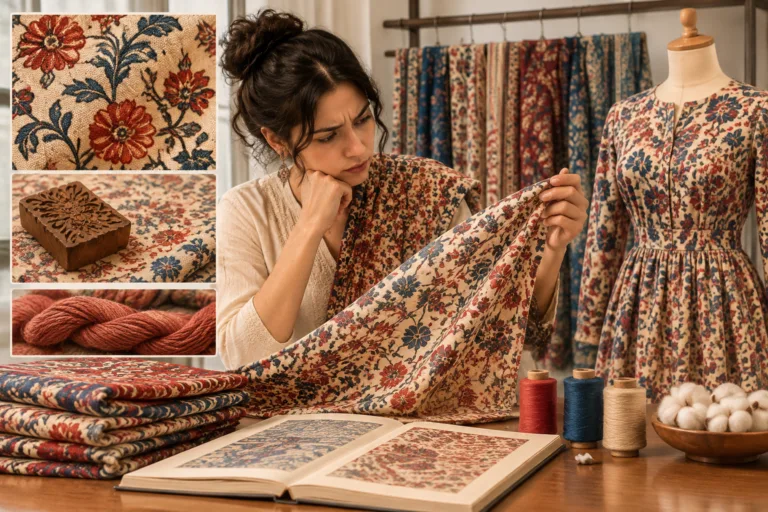
Assumption: a floral or ornamental appearance proves origin or technique. Visual resemblance can suggest a useful comparison, but it does not establish where a textile was made, how its decoration was applied, or what the pattern meant. Those conclusions require material, construction, technical, or contemporary documentary evidence. Appearance alone should remain an observation, not a provenance claim.
Assumption: every museum label is equally certain. An institution may identify an object’s location and collection history while qualifying its date, attribution, use, or restoration. Preserve wording such as “attributed to,” “circa,” and “possibly.” Useful conclusions can still be written: “the record identifies,” “the object is attributed to,” or “this may suggest.” When the available evidence does not establish a detail, state what additional record would be needed.

A Repeatable Research Workflow for Defensible Conclusions
Begin with a claim narrow enough to test. “What is the single origin of South Asian chintz clothing?” is too broad for one record. A question about an object’s approximate date, attributed place, documented wearer, or recorded use gives the evidence a defined task.
- Write the claim precisely. Identify the object, image, document, or group under discussion. Separate questions about material, making date, place, ownership, use, and popularity instead of combining them into one biography.
- Capture the original record. Record the institution or publication, stable record title, object or document identifier, access date, exact relevant wording, evidence type, and unresolved terms. Copy qualifications rather than silently converting them into facts.
- Match each source to its question. A holding institution is the appropriate starting point for object metadata. A technical or conservation record may address material findings. Archival documents can illuminate contemporary transactions, while scholarly work can provide broader historical interpretation. Source prestige does not make a record suitable for every claim.
- Compare relevant records. Where feasible, check a second independent record that addresses the same issue. Note whether the sources agree, qualify one another, contradict one another, or leave a gap. Do not average conflicting dates or create a precise range from incompatible descriptions.
- Separate record from inference. Draft one sentence for what is directly documented, another for the reasonable interpretation, and another for what remains uncertain. This keeps an editorial explanation from sounding like a catalogue fact.
- Identify the unresolved step. State what could change the conclusion: a fuller provenance record, a technical report, a dated image, a contemporary document, or other relevant evidence. Do not imply that an unavailable source has confirmed the claim.
A useful source log can therefore contain four layers: the original wording, the evidence type, the interpretation being considered, and the limitation that remains. This is especially important when a secondary summary compresses catalogue details, provenance, and social context into one sentence. Compare the specifications of the historical record itself, including catalogue wording, provenance, image metadata, and technical documentation, rather than treating a summary as complete.
When writing the final note, use a layered conclusion: “The record documents…” for a direct fact; “This may indicate…” for a supported interpretation; and “The available evidence does not establish…” for an unresolved point. That language is precise without making uncertainty useless.

Use the Evidence Before You Repeat the Story
South Asian chintz clothing research is strongest when the claim, source type, object context, and uncertainty match. Choose one garment or image, open its original record, log the evidence and qualifications, and compare it with one relevant independent source. Before sharing the result, ask what is documented, what is inferred, what is missing, and whether the wording would remain accurate if the disputed detail changed. Preserve the original catalogue language and source trail.
Frequently Asked Questions
What is the difference between a surviving chintz garment and evidence that chintz clothing was widely used?
A surviving garment proves that an example exists and may provide information about its materials, construction, date, or provenance. It does not show how common the style was. Claims about widespread use require broader evidence, such as multiple relevant records or documented social and commercial patterns.
How should I interpret an approximate date or attribution in a museum record?
Treat it as a qualified institutional assessment, not as an exact fact. Preserve terms such as “circa,” “attributed to,” or “possibly.” Separate the stated date from your interpretation and check whether the record explains the basis or limits of the attribution.
Can a historical image prove what fabric a South Asian garment was made from?
Usually, an image can show visible form, decoration, and context more reliably than fiber or production method. A caption may identify the sitter or garment, but that identification also needs evaluation. Use a technical or object record before treating fabric composition as established.
Why should a museum collection page be checked against the full object record?
An introductory collection page may summarize a group of objects and omit qualifications. The full record may provide the object number, material wording, date range, provenance, restoration notes, and attribution limits needed for a defensible claim.
How can I avoid treating one South Asian chintz garment as representative of an entire region?
Describe the specific object first: its recorded place, date, wearer or ownership history, and source limitations. Avoid extending those details to a country, community, class, gender, or period unless independent historical evidence supports that broader interpretation.
What should I record when comparing sources about a chintz clothing claim?
Record each source’s institution or publication, title, identifier, access date, exact wording, evidence type, and unresolved terms. Then note whether the sources agree, qualify, contradict, or leave the claim unanswered. Keep direct record facts separate from your interpretation.