Stretch wrapped yarn strength testing describes how a particular yarn specimen responds when pulled under a specified method. The result is not an unconditional rating for every garment use. To interpret it, read the reported value with its unit, measured property, specimen identity, test method, and test conditions. This approach reflects Apparel Wiki’s independent educational role, separate from the editorial relationship described on its Sponsor page.
In practical terms, a tensile result can help you understand resistance to pulling and how the specimen extends or breaks. It cannot, by itself, establish comfort, stretch recovery, sewability, durability, or final garment performance. The first question is always: what was tested, and under which conditions?
What a Stretch Wrapped Yarn Tensile Result Tells You
Tensile strength testing for stretch wrapped yarn measures the force required to pull a specified specimen until a defined event, such as maximum force or break, is reached. The reported result describes that specimen’s behavior during that test. It does not automatically represent every yarn made with the same broad fiber description, or every fabric and garment made from it.
A report may identify maximum force, breaking behavior, elongation at break, or force at a specified extension. These are related but different observations. Maximum force is the highest force recorded during the test. Elongation at break describes how much the specimen extended before it broke, generally expressed according to the report’s stated basis. Force at a specified extension describes the force observed at a selected extension point.
Those values should not be exchanged as synonyms. Qualitative stretch or recovery behavior is also different from a force or elongation result. A yarn may extend substantially during pulling, but that observation alone does not establish how well it returns after release or how it behaves through repeated use.
The yarn specimen matters because a wrapped yarn combines a core with one or more covering arrangements. Core material, covering fiber, wrap arrangement, and overall construction can affect how the specimen responds to load and where break behavior appears. A result for one yarn build should therefore not automatically stand for another build with a similar trade description.
Read the result, unit, specimen description, and method as one interpretation set. A force value without its unit is incomplete. The same number can have a different meaning when it refers to a different result type, specimen, or test setup. A method explains how the result was obtained; a product specification states what result is required. The existence of a method does not create a universal acceptance threshold.
A higher maximum force may indicate greater resistance to pulling in that particular test. It does not prove that the yarn is more comfortable, recovers better, handles sewing more easily, lasts longer, or produces a better garment. Those conclusions require evidence suited to each property and application.
How to Read the Test Report Before Comparing Numbers
Before comparing stretch yarn test results, record the report fields that identify both the material and the measurement. Start with the yarn designation, core and covering description when available, linear-density notation, lot or sample identity, and whether the report concerns a single yarn or an assembled specimen.
Next, identify the method name and version, test direction or setup, test rate or other method-specific settings, conditioning state, and any washing or other pre-treatment. The relevant fields depend on the method used, so they should be treated as report checks rather than a universal testing procedure. If a field is missing, request clarification before ranking two values.
| Report field | Observable input | Interpretation | Question before comparison |
|---|---|---|---|
| Specimen identity and construction | Yarn designation, core, covering, linear density, lot, and specimen type | Shows whether the tested material represents the same yarn build | Are both specimens genuinely comparable? |
| Test method and version | Named method, version, setup, direction, and relevant settings | Defines how the reported response was obtained | Were the results produced by matched methods? |
| Units and result type | Force unit, maximum force, elongation, or force at extension | Identifies what the number measures and how it is expressed | Am I comparing the same property and unit? |
| Conditioning or pre-treatment | Conditioning state, washing, or other preparation | Shows whether sample preparation could have changed the response | Were the samples prepared in the same way? |
| Replicate or summary format | Individual result or reported summary | Indicates how the result represents the tested observations | Are these values summarized on the same basis? |
Keep force units separate from linear-density units. Tex, denier, and dtex describe mass per length: tex is grams per 1,000 meters, denier is grams per 9,000 meters, and dtex is grams per 10,000 meters. They are not yarn diameter, and they should not be silently compared with an indirect count system such as Ne.
Also preserve the original notation. A plied count may refer to a single yarn or to the combined yarn, so the report owner should clarify what the notation represents. A complete-looking report is not automatically proof that a material meets an external requirement. Use the table to inspect the evidence, then compare like with like.
Variables That Can Change the Measured Result
Several yarn-level variables can change a tensile result. The core material, covering fiber, number and arrangement of wraps, twist, stretch component, and linear density can influence how load is transferred through the wrapped structure and when the specimen breaks. These are possible influences, not rules that make one construction always stronger.
Separate changes in the yarn from changes in the measurement. A different sample or lot, gauge setup, conditioning state, pre-treatment, or evaluation rule can change the reported result even when two product descriptions appear similar. Record sample identity and preparation before attributing a difference to fiber content or construction.
Stretch wrapped yarn construction also makes it important to consider peak force alongside extension behavior. A force result alone cannot describe the complete response relevant to a garment application. Fiber form, component proportion, yarn structure, and eventual fabric structure can combine in project-dependent ways, so mixed components should not be treated as an automatic quality or sustainability advantage.
How to Compare Two Stretch Wrapped Yarn Results
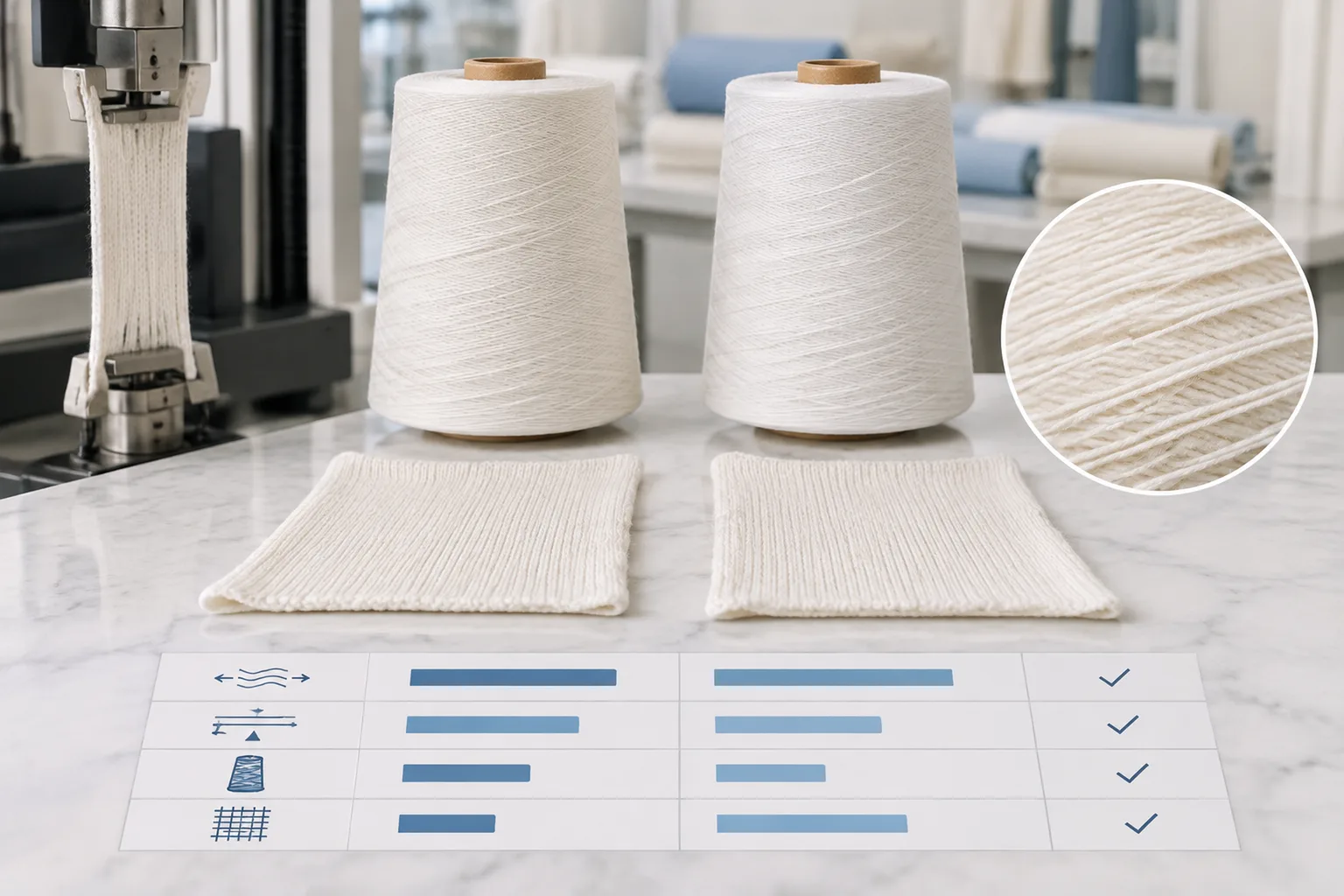
Compare stretch wrapped yarn strength results in a fixed order. First confirm that the specimens represent the same yarn construction. Then align the measured property and units, check the method and version, compare conditioning or pre-treatment, and finally review the replicate or summary format. A difference should remain unresolved when an earlier field does not match.
| Check | Observable input | Interpretation | Question before comparison |
|---|---|---|---|
| Specimen identity and construction | Yarn designation, lot, core, covering, wraps, twist, and linear-density notation | Shows whether the reports describe the same material build | Are these specimens genuinely equivalent? |
| Result type and units | Maximum force, elongation, force at extension, and the reported unit | Identifies what response the number represents | Am I comparing the same property in compatible units? |
| Method and version | Named method, version, setup, direction, and method-specific settings when reported | Shows how the result was obtained | Could different procedures explain the difference? |
| Conditioning or pre-treatment | Conditioning state, washing, finishing, or other preparation | Shows whether the yarn was tested in a comparable state | Was either sample changed before testing? |
| Replicate or summary format | Individual result, average, range, or another summary | Prevents a single observation from being mistaken for a full comparison | Are both values summarized in the same way? |
This matrix supports report inspection; it does not replace the applicable method or project specification. Two force values from different methods should not be ranked solely by numerical size. A different setup may measure a different response or apply different conditions.
For a lightweight stretch wrapped yarn intended for a close-fitting knit, a developer might examine both force and extension behavior before considering the intended fabric construction. That decision could change if the yarn count, covering arrangement, fabric structure, or test preparation differs. The comparison therefore supports a cautious decision, not a general claim that one yarn will perform better in every garment.
Separate an internal specification decision from a universal performance statement. A project may define a required result, but that threshold must come from the applicable technical document, buyer requirement, or other governing source. It should not be inferred from a test method or supplied as a general rule.
When information is missing, request the method details, result type, units, specimen identity, construction description, pre-treatment, and whether the value is an individual result or summary. Until those points are clear, label the comparison unresolved.
What a Tensile Number Cannot Tell You Alone
A yarn tensile result describes a measured response under stated conditions. Tensile strength and elongation at break do not independently establish elastic recovery, repeated-cycle behavior, abrasion resistance, pilling, colorfastness, seam performance, comfort, wash response, or final garment durability. Each property requires evidence suited to the question being asked.
Yarn-level evidence also does not directly become fabric- or garment-level evidence. The same yarn may behave differently after knitting, weaving, finishing, laundering, or incorporation into a seam. Fabric structure, stitch or weave arrangement, finishing, and construction can change the response experienced in the finished product. A tensile number should therefore not be presented as a garment guarantee.
A product specification may contain a required value, but the requirement must come from the applicable project, buyer, or technical document. Common practice is not automatically a universal specification, legal requirement, or approval rule. A report can show that a result was recorded without proving that the material meets every intended use.
Use a stop-and-check rule when the report omits its method, specimen identity, result type, or conditions. Do not fill the gap with assumptions or rank the sample against another incomplete report. A unit conversion or illustrative calculation can organize information, but it cannot validate a physical result or replace the required test evidence.
Apparel Wiki provides independent technical education about measurements, specifications, and evaluation questions. It is not a laboratory, certifier, manufacturer, or approval authority. When the decision concerns a defined requirement, return to the applicable specification and method documentation.
A Practical Interpretation Checklist
- Specimen: identify the yarn, lot, and specimen form.
- Construction: record the core, covering, wraps, twist, and notation.
- Result: identify the measured property and result type.
- Units: preserve the reported force and linear-density units.
- Conditions: match method, preparation, and conditioning.
- Decision: compare like with like or record what needs clarification.
For the next educational step, place the tensile report beside the applicable project specification or method documentation. Mark each statement as measured, required, or still unverified before making a material decision.
Frequently Asked Questions
Is a higher tensile strength value always better for stretch wrapped yarn?
No. A higher maximum force may indicate greater resistance in that stated test, but it does not by itself establish better stretch recovery, comfort, sewability, durability, or garment performance.
Which fields must appear beside a stretch wrapped yarn tensile result?
Check the specimen identity and construction, measured property, units, method and version, preparation or conditioning, and result format. The applicable method may require additional fields, so an unnamed method should remain a clarification point.
Can tensile results from two different test methods be compared?
Not reliably by numerical size alone. Different methods may measure different responses or use different conditions. Compare results only after confirming that the methods and relevant settings support a like-for-like comparison.
How do yarn construction and covering affect tensile interpretation?
Core material, covering fiber, wrap arrangement, twist, stretch component, and linear density can influence load transfer and break behavior. These are possible influences, not rules that make one construction universally stronger.
What is the difference between yarn tensile strength and elongation at break?
Tensile strength is a force result associated with resistance in the stated test. Elongation at break describes extension when the specimen breaks. They describe different parts of the response and should not be treated as interchangeable.
What should I do when a tensile report does not identify the specimen or test conditions?
Do not rank the result against another report or use it to support a broad performance claim. Ask for the specimen identity, construction, result type, method, units, preparation, and conditioning, then record the comparison as unresolved until clarified.