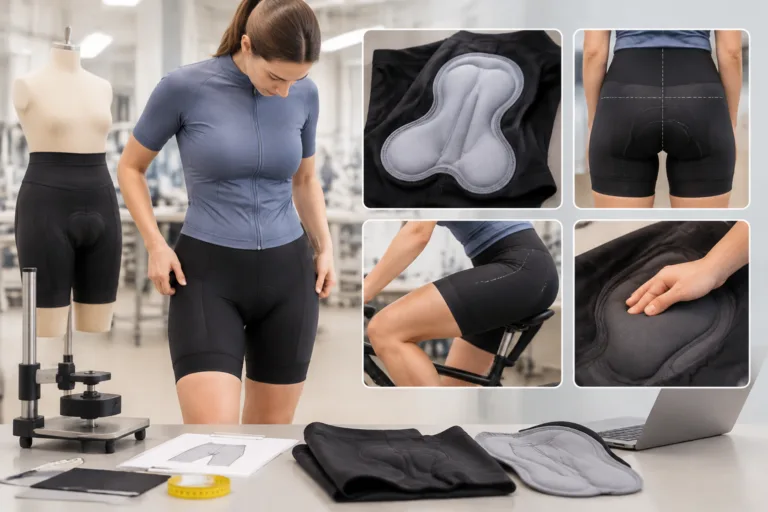
Good cycling shorts chamois positioning keeps the pad’s relevant padded zones aligned with the wearer’s contact areas while the garment remains stable in the intended riding posture. Judge that relationship while the shorts are worn and moving, not from the flat pad outline alone. Apparel Wiki maintains editorial independence as described on its Sponsor page.
Start with the riding task, posture, and garment size. Then observe coverage, pad orientation, folds, and movement. This approach helps separate an actual placement error from shifting shorts, unsuitable pad construction, or another fit variable. It does not establish a universal pad location for every rider or design.
What Chamois Positioning Means in Cycling Shorts
Chamois positioning describes the relationship among three elements: the pad’s functional zones, the wearer’s contact areas, and the position of the shorts during use. Correct-looking placement on a table is only a reference. Functional alignment becomes visible after the garment stretches over the body and responds to the intended posture and movement.
A task-first evaluation begins by defining how the shorts will be used. A seated position, a forward reach, repeated leg movement, and transitions between positions can change how the garment sits. The useful question is therefore not simply, “Is the pad centered?” It is, “Does the required padding remain aligned during the movements this design is intended to accommodate?”
Reviewers can organize that question into several observable checks:
- Does the relevant padded area sit beneath the intended contact area when the wearer assumes the target posture?
- Do the front and rear zones remain appropriately aligned as the wearer moves?
- Does the pad stay centered relative to the garment, or does it fold, rotate, wrinkle, or migrate?
- Do the shorts shift enough to change the effective position of the pad?
These observations concern placement and stability. They should not be confused with pad thickness, softness, moisture handling, edge shape, seam bulk, or general construction quality. Those attributes can affect how the garment feels, but none proves that the padding is in the correct location.
Keep the limits of the finding clear. A pad can look symmetrical and centered while flat yet move out of alignment when worn. Conversely, an unusual-looking flat placement may align as intended after the garment stretches into position. A favorable result on one wearer also does not validate every size, body proportion, pattern, riding posture, or use case.
The evaluation should record what is directly observable before assigning a cause. For example, “the rear pad edge moves forward during the transition into the riding posture” is an observation. Whether pad coordinates, pattern balance, material behavior, or garment retention caused that movement remains a separate design judgment.
Map the Pad to the Garment, Body, and Riding Task
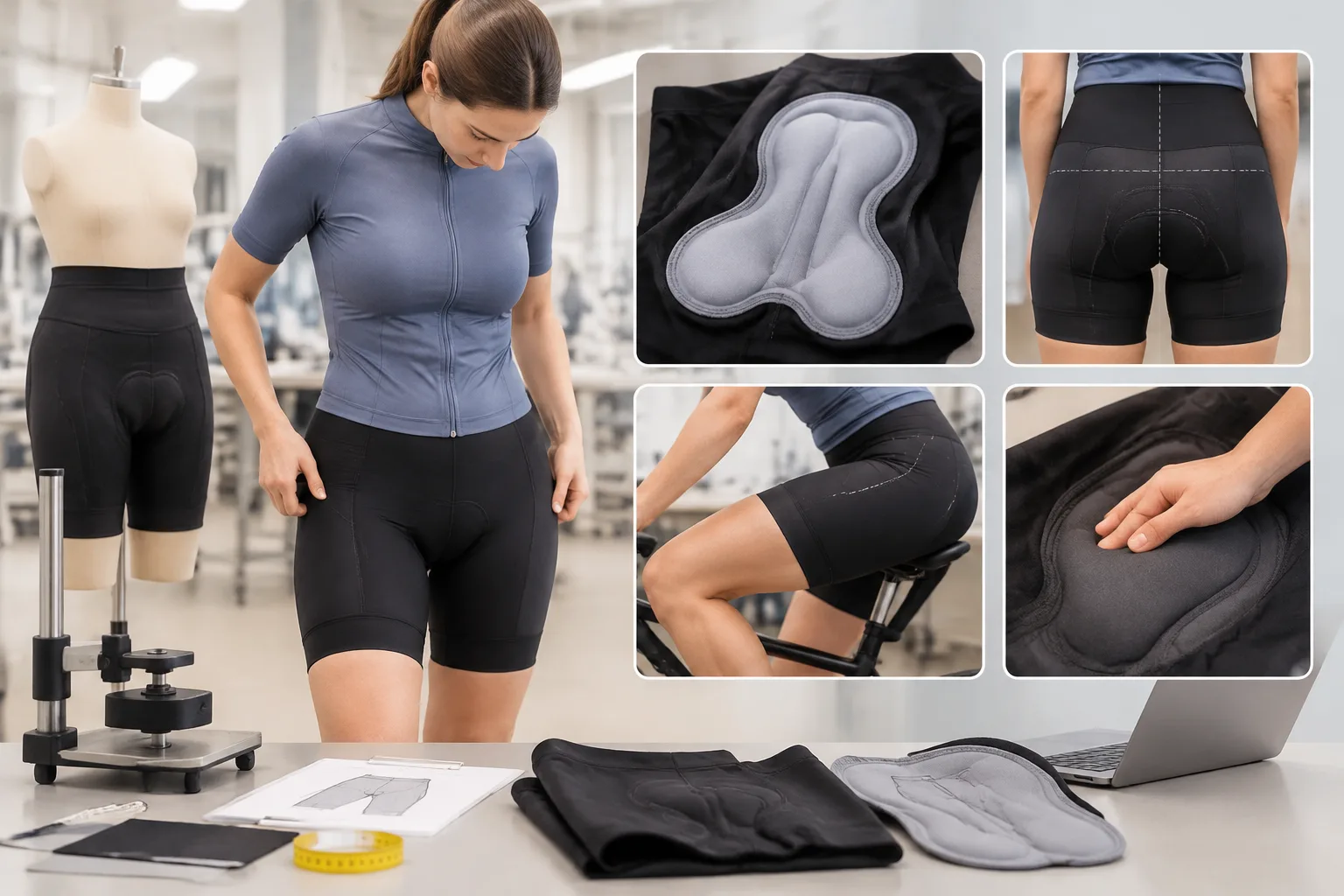
A positioning map connects pad landmarks to the shorts pattern and then to the worn garment. Begin with the flat sample. Identify the pad front and rear, centerline, widest zones, perimeter edges, attachment seams, and any changes in thickness or construction. Mark corresponding garment references, including center front, center back, crotch area, inseams, panel seams, waistband, and leg openings.
Next, compare those landmarks while the garment is worn. Record their relationship to the intended contact areas in standing, seated, forward-leaning, and pedaling positions. Include transitions between positions because a pad may align in a static pose but rotate or wrinkle as the garment moves. The purpose is to document change, not to declare one pose universally correct.
Several variables can alter apparent chamois placement. Inspect rise and waistband position, leg-opening stability, fabric stretch direction, and the balance between panels. Also consider size grading, torso-to-leg proportions, the wearer’s relationship to the saddle, and the posture represented by the review. Treat these as variables to examine rather than quantified causes unless suitable testing supports a stronger conclusion.
Mapping also helps separate location from feel. If the pad landmarks remain aligned but an edge creates localized pressure, inspect edge shape, thickness transitions, attachment seams, and fabric compression. If the entire pad moves with the shorts, garment stability may deserve attention before pad coordinates change. If the pad moves within an otherwise stable garment, attachment, panel balance, or local material behavior may be more relevant.
Consider a lightweight, highly extensible short. Its pad may appear centered and balanced off the body. Once worn, however, the shell may shift during leg movement while the pad rotates relative to the original centerline. That result does not automatically prove that the pad outline is wrong. The next review should compare retention, stretch behavior, attachment, and movement conditions.
Record each finding by position and movement. Note the landmark involved, where the issue appears, whether the shell also moves, and whether the condition repeats. Photographs or annotated sample diagrams can support comparison when used consistently. The final garment system matters: shell fabric, pad, elastic components, seams, and assembly interact, so isolated component qualities cannot establish finished-garment alignment.
Pattern and Construction Variables That Move the Chamois
A cycling shorts chamois pattern does not operate independently of the surrounding pattern. The pad’s coordinates relate to center front, center back, the crotch or gusset area, inseams, leg panels, waistband position, and nearby seam lines. Altering one area can change the pad’s worn relationship to the body even when the pad piece itself remains unchanged.
For example, a change in rise or panel balance may alter where the garment settles. Inseam and leg-panel geometry can affect how forces are distributed around the crotch area. Waistband and leg-opening retention may influence whether the shorts hold their position during movement. These relationships should be checked on samples; they do not establish a universal construction rule or acceptable amount of movement.
Material direction is another diagnostic variable. Compare stretch and recovery direction across adjacent panels and note whether one area appears to extend or return differently during wear. Differential behavior, panel imbalance, or unstable openings may coincide with pad rotation or migration. Record the association as an inspection lead unless an appropriate evaluation supports a causal claim.
Construction can also change the perception of alignment. Pad edge shape, attachment method, seam placement, seam bulk, and local compression may make a correctly located pad feel misplaced. A wearer may then pull the shorts higher, lower, or sideways, creating a secondary positioning change. Review the original alignment and the wearer’s adjustment separately.
Compare the same pad and garment landmarks across relevant sizes. Check their relationships in the flat pattern, the assembled shorts, and representative fit reviews. A successful result in one size does not demonstrate that pad coordinates, garment balance, and material behavior remain suitable throughout the size range. Body proportions can also change the worn result within a nominal size.
Diagnosis should come before redesign. Classify the initial issue as a possible pad-coordinate error, garment-stability problem, pattern-balance issue, material-behavior issue, construction effect, or interaction among these factors. Then change one clearly documented variable where practical and repeat the same observations. This preserves the link between the observed problem and the design decision without treating a sample result as a production guarantee.
A Practical Evaluation Workflow for Chamois Positioning
Begin by defining what the sample is meant to represent. Record the intended riding posture, garment size, shell and pad materials, construction details, and relevant body or use conditions. This brief prevents a general fit impression from being treated as a conclusion about every rider, size, or riding task.
Next, inspect the flat garment. Mark the pad front and rear, centerline, widest zones, edges, attachment seams, nearby garment seams, and the principal stretch direction. This map gives you a stable reference for later observations. It does not prove that the pad will align correctly when the shorts are worn.
Evaluate the garment in the intended posture and through relevant movement. Review standing, seated, forward-leaning, pedaling, and transitions where appropriate. Note whether the padded areas remain under the intended contact areas. Also record rotation, wrinkling, gaps, edge movement, or migration relative to the shorts. Keep the wording observational: describe what moved, where it moved, and when the change appeared.
Separate observations from judgments. A useful record identifies the visible or felt issue, its location, the position or movement that exposes it, and the variable that may explain it. For example, a pad that appears too far forward may reflect pad coordinates, a shifted waistband, pattern balance, or a change in how the wearer adjusted the garment. Do not change several variables before identifying the most plausible inspection lead.
Repeat the review across relevant sizes, body proportions, and representative materials where practical. Compare the same landmarks each time. A sample result remains sample-specific unless an appropriate validated method supports a broader statement. This workflow is an editorial evaluation guide, not a certification procedure or an approval of production.
Decision Matrix: What to Check Before Changing the Design
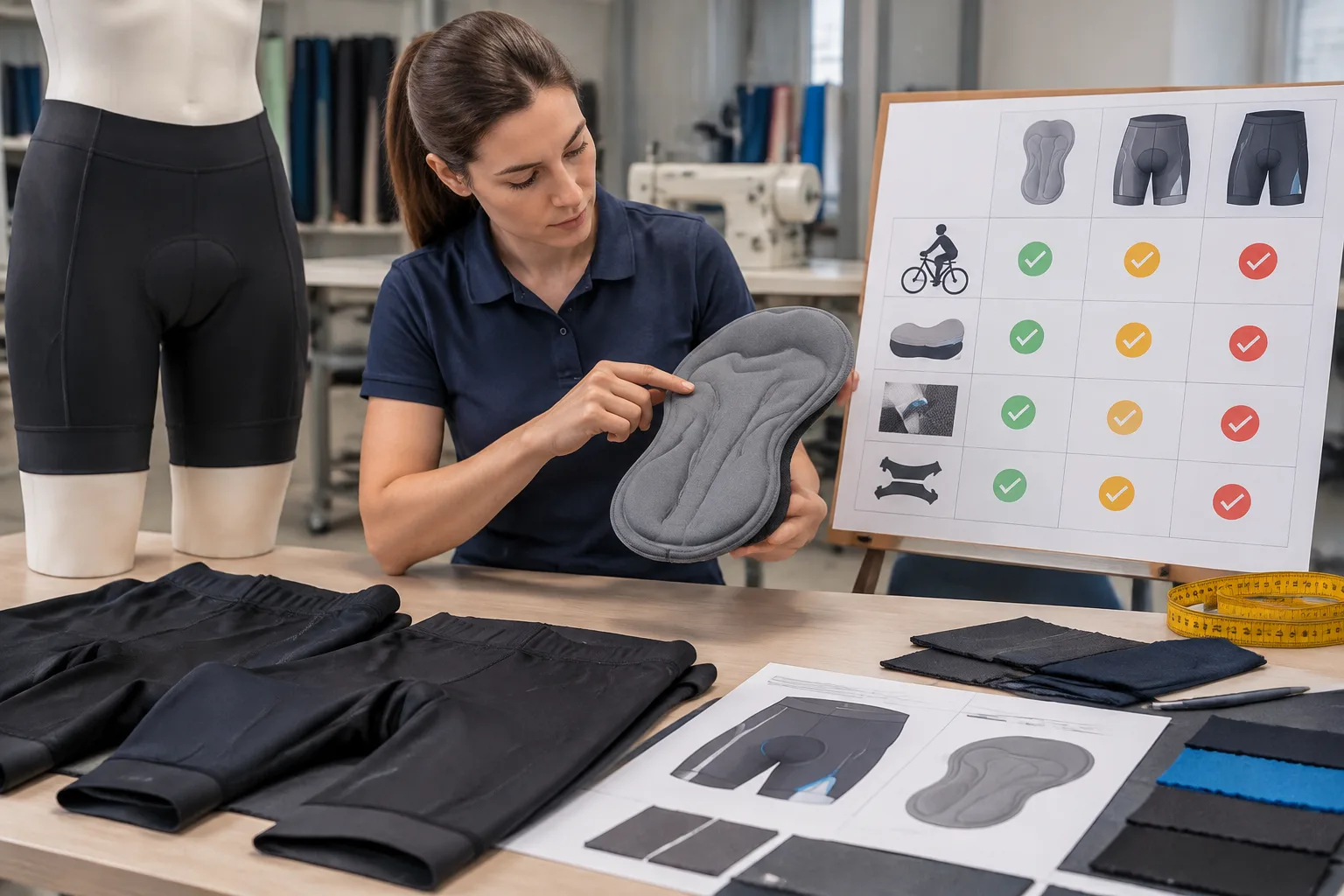
Use the following matrix to turn an observed positioning problem into a focused next check. The suggested inspection area is an initial direction, not a guaranteed correction. The same visible issue can result from different interactions among the pad, pattern, materials, and garment stability.
| Observable input | Likely positioning implication | Initial area to inspect or change | Variables that could change the choice |
|---|---|---|---|
| Pad rotates during movement | The pad centerline may no longer match the garment or intended contact areas. | Check pad coordinates, stretch balance, seam interaction, and garment retention before changing the pad outline. | Waistband position, leg-opening stability, material behavior, posture, and movement conditions. |
| Front or rear coverage does not match the task | The pad zones may not remain aligned with the relevant worn contact areas. | Compare posture, rise, pattern balance, pad coordinates, and intended use. | Torso-to-leg proportions, size, riding position, and how the wearer positions the garment. |
| Edge pressure occurs despite apparent alignment | The coordinates may be acceptable while edge shape, bulk, or local compression affects the fit impression. | Inspect pad edge shape, attachment, seam placement, and nearby construction. | Pad thickness, shell stretch, seam allowance, body proportions, and garment stability. |
| Pad migrates during movement | The issue may involve retention rather than the original pad location. | Compare waistband and leg-opening stability, fabric recovery, attachment, and movement conditions. | Stretch direction, recovery behavior, posture, movement range, and size selection. |
| Positioning differs between sizes | One set of pad coordinates may not remain suitable across the size range. | Check grading, body proportions, pattern balance, stretch behavior, and representative fit reviews. | Material changes, pad construction, panel geometry, and the range of users being assessed. |
Use the matrix to narrow the next question, not to assign a universal layout. For rotation, inspect the centerline and retention before assuming the pad itself is incorrectly shaped. For front or rear mismatch, review the intended posture and garment rise before extending a zone. For migration, distinguish a retention issue from a coordinate issue. For size inconsistency, do not treat one successful size as evidence that the full range is resolved.
Conclusion: Document the Fit Decision and Next Check
Cycling shorts chamois positioning is judged on worn alignment and stability during the intended task, not on a flat outline alone. Create a positioning map, then record the posture, movement, pad landmarks, observed changes, suspected variables, and next sample or source check. Compare representative sizes and conditions before treating a finding as general. The complete garment and intended user context matter, while Apparel Wiki remains an independent educational publication rather than a testing, certification, or manufacturing provider.
Frequently Asked Questions
Should chamois positioning be judged on a flat pair of cycling shorts or while worn?
Judge it primarily while worn and moving in the intended riding posture. A flat inspection helps identify pad landmarks, centerline, edges, seams, and stretch direction, but it cannot establish how those landmarks relate to the body after the garment stretches or shifts.
How can you tell whether a chamois problem is caused by pad placement or by the shorts shifting?
Compare the pad with the shorts’ landmarks before and during movement. If the garment shifts as a unit, inspect waistband and leg-opening stability, stretch behavior, and adjustment. If the garment stays positioned while the pad relationship changes, inspect pad coordinates, attachment, seam interaction, and pattern balance.
Which pattern and construction details can affect chamois alignment during pedaling?
Relevant details include the center front and back, crotch or gusset area, inseam, leg length, waistband, leg openings, pad attachment, seam placement, edge shape, and stretch direction. Their effects should be reviewed in the complete garment because separate component observations do not establish finished-garment performance.
Does a chamois position that works in one size automatically work across the size range?
No. Size grading, body proportions, panel balance, material behavior, and construction can change the worn relationship. Compare the same pad and garment landmarks across representative sizes and fit reviews before extending a conclusion from one size to the full range.
What should be recorded when comparing cycling shorts chamois positioning in samples?
Record the sample size and materials, pad landmarks, garment landmarks, posture, movement, visible or felt issue, location, and suspected variable. Note whether the pad rotated, wrinkled, gapped, or migrated, then document the next inspection or design check separately from the observation.