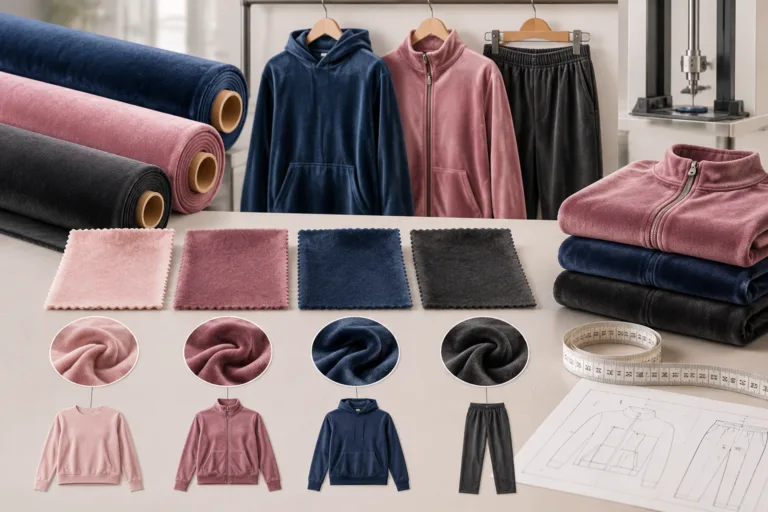
There is no single correct stretch velour GSM range for every garment. Start with the required coverage, silhouette, drape, support, and intended use. Then compare candidate weights alongside their construction, pile, stretch behavior, finishing, and care information. GSM can narrow the options, but it cannot approve a fabric by itself. Apparel Wiki provides independent educational guidance, with editorial independence described on its Sponsor page; it is not a manufacturer, laboratory, or certifier.
A close-fitting style and a full, flowing costume can require different qualities even when both use fabric sold as stretch velour. The useful question is therefore not “Which GSM is best?” but “Which candidate best fits the documented garment requirements?”
What Stretch Velour GSM Tells You
GSM means grams per square meter: the mass of fabric covering one square meter. It gives designers, developers, and buyers a common unit for comparing velour fabric weight. The comparison is most useful when the fabrics are broadly similar and their figures describe the same measurement state.
GSM is not a direct measurement of thickness. It is also not a rating for quality, warmth, opacity, stretch, recovery, or durability. A heavier candidate is not automatically better, more luxurious, or more suitable. Two fabrics with the same GSM can have different thicknesses, hand, pile appearance, recovery, and behavior in a garment.
Read “stretch velour” as a commercial starting description, not a complete material identity. The full description should separate several layers:
- Fiber content: the constituent fibers and their stated proportions.
- Yarn: the yarn characteristics used in the ground and pile, where that information is available.
- Fabric structure: whether the material is knitted, woven, or otherwise constructed, plus relevant structural details.
- Pile: how the raised surface is formed and how it appears or handles.
- Stretch system: the elastomeric component, structural stretch, and direction of stretch.
- Finishing and history: treatments, laundering, or other processes that may distinguish the sample from an untreated fabric.
Commercial naming can vary, so the word “velour” does not establish one fixed construction. Likewise, “stretch” does not state how far the fabric extends, in which direction, or how it recovers. GSM for stretch velour should therefore sit beside composition, construction, surface, stretch, recovery, finish, and care details on a comparison sheet.
Which Variables Change the Best GSM Choice?
Garment design changes which candidate deserves further evaluation. A close-fitting garment may place greater emphasis on controlled stretch, recovery, seam behavior, coverage, and comfort. A relaxed or fuller style may emphasize drape, body, surface appearance, shape, and construction stability. Neither design produces a universal GSM cutoff.
Begin with observable fabric variables. Compare stretch direction and the available recovery information. Examine pile height, apparent density, shading, and surface character. Record fiber and elastomeric content, construction, finish, and color. Pile and finishing can change perceived plushness, thickness, appearance, and handling without being fully described by area mass.
Fabric structure can provide useful clues, but it does not independently determine stretch, breathability, or durability. Those properties require relevant information or evaluation of the specific material. Even candidates with matching GSM figures may respond differently because their yarns, structures, pile, elastomeric components, or finishes differ.
Next, separate fabric variables from garment variables. Fit ease, panel shape, seam allowance, seam construction, and pattern orientation can change how the material behaves in the finished style. Grain or wale direction may also matter where relevant to the construction. A lining can alter the combined garment’s bulk, movement, coverage, and comfort, so the shell GSM alone is insufficient.
Intended use and care introduce further questions. Washing, abrasion, repeated stretching, heat, and moisture are conditions to evaluate for the particular fabric and design. Their effects should not be assumed from GSM or construction labels alone.
For a like-for-like review, record each supplier’s stated GSM and its measurement condition, usable width, composition, construction description, stretch direction, recovery information, finish, color, and care instructions. If the measurement basis is unclear, mark it as unresolved rather than treating the figures as directly equivalent. This approach helps teams choose GSM for velour clothing without turning an incomplete number into a performance promise.
Compare Stretch Velour Options by Garment Use
The following table is a screening framework, not a set of universal weight bands. “Lighter,” “middle,” and “heavier” refer only to the candidates being compared. Use the initial direction to create a shortlist, then examine representative samples against the garment’s priorities.
| Garment use | Inputs to observe | Likely selection emphasis | Initial direction | What could change it |
|---|---|---|---|---|
| Close-fitting, performance-oriented apparel | Stretch direction, recovery information, coverage, seams, fit ease, comfort | Compatibility with repeated body movement and the intended construction | Lighter or middle candidate | Pile, color, required coverage, lining, or weak seam compatibility |
| Relaxed tops or dresses | Drape, hand, surface appearance, body, garment length | Balance between fluidity, shape, coverage, and overall garment weight | Middle candidate | Desired silhouette, pile character, pattern volume, or layering |
| Fuller silhouettes or stage-oriented garments | Panel volume, movement, body, surface response, construction support | Intended visual shape without assuming maximum weight is preferable | Middle or heavier candidate | Costume movement, supporting layers, seam load, or desired drape |
| Lined or layered styles | Shell, lining, interlining, seams, combined bulk, intended environment | Behavior and comfort of the complete layered construction | Lighter or middle shell candidate | Lining weight, support needs, climate, coverage, or pattern structure |
For a lightweight, close-fitting style, the lighter candidate may be a sensible starting point only after checking stretch direction, recovery information, seam security, coverage, and comfort. A different pile, dark or light color, closer fit, or added lining could change that direction.
For a relaxed dress or fuller costume, compare how each sample hangs, handles, and presents its pile across representative panels. The heaviest option should not be assumed to create the intended shape. In a lined garment, review the shell and lining together because their combined bulk and handling matter more than the shell’s GSM alone.
This process produces an initial shortlist, not specification approval. Final selection still depends on sample evaluation, the pattern and seam construction, care requirements, and any project-specific performance criteria.
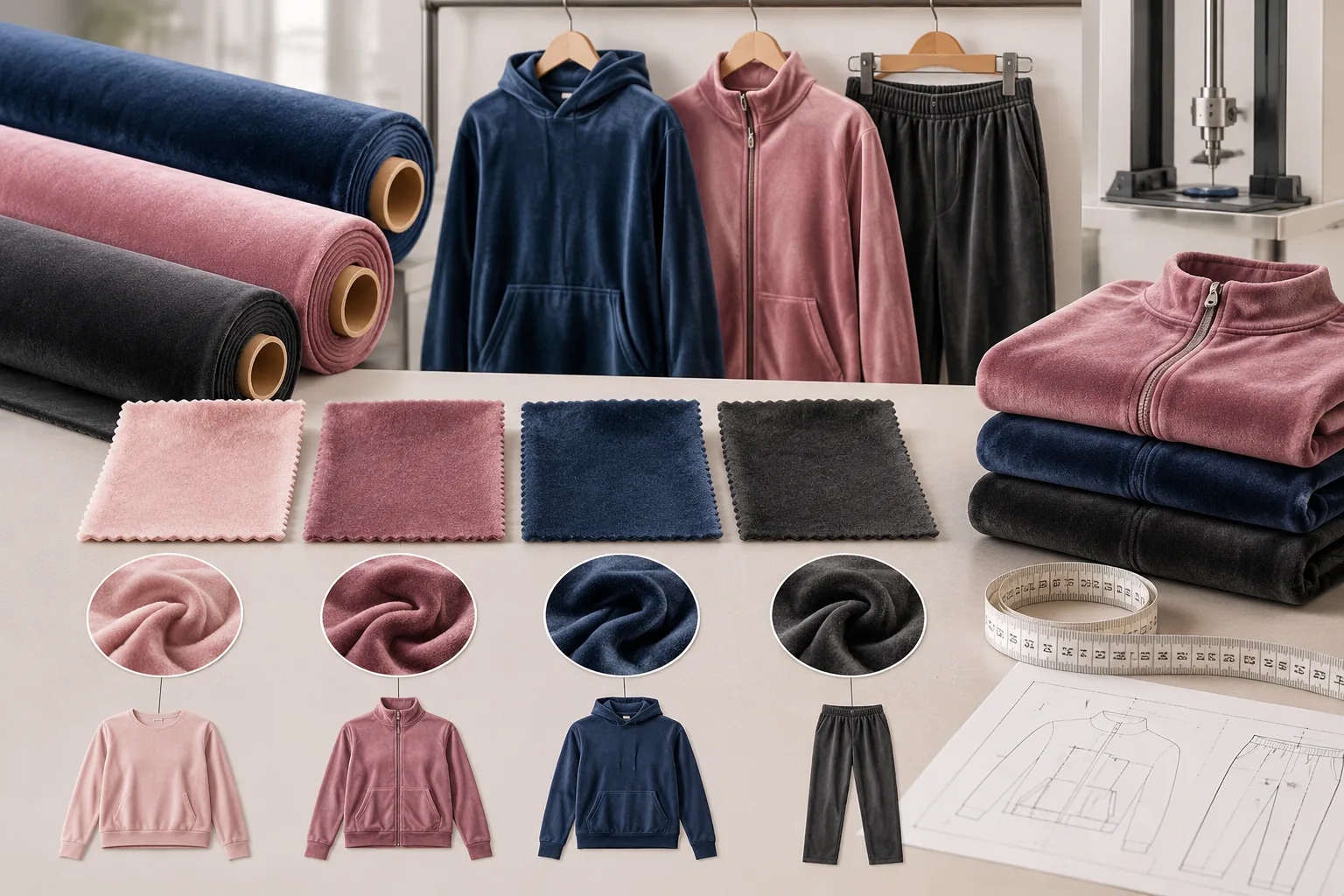
How to Evaluate a Candidate Stretch Velour Before Choosing
Begin with a comparison sheet for every candidate. Record the stated GSM and its measurement condition, composition, construction description, usable width, pile or surface description, stretch direction, recovery information, finish, color, and care instructions. Mark information as missing when it has not been supplied; do not substitute an estimate.
Compare samples under consistent viewing, handling, and measurement conditions. Note whether each sample is untreated, laundered, or exposed to another treatment. If samples have different histories, their observations are not directly equivalent. An informal comparison can identify questions, but it does not replace an applicable validated test method.
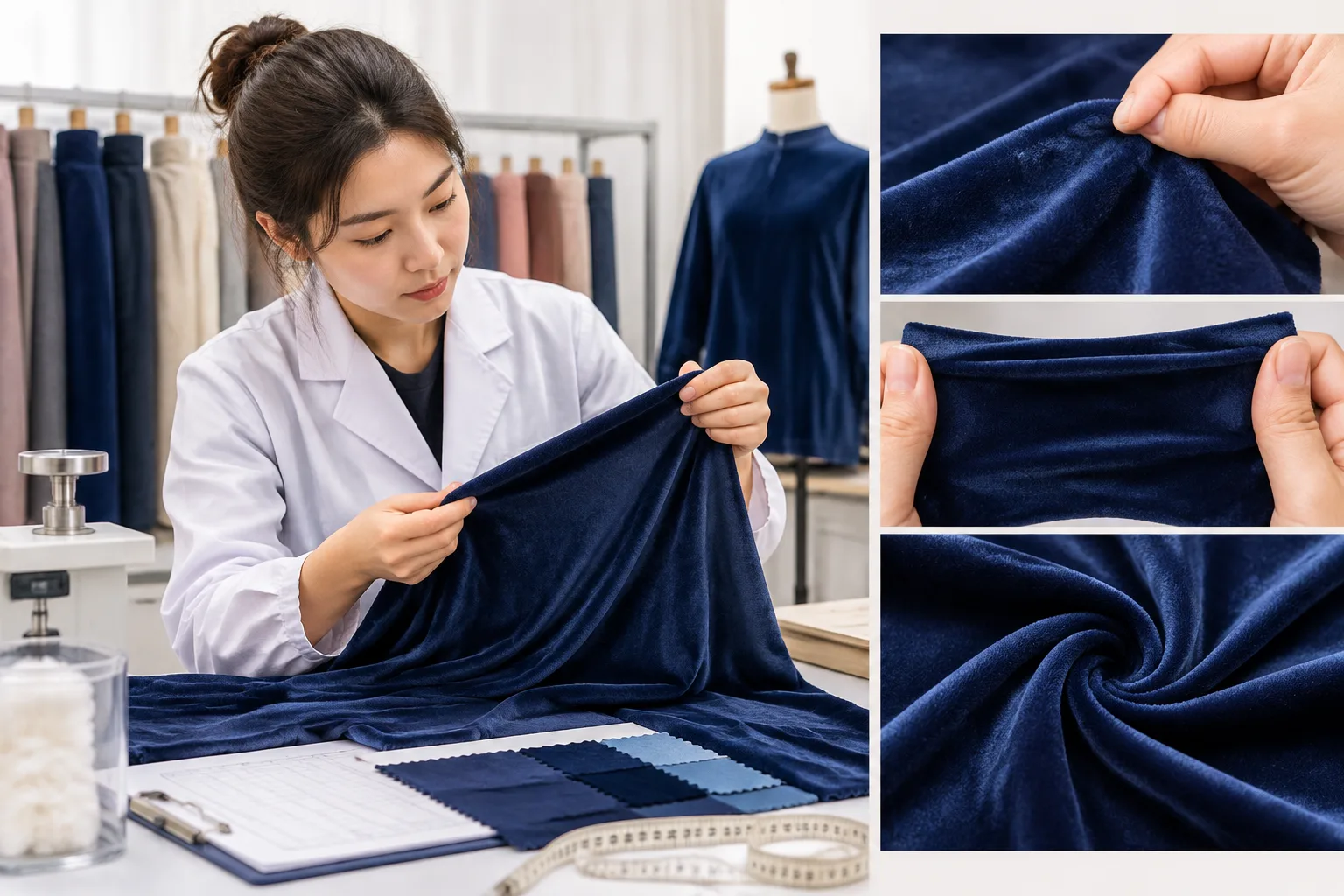
A practical velour fabric sample checklist should cover:
- surface uniformity, pile consistency, shine, and directional shading;
- appearance and distortion while stretched and after release;
- edge behavior during handling and preparation;
- coverage under the intended degree of stretch and lighting;
- seam appearance, stability, bulk, and surface disruption;
- compatibility with the pattern shape, fit ease, lining, and care plan.
Keep every observation tied to the specific sample. For example, visible shading on one color or finish does not establish how all stretch velour will behave. Likewise, supplier recovery information is useful for comparison, but the garment still needs evaluation under its intended construction and use conditions.
When practical, make a representative seam, hem, lined panel, or small garment section. Use the planned stitch and seam arrangement, matching the relevant fabric direction and layers. This exercise can expose puckering, pile disturbance, unwanted bulk, or handling questions that a flat swatch cannot show. It cannot guarantee full-production behavior.
Set the decision rule before making the final comparison. Keep a candidate when its documented specification and observed behavior match the garment priorities. Revise the design or requirement when a manageable conflict appears. Reject the candidate when a material mismatch remains, such as unsuitable coverage, surface response, construction compatibility, or care behavior. The reason should be documented rather than reduced to “too high” or “too low” in GSM.
Common Mistakes When Selecting Velour by GSM
The most common error is treating GSM as a shortcut for thickness, warmth, opacity, luxury, or durability. Those characteristics require separate information or evaluation. Check construction and pile for surface character, assess coverage under intended conditions, review stretch and recovery information, and examine care and construction compatibility.
Another mistake is comparing numbers that were not reported on a like-for-like basis. Two candidates may differ in construction, pile, finish, usable width, treatment history, or measurement condition. Their GSM figures still describe area mass, but a simple ranking cannot explain which fabric better fits the garment.
A lighter-versus-heavier decision should remain relative to comparable candidates. A lighter option may support one design’s handling or layering priorities, while a heavier option may better suit another design’s desired body or support. Neither direction is inherently superior. Compare drape, coverage, bulk, garment weight, seam behavior, and surface appearance against the intended silhouette.
Hand feel alone is also insufficient. A small swatch may feel appealing without showing how the pile shades across large panels, how the fabric behaves at seams, or how it interacts with a lining. Conversely, a specification sheet cannot reveal every visual and construction issue. Combine documented inputs with consistent viewing, handling, stretching, and representative construction checks.
Do not treat a source page, supplier statement, or sample observation as blanket proof of every performance characteristic. Separate reported specifications from your observations and from project-specific requirements. A formal test result, where relevant, should identify the evaluated property and applicable conditions rather than being generalized into an overall quality grade.
When information is incomplete, name the gap precisely. Ask whether the GSM applies before or after treatment, whether width means total or usable width, and whether stretch or recovery information covers the relevant direction. If clarification is unavailable, compare the candidates qualitatively and record the uncertainty. Never invent a tolerance, recovery value, or performance rating to complete the sheet.
Make the GSM Decision as a Specification, Not a Guess
Stretch velour GSM is a starting comparison value, not a standalone answer. Define the garment, silhouette, coverage, construction, care, and use priorities first. Then compare like-for-like fabric information and evaluate representative samples. The most defensible choice is the candidate that fits those documented priorities while remaining compatible with the pattern, seams, layers, and observed sample behavior.
As the next step, build a side-by-side specification sheet, mark every unresolved variable, and check the applicable measurement or performance method before finalizing the project requirement. This creates a traceable decision instead of relying on a generic online GSM range.
Frequently Asked Questions
Is a higher GSM always better for stretch velour clothing?
No. Higher GSM means greater mass per unit area, not automatically better quality or suitability. Compare relative weight with the garment’s silhouette, coverage, drape, layers, stretch and recovery needs, seam construction, and intended care.
How is stretch velour GSM different from fabric thickness?
GSM describes fabric mass per unit area. Thickness describes the distance between the fabric surfaces under stated measurement conditions. Pile, construction, yarn, and finishing can make fabrics with similar GSM feel or appear different in thickness.
What fabric details should be compared alongside stretch velour GSM?
Compare composition, construction, usable width, pile or surface description, stretch direction, recovery information, finishing, color, measurement condition, care instructions, and treatment history. These details help establish whether the GSM figures are meaningfully comparable.
How can a sample reveal whether a stretch velour fabric suits the intended garment?
A sample can reveal surface appearance, directional shading, coverage, distortion, edge handling, and compatibility with planned seams or layers. A representative construction adds useful evidence, but one sample cannot guarantee finished-garment or production performance.
Should the GSM of lined or layered clothing be judged from the shell fabric alone?
No. Evaluate the shell together with the lining, interlining, seams, and other relevant layers. Their combined bulk, handling, coverage, and suitability for the intended environment can change which shell candidate is the best starting choice.