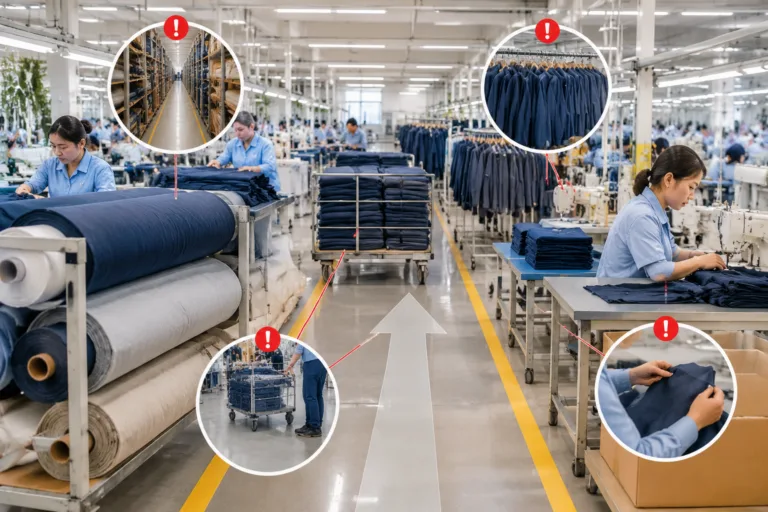

Sponsor support does not determine Apparel Wiki’s editorial guidance. For plaid matching capacity planning, begin by identifying the garment areas where pattern alignment matters, then confirm the fabric and pattern inputs that control cutting and handling. Map the dependent work through sewing and inspection before assigning people or equipment.
Plaid matching is the deliberate alignment of visible pattern features across related garment panels. It can add preparation, controlled handling, alignment checks, inspection, and correction work compared with an unrestricted layout. The effect is not universal: plaid geometry, fabric behavior, garment construction, matching points, batch variation, and the product’s acceptance criteria all influence the plan.
What Plaid Matching Changes in Production Planning
Plaid matching is a quality requirement at selected visual joins, not a claim that every panel receives identical treatment. Depending on the style, the critical points may include side seams, shoulder seams, center fronts, center backs, pocket edges, cuffs, collars, or other visible joins. A product specification or approved sample should identify which locations matter and what alignment is acceptable.
Once those points are known, matching can affect several parts of the production plan. Marker review may require more attention to repeat direction, panel orientation, usable fabric width, and the relationship between adjacent pieces. Cutting and bundling may require controlled handling so panels remain identifiable and are not mixed across intended positions. Sewing may require alignment checks at visible joins rather than relying only on the normal seam allowance.
Inspection also changes when a mismatch can affect appearance or the disposition of a panel. A correction may involve resewing, replacing a component, holding a bundle, or accepting the result under the product’s defined criteria. These are planning possibilities, not a fixed route for every plaid garment. Some styles have few visible matching points; others place pattern alignment across several high-visibility areas.
For that reason, a planning assumption should not be presented as a measured factory result. Without project-specific time studies or production records, it is more accurate to describe qualitative effects than to claim a percentage increase in labor, material use, or output loss. The first decision is to list the critical visual joins, define the applicable acceptance criteria, and confirm the inputs before sizing labor or equipment.
Those inputs include the plaid repeat and direction, fabric behavior, garment construction, pattern revision, order conditions, and the degree of visibility of a mismatch. A capacity estimate that omits one of these may describe nominal machine time while missing the work needed to prepare, check, hold, and correct matching-sensitive panels.
Map Material and Information Dependencies Before Sizing Capacity
Build the planning map from material and information inputs to the work they control. Confirm the relevant production fabric rather than treating a sample or approval piece as proof that every later batch will behave the same way. Fabric width, shrinkage behavior, color batch, surface defects, plaid repeat, and direction can affect the cutting decision. Pattern-piece shape and grain requirements also influence how pieces can be positioned.
Record the style, pattern revision, fabric batch, critical matching points, assumptions, and release conditions. Then map the dependencies through preparation, spreading, marker or layout review, cutting, bundling, sewing, inspection, and rework or disposition. This is a planning map, not a mandatory sequence for every product. The route and controls vary with the garment, fabric, and operation.
| Observable input | Likely implication | Initial planning choice | Variable that could change it |
|---|---|---|---|
| Small plaid repeat | More layout positions may be workable, but visible joins still require review. | Review the marker and identify only the panels needing controlled alignment. | Panel shape, grain direction, and the product’s visibility criteria. |
| Large repeat | Panel placement and orientation can restrict usable layout options. | Allow additional layout review and protect matching-critical pieces during cutting. | Usable width, repeat direction, and the specific pattern arrangement. |
| Stable fabric behavior | Handling and alignment assumptions may be easier to reproduce. | Use the confirmed material condition as the initial planning basis. | Actual-batch results, finishing, and changes in construction. |
| Variable fabric behavior | Cutting, sewing, and inspection decisions may require more checks. | Hold capacity assumptions until the relevant batch is assessed. | Stretch, shrinkage, defects, color variation, and usable width. |
| Many or highly visible matching points | More operations may require alignment control and inspection. | Reserve time for checking and possible correction work. | Acceptance criteria, seam construction, and panel visibility. |
The table provides an initial choice, not a universal layout rule. Confirm shrinkage, usable width, color batch, and surface defects on the material intended for production before finalizing the cutting plan. A changed batch or pattern revision should trigger a review of the map and its capacity assumptions.
Estimate Plaid Matching Capacity Planning From Labor and Bottlenecks
After mapping the work, create an initial estimate around the constrained operation or resource. Define the direct personnel assigned, the available minutes, the portion of time realistically available for the work, a consistent operation-time basis, and the matching-related preparation and checking tasks. Keep the definitions compatible: SAM and efficiency must describe comparable work, and losses already included in one input must not be deducted again.
An idealized relationship can illustrate the arithmetic:
output = direct personnel × available minutes × efficiency ÷ SAM
Using these example inputs, 10 people × 480 minutes × 0.70 efficiency ÷ 20 minutes SAM = 168 pieces. This is an illustrative calculation, not a measured result, recommendation, or guarantee of finished output. The inputs must come from the organization’s own time-study method and records when the result will guide a real capacity decision.
The calculation also does not account for every constraint. Matching-sensitive preparation may wait for material release or layout approval. Inspection may hold bundles, and correction work may compete for sewing capacity. Repeated checking, accumulation before one operation, rework, or unavailable panels can indicate that the effective constraint lies elsewhere.
Increasing one operation’s nominal speed may therefore increase work in process rather than finished output. Use a staged estimate: calculate the initial requirement, identify the likely constraint, observe actual operation times and quality-related interruptions, then revise labor or equipment allocation. Treat plaid matching capacity planning as a working estimate that becomes more useful when its assumptions are visible and tested against the process.
Choose Equipment and Allocate Work Around Matching-Sensitive Operations
Equipment planning should follow the work content and the likely constraint. Begin by identifying where people must review, align, handle, sew, inspect, or decide disposition. A machine count made before this map may describe nominal resources without showing whether material release, alignment control, or correction work limits finished output.
Equipment can support repeatability, controlled handling, visibility, or speed. These functions are not interchangeable. An alignment aid or suitable handling surface may help operators maintain a consistent position, while faster equipment may only shorten one operation. Neither function, by itself, establishes a higher finished output. The effect must be checked against the surrounding process.
| Observable input | Likely implication | Initial resource choice | Variable that could change it |
|---|---|---|---|
| Many visible joins or alignment points | More review, controlled handling, and checking may be needed. | Assign preparation and alignment work where it can be inspected before sewing. | Join visibility, panel shape, and the product’s acceptance criteria. |
| Large repeat, limited width, or directional fabric | Layout and cutting decisions may require closer review. | Provide layout review and suitable spreading and cutting capacity. | Usable width, defect location, repeat behavior, and pattern revision. |
| Visible seams with fabric movement | Sewing control and handling may compete with nominal machine speed. | Allocate an appropriate sewing workstation and time for alignment checks. | Stretch, recovery, panel size, seam construction, and operator method. |
| Frequent returns or correction decisions | Inspection and rework can become a downstream constraint. | Reserve inspection space and a defined disposition path. | Batch variation, defect causes, and the accepted level of correction. |
Labor allocation should reflect these different tasks. Pattern or marker review, controlled spreading, panel handling, alignment checks, sewing, inspection, and disposition decisions may require different skills and may compete for the same people. Space for staging and inspection also matters when bundles must be held rather than passed immediately to the next operation.
For a lightweight plaid knit with stretch and visible side seams, the initial plan would give particular attention to handling and alignment during preparation and sewing. That choice should be reassessed if the fabric behavior, seam construction, panel size, or visibility requirement changes. The scenario supports a planning question, not a universal staffing rule.

Monitor, Rebalance, and Document the Capacity Plan
A capacity plan is an evolving estimate. Before release, record the style and pattern revision, fabric batch, material checks, matching points, planned resources, acceptance assumptions, and conditions required to begin work. During production, add observed waiting, accumulation, bundle returns, inspection findings, rework causes, and changes to operating conditions.
Early warning indicators are often more useful than final output alone. Repeated alignment corrections can point to a preparation or sewing issue. Panel shortages can point to a material or layout issue. Machine queues can indicate an operation constraint, while delayed approvals can hold work before production reaches the expected route. These signals do not prove the cause, but they identify where investigation should begin.
Process checks also serve a different purpose from final inspection. They help determine whether work remains close to the approved target while production is underway. Final inspection can identify nonconforming garments, but it cannot erase every systemic process problem that has already created rework, delay, or unusable panels.
- Confirm the input. Check whether the material batch, pattern revision, usable width, defect distribution, or construction differs from the planning record.
- Locate the constraint. Follow waiting, accumulation, returns, delayed decisions, or repeated corrections to the material, information, labor, equipment, or quality-related source.
- Adjust the work allocation. Revisit sequencing, preparation, inspection coverage, or labor assignment before assuming that additional equipment is the answer.
- Reassess quality and work in process. Observe whether the change reduces the identified problem without moving accumulation to another operation.
Consider a woven plaid whose usable width or surface-defect distribution changes by batch. Carrying the original capacity assumption forward may misstate the work available to cutting and later operations. Revisit the layout and labor plan against the actual material record, then document which assumption changed and why the resource estimate moved.
Do not set a universal defect limit, rework rate, or monitoring threshold without the applicable product specification, quality plan, or validated process record. Qualitative triggers such as repeated returns or accumulating work are suitable for investigation, while formal release decisions require the governing project criteria.

Use a Staged Capacity Decision
Plaid matching capacity planning is an input-dependent estimate, not a universal staffing or equipment formula. Define critical matching points, confirm production-batch inputs, map dependent work, estimate the constrained resource, and monitor the assumptions. Before committing capacity, compare the pattern, fabric, construction, and process records with the planning matrix, then check the applicable specification or test method. Record changes in batch, pattern revision, visibility, and observed bottlenecks so the decision remains traceable.
Frequently Asked Questions
Does plaid matching always require more labor than an unrestricted fabric layout?
No. The effect depends on the repeat, garment design, visible joins, fabric behavior, matching criteria, and process route. Matching may add preparation, handling, checking, inspection, or correction work, but the amount must be established for the specific product.
Which fabric and pattern inputs should be confirmed before planning plaid matching capacity?
Confirm the repeat and direction, usable width, shrinkage behavior, color batch, surface defects, pattern revision, grain requirements, panel shapes, and matching points. Production-batch material should be checked because an approval sample does not automatically represent every later batch.
Can a machine-speed calculation determine output for a plaid garment?
No. A machine-speed figure addresses only part of the work. Material release, layout review, handling, alignment checks, inspection, rework, and downstream queues may limit finished output. Use operation records and process observation to test the constraint.
How should matching-sensitive work be treated when choosing equipment and labor?
Plan around the function required: review, controlled handling, alignment, sewing, inspection, or correction. Equipment that improves handling or repeatability serves a different purpose from equipment that raises nominal speed. Allocate labor to the actual work and skills required.
What should be monitored when the fabric batch or pattern changes?
Record the changed input and watch for panel shortages, repeated alignment corrections, bundle returns, machine queues, delayed approvals, and accumulating work. These signals can show that the original resource assumption no longer describes the current process.
When should a plaid matching capacity plan be recalculated?
Recalculate when material width, defect distribution, batch, pattern revision, construction, matching visibility, acceptance criteria, or observed bottlenecks changes. Also revisit the plan when process records show repeated waiting, rework, or quality interruptions that the original estimate did not capture.