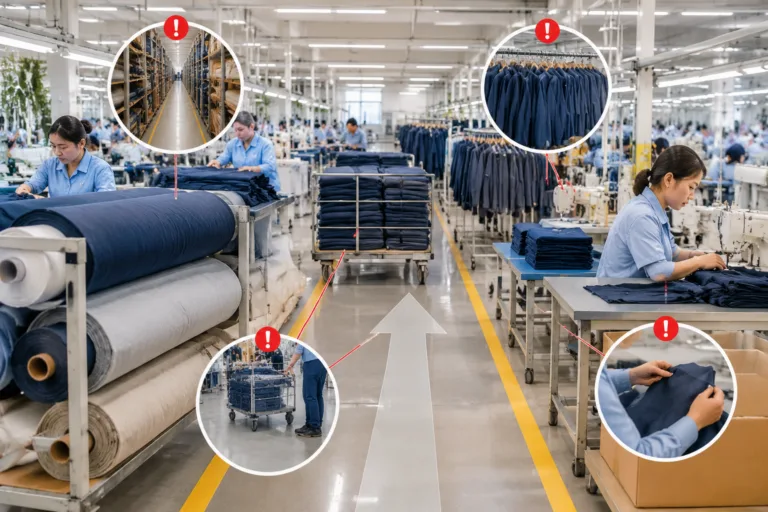
An assortment gap is a meaningful mismatch between what a customer or sales channel needs and what the current apparel range can provide. The gap may involve a missing product role, limited size or color depth, weak execution, poor visibility, or timing rather than a missing style. A useful Sponsor boundary also applies here: Apparel Wiki presents this as an independent educational planning framework, not as a manufacturer or service provider.
The assortment gaps planning process is therefore a decision sequence. Define the affected customer or use case, examine demand and current SKU evidence, account for channel, season, and inventory position, then decide whether to add, adjust, deepen, delay, or leave the gap open. The central question is not “What new product should we make?” but “What assortment problem has the evidence actually identified?”
What an Assortment Gap Means in Apparel
An apparel assortment gap exists when the current range does not adequately cover a relevant customer need or channel requirement. “Relevant” must be defined for the plan. A gap may concern a basic layering use case, a fit or size option, a climate need, a price position, or a product role that the range does not currently serve.
Start by separating breadth from depth. Breadth describes the number of style choices. Depth describes the quantity available across the colors and sizes within those styles. Adding a new silhouette increases breadth. Adding more units in selected sizes or colors increases depth. These choices create different coverage and inventory exposure, so a range with many styles is not automatically better covered or more commercially effective.
For SKU-level planning, ask whether the issue is a missing style, a missing color or size, or insufficient availability in an existing choice. Also record the channel, season, inventory position, and commercial objective. A DTC assortment may place more responsibility for discovery and inventory on the brand. Wholesale decisions may be shaped by the buyer’s range and delivery calendar. Preorder or made-to-order models can change the inventory commitment and fulfillment responsibility. The same apparent gap can therefore require different responses.
Separate an observed gap from an assumed opportunity. Repeated requests, a documented use case, or a consistent absence in the range are signals to investigate, not proof of demand. Before proposing a style, document the affected customer or use case, the missing product role, the evidence observed, the relevant timing, and the consequence of doing nothing. This record makes the decision reviewable and prevents a larger range from being treated as the default answer.
Diagnose the Gap Before Adding a Product
Use a diagnostic sequence before treating an assortment gap as a product-development brief. First define the customer need or use case and the comparison period. Then identify the relevant population, such as a channel, customer group, region, or season. Without a defined period and population, current SKU performance, feedback, and availability can be read in inconsistent ways.
Review the existing range for product absence, discoverability, availability, fit, construction, color, size, communication, and price architecture. A customer may appear to need a new basic layer when the existing style is difficult to find, unavailable in key sizes, unsuitable for the intended use, or presented outside the selling window. Each condition points to a different planning question. A new style may not solve a visibility or availability problem.
Next, compare adjacent styles by role and observed performance. Check whether an existing product already serves part of the use case, whether customers substitute one style for another, and whether a proposed addition would divide attention or inventory. An unmet request should not automatically be counted as incremental demand. The relevant issue may be that the current style is weak, poorly positioned, or insufficiently supported.
Consider a lightweight knit that appears to leave a gap for a basic layer. If the existing knit is hard to find, missing important sizes, or scheduled outside the selling window, the diagnosis changes. The response might involve navigation, size depth, calendar timing, or product revision rather than another style. This is a qualitative planning scenario, not evidence that any one intervention will improve sales.
Historical season performance can inform the next plan, but it is not certain demand for the current season. Seasonality, channel mix, returns treatment, and inventory availability can change the interpretation. Treat demand signals and product feedback as inputs for comparison. Label the resulting steps as planning recommendations, and keep the evidence limitations beside the diagnosis rather than turning an assumption into a specification.
Map the Gap to Assortment Roles and SKU Choices
Once the gap is diagnosed, assign it to a planning role before deciding how to change the SKU structure. Core styles can support an ongoing essential need. Image styles can express a collection direction or visual identity. Test styles can explore a less certain role with defined observation and continuation conditions. These are adaptable planning roles, not fixed industry categories or guarantees of commercial performance.
The choice should state whether it changes breadth, depth, or both. A missing role may justify a focused product test. A depth problem may call for changes to size, color, or replenishment allocation. A weak adjacent style may require revision, repositioning, or exit before another SKU is added. Every choice should connect the use case with fabric and construction requirements, fit and size coverage, channel, calendar, and inventory commitment.
| Observable input | Likely implication | Initial choice | Variable that could change the choice |
|---|---|---|---|
| A customer use case has no suitable product role | Potential breadth gap | Consider a focused test style | Strength of evidence, timing, and inventory exposure |
| An existing style serves the use case but lacks key sizes or colors | Potential depth or allocation gap | Review depth or replenishment | Available inventory, channel demand, and fit feedback |
| An adjacent style receives weak or conflicting response | Possible execution or positioning problem | Revise, reposition, or exit before adding | Substitution, product changes, and communication quality |
| The need appears only in one channel or selling window | Possible channel or timing mismatch | Delay, adapt, or test in the relevant context | Calendar, channel responsibility, and fulfillment plan |
The table exposes assumptions rather than prescribing a universal SKU count or range ratio. Before adding breadth, state what will be reduced, delayed, tested, or protected. Before increasing depth, state which sizes, colors, or channels receive priority and why. That breadth-versus-depth trade-off makes the inventory commitment visible.
Finally, write the proposed role in operational terms without claiming guaranteed results: which customer or use case is served, what the product must do, where it will be offered, when it must be relevant, and what evidence will support continuation. This creates a defensible assortment planning decision before a new SKU becomes an automatic solution.

Choose a Proportionate Response and Plan the Timing
Once the gap has been diagnosed and assigned to an assortment role, write an action hypothesis before changing the range. State which customer or use case is being served, which assortment problem should change, what evidence would support continuation, and what condition would trigger revision or exit.
The response may be to add a style, modify an adjacent style, increase depth, reduce an existing choice, delay the decision, or leave the gap open. Each option creates a different commitment. Adding breadth can improve choice, but it also increases the number of products that must be presented, tracked, and kept available. Increasing depth concentrates commitment in fewer styles while potentially improving coverage in priority sizes, colors, or channels.
Budget, inventory position, selling window, and business model should shape the choice. A small test may suit a gap supported by limited evidence when the decision can be revised. An existing-style adjustment may be more proportionate when the use case is already served but fit, construction, communication, or availability is weak. A depth change may suit a clear coverage problem. A deliberate no-action decision can be appropriate when the evidence is uncertain or the commitment would be difficult to reverse.
Timing needs the same conditional treatment. A late arrival may leave less time for the product to be relevant, while an early receipt may tie up inventory before demand is established. Scenario planning should connect the planned development, production and transport timing with the selling window. Last season’s timing can inform the plan, but it does not establish this season’s demand or calendar.
Before committing, check the product boundary with the responsible team. Fabric, construction, fit, capacity, and channel requirements may change the feasible response. Apparel Wiki provides an independent educational planning framework; it does not approve production or represent factory capability.
Measure the Decision and Reassess the Range
Define the review record before launch or an assortment change. It should identify the decision hypothesis, affected SKUs, period, channel, inventory available, sales treatment, returns treatment, and review date. Without this scope, later results can appear comparable while describing different conditions.
Sell-through and similar measures require a stated period and denominator. Record whether the available quantity includes opening inventory, receipts, transfers, or only units available for sale. Also state whether the sales figure is gross or net of returns. Different definitions should not be compared directly, and a percentage without its calculation context is incomplete evidence.
Pair commercial signals with product and customer information. Review substitution into adjacent styles, fit feedback, return reasons, size availability, stock interruptions, and operational friction. A weak result may reflect a product concept, but it may also reflect incomplete depth, poor timing, or limited availability. Separating those conditions prevents a launch problem from being treated as proof that the use case lacks value.
| Record | What to capture | Possible decision |
|---|---|---|
| Commercial result | Defined period, channel, availability, and sales treatment | Keep, deepen, reduce, or close |
| Product response | Fit feedback, return reasons, substitution, and use-case response | Revise or test again |
| Launch condition | Timing, size or color coverage, visibility, and inventory interruptions | Change the condition before judging the concept |
Use a simple decision log to record the action, the reason, and the uncertainty that remains. The result may be keep, deepen, revise, reduce, test again, or close. The purpose is better planning evidence, not a guaranteed sales outcome or a universal performance threshold.

Make the Next Assortment Decision Explicit
An effective assortment gaps planning process is direct: define the gap, diagnose its cause, assign a product role, choose a proportionate response, and review the result against predeclared evidence. Before changing the range, compare the proposed SKU with current roles, specifications, timing, inventory exposure, and data definitions. Check the applicable measurement method or internal reporting convention. Leaving a gap open can be a reasoned decision when evidence or resources are insufficient.
Frequently Asked Questions
How do you tell whether an apparel assortment gap is real or only a visibility problem?
Compare the stated use case with discoverability, availability, size and color coverage, fit, construction, communication, and timing. A missing product is more plausible only after existing options have been checked under a defined period and channel.
Should an assortment gap be filled by adding a new style or increasing depth in an existing style?
Use the diagnosis. Add breadth when a product role is genuinely missing; increase depth when an existing style serves the need but lacks priority sizes, colors, or availability. Modification, delay, or no action may be better when evidence is limited.
How do core, image, and test styles help organize an apparel assortment?
They provide adaptable planning roles. A core style may support an established use case, an image style may serve a presentation objective, and a test style may explore an uncertain opportunity. Set the objective, observation period, and continuation condition for each role.
What information should be documented before changing an apparel assortment?
Record the affected customer or use case, missing role, evidence observed, channel, season, inventory position, timing, proposed response, and consequence of doing nothing. Include the evidence that would support continuation and the condition that would trigger revision or exit.
How should sell-through or other assortment measures be defined before comparing results?
State the period, channel, denominator, opening inventory, receipts, transfers, availability, and treatment of returns. Also define whether sales are gross or net. Measures with different inputs or scopes should not be compared as though they use one consistent method.