Bonded knit GSM tells you how much a material weighs per unit area. It is useful for screening and comparing fabrics, but it does not tell you whether a bonded knit is well made, durable, comfortable, stable, or suitable for a particular garment. A bonded material may combine two or more layers, and its reported mass can include joining material or finishing as well as the knit components.
For practical material decisions, treat GSM as one input in a wider description. Compare the fiber and yarn information, knit structure, layer arrangement, bonding description, usable width, measurement state, and behavior under conditions relevant to the garment. An independent educational resource such as Sponsor information may explain site support, but it does not change the need to assess the material itself.
What bonded knit GSM tells you—and what it does not
GSM means grams per square meter: the mass of a material divided by its area. In everyday fabric discussions, it is often called fabric weight. For a bonded knit, the measured value may describe the completed assembly rather than only the visible face layer. Depending on the product description, the mass can reflect multiple knit layers, a bonding medium, a coating, and finishing.
“Bonded knit” is a common construction description for a composite material in which layers or components are joined. Commercial names vary, however, and the number and arrangement of layers may differ. Confirm the construction from the material specification instead of assuming that every product with the same name has the same build.
GSM can provide a clue about material build and help identify candidates that are clearly heavier or lighter. It is not the same as thickness, hand, stretch, recovery, breathability, durability, or quality. A heavier material is not automatically thicker in the same way, more stable, more comfortable, or better suited to the garment. Those outcomes depend on how the mass is distributed and how the material is constructed and finished.
Two bonded knits can have similar GSM while using different fibers, yarn characteristics, knit structures, layer proportions, bonding systems, or finish packages. One may feel fuller because of its structure, while another may place more of its mass in a backing layer or joining material. The number alone does not reveal how evenly the layers are joined or how the assembly will behave when cut, sewn, stretched, folded, washed, or worn.
The practical meaning of bonded knit GSM is therefore limited but useful: use it to organize an initial comparison, then review construction, intended use, and relevant condition-based evidence. A number describes an input. It does not independently prove that the finished material is better.
The construction variables behind the number
“Knit” identifies a fabric structure, not a fiber identity. Fiber composition, yarn characteristics, knit structure, layer count, bonding medium, and finishing are separate categories of information. A specification that says only “bonded knit” or gives only a GSM value leaves important parts of the material identity unresolved.
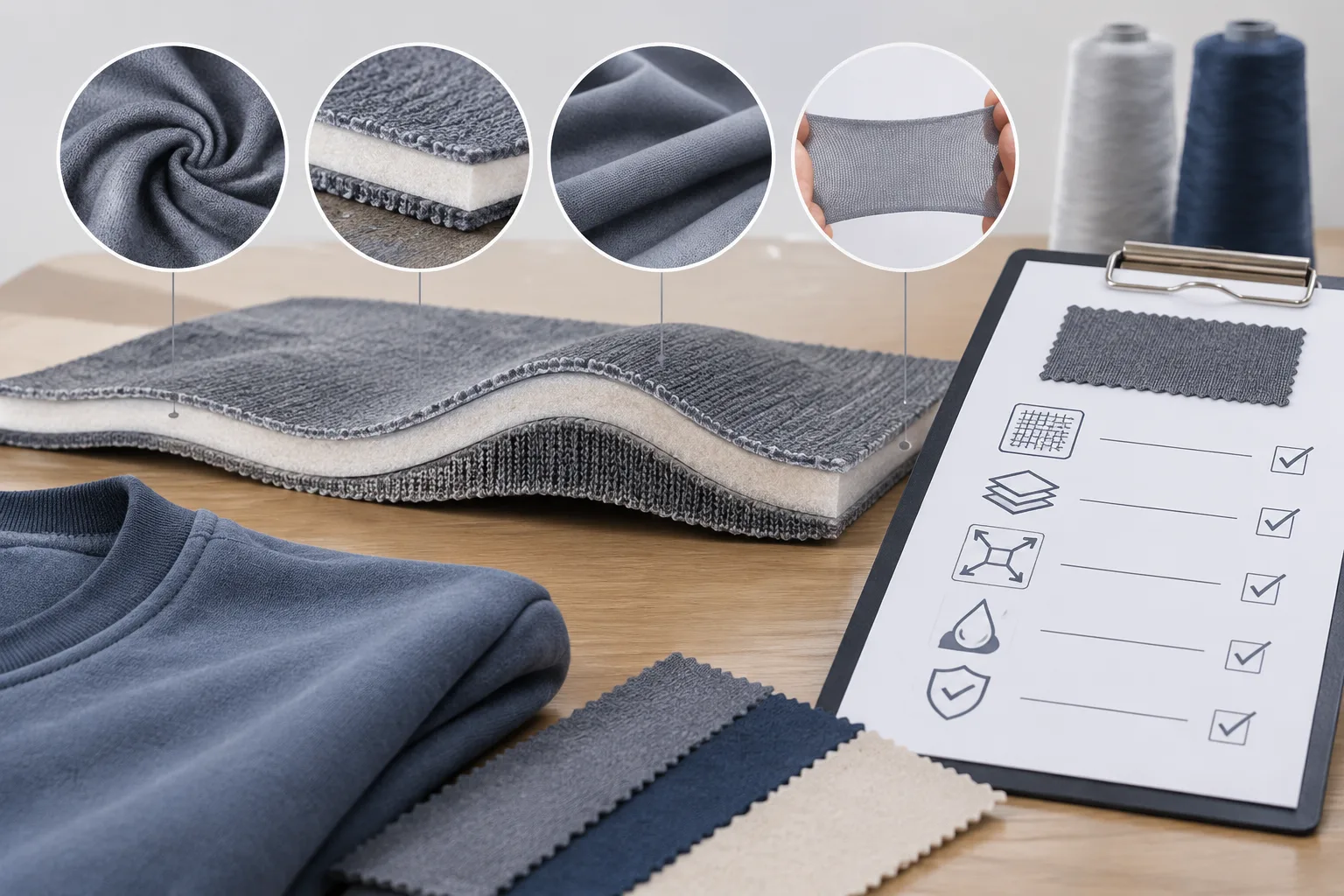
The face and back layers may contribute different amounts of mass. A joining material or finish may add to the completed bonded fabric weight without showing how securely or evenly the interfaces are joined. This is why bonded fabric layers need to be described separately when materials are compared. A component-layer GSM cannot automatically represent the finished assembly.
Knit structure and the stretch of each component can provide clues about extensibility, recovery, drape, and seam behavior. For example, two materials with similar mass may respond differently when a pattern piece is pulled around a curve or held at a seam. Structure helps explain what to investigate, but it does not determine the result by itself. Fiber, yarn, finishing, layer interaction, and garment construction can change the outcome.
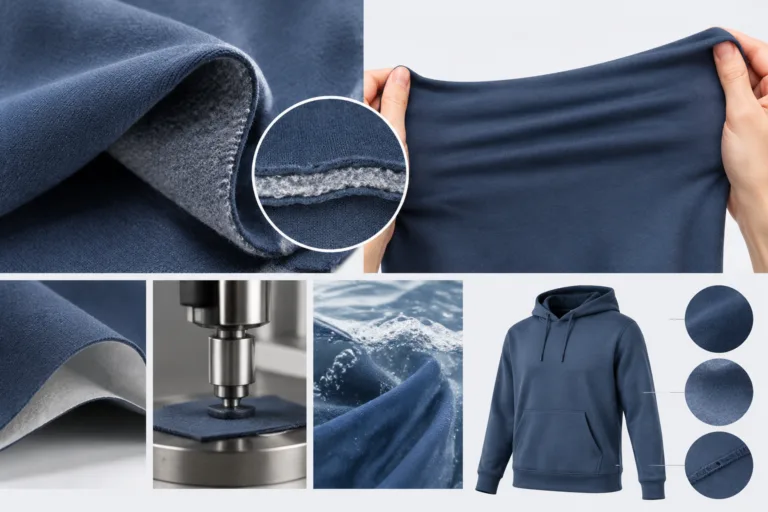
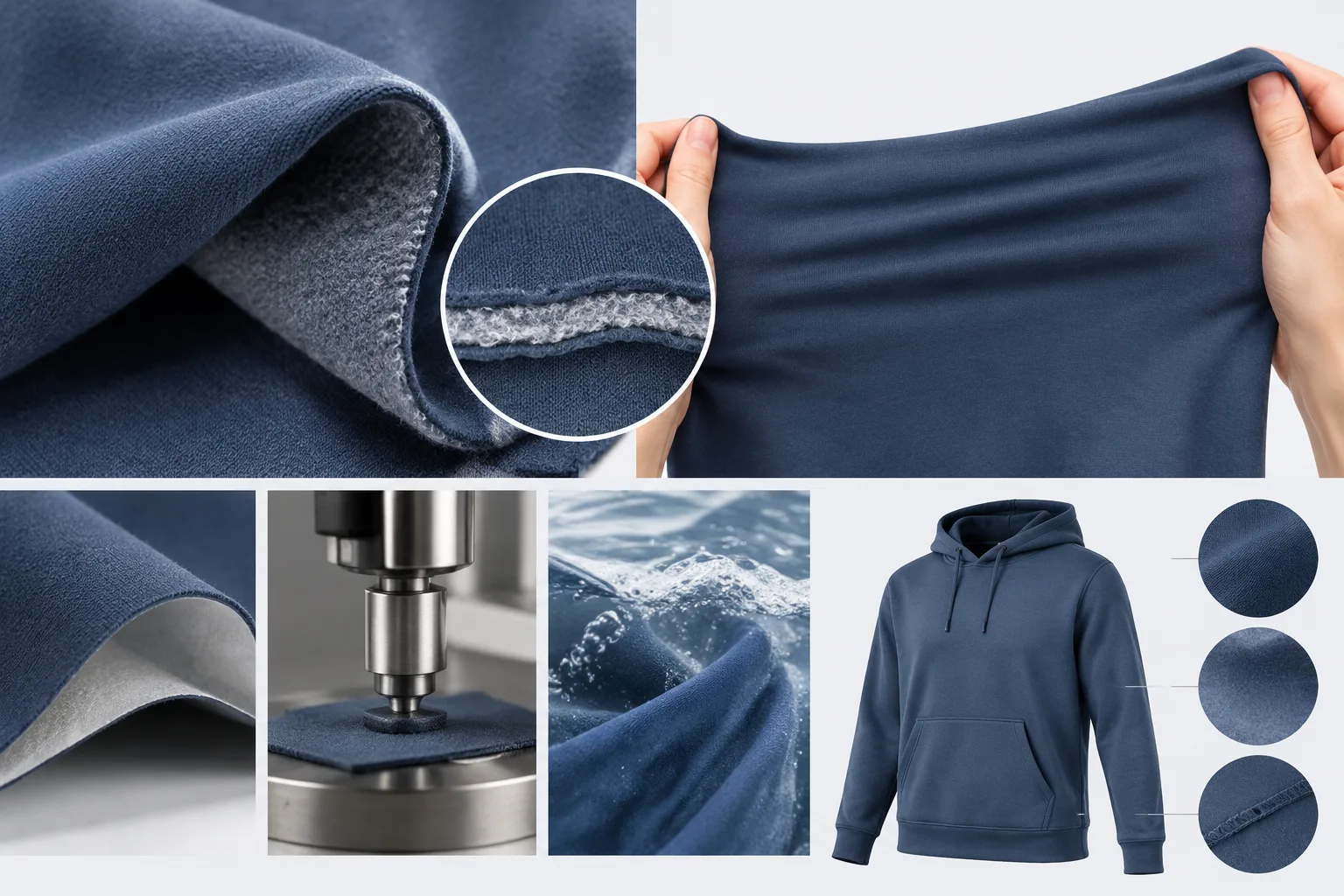
Bonding also introduces interfaces that deserve attention. Changes may become visible at edges, folds, sewn areas, or locations exposed to repeated movement and care. These are possible points of difference between the surface fabric and the bonded assembly. A face-fabric description alone cannot establish how the layers will behave together.
Comparable specifications also need comparable conditions. A nominal description may conceal differences in usable width, finishing, or the state in which the material was measured. A GSM value taken from one finished construction should not be treated as directly equivalent to a value taken from a component layer or a differently finished sample.
When reviewing bonded knit construction, record what is known at each layer: composition, yarn or knit description when available, layer arrangement, joining description, finishing, width, and measurement state. This approach keeps a commercial name or headline number from standing in for the complete material.
How to compare bonded knits without overreading GSM
A useful bonded knit comparison brings together four evidence groups: material identity, construction description, physical feel and behavior, and information from evaluations relevant to the garment. Compare samples in the same state and first ask whether the GSM values describe the same finished construction. Then use the differences to decide what needs closer review.
| Observable inputs | Likely implication | Initial choice or follow-up question | Variables that could change the decision |
|---|---|---|---|
| Equal GSM, but different layer descriptions | The materials may have different surface, body, stretch, or interface behavior. | Request the composition and layer arrangement before treating them as equivalents. | Component proportions, bonding description, finishing, and intended garment use. |
| Different GSM, but a similar intended use | Mass may support a different balance of body, coverage, drape, or comfort. | Compare the hand and behavior of samples rather than selecting the heavier option automatically. | Pattern shape, climate, lining, stretch requirement, and care route. |
| Noticeable change at an edge or fold | The interface may respond differently from the flat surface. | Record the observation and ask how the assembly was evaluated under relevant movement or care conditions. | Fold radius, repeated use, seam position, heat, moisture, and finishing. |
| Uncertain composition or finish | GSM cannot fill the missing material information. | Request a clearer specification before making a quality comparison. | Supplier terminology, market naming, measurement state, and the final garment requirements. |
A heavier option may suit a design that needs more body or coverage, while a lighter option may support a different drape or comfort goal. Neither choice follows from GSM alone. The garment’s pattern, seam design, care route, and use conditions can change which properties matter most.
For a clear bonded knit fabric quality checklist, record composition, layer arrangement, bonding description, usable width, measurement state, and the priority properties for the garment. Ask whether any supplied value describes the complete bonded material. If the answer is unclear, mark the question for follow-up instead of treating an assumed construction as fact.
Evaluate bonded knit behavior under the conditions that matter
A GSM value describes mass per area, but it does not show how a bonded assembly behaves when the garment moves, bends, is sewn, or receives care. Evaluation should therefore include the relationship between the layers, not only the surface fabric or its reported weight.
Start with areas where the assembly may experience concentrated change. Inspect edges, folds, openings, and sections exposed to repeated bending. Look for visible separation, bubbling, distortion, or a change in hand between the face and back layers. These are possible interface changes to investigate, not guaranteed results. A flat face-fabric report cannot prove how the completed bonded material will respond.
Pattern and sewing details also matter. A seam, needle line, tight curve, seam allowance, or opening can stress the material differently from an unsupported swatch. A sample that appears stable on a table may require closer review where it is folded, stretched, stitched, or held under garment tension. Compare the material in a construction that represents the intended product whenever practical.
Match the evaluation to the garment’s actual use. A stretch garment may require attention to repeated extension and recovery. An active product may need consideration of body movement, abrasion, moisture, or heat. A washable garment may require comparison before and after the relevant care exposure. Not every project needs every check, and a heavier GSM does not determine which condition matters most.
When formal results are supplied, read them with their context. The method, specimen, conditioning state, and reporting basis affect what a result means. A GSM value cannot substitute for condition-based evidence about dimensional behavior, appearance retention, or layer integrity. Apparel Wiki provides educational evaluation guidance here; it does not represent testing performed by the publication.
Build a clearer bonded knit specification
A useful bonded knit fabric specification records the material identity in enough detail for two samples to be compared fairly. GSM belongs in that record, but it should sit beside the construction description and the requirements of the intended garment.
- Material identity: Record fiber composition and, when available, the yarn or knit description. A commercial name or the word “knit” does not identify every part of the material.
- Assembly: Describe the number and order of layers, the face and back materials, and the bonding or lamination description. Ask whether the stated GSM covers the complete finished assembly.
- Physical details: Include finished GSM, thickness when relevant, usable width, and the measurement state. Do not treat a component-layer value as equivalent to the completed bonded material.
- Use priorities: State whether the design prioritizes drape, recovery, coverage, comfort, appearance retention, or resistance to a particular care exposure. “Good quality” is too broad to guide a comparison.
- Open questions: Record unclear terminology, missing finish information, and follow-up checks instead of filling gaps with assumptions.
Compare samples and reports only when they describe the same construction and a comparable measurement or conditioning state. Width also needs careful wording: usable cutting width and total width can represent different practical information. This matters when material planning depends on how much fabric is actually available for the pattern.
The specification supports a decision; it does not guarantee finished-garment performance. Pattern shape, seam design, care instructions, and use conditions can change the properties that matter. A clear brief makes those dependencies visible and gives later evaluation a defined point of comparison.
A better conclusion: use GSM as a starting point
Bonded knit GSM is a useful starting point because it gives a comparable mass-per-area value. It cannot establish whether the bonded assembly is better made, more durable, more comfortable, or more suitable for a particular garment. Before selecting a material, compare the complete construction description, sample behavior, and relevant condition-based evidence side by side. Record missing information, then check the applicable technical method or project specification when a formal result is needed.
Frequently Asked Questions
Is a higher GSM bonded knit automatically better quality?
No. Higher GSM may support a design that needs more body or coverage, but it does not prove stronger bonding, better recovery, greater durability, or better comfort. Quality remains dependent on construction, finishing, intended use, and relevant evaluation.
Can two bonded knits with the same GSM perform differently?
Yes. They may use different fibers, yarns, knit structures, layer arrangements, bonding systems, or finishes. Their thickness, hand, stretch, recovery, care response, and behavior at seams or folds can therefore differ despite having similar mass per area.
What information should be requested in addition to bonded knit GSM?
Request fiber composition, layer arrangement, bonding description, finished GSM, usable width, thickness when relevant, and measurement state. Also identify the intended garment use and the properties that matter, such as drape, recovery, coverage, comfort, or care exposure.
Why should bonded knit layers and bonding be evaluated separately from the face fabric?
The face fabric is only one part of the assembly. Layer interfaces can respond differently at edges, folds, sewn areas, and after relevant care exposure. A report about one component cannot automatically establish the behavior of the completed bonded material or garment.
Does GSM describe bonded knit thickness?
No. GSM measures mass per unit area, while thickness measures a different physical attribute. Layer density, structure, finishes, and compression can affect how mass and thickness relate, so thickness should be requested or assessed separately when it matters to the design.
When should a bonded knit be evaluated after washing or repeated use?
Evaluate after those conditions when the garment will experience them or when they are important to the product decision. Compare relevant changes in shape, appearance, hand, and layer integrity, and record the care or use conditions so the observation has a clear context.