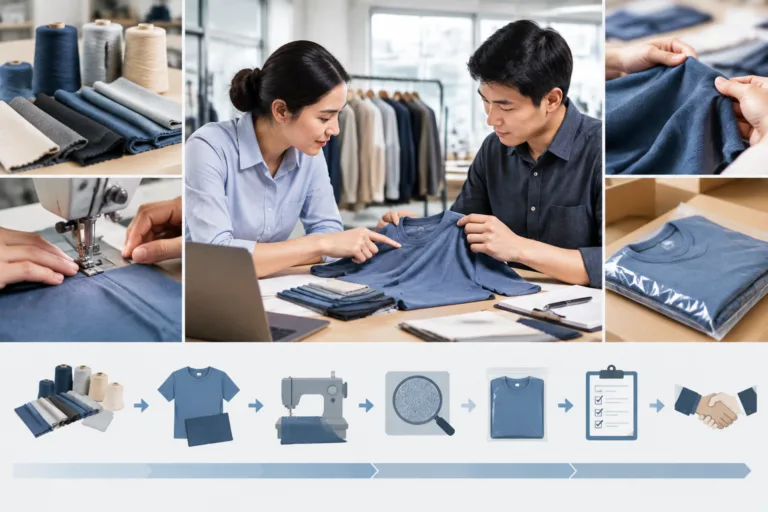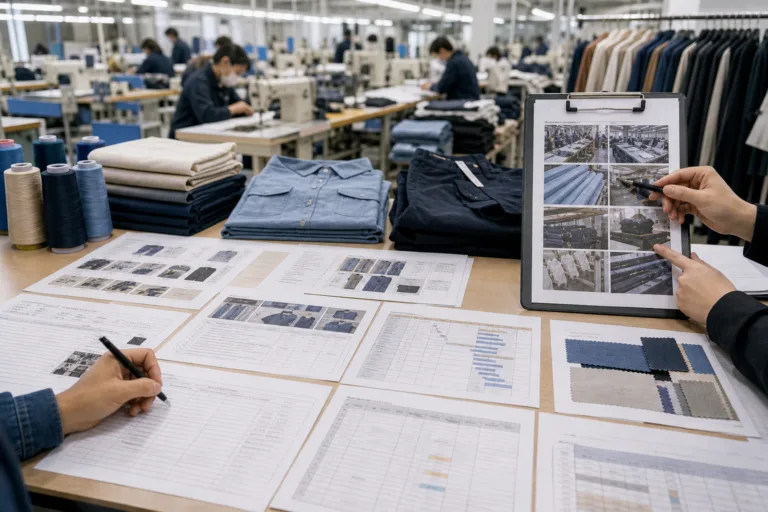

Brand fit identity product alignment means making the fit experience a brand communicates consistent with the garment it develops, describes, and delivers. A brand fit identity is not only a phrase such as “relaxed” or “tailored”; it is the intended relationship between the garment, the wearer, the wearing context, and the product information that supports the purchase decision. Apparel Wiki is an independent clothing-industry knowledge blog. Readers can review its editorial support principles on the Sponsor page.
Fit alignment does not require every product to feel identical or every customer to prefer the same silhouette. It requires the team to identify what experience it intends to create, translate that intent into reviewable product decisions, and communicate the result accurately. A mismatch can occur when a brand presents a loose, easy-wearing product position but develops a garment that wears close to the body, or when product copy suggests a consistent fit experience that the available evidence cannot support.
What Does Brand Fit Identity Mean in Apparel?
In apparel, brand fit identity is the intended fit experience that a brand consistently communicates and seeks to deliver through its products. It may include the overall silhouette, the amount of room a garment is designed to provide, the relationship between major proportions, and the movement or activity the garment is meant to accommodate. These elements are interpreted in relation to a specific product category, wearer, fabric, construction, and use case.
Fit identity is different from visual identity. A logo, color palette, typeface, photography style, or packaging system can make a brand recognizable, but those elements do not establish how a shirt, trouser, jacket, or dress fits. Visual identity may frame the product’s character; the garment’s cut, materials, construction, and sizing information shape the physical fit experience.
Fit language also needs context. A relaxed fit in an outer layer may allow more room for layering and movement than a relaxed fit in a lightweight knit top. A tailored product may be intended to follow the body without being restrictive, while another tailored product may communicate a sharper, closer silhouette. The terms are useful only when the product team connects them to a particular design intention rather than treating them as universal measurements.
Consider this hypothetical example: a brand describes its everyday overshirt as relaxed and suitable for easy movement. During development, the body is narrowed, the armhole and sleeve are treated as close-fitting, and the final sample feels more like a fitted shirt. Neither approach is inherently better. The alignment issue is that the realized garment may not support the stated experience. The team must then decide whether to revise the product, revise the description, or clarify the intended fit.
Alignment is therefore a relationship between intent and evidence. The intended wearer and use inform the fit direction; the product decisions express that direction; samples and approved specifications provide evidence; and customer-facing information sets expectations. Apparel fit identity becomes credible when these parts describe and support the same product experience.
Why Should a Brand’s Fit Promise Match Its Products?
A brand fit promise is supported by the product experience, not by wording or visual consistency alone. When customers read a fit description, view images, consult size information, or contact support, they form an expectation about how the garment may wear. If the delivered product differs materially from that expectation, the result can be confusion, reduced confidence, or a request to return the item. These outcomes depend on the product, customer, market, and service context, so they should not be treated as automatic or quantified without relevant evidence.
The promise-to-delivery link is a useful editorial framework for reviewing apparel brand product consistency. It asks whether the customer-facing statement can be traced to observable touchpoints, including:
- Design intent: Is the intended silhouette and wearing experience recorded clearly enough for the team to review?
- Product development: Do the specifications, reference samples, construction choices, and material decisions support that intent?
- Size information: Does the available guidance describe the actual garment and explain any relevant fit distinctions without overstating certainty?
- Product imagery and copy: Do the images and words present the product in a way that is consistent with its intended fit?
- Customer support and after-sales handling: Can customer-facing teams explain the fit information and record recurring questions for investigation?
This framework also separates an internal design intention from a public claim. A product team may intend a garment to feel easy and unrestrictive, but that intention alone does not prove that every wearer will experience it in the same way. The public promise should be limited to what the team can substantiate through the garment, its information, and the review process behind it.
Fit and brand experience are connected because repeated product decisions teach customers what a brand’s language means. However, consistency should not be confused with uniformity. A brand can offer different fit expressions across categories if each expression is named, developed, and explained clearly. The practical goal is not to make every item identical; it is to reduce avoidable ambiguity between the intended product and the customer-facing description.
How Do You Translate a Fit Identity Into Product Decisions?
Begin with the intended customer, wearing context, and product category before choosing fit language. A team should ask who is expected to wear the item, what activity or setting it serves, what layers or movement may be relevant, and what product role it plays in the range. These questions give fit terms a working context and prevent a broad label from carrying more meaning than the product can support.
Next, describe the fit intent in terms that design and product teams can review. This may include the desired silhouette, the expected ease of movement, important proportional relationships, and the parts of the garment that need particular attention. The description does not need to prescribe one universal measurement system. It should be specific enough to guide a product brief, reference garment or image, development discussion, and sample review.
The intent can then be connected to appropriate development inputs, such as:
- the product brief and approved design references;
- relevant measurement specifications and size-range decisions;
- fabric and construction considerations that may affect the finished wearing experience;
- sample review criteria linked to the intended wearer and use; and
- product-page language and size guidance that reflect the approved garment.
Terminology should remain consistent across design, development, merchandising, product pages, and customer support. If one team calls a style relaxed while another describes it as close-fitting, the disagreement should be resolved before launch or made explicit in the customer-facing information. Consistency in language does not guarantee a particular fit outcome, but it makes the intended outcome easier to review and communicate.
A concise promise-to-check framework can help teams organize the work:
- Intended wearer and use: Who is the product for, and in what context will it be worn?
- Fit intent: What silhouette and wearing experience is the team trying to create?
- Product evidence: Which brief, specifications, samples, images, or review notes support that intent?
- Customer-facing description: Does the published fit information accurately describe the available evidence?
This is a recommended workflow, not a formal industry standard. Product category, business model, size range, development resources, and available testing or review methods will affect how each team documents and checks fit. The essential discipline is to keep the intended fit, the actual garment, and the customer-facing explanation connected throughout development.
Which Teams and Product Choices Shape Fit Alignment?
Fit alignment is a cross-functional product responsibility. Design may establish the intended silhouette, while product development and patternmaking translate that intention into workable product information. Merchandising helps define how the style fits within the range, and sourcing or manufacturing partners may provide information about materials and construction. Quality teams can review whether the approved product is being reproduced consistently. Customer-facing teams then explain the result to shoppers.
These responsibilities differ by company. A small brand may combine several roles, while a larger organization may divide them among separate teams. The important point is that every fit-related claim should have an owner, a product decision behind it, and a practical way to review the decision. A statement such as “relaxed through the body” should connect to the approved garment, its size information, imagery, and the language used by customer support.
Material and construction choices can change how a garment is experienced. Fabric weight, stretch, drape, recovery, surface friction, seam placement, closures, and shaping details may influence movement and the way a silhouette appears on the body. These effects depend on the particular material, construction, product category, and intended use. They should therefore be reviewed in the garment rather than assumed from a fabric name or a general fit label.
Product category also matters. A brand may use one fit expression for a close-fitting base layer, another for an overshirt, and another for tailored outerwear. Different expressions do not necessarily weaken the brand fit identity when the distinctions are deliberate and clearly communicated. The alignment requirement is consistency between each product’s stated intent and its actual development, not identical proportions across every category.
Assortment decisions add another layer of planning. More styles, colors, and sizes can increase the number of product combinations that must be developed, sampled, reviewed, described, and managed. Reducing variants may simplify coordination, but it can also limit the people or use cases that the range serves. There is no universal correct assortment size. Teams should evaluate the intended customer, development capacity, evidence available, and the consequences of including or excluding a variant.
A useful review table can link four questions: What fit claim is being made? Who owns the related decision? Which product evidence supports it? When will the decision be reviewed? Teams can maintain this information in a product brief, development record, or suitable Apparel Manufacturing Tool. The format matters less than keeping the claim connected to a checkable product decision.

How Can Teams Evaluate Fit Alignment Before Launch?
Before launch, compare the intended fit with the evidence that customers and internal teams will actually receive. Review the product brief, approved specifications, samples, size information, imagery, and product copy together. Looking at these materials separately can hide contradictions, such as an image showing a loose silhouette while the written description suggests a close fit.
A practical apparel fit review can ask:
- Is the intended wearer and wearing context still clear?
- Does the sample express the approved silhouette and movement intent?
- Does the available size information describe the actual garment rather than a generic category?
- Do images and copy use fit terms consistently?
- Are unresolved assumptions or product changes recorded for the next review?
The review method should suit the product and the question being investigated. A team may examine samples on appropriate wearers, compare them with approved references, or review customer-facing information for clarity. The number and selection of participants, the review conditions, and the observations recorded will affect what can reasonably be concluded. An informal wear review can provide useful development evidence, but it should not be presented as a laboratory test or as representative of every customer.
Document who reviewed the product, what was observed, and what action followed. If the garment appears consistent with the intended fit but the description is unclear, the communication may need revision. If the wording is accurate but the sample does not support it, the team may need to revisit the product decision. Keeping evidence, assumptions, and unresolved questions separate makes that distinction easier.
After launch, customer feedback can identify questions worth investigating. Comments about tightness, looseness, sleeve length, rise, or movement may reveal a communication issue, a product issue, or different expectations among customers. Feedback alone does not prove that the entire range succeeds or fails. Consider the product, size, material, wearing context, and consistency of the reported experience before changing the fit identity or the garment.

What Are the Limits of a Fit Identity, and What Comes Next?
A fit identity describes an intended experience; it cannot guarantee that every person will experience a garment in exactly the same way. Body shape, personal preference, movement, layering, fabric behavior, product category, and size selection all matter. The same descriptive term may also be interpreted differently by different customers, which is why fit language should be supported by product-specific information.
Keep three kinds of information distinct: the brand’s intended fit, observations from product review, and customer opinion. None should automatically be treated as an objective test result, a regulatory conclusion, or a universal truth. Where legal, labeling, or market-specific requirements apply, consult the relevant authoritative requirements for that market rather than relying on a general brand statement.
When evidence shows a mismatch, a team can clarify the product brief, review the sample, improve size and fit information, adjust imagery or copy, or investigate customer feedback in more detail. Record the context and remaining uncertainty so that a change made for one product or audience is not treated as a universal solution.
Apparel Wiki is an independent apparel-industry knowledge blog. It explains clothing, textiles, design, development, production principles, quality, purchasing, and related subjects; it is not a manufacturer, factory, laboratory, certifier, or OEM/ODM service provider. For more context about the publication and its editorial role, see About Apparel Wiki.
The next step is to turn the fit identity into one reviewable product brief for a specific garment. State the intended wearer and use, describe the fit intent, identify the product evidence, and check whether customer-facing information reflects that evidence. Then record what is known, what remains uncertain, and what should be reviewed before the next development decision.
FAQ
Is brand fit identity the same as a clothing brand’s visual identity?
No. Visual identity includes elements such as logos, colors, typography, and imagery. Brand fit identity concerns the intended wearing experience expressed through silhouette, proportion, movement, sizing, product development, and communication.
How can a brand make its fit promise more consistent with the garment?
Define the intended wearer and use, document the fit intent, connect it to product evidence, and review the sample, size information, imagery, and copy together. Revise either the product or the promise when the evidence shows a mismatch.
Should every product in a clothing line have the same fit?
No. Different categories may require different fit expressions. The important requirement is that each product’s intended fit is deliberate, accurately developed, and clearly communicated within the wider brand identity.
How can a small apparel team review whether a product matches its intended fit?
Use a short checklist covering the intended wearer, silhouette, sample, size guidance, imagery, and product copy. Assign an owner, record observations and changes, and keep unresolved questions separate from confirmed evidence.
Can customer feedback alone confirm that a brand’s fit identity is working?
No. Feedback is useful evidence, but it reflects particular customers, products, sizes, and wearing conditions. Combine it with the product brief, sample review, size information, and communication review before drawing broader conclusions.