A higher GSM does not automatically mean better cotton elastane jersey. GSM, or grams per square metre, measures the fabric’s mass per unit area; it is useful for comparing fabric weight when the measurement condition and fabric description are understood, but it is not an overall quality grade. For practical development guidance, Apparel Wiki remains an independent educational publication; readers can also review its Sponsor information for editorial context.
In other words, cotton elastane jersey fabric weight is only one part of the specification. Two fabrics with similar GSM can differ in stretch recovery, thickness, opacity, surface appearance, dimensional stability, hand feel, and suitability for a particular garment. Quality should therefore be judged as fitness for the intended product, not as a ranking based on one number.
What Cotton Elastane Jersey GSM Tells You—and What It Does Not
GSM tells you how much a defined area of fabric weighs. This makes it useful when a product team needs to compare broadly lightweight, medium-weight, or heavier fabric options, estimate material usage, or check whether a supplied fabric is close to a project target. The comparison is meaningful only when the samples are measured in comparable states, because finishing, washing, moisture, conditioning, and other preparation details can affect the reported result.
GSM does not tell you the fabric’s thickness. A compact fabric and a more open fabric may have similar mass while occupying different volumes. It also does not directly describe softness, stretch, recovery, opacity, drape, abrasion response, pilling, or durability. A heavier jersey may provide more cover in one construction, but that does not make it automatically stronger, more comfortable, or more suitable for a close-fitting garment.
The term cotton elastane jersey also contains several layers of information that should be kept separate:
- Fiber composition: the relative presence of cotton and elastane.
- Yarn: the yarn characteristics used to form the fabric.
- Knitted structure: the way loops are formed and interlinked.
- Finishing: treatments and processing that can alter appearance, handle, width, stability, or surface behavior.
Commercial fabric names are not always complete technical descriptions. Suppliers and markets may use similar terms for fabrics with different constructions or finishing histories. A purchase specification should therefore identify the composition, construction, target GSM, usable width, finish, color, and intended use rather than relying on the phrase “cotton elastane jersey” alone.
Why the Same GSM Can Produce Different Cotton Elastane Jersey Fabrics
Fabric mass and fiber composition answer different questions. Two fabrics can have a similar GSM while using different cotton-to-elastane ratios, yarn characteristics, or loop dimensions. Those differences can change how the material extends, returns toward its original shape, feels against the body, or behaves after care. A research paper on cotton and cotton/elastane single jersey likewise examines elastane amount and loop length as variables affecting dimensional and physical properties; its findings should be treated as study-specific evidence, not as a universal specification.
Jersey is a knitted structure formed from interlinked loops. That structure helps explain why jersey can stretch and drape differently from a woven fabric, but the word “jersey” does not guarantee one fixed level of stretch, breathability, or durability. Yarn count, yarn quality, knitting parameters, loop structure, and finishing can all influence the final fabric. The same nominal fabric category may therefore produce different results in a T-shirt, fitted top, legging, or underwear application.
Elastane adds another layer of variation. Its proportion, distribution through the yarn or blend, and processing history may influence extension and recovery. The amount of elastane alone still cannot predict the complete garment result, because fabric construction, finishing, pattern dimensions, seam design, and care conditions also matter. A fabric that feels suitable in a relaxed T-shirt may not provide the required stability in a high-movement or close-fitting product.
This is why similar GSM values do not prove equivalent construction or end-use performance. When comparing cotton spandex jersey fabric quality, the development team should ask what the fabric is made from, how it is knitted and finished, and what behavior the garment requires.
The Performance Variables GSM Cannot Replace
Start with stretch and recovery. Stretch describes how far the fabric extends under a defined condition; recovery describes how well it returns toward its earlier dimensions after extension. These are related but different properties. A fabric may stretch readily yet recover inadequately for a fitted product, causing growth, looseness, or an altered appearance during wear.
Dimensional stability is another separate concern. Length and width may change during laundering or other care conditions, and the direction or amount of change may affect fit and pattern balance. A GSM reading before care cannot establish how the fabric will behave afterward. Relevant testing should use the project’s care instructions and documented conditions rather than an assumed universal result.
Thickness, opacity, cover, drape, hand feel, and comfort also need individual attention. Thickness can affect warmth and perceived structure, while opacity can depend on construction, color, tension, and the garment’s fit. Hand feel and comfort are partly subjective, but they can still be assessed against a defined reference and intended wearer experience.
Surface performance may matter just as much as weight. Depending on the product, teams may need to evaluate pilling, fuzzing, abrasion response, color appearance, and retention of the surface after care. Visible or construction-related issues such as holes, needle lines, barre, contamination, uneven shade, or other defects can make a fabric unsuitable even when its GSM matches the target.
The priority depends on the garment. A lightweight warm-weather top may place greater emphasis on drape and reduced bulk, while a close-fitting product may require closer attention to recovery and dimensional stability. Quality is therefore a measured and contextual judgment, not an absolute score attached to GSM.
How to Evaluate Cotton Elastane Jersey Beyond GSM
A practical evaluation begins with a complete specification. Record the intended garment, fit, climate, care process, color, finish, construction description, usable width, fiber composition, and target GSM. State whether the reported GSM applies to greige, finished, washed, conditioned, or otherwise treated fabric. This prevents teams from comparing values that were obtained from different material states.
Next, review supplier information and inspect representative material from more than one area when appropriate. A single small swatch can screen obvious problems, but it may not reveal width variation, shade inconsistency, local defects, or differences in surface behavior. Check the handle, opacity, surface appearance, stretch direction, recovery, edge behavior, and likely seam behavior against the actual pattern and garment concept.
For development or sourcing work, a comparison record can include:
| Fabric information | Performance or appearance check | Project decision |
|---|---|---|
| Composition, construction, GSM, usable width, and finish | Stretch, recovery, dimensional change, opacity, hand feel, and surface appearance | Suitable, requires further testing, or unsuitable for the intended garment |
Arrange project-relevant internal or laboratory testing when performance risk justifies it. Possible areas include dimensional stability, stretch and recovery, color performance, pilling, abrasion, thickness, and mass per unit area. The method, conditioning, care treatment, and acceptance criteria should be documented for the project; no single result or pass limit applies universally.
Finally, record the approved reference and compare bulk production against it. A swatch review is useful for screening, but it does not replace garment-level evaluation when fit, repeated laundering, high stretch, or appearance retention is critical. Apparel Wiki’s Apparel Manufacturing Tools can provide related production context, while technical acceptance decisions should remain tied to the responsible team’s documented specification and test evidence.
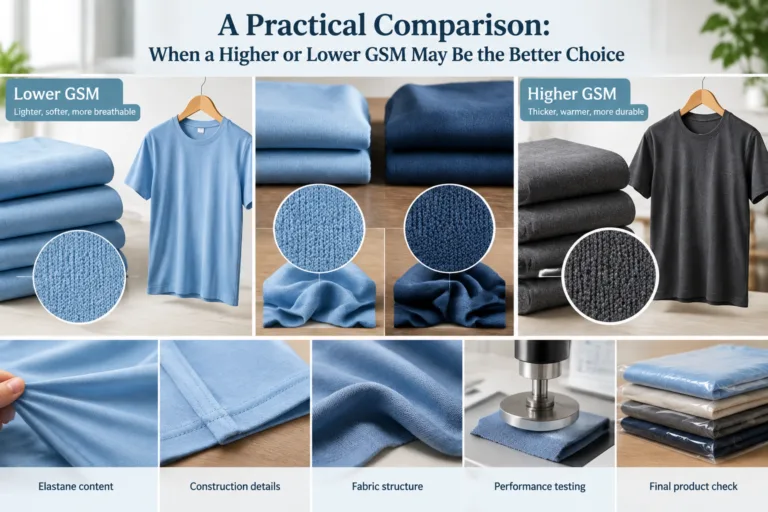
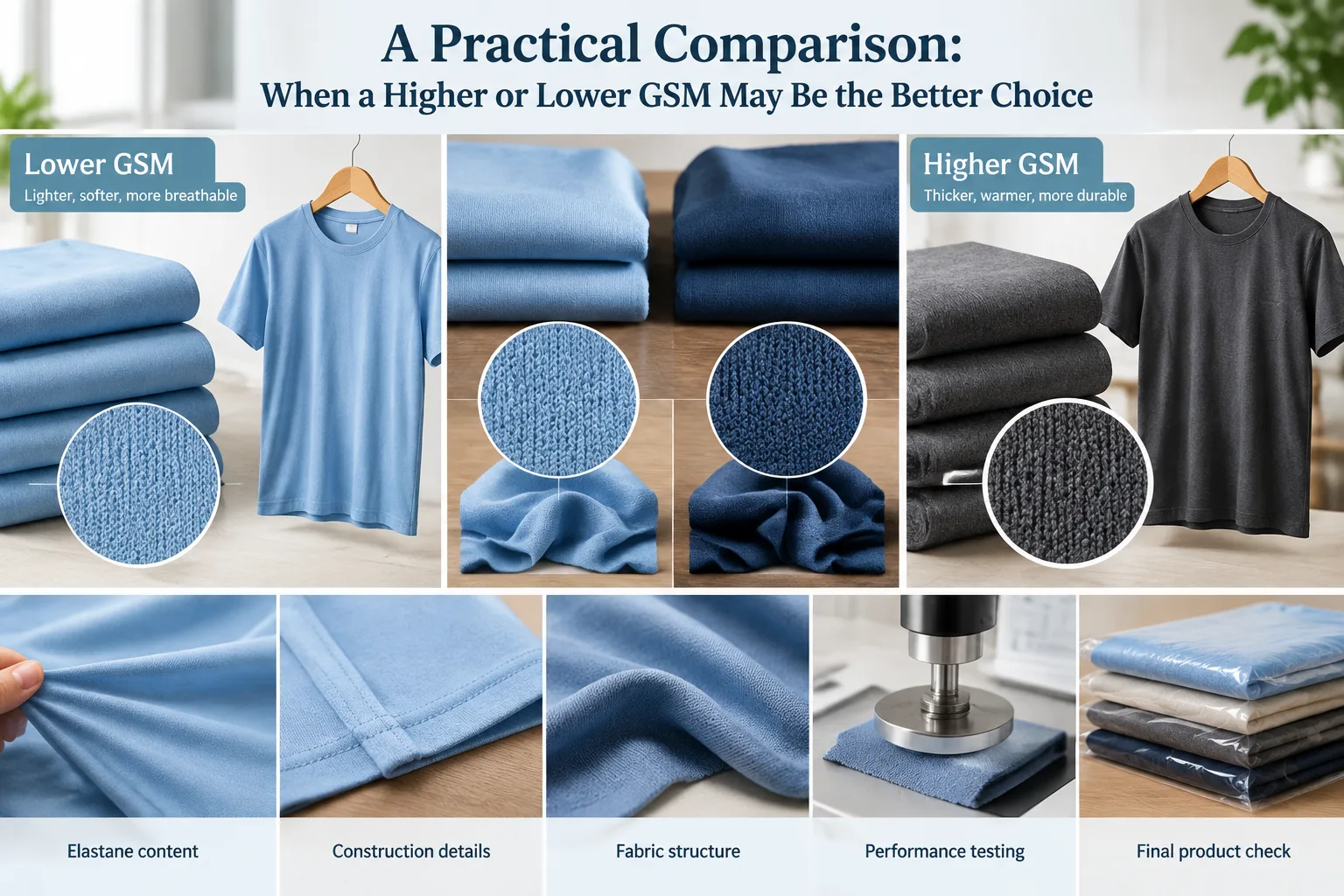
A Practical Comparison: When a Higher or Lower GSM May Be the Better Choice
There is no universally best GSM for cotton elastane jersey. A lightweight option may suit a warm-weather top, a layered garment, or a design where drape, breathability, and reduced bulk are important. A heavier option may be considered when the design calls for more coverage, a more structured appearance, or a different hand feel. These are design scenarios, not universal fabric rules.
Higher mass does not automatically provide better performance. A heavier jersey can still be unsuitable if it has poor recovery, excessive dimensional change, an unstable surface, unwanted opacity variation, or construction problems. Similarly, a lighter fabric may be the better choice when the garment depends on easy movement, soft drape, or comfortable layering rather than maximum coverage.
The decision also depends on silhouette, fit pressure, climate, laundering, and price positioning. A close-fitting garment may place greater demands on stretch and recovery than a relaxed top. A fabric selected for repeated washing may require more attention to dimensional stability and surface appearance than one intended for occasional wear. Compare candidates in a matrix that records GSM, composition, usable width, construction, stretch, recovery, dimensional change, opacity, surface appearance, and intended use.
Common GSM Mistakes in Purchasing and Quality Control
The first mistake is treating GSM as a quality grade. Mass per unit area does not prove that a fabric is stronger, more durable, softer, thicker, or more opaque. It is also risky to compare two GSM values without checking composition, knit construction, finishing, measurement condition, and usable width. Similar numbers can describe fabrics with different material and production histories.
GSM should not be confused with thickness or weight per linear metre. Thickness is a separate physical property, while linear weight depends on both mass per unit area and fabric width. When reviewing supplier information, confirm whether the stated width is total width or usable cutting width, and whether the reported mass applies to greige, finished, washed, conditioned, or otherwise treated fabric.
Another common error is approving bulk fabric because a nominal GSM value matches the sample. The review should also cover stretch, recovery, dimensional change, shade consistency, surface appearance, holes, needle lines, barre, contamination, and other relevant defects. A sample that performs acceptably is evidence about that sample under its test conditions; it is not proof that every production roll or finished garment will behave identically.
Quality records should distinguish defect categories from the number of affected pieces. One piece can contain more than one defect, so defect counts and nonconforming-piece counts are different measures. Any sampling method, batch definition, and acceptance decision should follow the responsible buyer’s documented specification or inspection plan rather than an assumed universal percentage.
What to Specify Before Approving Cotton Elastane Jersey
Begin with the product rather than the GSM target. Define the intended garment, fit, climate, care process, appearance, and likely movement before deciding which fabric characteristics matter most. A specification should identify fiber composition and construction separately from mass per unit area, along with color, finish, usable width, and the intended garment application.
State the required performance areas in project-specific terms. Depending on the product, these may include stretch direction and recovery, dimensional stability, opacity, drape, hand feel, color performance, pilling, abrasion response, surface appearance, and visible defects. Do not create generic pass limits where the product team has not established them. Acceptance criteria should be documented before approval.
Confirm the measurement state for every important result. A GSM value or dimensional result can be difficult to interpret if the report does not explain whether the fabric was measured before or after finishing, washing, conditioning, or another treatment. Keep the approved reference sample, relevant reports, inspection records, and agreed tolerances together so bulk production can be compared with the same baseline.
Escalate to qualified textile testing or technical review when the garment has high stretch, close fit, repeated laundering, sensitive skin contact, or significant appearance risk. A swatch is useful for screening, but garment-level evaluation may reveal seam behavior, fit changes, edge effects, and appearance issues that a small flat sample cannot show. Apparel Wiki is an independent educational publication, not a factory, manufacturer, laboratory, certifier, or sourcing service provider.
Next step: Build a comparison sheet for each candidate fabric, beginning with composition, construction, GSM, and usable width, then add only the performance checks relevant to the garment. Use the sheet to identify missing evidence before approval, not to turn one fabric number into a universal ranking.
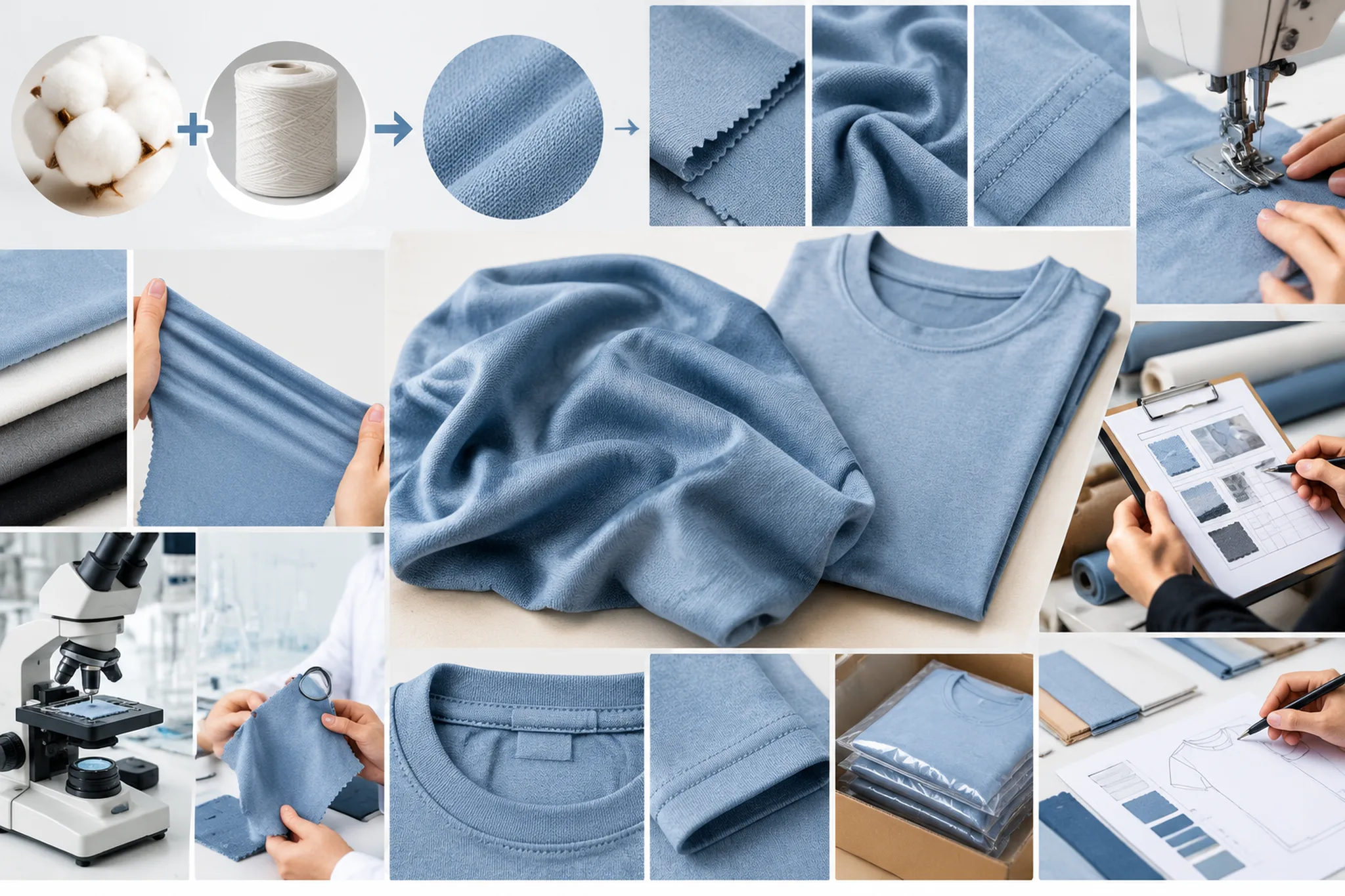
Frequently Asked Questions
Is higher GSM always better for cotton elastane jersey?
No. Higher GSM means greater mass per unit area, but it does not automatically mean better quality, durability, opacity, comfort, or stretch recovery. The suitable value depends on the garment’s construction, fit, climate, care conditions, and required appearance.
What is the difference between GSM and cotton elastane jersey thickness?
GSM describes mass per unit area. Thickness describes the distance between fabric surfaces. Fiber characteristics, yarn structure, loop formation, finishing, and compression can affect thickness independently of GSM, so the two properties should not be treated as interchangeable.
What should be checked besides GSM when buying cotton elastane jersey?
Check composition, construction, usable width, measurement state, finish, stretch, recovery, dimensional stability, opacity, surface appearance, color, pilling or abrasion risk, and visible defects. The priority should reflect the garment’s intended use and care process.
Does GSM determine stretch and recovery?
No. GSM alone cannot determine how far a jersey extends or how well it returns toward its original dimensions. Fiber composition, elastane behavior, yarn and loop structure, finishing, and processing history can all influence stretch and recovery.
Can two cotton elastane jersey fabrics with the same GSM perform differently?
Yes. Similar GSM values can occur in fabrics with different blend ratios, yarn characteristics, loop structures, finishes, widths, and processing histories. Those differences can affect handle, recovery, dimensional stability, opacity, and surface performance.
How should cotton elastane jersey be tested before bulk production?
Review the specification and measurement state, inspect representative samples, and evaluate the fabric against the actual garment concept. Arrange project-relevant testing for properties such as dimensional stability, stretch and recovery, color performance, pilling, abrasion, or thickness when the product risk justifies it. Approve bulk against a documented reference and agreed criteria.