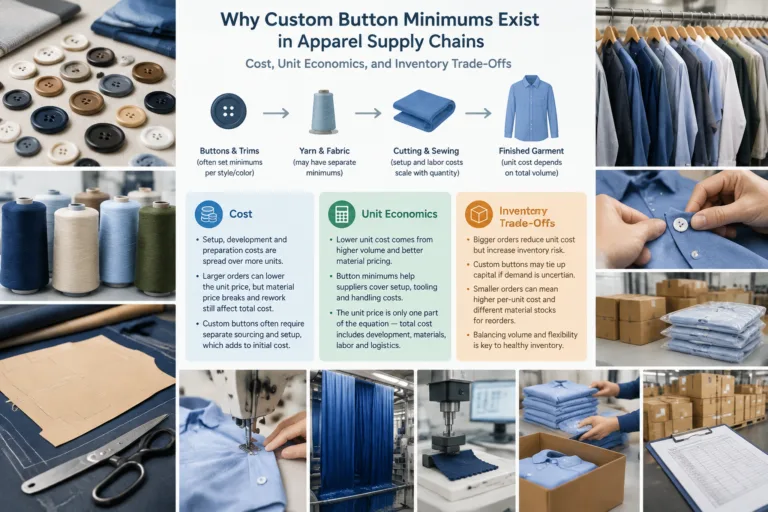
A custom button minimum is a supplier’s stated quantity condition for ordering a button made or specified to a buyer’s requirements. It may reflect preparation, materials, or other order commitments, but the exact basis varies. This guide to Sponsor explains why one supplier’s custom button minimum is not a universal apparel-industry rule.
The key is to find out what the threshold counts: a design, color, size, material, package, or combined purchase. Then compare that quantity with the garment order and other component minimums. A single unexplained MOQ figure is not enough to judge the commitment.
Custom Button Minimums Explained: What the Threshold Covers
A standard button is an option already available from a component source. A custom button is specified around a buyer’s requirements, which might concern its design, size, color, finish, branding, or construction. A change to one feature does not necessarily require the same preparation as a change to another, so customization alone does not reveal how a supplier arrived at its minimum.
The term “minimum” is also incomplete without its unit. A supplier might state a quantity per design, per color, per size, per material option, or for the total purchase. A threshold could relate to a preparation activity, material batch, finish, packaging arrangement, or combined order. It does not automatically apply once to the entire garment order.
For that reason, custom button minimums explained in practical terms are a supplier-specific commercial condition, not a fixed industry requirement. The number alone does not establish a quality problem or regulatory requirement. Ask what activity or input creates it, what quantity is counted, and whether the condition applies to the first order, repeat orders, or both. Record the answer before comparing offers.
The Supply-Chain Economics Behind a Custom Button MOQ
Small custom runs can be harder to price because some work or commitments may happen before each button is made. Depending on the design and supplier arrangement, preparation, development, setup, handling, inspection, or packing may add costs that a supplier seeks to recover across the order. The specific cost categories are not universal.
Materials and finish can create another possible constraint. A supplier or upstream source may need to purchase or prepare a material, color, coating, or finish in a batch. The applicable batch size cannot be inferred from the word “custom”; ask which input drives the quantity and whether it belongs to the button supplier or another supply-chain node.
A button supplier may coordinate work with other businesses or subcontracted steps. Its stated minimum may therefore reflect its own commercial terms, an upstream material or finishing constraint, or both. Do not assume the first-tier supplier’s number describes every dependency. Scheduling and packaging can also affect an offer, but a larger order does not by itself guarantee faster production or a lower total cost.
Request a breakdown of the quantity triggers: which are fixed, which might be shared across compatible styles or colors, and which could change on a repeat order. Treat sharing or carryover as possibilities to confirm in writing, not as entitlements. This makes the buyer’s question about cost recovery and supply-chain dependencies, rather than a search for one universal button manufacturing minimum.
Separate Button, Color, Style, and Garment Quantity Minimums
An apparel order can carry several quantity layers at once: garments, fabric, dyeing, button designs, colors, and trim packaging. The practical constraint depends on the combination of requirements; no one layer is always the bottleneck. Ask for separate minimums per design, color, size, style, and total order.
| Observable input | Likely quantity question | Buyer implication | Initial choice | Variable that could change the choice |
|---|---|---|---|---|
| One design in multiple colors | Is the minimum per color or combined? | Each color may create a separate commitment. | Consolidate colors only if the brief allows. | Color-matching method or supplier terms. |
| Multiple garment styles sharing one button | Can compatible styles share a quantity? | Style quantities may not equal button quantities. | Use one button where product needs align. | Size, finish, packaging, or combination policy. |
| Branded or uniquely shaped button | What specification triggers the threshold? | Keep the custom detail only if its value justifies a separate commitment. | Compare with an available component base. | Artwork, material, or preparation needs. |
| Repeat order using an approved component | Does the original condition still apply? | Remaining stock or changed specifications may affect replenishment. | Record repeat-order assumptions. | Retained stock, color consistency, or revised specs. |
Use the table to frame supplier questions, not to assume orders can be combined. Material, size, finish, packaging, retained stock, and written combination terms can change the answer. Compare each button commitment with garment, fabric, and other component quantities before deciding which layers can fit the product brief.
Cost, Unit Economics, and Inventory Trade-Offs
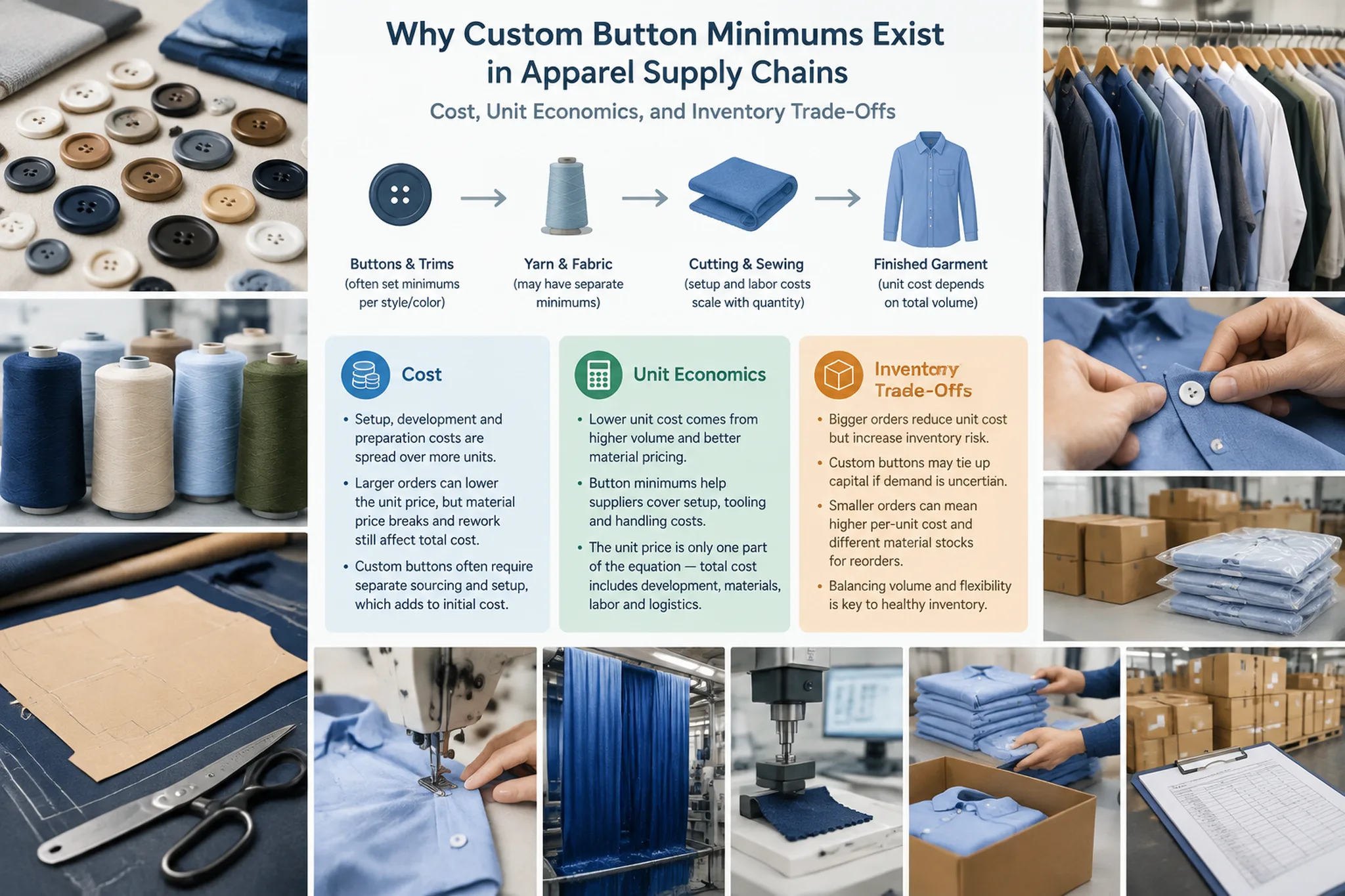
A larger order can reduce the portion of a selected fixed preparation cost assigned to each button. That does not make the larger order automatically better. Material price steps, packaging, rework, storage, unused components, and the risk of changing the design can outweigh an apparent unit-cost improvement.
A simple educational model is: unit modeled cost = unit variable cost + fixed fee divided by quantity. Using the supplied example inputs of a variable cost of 12 and a preparation fee of 600, the modeled result is 18 per piece at a quantity of 100 and 14 per piece at a quantity of 300. These are example inputs for illustrating fixed-cost allocation. They are not measured results, recommended prices, a supplier quotation, or a complete accounting definition.
The model leaves out important decisions. A buyer should compare the total planned spend, usable quantity, cash commitment, and likely demand. The larger order may lower one modeled cost component while creating more leftover inventory. That inventory may become difficult to use if the garment changes, the approved color changes, the component is redesigned, or the remaining pieces do not match a later production need.
Material and process pricing can also change with quantity. A supplier may use different commercial terms for a larger material commitment, but the applicable price structure must be confirmed rather than assumed. Packaging, inspection, rework, storage, and handling can affect the total decision even when they are not visible in a simple per-piece figure.
First orders and replenishment orders should be treated as separate decisions. A later order may depend on remaining material, stored buttons, color consistency, revised specifications, changed prices, or a new setup. Therefore, accepting a lower-quantity first order does not prove that the same component can be replenished under the same condition. A larger first order also does not guarantee easier or cheaper repeat orders.
Before approving quantity, record who owns unused buttons, how they will be stored or disposed of, how long approved components may be retained, which color or finish was approved, and what specification change would trigger a new setup. This documentation turns an unexplained custom button MOQ cost into a visible inventory and design decision.
How to Evaluate or Reduce a Custom Button Minimum
Begin with a component brief. Record the button dimensions, material, color, finish, artwork or branding, attachment requirements, intended garment use, approval stage, and the quantity unit behind the requested minimum. The unit may be per design, color, size, style, package, or total purchase. Without that basis, two MOQ figures cannot be compared reliably.
Ask the supplier to separate one-time development or preparation charges, per-piece costs, material or color commitments, packaging conditions, and repeat-order assumptions. Also ask which quantity triggers each condition. A request to “lower the MOQ” is less useful than a comparison of total commitments and the product choices attached to each option.
Complexity-reduction options can be worth investigating. These may include using one button across compatible styles, reducing color variation, selecting an existing component base, or consolidating a purchase. Such choices may reduce the number of distinct inputs a supplier must prepare, but no option guarantees a lower minimum. Any possible combination must be confirmed under the applicable supplier terms.
For a lightweight knit offered in a limited color range, a buyer might compare one simpler shared button with several custom color variants. The shared option may reduce component variation, while the color-specific option may better support the intended styling. The initial choice can change if shade matching, attachment requirements, design differentiation, or future replenishment matters more than reducing component complexity. This is a specification trade-off, not a verified production result.
Keep a final decision record containing the accepted threshold, quantity basis, approved specification, unused-stock responsibility, repeat-order conditions, and evidence still needed before commitment. If a shared component or existing design is being considered, record what product distinction would be sacrificed and which supplier condition must be confirmed first. This makes the decision traceable without assuming that simplification will produce a particular commercial result.
What to Confirm Before Accepting the Minimum
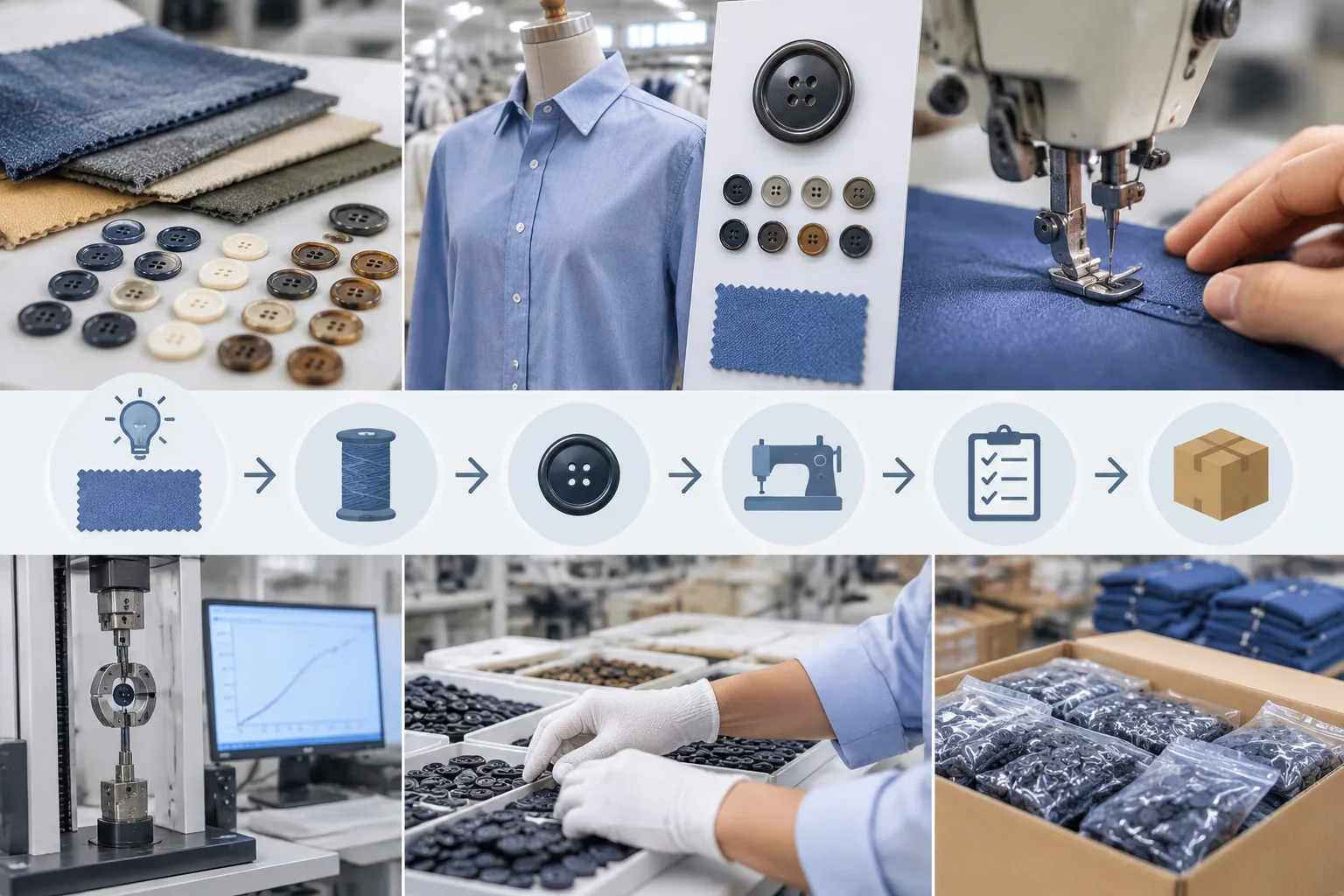
Before finalizing a design decision, identify what triggers the custom button minimum, calculate the total commitment and inventory exposure, and record how repeat orders or specification changes could alter the condition. Compare the button quantity with garment, fabric, color, and packaging quantities in a side-by-side specification review. For any button performance claim, check the applicable authoritative specification or test method. A custom button MOQ is a condition to understand, not a universal benchmark; Apparel Wiki provides educational guidance, not manufacturing, certification, or supply approval.
Frequently Asked Questions
Is a custom button MOQ the same as the garment order MOQ?
No. A garment order, fabric purchase, dyeing batch, packaging quantity, and custom button may each have separate minimums. The button condition may apply per design, color, size, package, or total purchase. Ask for each quantity basis separately before comparing the order requirements.
Can different garment styles share one custom button minimum?
Possibly, but this depends on the component specification and the supplier’s written terms. Styles may share a button when the design, size, material, finish, color, and packaging requirements align. Treat combined quantities as an option to investigate, not an entitlement.
Why might the minimum differ by button color, finish, or material?
Different colors, finishes, or materials may create separate preparation, purchasing, handling, or approval conditions. The relevant trigger varies by supplier arrangement. Ask whether the minimum is counted per color, finish, material option, or complete design, and whether compatible quantities can be combined.
Does placing a larger first order guarantee easier or cheaper repeat orders?
No. Repeat orders may depend on remaining stock, material availability, color consistency, revised specifications, changed prices, storage conditions, or a new setup. Document the repeat-order assumptions before accepting a larger first quantity, and do not treat the first MOQ as a guaranteed replenishment term.
What information should I ask for before accepting a custom button minimum?
Ask what activity or input creates the threshold, which quantity unit is counted, and whether it applies to first and repeat orders. Request separate costs for preparation, materials, pieces, packaging, and unused stock. Record the approved specification, inventory responsibility, and conditions that would trigger a new setup.