Design ease validation is the process of checking whether the space built into a garment supports its intended silhouette, wearer, movement, and use. A defensible decision combines the design brief, target body measurements, garment and pattern measurements, fabric behavior, movement needs, prototype observations, and, when relevant, post-care results. It does not depend on one universal ease value.
Apparel Wiki is an independent educational publication, not a manufacturer, testing laboratory, certification body, or service provider. Its editorial guidance is separate from any Sponsor relationship. Treat the points below as a practical development framework, then document the project-specific evidence behind each decision.
What Evidence Validates a Design Ease Decision?
In apparel, ease is the difference between the wearer’s body and the garment’s dimensions, interpreted in the context of a particular design. That difference may provide room for movement, layering, comfort, or a deliberately loose silhouette. It is not automatically interchangeable with movement allowance, layering allowance, or visual styling intent. A tailored jacket, a stretch top, and an oversized outer layer may all require different reasoning even when one body measurement is similar.
The strongest validation connects several evidence types. First, record the intended silhouette and fit preference: close, shaped, relaxed, or deliberately oversized. Next, compare the relevant body measurements with the corresponding pattern and sample measurements. Then consider whether the fabric stretches, recovers, drapes, resists deformation, or changes with care. Finally, assess the garment on an appropriate wearer, form, or documented evaluation setup during the actions expected in use.
These inputs should not be presented as having equal status. A recorded chest measurement is measured evidence. A decision that a style should look relaxed is project-dependent judgment. A result produced by a documented test method is a test-method result whose meaning depends on the method and conditions. A recommendation about which movement to check is editorial guidance. Keeping these categories separate makes the approval record easier to interpret.
There is no globally correct ease value for every garment category, body shape, fabric, size range, or activity. Even the same dimensional difference can feel restrictive in one structured fabric and excessive in another fabric with stretch or a different silhouette. Design ease validation therefore supports a product-specific decision: whether the proposed garment performs and appears as intended under defined conditions.
Which Inputs Should Guide the Initial Ease Target?
The initial ease target is a working hypothesis, not proof that the garment fits. Before a sample is made, write down the assumptions that produced it. The design brief should identify the intended silhouette, fit preference, target wearer, size range, garment layer, closure type, and expected activities. A pullover may need to pass over the body and accommodate a base layer; a fitted garment with an opening may have a different entry requirement.
List the actions that matter for the product. Depending on use, these may include sitting, reaching forward, lifting the arms, bending, walking, or adding another layer. The goal is not to prescribe one movement list for every garment. It is to identify the actions that could expose a poor decision about ease, balance, closure placement, or coverage.
Use a clearly defined body measurement chart as a starting reference. Identify each measurement point, unit, size, and measurement condition. The same discipline should apply to pattern and garment measurements. If a project uses an existing size chart, record whether it represents the intended wearer population or only a development convention. A size label by itself does not explain how much usable room the garment provides.
Fabric behavior is another essential input. Record stretch direction and expected stretch, recovery, weight, drape, structure, and any available material information for the actual fabric or a clearly identified substitute. Stretch and recovery should be considered separately: a material may extend during movement but fail to return fully afterward. Construction can also change the result through seam placement, panels, linings, closures, elasticized areas, and openings.
Document these assumptions beside the initial target. That record allows a later reviewer to ask whether a fit problem came from the ease decision, an incorrect body reference, a fabric substitution, a construction choice, or a mismatch between the intended silhouette and the sample. Avoid treating an unevidenced ease table as a universal answer.
How Do Body and Garment Measurements Relate?
Body and garment measurements are different measurement objects. A body measurement describes a person at a specified location and condition. A garment measurement describes the pattern or finished item at a specified location and state. The two can be compared only when their locations, definitions, units, and measurement conditions are compatible.
| Measurement object | What to record | How to interpret it |
|---|---|---|
| Body | Location, unit, posture, and size reference | Describes the target body dimension, not the garment’s usable space |
| Pattern | Pattern point, seam allowance treatment, and intended construction | Shows the planned dimensions before material and assembly effects |
| Garment | Location, flat or on-form state, relaxed or stretched condition | Shows an observed dimension under stated conditions |
A flat half-chest measurement multiplied by two gives an approximate garment circumference. It does not become the wearer’s usable chest measurement. The result may include design ease, movement room, shaping, and the effects of seams or panels. Darts, pleats, curved seams, openings, elasticized sections, and directional stretch can all change how much space is available during wear.
For each comparison, label the measurement as body or garment and identify the exact location. State whether the garment was measured flat, relaxed, stretched, or on a form. Also record the equipment or method used when that detail affects repeatability. A measurement without its condition may look precise while remaining difficult to reproduce.
Measurement evidence is valuable for detecting inconsistencies between the brief, pattern, and sample. It cannot by itself prove comfort, mobility, appearance, or acceptable fit. Those conclusions require observation on an appropriate wearer or evaluation setup, including the movements relevant to the garment.
What Prototype and Movement Tests Reveal About Ease
A prototype test asks whether the proposed ease works in use, not merely whether a measurement matches a chart. Fit the intended size on an appropriate wearer, dress form, or documented evaluation setup. Record the wearer or evaluator profile, garment size, fabric, construction state, and test actions so that later samples can be compared under reasonably consistent conditions.
Begin with static observation. Check for pulling, collapse, drag lines, gaping, excessive volume, imbalance, and inadequate coverage. Then test relevant actions such as raising the arms, reaching, sitting, bending, walking, or putting on an additional layer. Observe pressure, restriction, sliding, exposure, and whether the garment recovers after movement. A single standing pose can conceal problems that appear as soon as the body changes position.
For each finding, record the action, location, visible or reported symptom, severity description, suspected cause, and proposed adjustment. Insufficient ease is only one possibility. Incorrect balance, seam placement, fabric limitation, closure design, or construction error may produce a similar symptom. Wearer feedback should be reviewed alongside visual observations and measurement records rather than replacing them.
Keep the procedure repeatable enough for development and review teams to compare samples. These are project validation activities, not universal medical or ergonomic conclusions. A result supports the garment and conditions that were actually evaluated; it should not be extended automatically to every body shape, size, activity, or wearing situation.
How Do Fabric, Construction, and Garment Life Change the Result?
A garment’s nominal dimensions do not tell the entire fit story. Stretch and recovery must be considered separately: a fabric may extend during movement but recover unevenly afterward, while a stable fabric may preserve its dimensions yet provide little additional mobility. Weight, drape, structure, and the direction of stretch can also change how the same intended ease feels on the body.
Construction determines how available space is distributed. Seam placement, darts, panels, linings, openings, closures, and elasticized areas may redirect pressure or restrict movement even when a measurement appears sufficient. A shoulder seam, armhole, waistband, or shaped side panel can therefore create a fit issue that is not solved simply by adding more overall ease.
Care and use introduce another validation point. Dimensional change, elastic recovery, fabric distortion, and changes at seams can alter both appearance and movement. When the product risk justifies it, compare agreed key measurements and visual observations before and after the applicable care or use simulation. Record the material, construction state, care conditions, and observations so the result can be interpreted.
A supplier or laboratory result describes the material or test specimen under its documented conditions. It does not automatically describe the finished garment in wear. Likewise, one fitting session or one wash is not proof of complete life-cycle performance. Risk-based review is more useful: garments that depend heavily on stretch, close fit, recovery, or dimensional stability deserve more scrutiny than products where those factors have little effect on use.
How Should Teams Compare and Approve Ease Decisions?
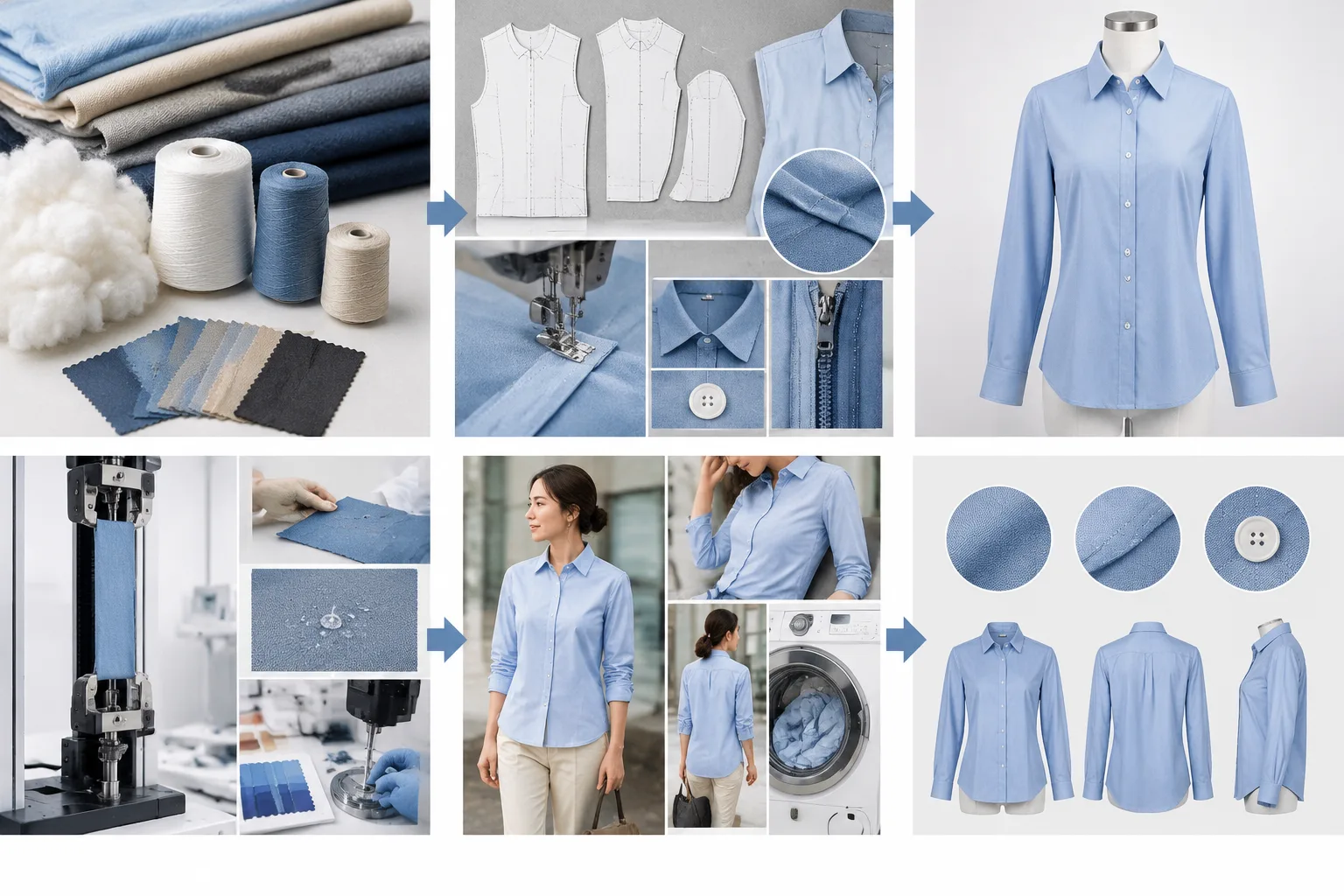
Approval becomes more defensible when the team keeps one evidence record from design intent through sample review. It should identify the intended silhouette, target wearer and size, body measurement assumptions, pattern measurements, finished-garment measurements, fabric assumptions, movement observations, and any post-care findings. Each measurement should retain its location and condition, such as flat, relaxed, stretched, or measured on a form.
A practical review matrix can connect each finding to an action. Useful fields include the evidence observed, the problem location, the activity or condition in which it appeared, the likely cause, the proposed response, the responsible owner, and the approval status. The likely cause should remain open to alternatives. Insufficient ease, incorrect balance, seam placement, fabric limitation, closure design, and construction error can produce similar symptoms.
Separate project-defined acceptable variation from unresolved fit or performance risk. The decision may be to revise pattern ease, change the fabric, adjust construction, alter a closure, or revise the intended silhouette. It may also be appropriate to collect more evidence before approval. A measurement result should not be treated as stronger than a documented movement problem simply because it is easier to record.
Recheck the decision after a material substitution, size-range change, pattern revision, construction change, or grading adjustment that could affect fit. A concise history of sample versions and decisions helps the team distinguish a changed product from a failed test. For teams organizing development records, an Apparel Manufacturing Tools resource may help structure related review work, but the validation conclusion must still come from the project’s own evidence.

What Can Design Ease Validation Prove and What Can It Not Prove?
Design ease validation can support a product-specific decision about intended fit and use under the conditions that were evaluated. It can show whether the documented silhouette, measurements, material assumptions, construction, and relevant actions are reasonably consistent with the development goal. This is useful evidence for pattern revision, sample approval, size-range review, material review, and production checkpoints.
It cannot establish one globally correct ease value. A successful sample on one body, in one size, or during one action does not prove the same result across every body shape, size, activity, layering condition, or wearing preference. A measurement match alone also cannot prove comfort, mobility, appearance, durability, or regulatory compliance.
When results conflict, document the unresolved assumption instead of forcing a final conclusion. The next evidence may involve another size, wearer, body measurement, fabric state, construction version, movement, or care condition. The required follow-up depends on the product risk and the decision being made. Product-development approval is a project judgment; it is not the same as certification or a compliance determination.
In practical terms, design ease validation is strongest when it connects intent, measurement, material behavior, movement, and change over time. Its value lies in making the reasoning traceable and revisable, not in turning a context-dependent fit decision into a universal specification.
Next step: Build a short evidence record for the next sample, then review it with the pattern, material, and product teams together. Mark which findings are measured, observed, test-based, or still assumed, and define the smallest additional check needed before changing the pattern or approving the fit.
Is design ease the same as the difference between body and garment measurements?
Not exactly. That difference can indicate intended ease, but it also reflects measurement conditions, design features, movement needs, layering, and fabric behavior. It should be interpreted as product-specific evidence rather than a universal allowance.
What measurements should be recorded when validating design ease?
Record the body or garment object, exact location, units, size, and measurement condition. For garments, note whether the piece was measured flat, relaxed, stretched, or on a form, and identify features that affect usable space.
Can a garment measurement chart prove that the ease is correct?
No. A chart supports comparison, but it cannot by itself establish mobility, comfort, appearance, or performance during use. Static measurements should be reviewed with prototype observations and relevant movement checks.
Which movements should be included in a design ease fit test?
Choose actions that reflect intended use, such as raising the arms, reaching, sitting, bending, walking, or adding a layer. Record pressure, restriction, sliding, exposure, pulling, and recovery during and after each relevant action.
How does fabric stretch affect the amount of ease a garment needs?
Stretch may provide temporary movement space, but recovery, direction, structure, and construction determine how that space behaves. A stretchy fabric does not automatically make a particular ease target correct.
Should design ease be checked again after washing or use?
When care or use could change dimensions, recovery, or structure, compare key measurements and appearance again under documented conditions. One check does not prove complete life-cycle performance, but it can reveal a risk that needs further review.