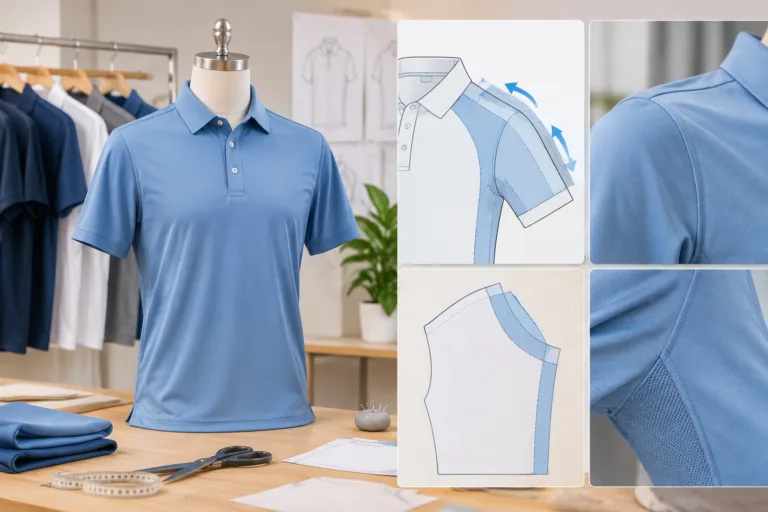
Golf shirts shoulder mobility depends on coordinated pattern, fabric, and construction choices that accommodate arm and upper-body movement without unacceptable restriction or displacement. It is not created by stretch or loose fit alone. Apparel Wiki approaches this as an independent educational topic; its Sponsor page explains the publication’s separation of sponsorship from editorial control.
Effective design begins with the wearer’s movements: raising the arms, reaching forward, rotating the torso, and moving into a golf-related posture. The designer then balances movement room against the intended silhouette, collar and placket position, sleeve appearance, and hem stability. The result must be assessed as a complete garment because each area can affect the others.
What golf shirts shoulder mobility requires
Shoulder mobility in golf shirts means the garment can accommodate the intended movements with an acceptable level of pressure, pulling, and displacement. It does not mean the shirt improves the wearer’s golf performance. Nor does the product name establish a functional grade. Two shirts described as golf shirts can have different fits, materials, and movement behavior.
Restriction can begin in several connected areas. Limited room across the upper back may become apparent when the arms reach forward. The shoulder line can shift, while the armhole or sleeve resists arm raising. A side seam may pull toward the front or back. At the same time, the hem can rise because movement transfers tension through the body.
These effects show why a single feature cannot prove golf shirt movement. A flexible fabric may still feel restrictive if the sleeve and armhole do not work together. A generous chest measurement may not provide useful room where reaching creates tension. Conversely, adding space everywhere can produce excess fabric without solving localized pressure.
The first design question is therefore not “How loose should the shirt be?” It is “Which movements must this shirt accommodate, and what fit should it retain while doing so?” A close, tidy silhouette and a relaxed silhouette can both support movement, but they distribute allowance differently. Repeated motion also raises appearance questions: whether the collar remains settled, the placket stays reasonably aligned, and the hem returns to an acceptable position.
A short decision frame keeps the review focused:
- For forward reaching, inspect the upper back, shoulder position, armhole, and sleeve interaction.
- For arm raising, inspect underarm geometry, sleeve width, side-seam pull, and hem movement.
- For rotation, inspect diagonal tension across the back and body, then consider fabric behavior.
- For a tidy fit, record both movement freedom and unwanted shifting or excess fabric.
This task-first approach turns golf shirt fit for movement into a defined development problem. Identify the motion, locate the symptom, select the relevant design variables, and review their combined effect on the assembled shirt.
Pattern choices that create room to move
A golf shirt pattern for mobility should place movement allowance where the body and garment need it. Upper-back width or shaping can accommodate forward reach and rotation. The useful location and amount depend on the silhouette, size range, wearer posture, material behavior, and intended fit. No single back shape works for every project.
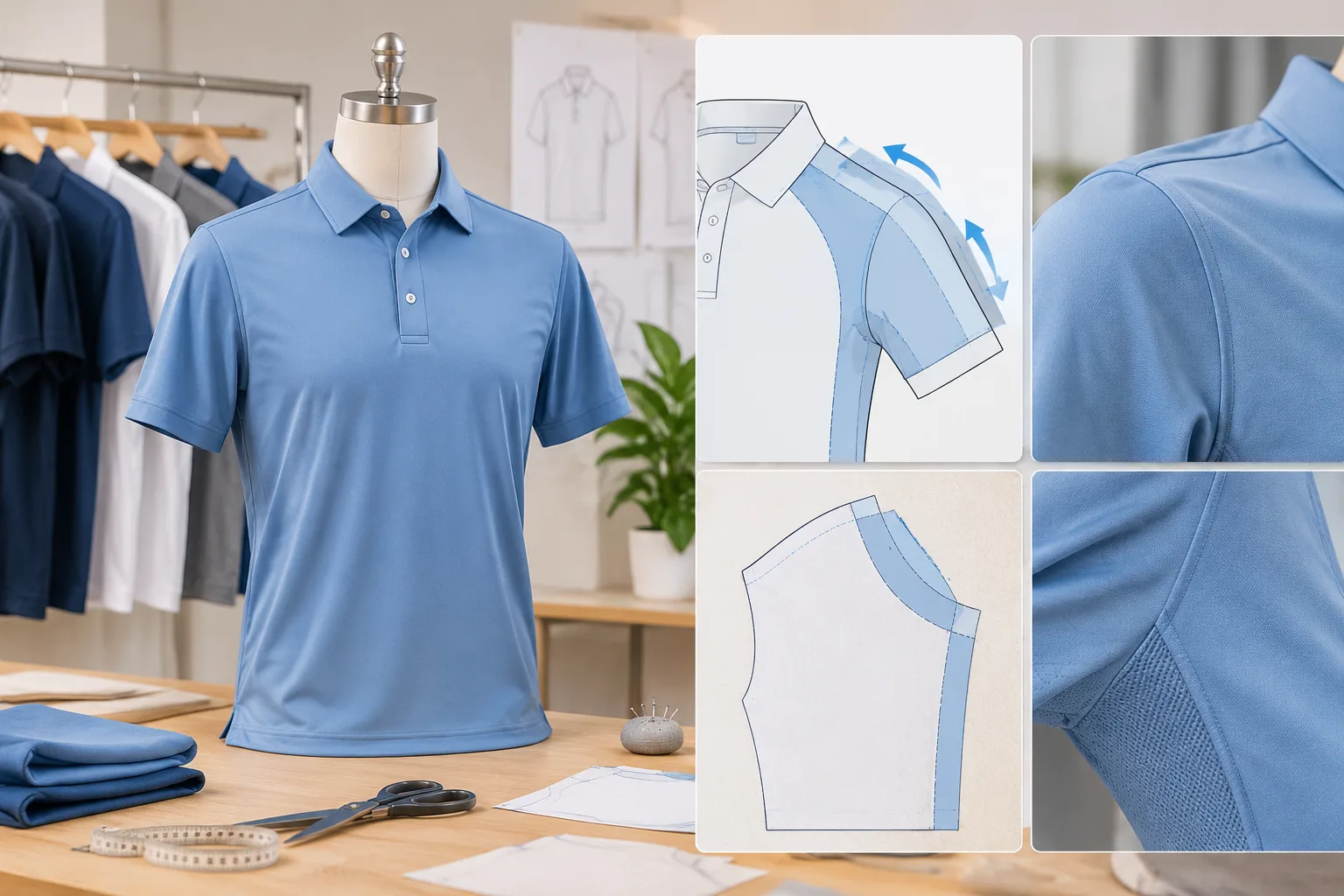
The golf shirt armhole and sleeve form an interacting system. Armhole depth and shape influence how the body and sleeve meet. Sleeve-cap geometry, sleeve width, and underarm construction affect how the sleeve responds when the arm rises or moves forward. Changing one area can alter pressure, drag, appearance, or hem movement elsewhere, so no isolated geometry is automatically superior.
Increasing the entire chest or body circumference may create general looseness while leaving the original movement problem unresolved. Targeted shaping can preserve a cleaner silhouette, but it may require closer pattern control. More body ease can be appropriate for a relaxed fit, yet excess fabric may affect side-seam position, drape, and hem stability.
| Observable symptom | Pattern area to inspect | Probable implication | Initial design choice | Variables that could change the choice |
|---|---|---|---|---|
| Upper back pulls during reaching | Back width, shoulder, armhole | Movement allowance may be poorly located | Compare localized back shaping or ease | Posture, size, fit, fabric behavior |
| Sleeve drags as the arm rises | Armhole, sleeve cap, sleeve width | Sleeve and body geometry may conflict | Compare coordinated sleeve and armhole revisions | Sleeve length, construction, intended silhouette |
| Hem rises during forward movement | Upper body, side seam, underarm | Tension may be transferring through the body | Trace the pull before adding body length | Recovery, hem restraint, layering, posture |
| Extra fabric remains after adding ease | Chest, back, side seam | Allowance may be too broad or misplaced | Redistribute room toward the active area | Drape, size range, visual fit target |
The collar, placket, side seams, and hem provide additional evidence. Their movement can reveal how upper-body tension travels through the shirt, but they are not necessarily the source. Inspect where pressure or excess fabric appears before changing the pattern, then compare the revised assembled sample.
Fabric and construction trade-offs for shoulder movement
Pattern geometry provides space, while fabric behavior influences how that space responds under movement. Extensibility and recovery describe different concerns. A fabric may extend during reaching but return poorly to the intended appearance. A firmer material may retain its shape more readily yet require deliberate pattern accommodation. Neither behavior proves that the finished shirt will move well.
Knit structure, fiber content, fabric weight, drape, and finishing can all change how a candidate material behaves. These variables should be reviewed for the actual fabric rather than inferred from a broad material label. Useful questions include how the fabric responds in relevant directions, whether it recovers after repeated movement, and how its appearance changes under localized tension.
Golf shirt construction can support or oppose the pattern and fabric. Seam direction and bulk may affect comfort or resistance around the shoulder, armhole, and underarm. Stitch and seam construction, sleeve joins, labels, and reinforcement can create localized differences. The hem and placket may also restrain movement or show distortion when tension travels through the garment.
Component flexibility cannot be added together as proof of whole-garment mobility. The main fabric, thread, trims, labels, reinforcements, and assembly method form one system. A flexible main fabric does not remove the need to inspect a firm placket, bulky join, restrictive seam, or stabilizing component. Final evaluation should therefore use the intended materials and assembly.
For a lightweight knit intended for repeated reaching, a designer might combine modest pattern ease with attention to recovery and seam comfort. The aim would be movement without losing the intended silhouette. With a firmer fabric, the same fit concept might need more purposeful upper-back, sleeve, or underarm shaping.
That comparison is a design scenario, not a fixed material rule. The preferred balance can change with fit, size, fabric behavior, construction, layering, and use conditions. A sound golf shirt shoulder design coordinates these variables and records both benefits and trade-offs. More extension may assist movement, while recovery, stability, seam comfort, and visual control determine whether the complete result remains acceptable.
How to evaluate shoulder mobility in a finished golf shirt
Begin with an evaluation brief rather than an undefined request to “check mobility.” Record the intended fit, target sizes, expected clothing layer, relevant movements, and garment behaviors that matter. These may include upper-back pulling, armhole pressure, sleeve drag, hem lift, unwanted exposure, or discomfort at a seam.
Review a fully assembled shirt made with the intended fabric, trims, reinforcements, thread, and construction. A fabric panel can describe one component, but it cannot show how a sleeve join, placket, label, or hem behaves within the finished garment. A prototype in substitute materials may still support early development, provided its limitations are documented.
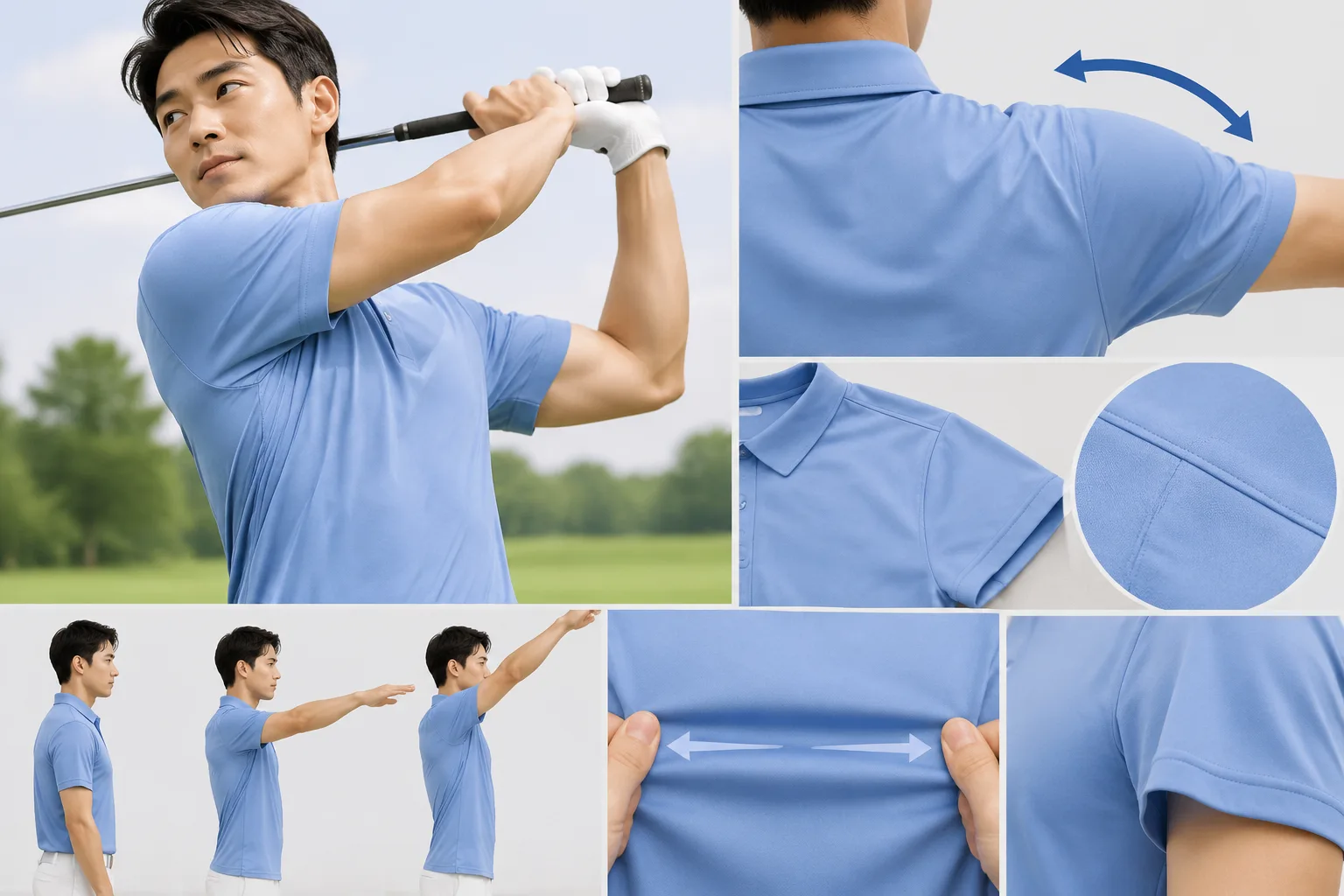
Use a consistent qualitative movement sequence that reflects the wearing task. The sequence can include:
- Standing in a neutral position to establish the shirt’s initial fit and balance.
- Reaching both arms forward while observing the upper back, shoulders, sleeves, and hem.
- Raising the arms and noting pressure, sleeve movement, exposure, and garment displacement.
- Rotating the upper body while checking whether one side behaves differently from the other.
- Taking an address or swing-preparation posture relevant to the intended use.
- Returning to neutral and observing whether the shirt recovers its original position and appearance.
Record freedom of movement and its consequences. A wearer may complete the motion while the collar shifts, the placket twists, the hem rises, or a sleeve seam becomes uncomfortable. Those observations reveal a different design balance from a shirt that permits the same movement while remaining acceptably stable.
When practical, compare versions by changing one meaningful variable at a time. For example, compare an upper-back pattern adjustment while keeping the material and sleeve unchanged. A separate comparison could then examine sleeve geometry or fabric behavior. Controlled comparisons make the likely influence of each change easier to interpret, although garment variables can still interact.
Include key sizes and representative wearers for the stated fit intent. Posture, body proportions, size, and layering can expose different restrictions or areas of excess. Record who wore each sample, which size was assessed, and where the garment sat before and after movement.
This review is a development tool, not proof of certification or compliance with an unspecified standard. A favorable observation in one size, one wearer, or one component does not establish performance across the range. If a project has formal requirements, use the applicable documented method and acceptance criteria.
Troubleshooting restriction and choosing the next design change
A visible symptom identifies where to investigate, but it rarely proves a single cause. Diagnose golf shirt mobility problems by linking the symptom to the movement that produces it. Then inspect the surrounding pattern, material, and construction variables before selecting an alteration.
Pulling across the upper back
Check whether the pulling begins during forward reach, rotation, or both. Inspection points include back width and shaping, shoulder position, the relationship between armhole and sleeve, seam placement, and fabric extensibility. Increasing the entire body circumference may add unwanted fullness without placing useful room where the restriction occurs.
Underarm pressure or sleeve drag
Compare armhole shape and depth, sleeve-cap geometry, sleeve width, underarm construction, wearer posture, and fabric behavior. Similar discomfort can arise from different interactions. Treat each proposed change as an inspection hypothesis, then compare it in an assembled sample instead of assuming one alteration will solve every case.
Hem lift, collar movement, or placket distortion
These symptoms show how movement travels through the garment. Inspect upper-body ease, fabric recovery, front construction, and hem restraint together. Also note whether the shirt returns to its intended position after the arms lower. Changing only the hem may leave the original source of tension unresolved.
Excess fabric after adding ease
If mobility improves but the shirt appears loose or unstable, reconsider where the added room sits. Compare that location with the actual restricted area and the intended silhouette. Fabric recovery and drape can also influence whether additional ease remains visually controlled after movement.
Use a focused iteration record for each sample:
- Symptom: Describe the pulling, pressure, drag, displacement, or excess fabric without assigning a cause.
- Triggering movement: Record the reach, arm raise, rotation, or posture that produces it.
- Sample context: Note the size, wearer or fit reference, clothing layer, fabric, trims, and assembly.
- Design change: Identify the pattern, material, or construction variable changed from the comparison sample.
- Result: Record movement freedom, comfort, appearance, stability, and recovery after movement.
If several variables change together, the next comparison may not reveal which one affected the result. Where practical, preserve a reference sample and compare garment specifications before revising the pattern. Photographing the same postures can support discussion, but images should accompany written observations because angle and timing can obscure pressure or discomfort.
For the next iteration, choose the smallest meaningful change connected to the recorded symptom. Review the assembled sample again under the same conditions. When specifications include a formal evaluation requirement, check its method before finalizing the review plan rather than substituting an informal fit observation.
Design shoulder mobility as a whole-garment decision
Designing shoulder mobility for golf shirts requires a coordinated view of movement intent, pattern geometry, material behavior, construction, fit, and appearance. No stretch feature, armhole adjustment, or ease increase proves suitable mobility for every wearer, size, and use condition.
The practical next step is to create a movement-and-symptom brief, compare the relevant garment specifications, and inspect the restricted area with its interacting variables. Then evaluate the final assembled shirt using an appropriate, documented method. This sequence turns general fit concerns into decisions that can be reviewed and compared.
Frequently Asked Questions
Is more overall ease always the best way to improve shoulder mobility in a golf shirt?
No. Overall ease can add fullness without placing room where movement requires it. First identify the restricted area and triggering motion. A focused review of the upper back, shoulder, armhole, sleeve, or underarm may produce a more controlled design direction.
Which golf-shirt pattern areas should be checked when the upper back pulls during reaching?
Inspect back width and shaping, shoulder position, armhole geometry, sleeve interaction, and nearby seams. Fabric behavior and wearer posture also matter. Pulling is an observation, not proof that one pattern area is solely responsible.
Can a stretch fabric compensate for a restrictive golf-shirt pattern?
It may reduce some perceived restriction, but stretch alone does not establish acceptable mobility. The fabric must work with the pattern and construction, while recovery, seam comfort, garment displacement, and appearance remain suitable for the intended fit.
How should shoulder mobility be reviewed on a finished golf shirt?
Use the intended materials and assembly, define a repeatable movement sequence, and record restriction, comfort, appearance, hem stability, and recovery. Compare key sizes and representative wearers. Apply a formal method when the project specification requires one.
Why can a golf shirt move well but still look unstable or uncomfortable?
Movement freedom is only one outcome. The shirt may permit the motion while its hem rises, collar shifts, placket distorts, seams press, or fabric fails to recover. Evaluation should therefore consider comfort, position, and appearance alongside mobility.