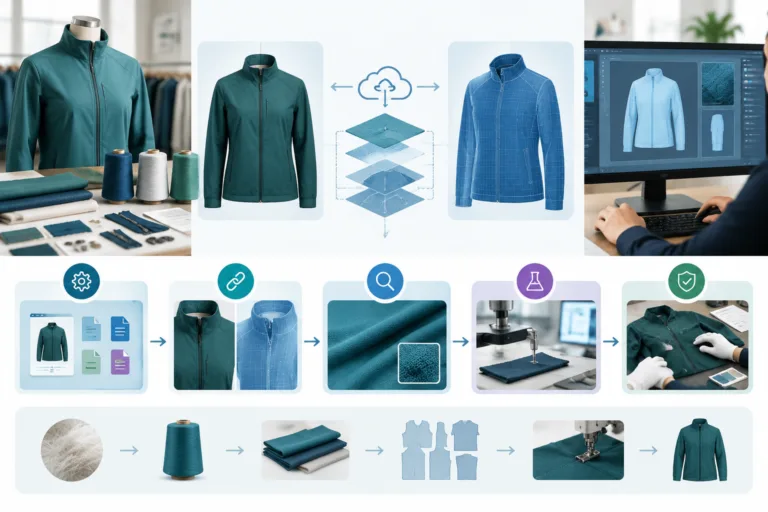
Digital twins implementation in apparel is the planned creation and management of a digital representation of a garment, material, production process, machine, order, or related operation that remains connected to relevant real-world data for a defined purpose. The practical question is not whether a company has a 3D file, but whether people can trust the representation when making a product, production, quality, or coordination decision. Apparel Wiki is an independent educational publication; support from a Sponsor does not make the site a manufacturer, software vendor, testing laboratory, or implementation provider.
An apparel digital twin may combine several connected representations, depending on the project. It could link a garment’s style and revision information with materials, fit decisions, sample status, and production records. It could instead represent a sewing machine, a factory process, an order, or a material batch. The scope must be chosen deliberately because “digital twin” does not describe one fixed product category or one universal software feature.
What does digital twin implementation mean in apparel?
A static 3D garment, CAD file, product record, or visualization can be useful without being a digital twin. The distinction is the agreed relationship with the physical item or process: which data is connected, how it is updated, who maintains it, and what decision it supports. A model that opens on a screen but has no reliable identity, revision relationship, or operational purpose is not automatically a connected twin.
For that reason, digital twin implementation is mainly a process, ownership, data, and governance decision. Software may provide storage, modeling, integration, workflow, or analytics capabilities, but purchasing a platform does not by itself define the represented entity or make its information trustworthy. Product capabilities also vary. PLM, ERP, MES, WMS, CAD, 3D, quality, and analytics tools may have overlapping functions, so this guide does not assume that any category has a fixed feature set.
The implementation boundary should be written in practical terms: “This representation will help the product team review approved sample changes,” or “This representation will help quality staff trace a recurring production issue.” The statement should identify the physical subject, the relevant data, the decision owner, and the point at which the information is considered stale or incomplete. That level of clarity prevents a broad technology ambition from replacing a usable workflow.
Which apparel process should the digital twin support first?
Begin with one recurring decision where improved visibility, traceability, simulation, or coordination could be examined. Possible starting points include product-development handoffs, fit and sample review, material or component changes, production monitoring, quality investigation, order status, or maintenance of production assets. These are illustrative options, not a claim that every apparel organization will receive the same value from them.
Map the current process from trigger to decision. Record who starts the work, which inputs are required, what output is produced, where information is copied, where approvals occur, and where delay or rework appears. Then define what the proposed twin must answer. For example, a team reviewing a component change may need to know which version is approved, which materials are affected, and whether the change has reached the relevant production records.
Keep outcomes separate from features. Faster review, clearer traceability, fewer avoidable data errors, or better coordination are outcomes. A 3D viewer, system connection, dashboard, or automated alert is only a possible means of pursuing one. Combining product development, factory operations, logistics, and customer-facing information in a first pilot can make responsibility and measurement unclear unless those dependencies are essential to the selected decision.
| Selection question | What to examine |
|---|---|
| Process value | Would better information change a recurring decision or reduce avoidable coordination effort? |
| Data readiness | Are the required records available, identifiable, and maintained well enough to test? |
| Ownership clarity | Is there a named person or team able to decide, correct, and maintain the information? |
| Integration effort | How many systems, partners, handoffs, and data definitions are involved? |
| Pilotability | Can the team compare similar work and observe the result within a controlled scope? |
Who owns the digital twin and its decisions?
Ownership should be divided rather than assigned vaguely to “the system.” One person may be accountable for the business outcome, while other people maintain source data, approve process changes, manage integrations, control access, or support ongoing operation. A software administrator can manage permissions and configuration without owning the business meaning or accuracy of the data.
Within the selected scope, clarify responsibility for product identity, style and version information, colors and sizes, materials, specifications, manufacturing records, and change approvals. Define who may create, approve, change, retire, and correct a twin or its linked records. If the workflow crosses a brand, supplier, or factory boundary, access and correction responsibilities should be agreed through the relevant project documentation and commercial arrangements.
| Responsibility | Planning question |
|---|---|
| Business outcome | Who decides whether the twin supports a meaningful apparel process? |
| Process decision | Who acts on the information and approves an operational choice? |
| Source data | Who defines, corrects, and maintains each important field? |
| Integration | Who manages data exchange, failures, and technical dependencies? |
| Access and maintenance | Who grants access, reviews stale records, and coordinates changes? |
This is a planning matrix, not a universal organizational model. Design, product development, sourcing, factory, quality, IT, and external partners may each own different parts of the process. The important result is an explicit agreement about accountability, not an abstract promise that the twin is a single source of truth.
What data and system boundaries must be agreed before integration?
Start by defining the identity of the represented item or process. Depending on the use case, that may include style, color, size, material, component, order, batch, machine, location, and version. Establish shared meanings for names, units, status values, revisions, timestamps, and relationships before connecting systems. The minimum data set should be limited to information that a named decision owner will maintain and use.
Next, decide which system is authoritative for each field, how changes are approved, and how records are linked. PLM, ERP, MES, WMS, CAD, 3D, quality, and supplier tools may serve different business purposes, but their actual functions can overlap. Tool labels alone cannot determine the correct boundary. A field-level data contract or boundary map should state what moves between systems, what remains local, and what happens when values conflict.
Inconsistent style numbers, colors, sizes, material codes, or versions can carry errors into purchasing, production, and fulfillment. Automation does not resolve conflicting meanings, missing source data, or unclear ownership by itself. Before promising end-to-end connectivity, test the specific workflow and document whether identity, dimensions, materials, revisions, permissions, and other metadata remain usable for the intended decision.
How should an apparel team test interoperability and twin fidelity?
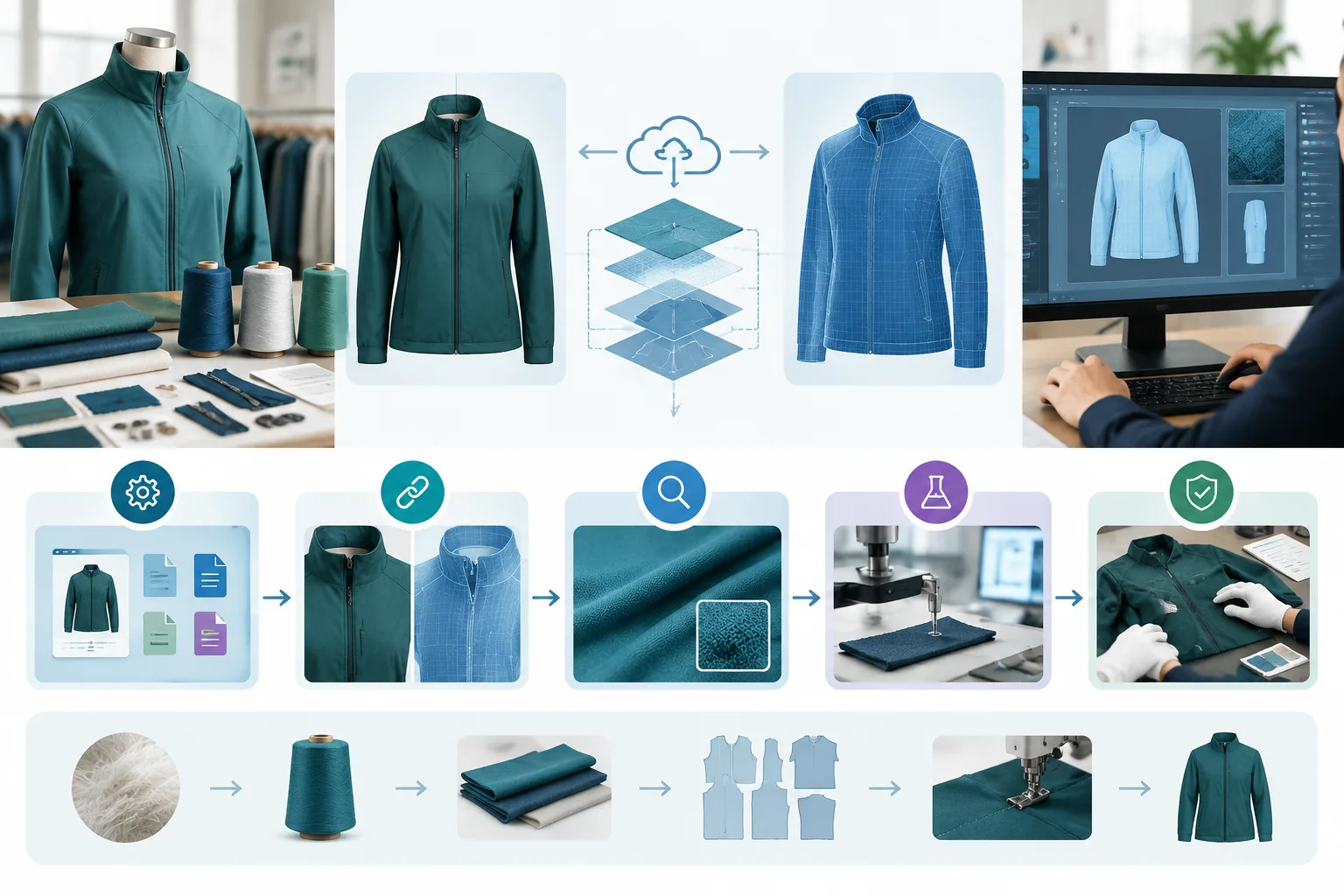
Interoperability testing should show whether linked information remains useful for the selected decision, not merely whether a file opens. Begin with representative cases: a straightforward garment or process, a complex material or component structure, a revised version, and an intentional exception such as a missing value or failed transfer. These cases reveal different risks than a carefully prepared demonstration file.
Test the complete path from creation or import through editing, approval, synchronization, display, export or return, and error recovery. For each step, record what should happen, who is responsible, and what evidence confirms the result. Check the fields that matter to the use case, including geometry, measurements, materials, component relationships, identity, revision status, timestamps, and permissions.
Then compare the digital representation with the physical sample, production record, or process event it is intended to represent. This is the functional meaning of twin fidelity: the representation is accurate and timely enough for a defined decision. It does not mean that one model is universally perfect or that every attribute must have the same level of detail.
Define acceptance criteria before the pilot begins. Classify defects by consequence, such as cosmetic display problems, incorrect identity, missing component information, unusable permissions, or errors that could affect a production decision. A successful file exchange is only one test result; it is not proof of complete or lossless interoperability across all software combinations.
How should the first digital twin pilot be designed and evaluated?
A first pilot should be a controlled learning exercise tied to one process and a named decision owner. Establish a baseline for comparable current work before introducing the new workflow. The baseline may describe the task, sample population, observation period, quality measures, rework, manual effort, and relevant cost categories. Keep the definitions stable enough that later results can be interpreted honestly.
Limit the pilot to a practical scope with named participants, representative records, an observation period, a training approach, and an escalation path. Include the people who create, review, correct, and act on the twin’s information. A pilot that proves only that a technical team can move data may not show whether product developers, quality teams, sourcing teams, or factory users can make better decisions with it.
Compare like-for-like tasks and record implementation effort alongside any observed benefit. Include integration work, data cleanup, training, support, maintenance, and exception handling rather than counting only software fees. Suitable evaluation categories can include process quality, elapsed time, data completeness, user adoption, unresolved errors, total effort, and the effect of exceptions on the intended decision.
Set success criteria, stop conditions, and a review point before the pilot starts. The outcome may be to continue, revise the scope, gather more evidence, or stop. Vendor demonstrations and hypothetical savings are not evidence of actual return on investment. Financial modeling becomes more defensible only when the project has a reliable baseline, defined assumptions, and cash-flow inputs. For related tool categories and workflow considerations, readers can consult Apparel Wiki’s Apparel Manufacturing Tools guide.
What governance keeps a digital twin useful after launch?
Governance begins when the pilot becomes part of ongoing work. Establish a change process for new styles, revisions, materials, suppliers, machines, workflows, and retired records. The process should identify who requests a change, who checks its effect on linked records, who approves it, and how the previous state is preserved or retired according to the project’s requirements.
Define review triggers for stale data, failed synchronization, missing ownership, unexpected physical changes, and exceptions outside the original scope. Monitor whether users act on the twin’s information and whether the intended process outcome improves. Usage alone is not proof of value; a record can be viewed frequently and still contain incomplete, late, or misunderstood information.
Document access, security, confidentiality, partner permissions, backup, retention, and incident response with qualified technical, legal, and commercial advice where needed. Requirements vary by organization, information type, location, and agreement. A digital twin is not automatically secure, compliant, or appropriate for every data category simply because it is connected to other systems. Apparel Wiki provides educational guidance as an independent knowledge publication; see its About page for site context and its Privacy Policy for website-specific information.
Known limitations should remain visible after launch. Incomplete source data, inconsistent partner systems, uncertain physical measurements, model assumptions, and maintenance burden can all reduce usefulness. A practical implementation checklist is: approve one use case, assign owners, document the minimum data set, agree field definitions and change rules, test representative exchanges, record defects and decisions, and set a date to review whether the pilot should continue or change.
The next step is to turn the chosen use case into a short working brief. State the decision to improve, the physical entity or process represented, the minimum information required, the systems involved, the responsible people, the test cases, and the evidence that would justify continuation. This keeps digital twins implementation grounded in an observable apparel workflow.
Is a 3D garment model the same as a digital twin?
No. A 3D model can be one part of a digital twin, but a twin also requires an agreed relationship with relevant real-world data and a defined purpose. A static model or visualization without that connection is not automatically a digital twin.
Who should own digital twin data in an apparel company?
Ownership should be divided by responsibility. Name accountable owners for the business outcome, process decisions, source data, integration, permissions, and maintenance. A software administrator is not automatically responsible for the business meaning or accuracy of every record.
What should an apparel team define before connecting PLM, ERP, MES, or 3D tools?
Define the represented item or process, shared names and units, status and revision rules, timestamps, relationships, authoritative fields, approval paths, and the minimum data set. Document what moves between systems and how conflicts or missing values are handled.
How can a company test whether its digital twin data is accurate enough for production decisions?
Use representative simple, complex, revised, and failed-transfer cases. Test the full exchange path, compare the digital record with the relevant physical or production evidence, and set acceptance criteria for identity, measurements, materials, revisions, permissions, and other decision-critical fields.
What is a sensible first pilot for digital twin implementation?
Choose one recurring decision with visible process pain, a manageable data boundary, clear ownership, and people who can act on the result. Limit the scope and compare the new workflow with a defined baseline rather than attempting a company-wide transformation immediately.
How should a team measure the value of a digital twin without relying on vendor projections?
Compare like-for-like tasks using a baseline and agreed measures for quality, elapsed time, data completeness, rework, manual effort, adoption, exceptions, and total implementation effort. Report the project’s own evidence and assumptions; do not treat a demonstration or hypothetical savings as measured return on investment.