Low twist yarn generally makes fabric feel softer, fuller, and loftier, while giving the surface a more diffuse or matte appearance. The trade-off is that reduced twist can lower fiber cohesion, so the yarn may be less resistant to slippage, abrasion, and some forms of wear. The result depends on fiber type, yarn count, fabric construction, and finishing. Apparel Wiki is an independent educational publication; its Sponsor page explains the site’s editorial relationship with commercial support.
For that reason, low twist yarn fabric behavior should be read as a set of tendencies rather than a guaranteed result. Twist changes the yarn’s structure, but the finished fabric determines how those changes are felt and seen. The sections below separate the basic mechanism from the effects on handle and appearance.
What Low Twist Yarn Is and Why Twist Matters
Twist is the spiral arrangement of fibers around the length of a spun yarn. These turns draw the fibers together, help them grip one another, and give the yarn enough cohesion to withstand handling during fabric formation and use. A yarn with lower twist has fewer binding turns relative to the system being considered, so its fibers remain less compacted and may sit more openly within the yarn structure.
That looser structure is the central reason low twist yarn often feels bulky, soft, and lofty. Less fiber compression leaves more space within and around the yarn. The surface can feel fuller because the fibers are not pulled as tightly into a compact strand. At the same time, fibers may slip more easily when the yarn is pulled, rubbed, bent, or processed. This can reduce cohesion and contribute to lower strength relative to a more firmly twisted version of a comparable yarn.
“Low twist” is a relative description, not a universal threshold. A twist level that is considered low for one fiber, yarn count, or spinning system may be ordinary for another. Fiber length, surface characteristics, fineness, and the intended fabric all affect how much twist is needed. Comparisons are therefore most useful within the same fiber and yarn system, rather than between unrelated yarn specifications.
Low twist is not automatically a defect. It can be a deliberate design choice when a soft, lofty hand is more important than a compact, highly cohesive yarn. The limitation appears when the twist is insufficient for the intended process or end use. Fibers may shift during fabric formation, and the finished material may show reduced stability, fuzz, or wear resistance. Twist is one influence among several, so it should not be treated as the sole explanation for every difference in fabric handle.
How Low Twist Changes Fabric Handle: Softness, Drape, and Bulk
The most immediate effect of low twist yarn is often a fuller and softer hand. Because the fibers are less compressed, the yarn can create a plumper surface with a gentle, cottony, or lofty feel. This is why low twist structures may suit fabrics where comfort and softness are more important than a crisp or tightly defined hand.
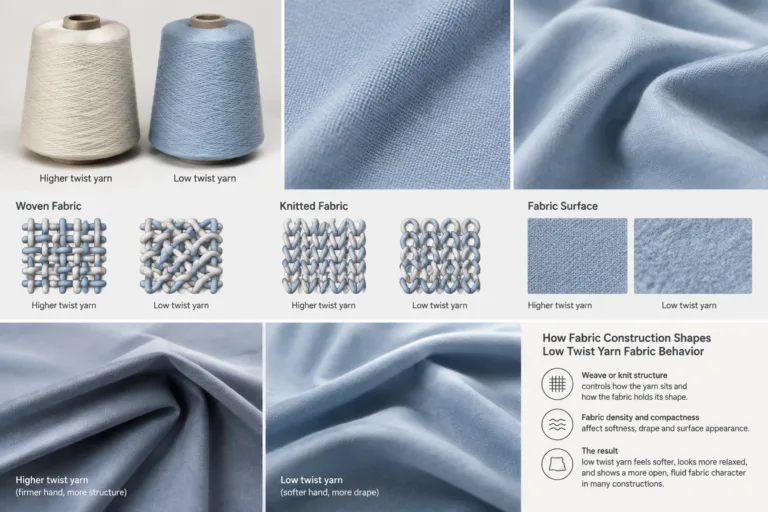
Bulk also affects how the fabric moves. A low twist yarn can make fabric feel fuller and less fluid for a given weight, especially when its open structure contributes noticeable loft. That does not mean every low twist fabric will have poor drape. Fiber flexibility, yarn count, fabric density, stitch or weave structure, and finishing can all change the result. A soft yarn in a dense fabric may move quite differently from the same yarn in a loose construction.
The open surface may also influence perceived warmth and cushioning. Air held within a loftier yarn and fabric surface can make the material feel more insulated or padded to the hand. This is a perception of the finished textile, not a performance guarantee based on a yarn description. Handle should be checked on fabric samples because fabric construction mediates the yarn’s contribution.
Initial softness is only one stage of the product’s life. Washing, drying, repeated bending, and contact with other surfaces can alter the yarn’s surface and cohesion. Depending on the fiber and construction, the fabric may soften further, become fuzzier, or lose some surface integrity. A fabric that feels attractive when new should therefore be assessed alongside its intended care conditions and use.
For product decisions, compare finished fabrics under similar conditions rather than judging loose yarn alone. Check whether the hand is soft without being unstable, whether the fullness supports the intended silhouette, and whether the fabric remains comfortable after the relevant care process. These observations are more useful than treating “low twist” as a promise of one fixed drape or softness level.
How Low Twist Changes Fabric Appearance: Luster, Texture, and Surface
Lower twist often leaves more fiber ends and small surface irregularities exposed. The yarn can therefore appear softer, fuzzier, or more diffuse than a firmly twisted yarn. A higher-twist yarn usually presents a sleeker surface and may reflect light more directly, creating a cleaner or sometimes more lustrous appearance. The difference is a typical tendency, not an absolute rule.
A loftier surface scatters light across a wider area. This can make the fabric look more matte and soften the visual intensity of a color or pattern. Prints may appear less sharply defined when surface fibers interrupt the boundary of the design. Textures can also look deeper or more dimensional because the raised surface creates small areas of light and shadow.
Surface hairiness is not inherently good or bad. In a casual knit or brushed-looking fabric, a soft peachy character may be part of the intended style. In a smooth, crisp garment, the same hairiness may look untidy or reduce visual definition. With use, loose fibers can contribute to fuzz and may participate in pilling when fiber movement, abrasion, and fabric structure allow pills to form. Twist is relevant, but it does not determine pilling by itself.
The fresh-fabric appearance should be separated from the appearance after laundering and abrasion. Low twist surfaces may change more visibly because their fibers have less compact support. Care conditions, fiber length, blend composition, fabric density, and finishing can either emphasize or moderate that change. A sample review should include the surface under the lighting in which the garment will be viewed, since diffuse fibers can alter color and texture perception.
Two fabrics made from similar fibers can still look noticeably different because their yarn twist and finishing differ. Read yarn information alongside the fabric’s construction, surface treatment, and intended style. The practical question is not whether low twist produces a superior appearance, but whether its softer, more matte, and potentially hairier character supports the garment’s design and expected use.
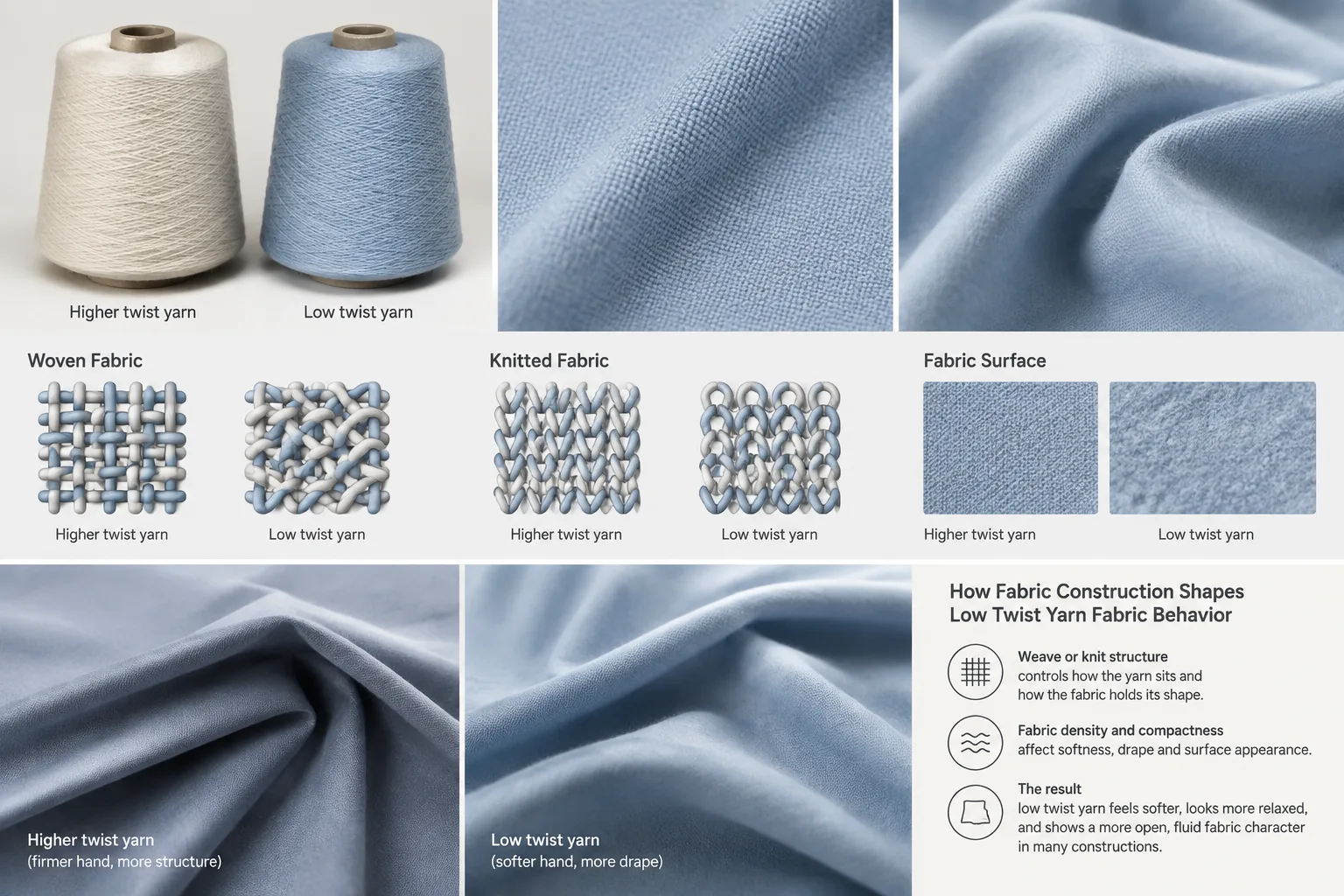
How Fabric Construction Shapes Low Twist Yarn Fabric Behavior
A low twist yarn does not produce one fixed fabric result. The fabric structure determines how much of the yarn’s softness, loft, and surface openness remains visible in the finished material. A loose knit can allow the yarn to expand and move, while a dense woven can constrain it and give the fabric a firmer, more stable character.
Stitch density, weave density, fabric weight, and finishing all influence the result. In a knit, a lofty low twist yarn may create a fuller hand and a more relaxed surface. In a woven, the same yarn may feel less open if the warp and weft are held tightly in place. Finishing can further alter softness, surface hairiness, dimensional stability, and visual definition.
The central trade-off is cohesion. Lower twist commonly gives fibers less compact support, so they may slip or separate more readily than in a more firmly twisted yarn. That tendency can reduce yarn strength and affect the fabric’s resistance to abrasion, fuzz, pilling, or seam stress. These are possible behavior patterns, not universal performance ratings. Fiber length, fiber shape, blend ratio, yarn count, and fabric density can either increase or reduce the effect.
For example, a lightweight knit intended to feel soft, lofty, and comfortable may benefit from a lower twist choice when stability requirements are moderate. A fabric intended to retain crisp edges, withstand repeated rubbing, or show a sharply defined surface may require a different balance, potentially including a higher twist level. Heavy finishing or a blend can change that decision, so twist should not be judged separately from the complete fabric design.
Fiber content alone is not enough to predict low twist yarn fabric behavior. Two fabrics with similar fiber names can respond differently when their fiber morphology, blend proportions, yarn count, construction, and finishing differ. Evaluate the finished fabric against its intended use rather than treating low twist as either a benefit or a defect.
Comparing Yarn Twist Levels for Handle, Appearance, and Durability
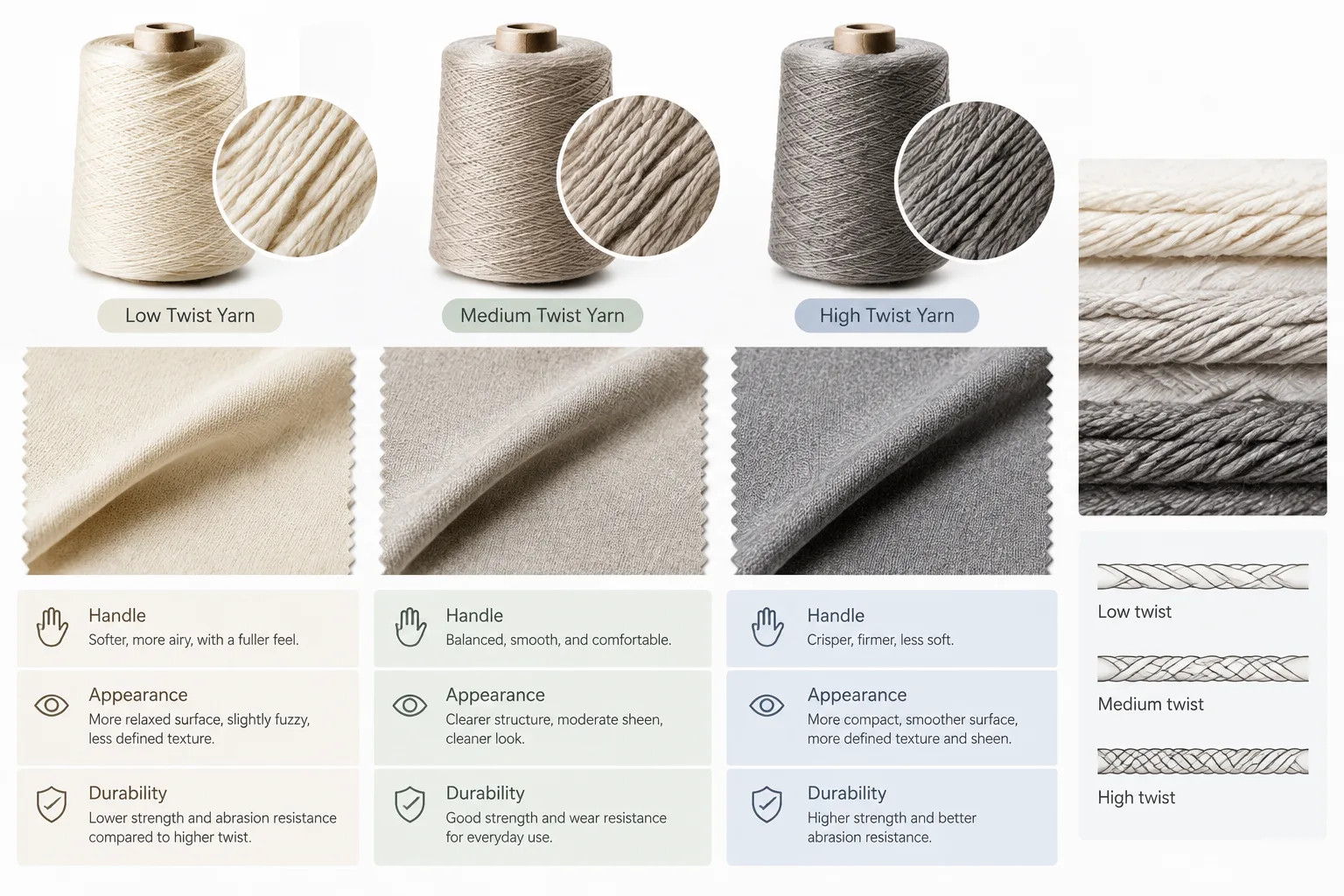
The comparison below organizes typical tendencies in spun yarns. “Lower,” “medium,” and “higher” are relative descriptions within a comparable fiber and yarn system. They are not universal twist categories or performance grades.
| Relative twist | Typical handle | Typical surface | Relative cohesion and durability | Often considered for |
|---|---|---|---|---|
| Lower twist | Fuller, softer, loftier | More diffuse, matte, or hairy | Less cohesion may increase sensitivity to wear, depending on the system | Soft knits, lofty surfaces, and fabrics where comfort is prioritized |
| Medium twist | More balanced between softness and firmness | Moderate definition and surface openness | Balanced cohesion for a broad range of uses | General-purpose constructions requiring a compromise between hand and stability |
| Higher twist | Firmer, potentially crisper, and less bulky | Smoother, clearer, and sometimes more lustrous | Greater cohesion may support surface definition and wear resistance | Crisp wovens, smoother surfaces, and uses where stability is important |
Use the table as a starting framework, then compare observable results. A visibly fuzzy yarn, a very soft fabric hand, or a diffuse surface may point toward a lower twist choice. A firm hand, clean yarn outline, or crisp fabric surface may point toward a more cohesive construction. Fiber type, yarn count, fabric density, finishing, and the intended care cycle can change the interpretation.
Ask suppliers to define the designation in their own system. Confirm whether “low twist” describes a single yarn, a component of a plied yarn, or the final plied construction. Also clarify how a notation such as a count-over-count description is being used. Direct count systems such as tex, denier, and dtex describe linear density differently from indirect systems such as Ne, so values from those systems should not be compared by size alone.
For a useful yarn twist levels comparison, request like-for-like fabric references or samples made with comparable fiber content, yarn count, fabric construction, and finishing. Compare them under the same lighting, handling, laundering history, and intended-use conditions. A supplier’s descriptive label can guide questions, but it is not by itself a verified specification.
Key Takeaways on Low Twist Yarn and Fabric Character
Low twist yarn generally supports a softer, fuller, loftier, and more matte fabric character because its fibers are less compacted. The same openness can reduce cohesion and make fuzz, pilling, abrasion, or seam behavior more sensitive to the fiber, count, blend, construction, finishing, and use. For an educational next step, compare fabrics made with different relative twist levels under the same conditions, or review the applicable yarn count system before interpreting a specification.
Frequently Asked Questions
Is low twist yarn weaker than regular twist yarn?
It can be, because lower twist may give fibers less compact support and reduce cohesion. The actual result depends on fiber type, yarn count, spinning design, and whether the yarn is single or plied. Treat strength as a system-dependent tendency, not a universal value.
Does low twist yarn always make fabric softer?
No. Lower twist often supports a softer and fuller hand, but fabric density, fiber type, yarn count, finishing, and fabric construction can override or moderate that effect. Judge the finished fabric rather than predicting handle from twist terminology alone.
How does low twist yarn affect pilling and fuzz over time?
Its more open surface may make fuzz or surface change more noticeable, but twist does not determine pilling by itself. Fiber length, fiber movement, abrasion, blend composition, fabric structure, laundering, and finishing also influence whether pills form and remain visible.
Can low twist yarn be used in both knits and wovens?
Yes, low twist yarn can be considered for both, but the construction changes the outcome. A loose knit may emphasize loft and softness, while a dense woven may constrain the yarn and provide greater stability. The end use should determine the balance.
How should I compare yarn twist between different suppliers?
Ask each supplier to define the twist description, yarn count system, and whether the value applies to a single or plied yarn. Compare fabrics made with similar fibers, counts, constructions, and finishes. Do not rank figures from different count systems by number alone.
Does low twist yarn change how fabric color looks?
It can. A loftier or hairier surface scatters light, which may make color and pattern appear softer, more diffuse, or less sharply defined. Lighting, dyeing, finishing, fiber type, and fabric construction also affect the visual result, so inspect the finished fabric.