Understanding Measurement Chart Apparel, Garment Size Chart Basics
Developing a well-structured measurement chart apparel, garment size chart is essential for fashion businesses, designers, and manufacturers. These charts ensure garment consistency, accurate sizing, and optimal fit for end users. Whether you’re creating clothes for children or adults, tops or bottoms, following key measurement guidelines and applying industry standards will reduce costly errors and ensure brand reliability.
Key Terms: Measurements, Tolerance, and Grades in Apparel

Before building a measurement chart, it’s crucial to understand standard industry terminology:
- Key Measurements: The essential body or garment dimensions needed to construct a pattern accurately. Examples include chest, waist, hip, inseam, and sleeve length.
- Tolerance: The permissible measurement variation allowed during production.
- Size Grade: The incremental increase or decrease between sizes, ensuring proportional scaling from base size to other sizes.
Why a Robust Measurement Chart is Non-Negotiable
A precise measurement chart apparel, garment size chart helps align design, production, and quality teams. Without a robust chart, garments may fail fit tests, increase returns, or damage reputation. Apparel Wiki notes that disciplined measurement chart development reduces disputes between design and production, especially during sampling and bulk manufacturing phases.
Industry Standards for Top Garment Measurements
Tops—such as shirts, blouses, t-shirts, and jackets—require a defined set of dimensions. Commonly included top measurements:
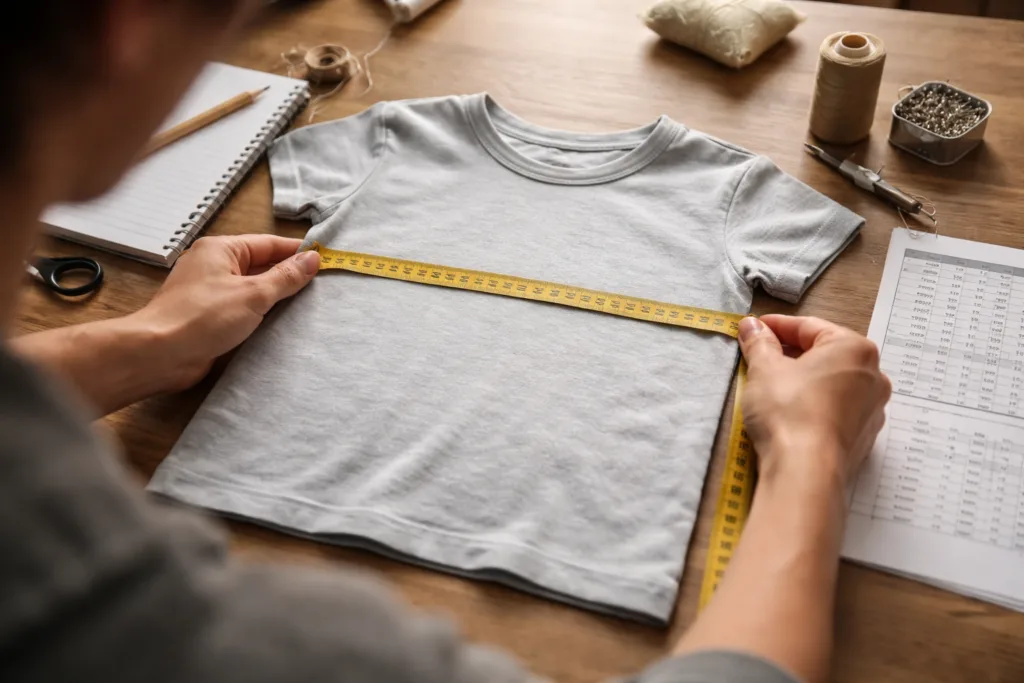
- Chest/Bust (measured 1″ below armhole, straight across chest)
- Waist (narrowest part between ribs and hips)
- Shoulder Width (across the back, edge to edge)
- Sleeve Length (shoulder point to cuff edge)
- Garment Length (side neck to hem)
Below is an example garment size chart for adult unisex t-shirts:
| Size | Chest (in) | Waist (in) | Shoulder (in) | Sleeve (in) | Length (in) |
|---|---|---|---|---|---|
| XS | 34 | 32 | 16 | 8 | 25 |
| S | 36 | 34 | 17 | 8.5 | 26 |
| M | 38 | 36 | 18 | 9 | 27 |
| L | 41 | 39 | 19 | 9.5 | 28 |
| XL | 44 | 42 | 20 | 10 | 29 |
Industry Standards for Bottom Garment Measurements
Bottoms—such as jeans, trousers, shorts, or skirts—need a dedicated set of core dimensions:
- Waist
- Hip (widest part around seat)
- Front Rise (from crotch seam to top waist front)
- Inseam (crotch seam to hem along inside leg)
- Outseam (top waist to hem along side leg)
- Leg Opening (hem circumference)
Sample adult unisex jeans measurement chart:
| Size | Waist (in) | Hip (in) | Front Rise (in) | Inseam (in) | Leg Opening (in) |
|---|---|---|---|---|---|
| 28 | 28 | 34 | 9 | 30 | 14 |
| 30 | 30 | 36 | 9.5 | 31 | 15 |
| 32 | 32 | 38 | 10 | 32 | 15.5 |
| 34 | 34 | 40 | 10.5 | 33 | 16 |
Kids vs. Adults: Differences in Measurement Chart Apparel, Garment Size Chart
Children’s clothing sizing differs from adults in both scale and increments. Kids grow in predictable yet rapid phases, so sizes may reference age ranges or height brackets more commonly. For example:
- Kids: Size 2T, 4T, 6, 8, or by height (e.g., 104cm, 116cm)
- Adults: Numeric or lettered sizes (e.g., S, M, L, or 32, 34, 36)
The tolerances can be slightly wider in kids’ wear, given growth rate and comfort priorities. Adult size charts often require finer increments and tighter tolerances to ensure a tailored look.
Establishing Tolerances: How Much Variation is Acceptable?
Allowable production tolerances vary by garment type and market position. Here’s a simple reference table:
| Measurement Point | Tolerance (+/-) |
|---|---|
| Chest/Bust | 0.5″ (1.3 cm) |
| Waist | 0.5″ (1.3 cm) |
| Hip | 0.5″ (1.3 cm) |
| Sleeve/Leg Length | 0.25″ – 0.5″ (0.6 – 1.3 cm) |
High-end or technical lines may aim for tighter tolerances, while mass retailers often permit wider deviations to manage cost and speed. As Rain Chen from Apparel Wiki advises, “Clear tolerance specs reduce factory disputes and help prioritize critical fit points during Quality Control checks.”
Measurement Chart Apparel, Garment Size Chart in Sample Development
During sampling, brands use the measurement chart apparel, garment size chart to check prototypes and fit samples against specs. Consistent measuring technique—flat vs. 3D, measuring along seams, etc.—must be standardized. For best results, attach sample comments and fit feedback directly to the chart, iterating until results are approved for bulk production.
Choosing Base Size for Your Measurement Chart
The base size is typically the best-selling or median size within your target market. All other sizes are graded up or down from this base using a consistent grade rule table. For example, a base size M for women, or 32 for men’s pants, creates proportional scaling for S/XS or L/XL sizes.
Grade Rules and Their Role in Garment Sizing
Grade rules are the step values for each measurement between adjacent sizes. If the chest increases by 2″ per size and the waist by 1.5″, those are your grade rules. Ensuring logical, comfortable progression is vital to avoid sizing gaps or overlaps—a common pitfall noted in large retail returns.
Standardized Measuring Procedures
A common source of factory issues is lack of clarity regarding how and where to take each measurement. Supply clear written instructions and diagrams with your measurement chart apparel, garment size chart for reference:
- Indicate precise start/end points for each measurement.
- Specify garment condition (spread flat, buttoned, on mannequin, etc.).
- Include images or sketches for visual guidance.
Adapting Measurement Charts for Fabric Types and Styles
Different fabrics behave differently. Woven and non-stretch fabrics require extra ease, while knits allow for negative ease (intended tightness). Adjust your measurement chart apparel, garment size chart accordingly, accounting for shrinkage, drape, or elasticity during wear and wash.
Industry Benchmarks: What Are Typical Size Ranges?
Common size ranges vary by category and market:
- Missy: XS to XXL or 2–18
- Menswear: S to XXL or 28–40 waist
- Children: 0–24 months, 2T–7, or by centimeters of height
Global brands may also offer petite, plus, or tall size charts. Benchmark your size runs against leading competitors to verify market alignment.
Digital Tools for Creating Garment Measurement Charts
From simple Excel templates to advanced PLM (Product Lifecycle Management) solutions, brands leverage digital tools for streamlined charting, version control, and collaboration. PLM systems help standardize formats and link charts directly to technical packages and Bills of Material, reducing error risk in fast-paced environments.
Measurement Chart Apparel, Garment Size Chart for E-Commerce Suitability
Online retailers must provide clear, easy-to-read charts on product pages. Customers rely heavily on these charts to make confident purchases. Include both garment measurements and recommended body measurements, and add guidance about fit intent (slim, regular, relaxed).
International Size Conversions: Navigating Global Sizing
When selling internationally, provide conversion tables (e.g., US, UK, EU, ASIA) adjacent to the measurement chart apparel, garment size chart. Note that no universal conversion matches perfectly; always reference specific body dimensions in addition to size labels to avoid confusion.
Common Mistakes in Measurement Chart Apparel, Garment Size Chart Creation
- Not specifying tolerance ranges
- Ignoring body shape variations by market
- Leaving out detailed measurement methods
- Assuming international size labels are identical
Take care to double-check for completeness and clarity before sending to your manufacturing partner. Apparel Wiki often sees fit issues arising from ambiguous points such as shoulder slope or crotch depth—illustrate and specify these gray areas deliberately.
Integrating Feedback Loops: From Fit Sessions to Chart Updates
Continually improving your measurement chart apparel, garment size chart is crucial. Gather feedback from in-house fit sessions, customer returns analysis, and production QC audits. Update the chart when trends indicate recurring issues.
Measurement Chart Apparel, Garment Size Chart as a Communication Tool
Think of your chart not just as numbers on a page but as a vital bridge between your design vision and factory reality. Precision, repeatability, and clarity in your documentation translate directly into successful, scalable production outcomes.
Compliance and Regulatory Considerations
Certain regions have labeling and sizing communication regulations (e.g., European standards in children’s sizing). Review current compliance standards in your target markets to avoid costly delays or label recalls.
Practical Observations From Sample Room and Factory Floors
Practical experience on the manufacturing floor shows that seemingly minor chart details—like half vs. full circumference measurements—can cause production errors. Rain Chen from Apparel Wiki recommends periodic joint measuring sessions between brands and factories, ensuring everyone interprets chart directions the same way, thereby preventing bulk shipment size inconsistencies.
How to Approve and Archive Your Measurement Chart Apparel, Garment Size Chart
Once your base chart is tested and approved during development—and tested with multiple size samples—lock it as the master version for that style. Archive the chart for future use, update as trends or customer profiles shift, and ensure all stakeholders have access to the latest version.
Measurement Chart Apparel, Garment Size Chart
The foundation of every successful apparel collection is a robust, meticulously developed measurement chart apparel, garment size chart. Follow best practices outlined here: define key dimensions and tolerances, align with market norms, standardize measurement techniques, and keep your chart updated with real-world feedback. A disciplined approach not only improves fit and reputation but pays off in reduced returns, smoother manufacturing, and loyal customers.
Conclusion: Taking the Next Steps in Garment Sizing Excellence

Developing a strong measurement chart apparel, garment size chart gives your brand a decisive edge—from smoother production to higher customer satisfaction. Dedicate time to research, clarify every spec, and foster clear communication with your factory partners. Adjust as new fabrics and markets emerge, and treat your measurement chart as a living document for continuous improvement and success.
Frequently Asked Questions
What are the most critical measurements for tops?
Chest, waist, shoulder width, sleeve length, and garment length are essential for ensuring proper fit for tops.
Why are garment tolerances important in production?
Tolerances define allowable deviations during manufacturing, helping to prevent disputes and ensuring garment quality stays within acceptable limits for retailers and customers.
How do children’s size charts differ from adults’?
Kids’ charts often use age or height ranges, with wider tolerances due to fast growth, while adult charts are more specific with tighter increments and numeric or lettered sizing.
What’s the best way to communicate measurement methods to a factory?
Provide detailed instructions with diagrams or photos, clearly define measurement points, and conduct joint measuring sessions for alignment, especially during sample approval.
How do I handle international size conversions?
Include conversion tables for target markets and always add body measurements to size charts for clarity, since labels can vary between regions.
What tools can I use to create measurement charts?
Excel templates, Google Sheets, and PLM software are common tools. PLM systems provide version control and streamline chart updates across teams.