Useful microplastic shedding reduction supplier questions connect a claimed improvement to a defined textile, garment, use pattern, and washing context. Start by asking what changed, what it was compared with, and what evidence supports the difference. Apparel Wiki provides an independent educational framework for that conversation; its Sponsor page explains that sponsorship does not confer editorial control.
Ask suppliers to identify what they call shedding, which released material they assessed, and how they reported it. Then separate the product specification, supplier explanation, and supporting record. A useful answer states its conditions and limitations. A broad “low-shed” label leaves those questions unanswered.
Microplastic Shedding Reduction Supplier Questions to Ask First
Begin with the exact product under discussion. Request fiber composition, yarn details, fabric structure, finishing, and garment construction, alongside intended use and care. Tie the answer to a specification revision or identifiable sample. Without that reference, two suppliers may be answering questions about different products.
Apparel Wiki recommends organizing the first conversation around these questions:
- What is changing? Ask the supplier to identify the proposed intervention and the baseline material, process, or alternative used for comparison.
- What does “reduction” describe? Ask whether the claim concerns released mass, particle counts, loose fibers, or another reported outcome. Request the definition and reporting units.
- What conditions does the answer cover? Request sample identity, washing or abrasion conditions, and the collection approach. Ask whether the assessment concerns fabric or a completed garment.
- What supports the statement? Establish whether it comes from a measurement, an estimate, a company record, or a general assertion about the material.
Keep the claimed outcomes separate. A statement about released mass does not supply a particle count. Likewise, ask what the supplier includes under “microplastic” and how the material was identified. Do not assume that every record using “fiber shedding” addresses the same particle category.
For low-shedding textile sourcing, request a bounded answer: which product, compared with what, under which conditions? A supplier may provide useful information while leaving some questions open. Specific limits are more actionable than an unexplained promise covering every garment and care routine.
Keep a question record with separate entries for the supplier’s statement, its supporting document, unresolved variables, and the proposed next check. Mark missing information as unresolved. Record your sourcing interpretation separately so a supplier’s explanation does not silently become an accepted performance conclusion. Preserve the date and specification reference when the supplier later revises an answer.
What Shedding Means at the Fiber, Fabric, and Garment Levels
For supplier discussions, first establish what “shedding” means in the supplied documentation. Ask what material leaves the sample, at which stage, and what the assessment captures. Keep “fiber shedding” and “microplastic release” separate in your notes until the supplier explains their relationship within that assessment.
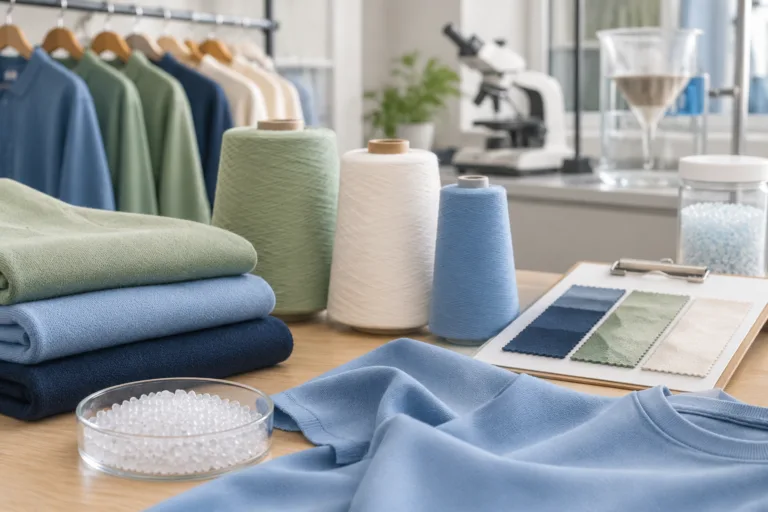
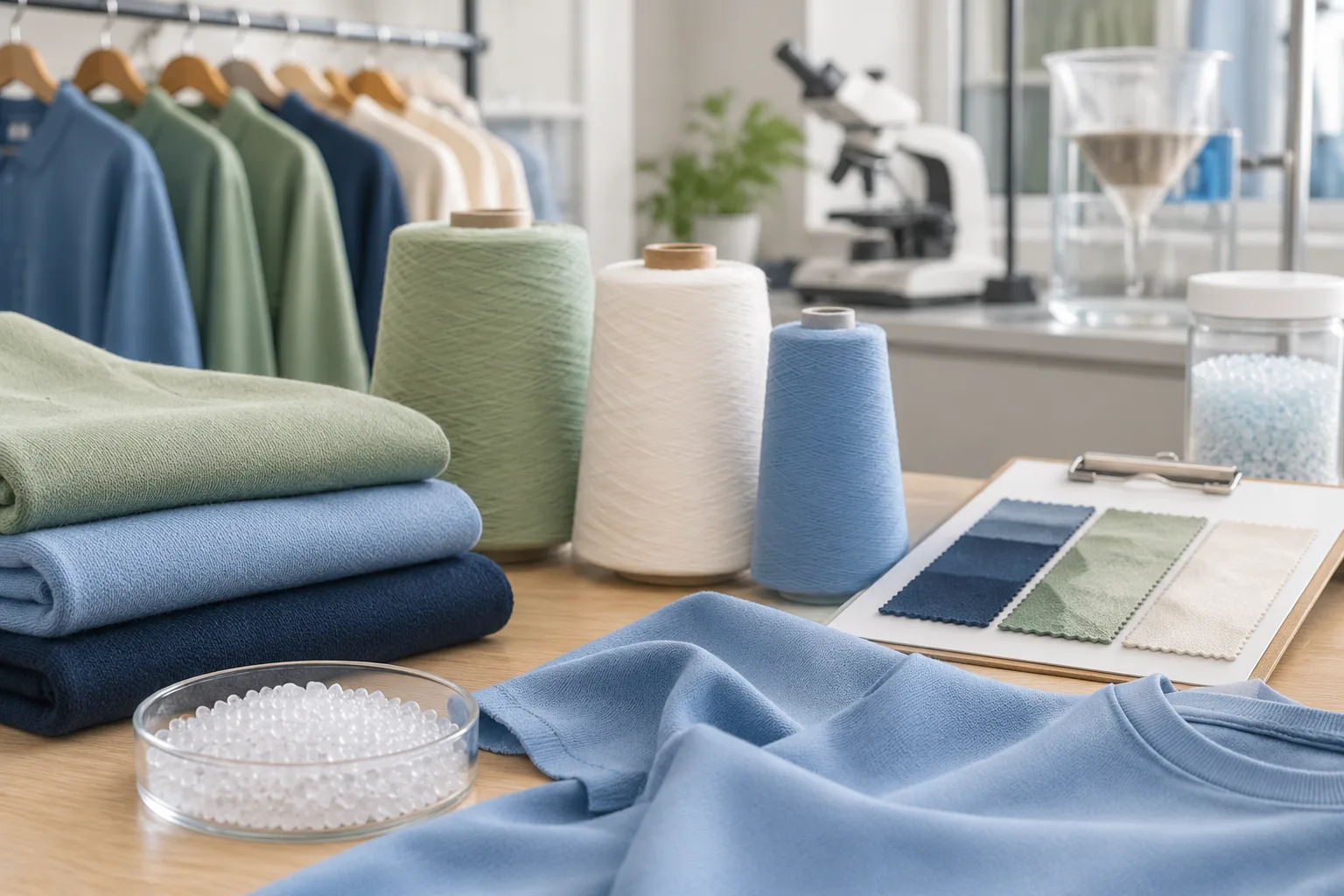
Build the material description in layers. Fiber content identifies composition; yarn information describes the yarn used; fabric construction identifies its structure; finishing records the treatments applied. A commercial fabric name is a starting point, but request these details rather than assuming the name specifies them all.
Add garment assembly as a separate layer. Ask whether the evidence covers unassembled fabric, a garment panel, or the finished item. Record the relevant seams, exposed edges, trims, and component materials. Their presence identifies questions for product assessment; it does not establish their effect on shedding.
Next, locate the concern within the product’s life. Is the supplier discussing manufacturing, laundering, abrasion, wear, or another defined stage? Request separate descriptions where several stages are mentioned. An answer about a washing assessment should remain labeled as such, without becoming a conclusion about every use stage.
Treat knit versus woven as a construction distinction, not a sourcing verdict. Ask how yarn, construction details, finishing, and garment design are represented in the evidence. A category label alone supplies no product-specific basis for declaring either option the lower-shedding choice.
Ask which features the supplier controls in the proposed specification and which remain project-dependent. These may include the selected finish, construction details, garment design, care instructions, and assumed use pattern. Request an explicit list of changes that would require reconsidering the supporting evidence.
Finally, define the comparison basis, or functional unit: what quantity or service does each answer represent? Record assumed use life, washing, and disposal boundaries where relevant to the assessment. Keep a fabric-level comparison separate from a claim about a garment over its useful life. This is an editorial comparison rule, not a universal test specification.
How to Evaluate a Supplier’s Shedding Evidence
Start with traceability. Match the report’s sample identifier to the proposed fiber, yarn, fabric, finish, and garment specification. Ask when the sample was produced and whether it represents the current proposal. Request an explanation of any differences between the tested sample and the intended product.
Next, request the complete assessment description. Useful textile shedding test questions cover sample preparation, washing or abrasion procedures, collection and analysis, reporting units, and relevant controls. If a supplier names a method, check its documented scope before treating another report using that name as directly comparable.
Ask how repeated assessments were handled and whether the report describes variation between results. Request the original supporting record for any statement about consistency. A summary value without that context does not answer how repeatable the reported outcome was under the stated conditions.
Identify the data type before interpreting the result. A measurement on an identified sample, a company record, a database average, and a model estimate answer different evidence questions. A company record may contain measurements or estimates, so ask what it records rather than judging by its format.
For estimates, request the data date, geographic basis, assumptions, and omitted stages. Where impacts or quantities are shared between products, ask how that allocation was made. Keep estimated values labeled as estimates; do not rewrite an industry average as a measurement of the proposed textile.
Compare textile test results only after aligning the reported outcome, functional unit, preparation, conditions, and assessment boundaries. When these differ materially, retain both records and identify the mismatch. The records can inform further questions without establishing which supplier’s product sheds less.
Limit each conclusion to the tested sample and conditions. Ask for product-specific support before extending a result to other finishes, constructions, or an entire product line. Record broader supplier claims separately from what the supplied evidence establishes.
Material and Construction Questions That May Change Shedding Risk
Move from the evidence record to the proposed textile specification. Ask why the supplier selected that yarn and fabric construction, which surface or structural features they consider relevant, and what product-specific evidence supports the explanation. Treat each answer as a variable to investigate, not proof that a particular fiber, yarn, knit, or weave is inherently low-shedding.
- Yarn: Request the yarn description used for the proposed fabric. Ask whether the supporting evidence concerns that yarn or a materially different product.
- Fabric construction: Record the construction alongside fiber content and yarn information. Ask which construction details were controlled in the assessment and which could change during development or production.
- Finishing: Identify brushing, raising, coating, surface treatment, or other finishing included in the specification. Ask what outcome the treatment is intended to affect and whether its durability, maintenance requirements, and later handling have been assessed. A treatment name alone does not establish effectiveness.
- Garment assembly: Ask whether the evidence covers fabric only or the assembled garment. Exposed edges, seams, trims, and contact between surfaces may warrant product-level investigation, but their effects should not be assumed without applicable evidence.
Care conditions belong in the same discussion. Ask whether the supplier’s recommendation assumes particular washing, drying, wear, or maintenance conditions. Then compare those assumptions with the intended product. Evidence based on a different care pattern may still inform questions, but it does not establish the same outcome for the planned garment.
Consider a lightweight knit intended for frequent home laundering. The sourcing team would need answers about its yarn, surface treatment, garment construction, and care evidence under relevant conditions. For a structured woven item used and washed less often, the important assumptions may differ. This comparison does not predict which option sheds less; it shows why use and care must remain attached to the claim.
Finally, record other implications separately. A shedding-related intervention does not by itself demonstrate preferable water, climate, chemical, durability, labor, or overall environmental performance. Each dimension needs its own defined claim and suitable evidence.
A Practical Matrix for Comparing Supplier Responses
The following supplier sustainability comparison matrix is an editorial decision aid, not a certification or supplier approval. Mark each input as documented, partially documented, or unresolved. These labels describe answer quality; they do not predict shedding performance.
| Observable supplier input | What it may indicate | Initial sourcing response | Variables that could change the response |
|---|---|---|---|
| Defined product scope | The claim identifies a fiber, yarn, fabric, finish, garment, or combination. | Compare only within the stated scope. | Specification changes or an undefined product level. |
| Material and construction detail | The commercial name is supported by a fuller material description. | Check it against the proposed specification. | Substituted yarns, finishes, constructions, seams, or trims. |
| Stated intervention | The supplier identifies what was changed and the intended outcome. | Request evidence tied to that change. | Different baseline, treatment durability, or maintenance assumptions. |
| Method disclosure | Preparation, conditions, collection, analysis, and units are described. | Review whether the method fits the claim. | Missing controls, incompatible conditions, or a different measured outcome. |
| Sample traceability | The record can be connected to the proposed product. | Proceed to closer technical comparison. | Production revisions or an untraceable test sample. |
| Functional unit and use-care assumptions | The result has a defined comparison basis and context. | Align these before ranking alternatives. | Different use life, washing, drying, wear, or disposal assumptions. |
| Evidence status | The answer distinguishes measured results, records, estimates, and unsupported claims. | Keep each data type labeled; clarify gaps. | New documents, revised assumptions, or missing stages. |
A documented, traceable sample assessed under compatible conditions may justify closer comparison. An unresolved method, outcome, or boundary calls for clarification or qualitative review, not an immediate performance ranking. Retain both records when conditions differ, but state why they cannot support a direct comparison.
Keep trade-offs in separate fields so one positive attribute does not become an overall environmental conclusion. Save the comparison date, product specification, assumptions, and open questions. Later supplier revisions or evidence can then be reviewed against the same defined scope.

Use the Answers to Define the Next Verification Step
Turn the question record into a short verification brief. Include the product identity, intended use and care, claimed outcome, functional unit, evidence scope, unresolved variables, and source needed for the next check. Compare complete specifications, then consult the applicable authoritative method or original study for the exact claim. The relevant source will depend on the outcome, product, conditions, and market.
Leave unsupported conclusions unresolved. Revisit the comparison whenever the material, construction, finish, garment assembly, or care assumptions change. This preserves a clear boundary between supplier claims, available evidence, and the sourcing decision.
Frequently Asked Questions
What should I ask a textile supplier first about microplastic shedding reduction?
First define the proposed product, including its fiber, yarn, fabric construction, finish, garment assembly, intended use, and care. Then ask what outcome is claimed, what baseline is used, which sample was assessed, and what evidence supports the statement.
Can a fiber name alone show that a garment will shed fewer microplastics?
No. A fiber name does not describe the complete yarn, fabric construction, finish, garment assembly, or use conditions. Request the full specification and product-relevant evidence before drawing a comparative conclusion.
What evidence should a supplier provide for a low-shedding textile claim?
Request a traceable sample identity, the exact assessed outcome, preparation and assessment conditions, collection and analysis details, reporting units, relevant controls, and the original record. Also identify whether the information is measured, recorded, estimated, or generalized.
Can test results from two suppliers be compared if their washing methods are different?
Not as a direct performance ranking unless the methods and boundaries are sufficiently compatible. Retain both results, document the differences, and request clarification or a method review before deciding that one product sheds less.
How should garment construction and care instructions appear in a shedding-reduction discussion?
Record construction and care as explicit conditions of the claim. Note whether the evidence covers fabric or a complete garment, and whether its washing, drying, wear, seams, edges, and trims correspond to the proposed product.