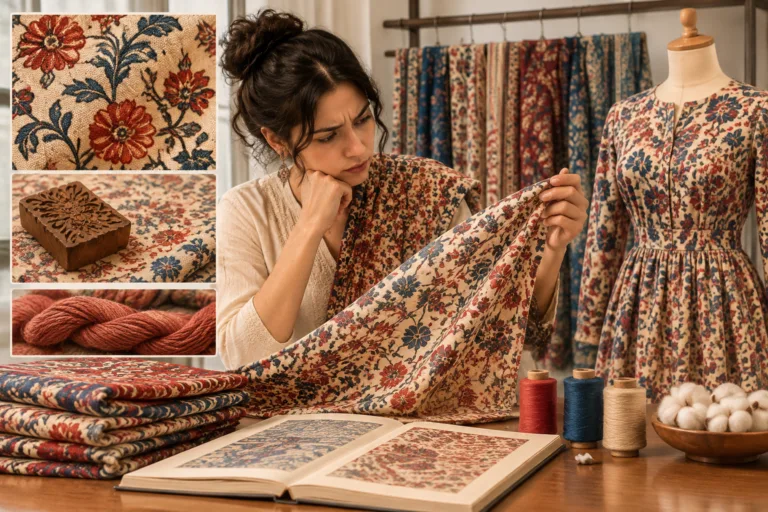
Sari draping social history is not a story of one fixed garment with one permanent meaning. A sari drape is both a practical arrangement of cloth around the body and a practice interpreted within a particular social setting. Period, place, wearer, material, occasion, labor, and audience can all change what an arrangement communicates. This independent educational discussion is separate from sponsorship decisions; Apparel Wiki explains that distinction on its Sponsor page.
To read historical sari draping carefully, begin with what a source actually shows. Then distinguish documented evidence from interpretation and from an illustrative comparison. A visible fold, exposed edge, tucked section, or change in coverage may relate to movement, modesty, display, identity, status, community belonging, gender expectations, or adaptation. It may also reflect fabric behavior, instruction, comfort, or the limits of the source. No single explanation should be treated as universal without evidence.
Sari Draping Social History: How to Read Meaning Across Periods
Sari draping is often discussed as though a recognizable garment form must carry a stable social code. Historical reading requires more care. The same broad arrangement may communicate differently when worn for work, ceremony, domestic activity, public appearance, or representation. A lightweight cloth arranged for movement may be read through labor and comfort in one setting, while a similar visual outline may be interpreted through formality or social display in another.
The key distinction is between an observed feature and the meaning assigned to it. A photograph may show how cloth was positioned, but it does not automatically reveal why the wearer used that arrangement, how common it was, or how others understood it. A painting may emphasize an idealized appearance, a commissioned identity, or a staged scene. A surviving garment may reveal material and construction clues while leaving the original wearer, occasion, and frequency of use uncertain.
Historical sari draping is therefore best studied through bounded comparisons. An early surviving object, a later image, a commercial record, and evidence of widespread adoption represent different kinds of historical milestones. They should not be combined into a single invention date or uninterrupted chronology. A technique may be visible in one record long before it became accessible, socially accepted, or common in a particular setting.
Regional and social variation is central. A claim about one community, period, or location cannot automatically describe an entire country or era. The source type also matters: a personal account, institutional rule, portrait, advertisement, surviving textile, and scholarly interpretation answer different questions. When evidence is incomplete, wording such as “the available records show” keeps the conclusion proportional to the record.
For readers, this approach creates a practical sequence: identify the draping feature, locate the source in time and place, establish who is represented, and then ask what interpretations the evidence can support. A documented association may be meaningful without proving wearer intention or a single cause. An illustrative example can clarify that method, but it must remain clearly separate from a claim about historical fact.
Evidence Before Origin: What Surviving Records Can and Cannot Show
The history of sari draping should not be organized around a search for one original form. “Earliest” can refer to several different things: the earliest surviving object currently known, an early visual representation, a written description, a documented commercial introduction, or evidence that a practice became widespread. These milestones do not necessarily occur together, and the absence of an earlier surviving record does not prove that no earlier practice existed.
A surviving textile can provide valuable material evidence. Its fibers, weave, dimensions, finish, seams, wear, and repairs may help researchers consider how it could have been handled or worn. Yet those details do not by themselves establish the original wearer, social meaning, everyday frequency, or geographic reach. Ownership may have changed, the object may have been altered, and its present condition may reflect later conservation rather than its original use.
Provenance is part of interpretation, not a minor catalog detail. Production date, place of origin, collection history, ownership, and repair records can alter what an object supports. A museum collection entry may document an object’s description without proving every conclusion about its social role. Researchers should consult the specific catalog or scholarly record and keep uncertain attribution or dating beside the claim it qualifies.
Images require the same discipline. Before treating a pictured drape as everyday practice, ask who made the image, when, for which audience, and under what conditions. A portrait, studio photograph, painting, performance image, fashion presentation, or official record may show a selected appearance rather than ordinary dress. Even an image made in a domestic or public setting does not automatically establish how frequently the arrangement was used by others.
Written records can add context, but they also have authorship and purpose. A description may reflect an observer’s vocabulary, a rule, a commercial interest, or a particular event. The available records may support the existence of an arrangement without establishing its meaning, popularity, or cause. This is why claims of a sole inventor, universally earliest drape, or complete representation of a period exceed what many surviving sources can show.
A careful account separates record from inference: the source documents an object, image, statement, or event; the researcher interprets its possible significance; and broader conclusions require comparison across relevant evidence. This does not make historical knowledge impossible. It makes the history of sari draping more precise by showing which parts are documented and which remain provisional.
Draping, Identity, and Everyday Social Roles
Draping can acquire social meaning through its relationship to region, community, gender expectations, life stage, occupation, labor, occasion, modesty conventions, fabric behavior, and access to garments or technologies. These variables do not form a universal code. Their importance must be established for the particular setting being studied, and several may operate at once.
A wearer may arrange cloth to balance movement, coverage, display, heat, work, ceremony, and social expectations. An observer may later interpret the same arrangement as a sign of identity or status. Those interpretations can overlap, but they are not identical. A visible adaptation may result from comfort, instruction, fashion, fabric limitations, or the demands of work rather than from one deliberate symbolic message.
Consider a lightweight sari used during active work. Its arrangement might prioritize movement, secure handling, and manageable fabric while still meeting local expectations of coverage or appearance. In a formal setting, similar material could be arranged to emphasize presentation, ceremony, or audience. The contrast does not prove that one drape has one meaning. It shows why material, occasion, movement, and audience must be examined together.
Class, community, gender, and access can also shape who is permitted, expected, or able to wear a particular arrangement. A documented association may reveal that a style appeared in a specific social context, but it does not automatically establish a universal rule or explain causation. Coexistence between a draping practice and a social role is evidence of context; it is not, by itself, proof that one produced the other.
Technology and labor add further layers. Cloth width, weight, finish, availability, and handling properties can influence the arrangements that are practical or desirable. Access to particular textiles or methods may differ among groups. Still, material possibility does not determine social meaning on its own. Preference, instruction, affordability, identity, convention, and resistance can mediate how a drape is adopted and understood.
For that reason, the social meanings of sari draping should be described relationally. Ask who wore the arrangement, where and when it appeared, what activity or occasion was involved, and who is interpreting the evidence. A strong historical explanation preserves those boundaries instead of treating one community’s practice, one image, or one observer’s description as representative of an entire period.
How Trade, Technology, and Regulation Can Change a Draping Practice
Sari draping changes over time through overlapping influences, not a single invention or outside force. A textile, technique, or production method may first exist, then become commercially available, circulate through trade, gain acceptance in a particular setting, and eventually become widespread there. Those stages can occur at different times, and some practices may remain limited or decline as others take hold.
Changes in cloth production or availability can alter what arrangements are practical. Width, weight, finish, and condition may affect how a length of fabric can be handled or secured. But material properties do not dictate a drape’s social meaning. Labor needs, affordability, instruction, personal preference, community expectations, and resistance can all shape whether a new option is adopted.
Trade can expand access to materials and influence local markets, but circulation alone does not show that every wearer adopted a particular textile or arrangement. Likewise, a documented commercial introduction marks availability, not widespread use. To connect a change in trade or production with a change in dress, evidence needs to establish the relationship in a specific time and place.
Institutional expectations, laws, and political environments may also affect clothing practices. These claims need evidence tied to the relevant period: the end of one trade arrangement or policy does not establish that later restrictions disappeared. Schools, workplaces, visual media, and political campaigns can record or encourage change, but an image or campaign by itself cannot show how broadly people adopted a practice. Separate what the record documents from what it suggests about adoption, and avoid treating coexistence as proof of cause.
A Practical Framework for Comparing Draping Across Periods
Compare what a source shows with what it can support. The questions below help keep an interpretation tied to its evidence rather than ranking one arrangement as more authentic or advanced.
| What is observable? | What might it suggest? | What should be checked next? | What could change the interpretation? |
|---|---|---|---|
| Cloth width, weight, finish, or condition | Possible constraints or choices in arranging the fabric | How the material is documented and whether it was altered | Uncertain provenance, repair, or incomplete material records |
| A pictured drape and its setting | A presentation associated with a particular occasion | Creator, audience, date, staging, and source provenance | Performance, ceremony, or deliberate artistic representation |
| Visible activity or movement | Possible practical adaptations for an activity | Whether the source identifies the wearer and activity | Staging or an observer’s interpretation of the image |
| Institutional or commercial context | Possible access, expectations, or circulation of a practice | Which group, place, and period the record covers | Limited evidence of frequency, acceptance, or causation |
Before drawing a broader conclusion, record the source and define the comparison’s period, place, wearer, and occasion. Separate visible details from interpretation, and note uncertainty. When using a historical drape as a design reference, check the specific scholarly or institutional record before treating an association as a general rule.

Conclusion: Context Comes Before Meaning
Sari draping social history is a history of changing relationships among cloth, body, setting, community, labor, technology, and evidence, not a fixed code. To study a specific arrangement, identify what is visible, then compare it with the dated source, location, wearer, occasion, material details, and provenance. Check the relevant scholarly or institutional record, and distinguish a documented association from an interpretation before drawing broader conclusions.
Frequently Asked Questions
Did sari draping have one original form?
The evidence presented here does not establish one original form. Surviving objects, images, written records, commercial introductions, and broader adoption are different kinds of evidence and milestones; none alone proves a single origin or universal starting point.
Why can the same sari drape have different social meanings?
Meaning depends on context, including period, place, wearer, material, activity, occasion, and audience. A practical arrangement may also acquire a symbolic interpretation, but that interpretation needs evidence and should not be assumed to reflect every wearer’s intention.
How can a historical image show whether a drape was everyday or ceremonial?
An image alone may not settle that question. Check its date, creator, intended audience, provenance, and whether the scene was staged, artistic, ceremonial, or documentary. If the source cannot establish everyday use, describe what it depicts without generalizing its frequency.
What evidence is most useful when researching sari draping social history?
Use evidence that fits the claim: a specific collection record for an object, or a dated and contextualized image or written source for a representation. Check provenance and material details, then distinguish what the source documents from interpretations about meaning, frequency, or cause.
How did textiles, trade, and technology influence changes in sari draping?
They could affect material availability and the practical options for arranging cloth. Their influence depended on local access, labor, preference, affordability, and social expectations. Establishing a particular historical effect requires evidence for the relevant place and period.
Can a modern designer use a historical sari drape without treating it as universal?
Yes. Treat it as a context-specific reference: document its source and known setting, separate visible construction from attributed meaning, and avoid presenting one example as representative of a whole community or historical period.