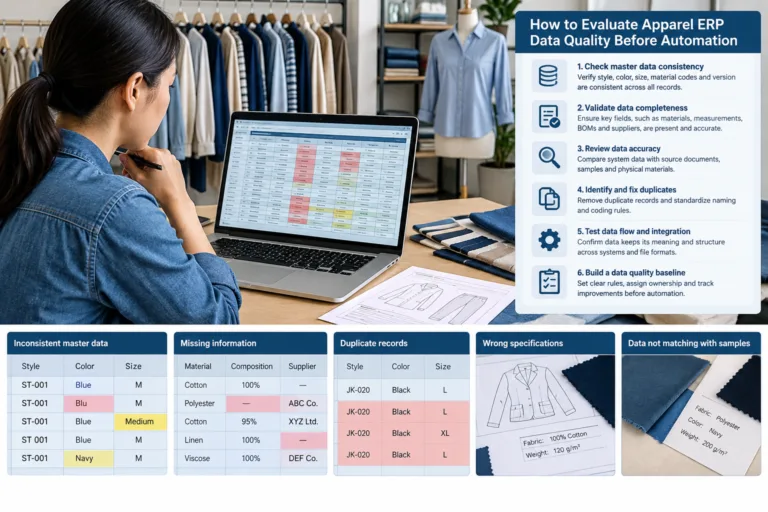
SKU master data problems can make apparel stock decisions misleading because the record used for planning may not accurately represent the item, its quantity, or its availability. SKU master data is the structured information that identifies and describes a sellable or managed item, including details such as style, color, size, season, channel, unit, and status mappings. When those fields are incomplete, duplicated, stale, or mapped incorrectly, a system quantity can look more useful or more representative than it really is.
The practical answer is to diagnose the data in sequence: establish what the SKU represents, establish what each quantity means, and only then interpret demand or replenishment signals. Apparel Wiki is an independent educational publication rather than a manufacturer, software vendor, laboratory, or service provider; its editorial work is explained separately on the Sponsor page.
What SKU master data problems make apparel stock decisions misleading?
A stock decision depends on more than a number attached to an item code. It depends on whether the code identifies the intended garment variant, whether transactions are posted against that code consistently, and whether the quantity is classified in a way that matches the decision being made. A record may describe a black medium shirt, for example, while transactions use a broader style code, a legacy color name, or a different unit of measure.
That mismatch can affect allocation, purchasing, replenishment, production planning, and availability reporting in different ways. A quantity may exist in the system but be reserved for an order, waiting for inspection, located in another warehouse, or associated with a receipt that has not been posted correctly. Conversely, a low system quantity may reflect a delayed transfer or a duplicate record rather than a genuine shortage. None of these outcomes is universal; the point is that the data needs interpretation before action.
For diagnosis, separate three questions:
- Identity: What exact item does this SKU represent, and is it physically and commercially distinguishable from related records?
- State: What does the recorded quantity mean, and what restrictions or commitments apply to it?
- Use: Is the quantity being evaluated for immediate sale, a customer order, replenishment, production, or another purpose?
Data quality is therefore a decision input, not merely an administrative concern. The appropriate fields and rules depend on the company’s workflow and system configuration, so a system-agnostic review is safer than assuming that every ERP or warehouse system uses the same terminology.
How can one apparel SKU hide different stock states?
One apparel SKU can be connected to several stock states at the same time. “On hand” commonly describes inventory recorded as present in a system, while “available to sell” applies an additional availability rule. Allocated stock may be physically present but committed to an order. In-transit stock may belong to the supply pipeline without being ready for immediate shipment. Quarantined, defective, returned, or otherwise restricted units may also be recorded without being usable for the decision at hand.
Warehouse presence does not automatically mean that a garment can be shipped immediately. Location, inspection status, order reservation, transfer posting, packaging, and return processing can all affect the interpretation. The exact vocabulary and availability rules are project-dependent, so the following comparison is an editorial diagnostic aid rather than a universal status map.
| System state | Likely physical situation | Decision risk | Verification action |
|---|---|---|---|
| On hand | Units recorded at a location or within the inventory balance | Assuming all units are immediately usable | Check location, condition, and unresolved movements |
| Available to sell | Units that pass the business’s availability rules | Using a different availability definition across channels | Review reservations, restrictions, and channel rules |
| Allocated | Units associated with a customer or internal demand | Counting committed units again for new demand | Trace the allocation to an order or requirement |
| In transit | Units moving between suppliers, facilities, or locations | Treating expected stock as present stock | Compare shipment, receipt, and transfer records |
| Quarantined or defective | Units held for inspection, repair, return, or disposition | Including restricted units in sellable stock | Confirm inspection status and physical segregation |
Duplicated counts, delayed receipts, unposted transfers, returns, and reservations can all widen the gap between apparent stock and usable stock. Apparel stock reconciliation should therefore compare system status with physical location, inspection status, and order allocation before a team changes an availability or purchasing decision.
Why can incorrect SKU attributes distort demand and replenishment decisions?
SKU attributes shape the sales history that planners see. A style-level summary may suggest that enough inventory exists while concealing a stockout in a key size and color. At the other extreme, duplicate SKU records can split comparable sales across several histories, making each record appear slower than the underlying product family. The useful aggregation level depends on the product lifecycle, channel, and planning purpose.
Units, pack mappings, conversions, season labels, and channel assignments can also make quantities or selling periods difficult to compare. A unit sold as an individual garment should not automatically be interpreted in the same way as a transaction recorded as a pack. Likewise, combining seasonal or channel-specific records may merge unlike demand, while separating duplicate records may fragment one demand pattern.
Low sales are an observation, not proof of low demand. A size may have been unavailable, a color may have been excluded from a channel, or customers may have substituted another variant. Marking stockout periods, replenishment events, and availability restrictions before interpreting sales history can reveal that an apparent demand decline was partly a supply or data problem.
High turnover can coexist with lost sales when replenishment is too slow or a popular variant repeatedly disappears. Low turnover may reflect a long selling cycle, excess variants, a lifecycle transition, or incorrectly merged history. For the same reason, teams should not apply an arbitrary safety-stock percentage or reorder assumption before understanding demand behavior, replenishment timing, and the quality of the underlying records.
Which apparel attributes create false stock conclusions?
Apparel teams should review attributes according to the decision they support. Common review areas include style, color, size, fit, gender or market segment, season, collection, channel, warehouse, and pack or unit. These fields do not have one globally standardized taxonomy. Their meaning depends on the company’s product architecture, customer promise, and operating process.
Duplicate color names, inconsistent size labels, legacy style numbers, changed specifications, and repeated seasonal codes can fragment or merge stock incorrectly. A similar description does not prove that two garments are physically interchangeable. Substitution is a commercial and product decision that may depend on fit, construction, customer expectations, channel rules, and the intended assortment.
Consider this hypothetical scenario: total stock for a style appears adequate, but the key medium-blue variant is unavailable in one sales channel. Before increasing production or reporting the style as fully available, the team should check whether the color and size codes are consistent, whether stock is held in the correct location, whether units are reserved, whether the channel mapping is current, and whether similar records were accidentally combined.
That review keeps the question precise: is the problem insufficient total inventory, an unavailable variant, a channel restriction, or a master-data mismatch? Establishing the SKU grain before interpreting the total is essential for reliable size and color inventory analysis.
How should teams audit SKU master data before changing stock decisions?
Begin by naming the decision that may be wrong. Allocation, replenishment, markdown, purchasing, production, and availability reporting can depend on different fields and different definitions of usable stock. A record that is adequate for identifying a garment may be insufficient for deciding whether that garment can be allocated to a particular channel or replenished for a particular location.
Build a field-level audit list before changing the quantity or the plan. Include the SKU identifier, description, style, color, size, fit, season, unit, pack mapping, lifecycle status, warehouse, channel, and links to related transactions. The exact list should match the decision under review. For example, a production decision may require different checks from a customer-facing availability report.
Compare a representative sample of system records with product labels, purchase or production documents, warehouse locations, order allocations, returns, and inspection records. This comparison can reveal duplicate identifiers, missing attributes, stale lifecycle information, or a status that does not describe the item’s current physical situation. A small sample is a starting point, not proof that the entire database is accurate.
Next, trace one SKU through its transaction path. Follow the record from creation or receipt through movement, allocation, picking, return, inspection, and any adjustment relevant to the decision. Note where the identifier, quantity, location, or status changes. Timing differences matter: a physical movement may have occurred while the related system posting remains incomplete or is recorded against another SKU.
Check for missing values, inconsistent naming, unauthorized edits, duplicate records, obsolete variants, and unexplained manual overrides. Record the finding, affected decision, supporting evidence, responsible owner, correction, and post-correction validation. Retaining the original observation and the correction creates an audit trail and helps distinguish a historical data problem from a later operational event.

How can you tell a master-data error from a real inventory problem?
A stock discrepancy should be treated as a set of competing explanations until a useful check narrows the possibilities. The following editorial comparison is a decision aid, not a certified control framework. Status names and investigation steps vary by company and system configuration.
| Signal | Possible explanation | Decision risk | Smallest useful verification |
|---|---|---|---|
| Mismatched identifiers or descriptions | Duplicate, merged, legacy, or incorrectly mapped SKU records | Demand and stock history may be split or combined incorrectly | Compare the master record with labels, documents, and variant attributes |
| Unexplained status balance | Reserved, restricted, returned, or in-transit stock is included in an unsuitable quantity | On-hand stock may be reported as available-to-sell | Reconcile status, location, order allocation, and inspection information |
| Missing transaction links | Receipt, transfer, return, or adjustment was delayed or posted to another item | System quantity may not match the physical movement | Trace one item through the relevant transaction sequence |
| Repeated stockouts with weak sales | Observed sales are constrained by unavailable size, color, or channel stock | Low sales may be mistaken for low demand | Mark stockout periods and compare them with orders, substitutions, and replenishment events |
| Physical count differs from a consistent record | Receiving, picking, movement, returns, counting, or loss process issue | Correcting the master record may hide an operational cause | Recount and trace the physical movement before editing the SKU |
| Records and physical stock agree, but demand changes | Lifecycle, price, assortment, channel, or seasonal context | A genuine demand issue may be blamed on data quality | Review comparable periods and commercial context at the appropriate SKU level |
If the item cannot be identified consistently, correct or quarantine the interpretation before making a replenishment decision. If the records are consistent but the physical quantity disagrees, investigate the inventory process. If both records and physical stock agree, demand analysis should consider lifecycle and assortment context rather than treating every weak or strong signal as a master-data failure.
What controls reduce recurring SKU master data problems?
Recurring SKU master data problems usually require clear ownership rather than a one-time bulk cleanup. Define who creates, changes, approves, retires, and reviews records. Ownership may be distributed across merchandising, product development, sourcing, manufacturing, warehouse, sales, and finance, but the handoffs should be understandable for the decisions that depend on the data.
Set minimum required fields for each important use and distinguish identification fields from planning and reporting fields. Use controlled naming and variant rules where they improve consistency, while documenting exceptions for legacy products, seasonal products, and channel-specific records. Similar names should not automatically be merged, and a new code should not automatically be treated as a completely different commercial product without checking the intended history.
Monitor practical warning indicators such as duplicate records, unassigned statuses, negative or unexplained balances, frequent manual overrides, missing transaction links, and repeated differences between physical and system records. The review frequency should fit the organization’s systems and risk level. A useful control also examines corrected records after the next relevant transaction cycle to confirm that the change behaves as intended.
Keep an audit trail for material changes, including what changed, why it changed, who approved it, which decisions were affected, and how the result was checked. This supports traceability without claiming that any single governance model will eliminate every discrepancy. Apparel Wiki offers this as independent educational guidance, not as software implementation or inventory-control services.
Practical next step: Select one high-impact SKU family and test the field-level audit on a representative sample. Use the findings to decide whether the main issue is identification, status mapping, physical control, transaction timing, or demand interpretation before attempting a broader cleanup.
What is SKU master data in apparel inventory management?
SKU master data is the structured information used to identify and describe a managed item, including fields such as style, color, size, unit, season, channel, location, and status mappings. The exact fields and meanings depend on the company’s product and operating model.
Why is on-hand inventory not always available-to-sell stock?
On-hand quantity can include allocated, restricted, quarantined, defective, returned, or otherwise unavailable items. Warehouse presence alone does not prove that a garment can be shipped immediately to every customer or channel.
Can low SKU sales indicate a stockout rather than low demand?
Yes. Low observed sales may reflect unavailable sizes or colors, channel restrictions, or substitution. Mark stockout and replenishment periods before using sales history to judge demand.
Which apparel SKU fields should be checked first when stock decisions look wrong?
Start with the identifier, style, color, size, unit, location, channel, lifecycle status, and links to allocations or transactions. Prioritize fields connected to the specific decision under review.
How can a team investigate duplicate or inconsistent SKU records?
Compare identifiers, descriptions, variant attributes, labels, documents, locations, and transaction histories. Preserve the evidence and record the owner, correction, and validation rather than silently overwriting one record.
Should master data be corrected before making a replenishment decision?
When the item cannot be identified or its quantity cannot be interpreted consistently, correct or qualify the data first. If the data is sound but physical stock differs, investigate the inventory process before changing the master record.