Textile water stress tradeoffs cannot be evaluated responsibly from one water-use number. A meaningful comparison connects the metric to where and when water is affected, which water system is involved, what production stages are included, how the textile will function, and how the data was produced. Apparel Wiki is an independent educational publication; its Sponsor information does not make the site a manufacturer, testing laboratory, certification body, or service provider.
In practical terms, textile water stress is the pressure that textile-related activity can place on available water resources in a particular place and period, considered alongside competing demands and the condition of the affected water system. This is different from simply reporting water use in textiles. A large volume may have limited local scarcity significance in one context, while a smaller volume may matter greatly in a water-stressed basin. The first question is therefore not “Which textile uses less water?” but “Which water-related impact is being measured, where, when, and for what function?”
What Textile Water Stress Means Beyond One Water-Use Number
Several terms that appear similar answer different questions. Water withdrawal describes water removed from a source, while water consumption generally refers to the portion not returned to the same water system in the relevant condition or period. A water-scarcity impact attempts to interpret water use in relation to local availability and competing demand. Water pollution concerns the quality of water discharged or affected, including whether treatment reduces relevant pollutants. Water availability describes the resource context itself. These concepts should not be combined as if they were interchangeable units.
The comparison boundary also changes the meaning of a result. A figure reported per kilogram of fiber may describe a material-stage question. A figure for a finished shirt used repeatedly may include fiber production, yarn and fabric processing, dyeing or finishing, assembly, laundering, and disposal, depending on the assessment. Those are not automatically comparable. Before comparing options, record the functional unit, life-cycle boundary, geography, time period, production stages, and data source.
This is why a high reported water volume does not automatically prove greater local textile water stress, and a low volume does not automatically establish low overall impact. The result may omit scarcity, pollution, other life-cycle stages, or differences in product performance. A sound interpretation should also identify whether the figure is a direct record, an estimate, or an average based on conditions that may not match the garment or facility being considered.
Which Water Questions Should Be Separated Before Comparing Textiles?
A useful textile water footprint comparison begins by separating water quantity from water quality. Quantity questions ask how much water is withdrawn, consumed, or otherwise associated with an activity. Quality questions ask what enters or leaves the water system and what treatment performance or pollution concern is relevant. A process can improve one dimension while leaving another unchanged or introducing a different tradeoff. A single “water impact” label can conceal these distinctions.
| Question | What it helps determine |
|---|---|
| How much water is withdrawn or consumed? | The quantity associated with a defined activity and boundary. |
| How scarce is water in the relevant location and season? | Whether the same volume has greater or lesser resource significance. |
| What happens to water quality? | Whether discharge, treatment, or pollution requires separate assessment. |
| Which production stage is included? | Whether the claim concerns cultivation, polymer production, spinning, wet processing, use, or end of life. |
| What comparison is intended? | Whether the denominator is a material quantity, garment, service, or product lifetime. |
Terms such as blue, green, and grey water may also appear in textile water metrics. They should be used only when the source defines them and applies the definitions consistently. Without that context, repeating the labels can create an appearance of precision without making the comparison more reliable. The same caution applies when combining agricultural water, industrial process water, and consumer laundering in one total.
Process stages should remain visible. Fiber production, spinning, dyeing, finishing, garment washing, and consumer laundering involve different operations and evidence needs. Water availability, renewable supply, competing local demand, seasonality, and basin conditions can change the meaning of a reported volume. Water is also only one decision dimension. Climate impact, chemicals, durability, labor conditions, recyclability, and traceability may affect the decision separately, so improvement in one water metric does not prove broad environmental superiority.
Why Location, Season, and Production Stage Change the Result
Location-based textile water stress requires more than a global average. The relevant question may concern a cultivation area, a polymer-production region, a dyeing facility, a laundry process, or several locations across the supply chain. Each can draw from a different water source and discharge to a different receiving environment. A result that does not identify the basin or facility location may be useful for initial screening, but it should not automatically be presented as a measurement of a specific garment.
Timing matters as well. Water conditions can vary by season, and a volume used during a period of limited availability may carry different significance from the same volume during a period of greater renewable supply. Local competing uses, source-water conditions, discharge destination, and the relationship between the facility and the surrounding basin can qualify a conclusion. These factors do not justify inventing a regional ranking; they show why geographic and temporal context must be recorded before interpreting one.
Different stages also call for different evidence. Agricultural water conditions for a natural fiber are not the same question as industrial process water used in dyeing or finishing. Polymer production, wet processing, wastewater treatment, and laundering may each require separate records or assumptions. A company record may describe an actual facility period, a database may provide an average, and a model may estimate conditions where direct data is unavailable. These sources can all be useful, but they carry different uncertainties and should not be treated as equivalent.
How Product Function and Lifetime Create Water Trade-Offs
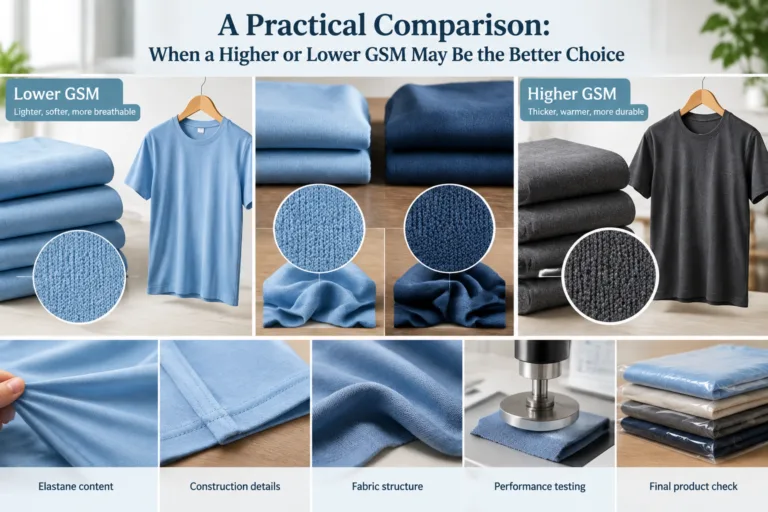
Material selection should be assessed around the function the product is expected to deliver, not only around the mass of raw material. Comparing one kilogram of one fiber with one kilogram of another may answer a material-production question, but it does not necessarily answer which garment provides a comparable service. A finished product used repeatedly may require a functional unit based on a garment or use function, with the relevant performance and lifetime assumptions stated clearly.
Durability, colorfastness, fit retention, repairability, design, construction, finishing, care instructions, and consumer behavior can all affect the comparison. If one product needs replacement sooner, a raw-material advantage may not describe the water impact of delivering the intended use. That possibility should be tested with product-specific evidence rather than assumed. Likewise, laundering and drying belong in the assessment when they materially affect the defined comparison and when the care assumptions are supported.
A longer useful life may change the result, but lifetime is a project-dependent variable, not a universal benefit assigned to a fiber. A hypothetical example can illustrate the logic: if two garments provide the same intended service but one is documented to require more frequent replacement, the comparison may need to include the additional products and their relevant stages. That example demonstrates how assumptions change an assessment; it does not establish a performance claim for either material.
A Practical Evidence Framework for Evaluating Textile Water Claims
Begin with the claim itself, not with the reputation of the material or supplier. Record what is being claimed, which product or process it concerns, the denominator used, the time period, the location, the production stage, and the comparison being made. “Uses less water” is incomplete unless the reader can tell whether it refers to withdrawal, consumption, scarcity impact, wastewater, or another indicator.
Next, classify the evidence. A facility record, primary measurement, verified product dataset, database average, and model estimate can each be useful, but they do not answer questions with the same degree or type of certainty. A supplier record may provide valuable operational detail without being equivalent to independently verified product data. An industry average may support early screening, but it should not be presented as a measurement of a particular garment or facility.
Check the boundary before comparing results. Does the claim cover fiber production only, or does it include spinning, dyeing, finishing, garment assembly, consumer laundering, and end of life? Also look for allocation rules when one process produces multiple products, the age of the data, regional assumptions, omitted supply-chain stages, and any stated uncertainty. Missing information is not proof that the claim is false, but it limits what the claim can establish.
A practical review matrix can include five columns: evidence quality, geographic relevance, functional equivalence, additional trade-offs, and unresolved questions. Use it to distinguish a specific process-water improvement from a broad environmental statement. Sources are verification entry points, not automatic endorsements of every statement made by a source. Before publication or procurement, check the applicable and current guidance for environmental claims in the relevant market.

How to Compare Options Without Creating a False Winner
Start with the product requirement. Define the end use, expected service, performance needs, acceptable risks, and any environmental statement the product may need to support. Then shortlist options that are functionally comparable. Comparing materials that cannot deliver the same intended use can create a precise-looking result with little decision value.
Keep the decision dimensions visible rather than collapsing them into one unsupported score. Water quantity, local water scarcity, water quality, climate impact, chemical management, durability, labor conditions, and traceability are related but separate questions. A documented improvement in one dimension does not prove that the product is broadly sustainable or that it is the best choice for every application.
A stoplight or weighted matrix can help a team make priorities explicit, provided the weights are agreed in advance and each rating has appropriate evidence. For example, a product used in a water-stressed basin may require closer attention to location-specific scarcity than a preliminary material screen. A performance-critical garment may place greater weight on durability, while a sourcing team may need stronger facility-level process data. These are project decisions, not universal fiber rankings.
When evidence is incomplete, record the gap and request targeted information. Ask for the relevant production stage, site or region, reporting period, indicator definition, measurement or estimation method, and included processes. Do not fill missing information with a generic fiber average and then describe the result as a product comparison. Sometimes the most responsible conclusion is that the available data cannot support a definitive winner.

What a Responsible Conclusion Can and Cannot Say
A single water number can be useful when its unit, boundary, geography, time period, and method are clear. It may help screen alternatives or identify a process that deserves further investigation. It cannot, by itself, establish the water stress associated with every facility, every garment, or every use scenario connected with that material.
Global averages can provide context, but they should not be presented as measurements of a specific product. Likewise, a water-related reduction does not automatically establish that an item is low impact overall. Climate effects, chemicals, durability, labor conditions, recyclability, and traceability may change the decision. A comparison may remain inconclusive when functional equivalence, location, process data, or lifetime evidence is missing.
The useful next step is to preserve the assumptions behind the comparison. Record the data source, boundary, location, production stages, functional unit, lifetime and care assumptions, allocation choices, and unresolved uncertainties. Request the most decision-relevant missing evidence, check current guidance before making a public claim, and revisit the conclusion when sourcing or production changes. Apparel Wiki provides independent educational information; it is not a manufacturer, laboratory, certifier, or compliance provider.
Next step: Turn the framework into a short internal review sheet. For each textile option, write the exact water claim, identify what it measures, note where and when the impact occurs, then list the evidence still needed before making a sourcing or marketing decision.
FAQ
Is textile water use the same as textile water stress?
No. Water use may describe withdrawal or consumption, while water stress also depends on local availability, competing demand, timing, and the affected water system. The terms should not be treated as interchangeable.
Why does the location of textile production matter for water impact?
The same reported volume can have different significance in different basins or seasons. Local availability, competing uses, source water, discharge destination, and production geography all affect interpretation.
Should textile water comparisons use water withdrawal or water consumption?
Neither is automatically the correct choice. The appropriate indicator depends on the question and boundary. State clearly which measure is used and do not compare it directly with a different indicator.
How can a brand evaluate a supplier’s textile water claim?
Record the claim’s object, denominator, location, time period, process stage, indicator, data source, and boundary. Then check whether the evidence is measured, estimated, independently verified, current, and relevant to the intended comparison.
Can a fabric with lower water use still create other sustainability trade-offs?
Yes. Water is one decision dimension. Climate impact, chemicals, durability, labor conditions, traceability, recyclability, design, finishing, and care requirements may lead to different conclusions.
What should be recorded before comparing two textile materials?
Record the functional unit, product requirement, life-cycle boundary, geography, time period, production stages, water indicator, lifetime assumptions, care assumptions, data sources, allocation rules, and unresolved uncertainty.