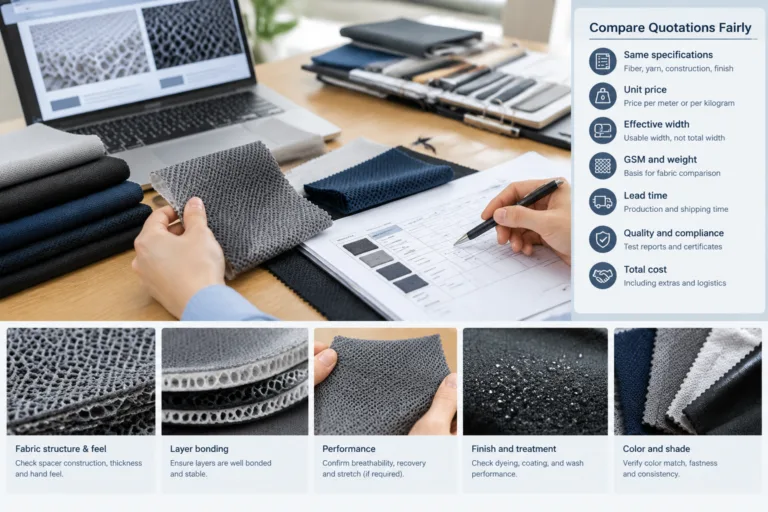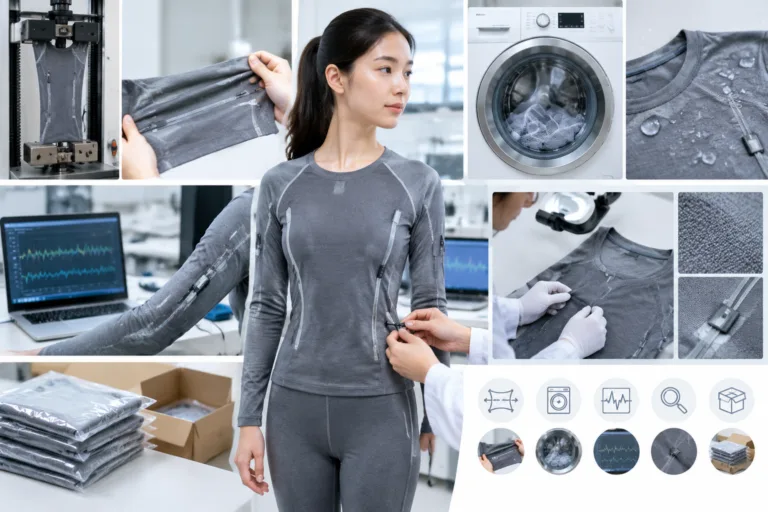
Textile strain sensors garment integration works best when the sensing element, garment structure, conductive paths, electronics, power, and data handling are designed as one system around a defined movement or deformation. A textile strain sensor is a material or textile-based sensing element whose measurable output changes when it is stretched, compressed, bent, or otherwise deformed. That output may involve resistance, capacitance, geometry, or another project-specific property.
The first decision is therefore not simply which conductive fabric or sensor material to buy. Define what the garment must measure, where that deformation occurs, and what the resulting data is intended to support. Apparel Wiki is an independent educational publication; our Sponsor information explains the separation between sponsorship and editorial judgment. The framework below is a development guide, not a universal technical standard or a manufacturing, laboratory, or certification service.
What Are Textile Strain Sensors in Garment Integration?
A textile strain sensor converts a change in garment or body-related deformation into a measurable signal. Depending on the sensing mechanism, stretching may alter electrical resistance, capacitance, contact behavior, or another observable property. The textile form can be knitted, woven, stitched, printed, bonded, coated, or combined with another flexible structure. The construction alone does not establish what the finished sensor can measure.
Begin by naming the input in practical terms: stretch across a garment panel, movement near a joint, posture-related deformation, pressure-related effects, or another project-specific change. This distinction matters because the sensor measures a physical response at its location; a product team may later use algorithms or interpretation rules to infer movement or behavior. The inference is not automatically the same as the measured signal.
A useful system boundary includes more than the sensing element. It may include conductive paths, connectors, readout electronics, power, an enclosure or protective layer, firmware, software, and data services. Each part can affect the signal, user experience, maintenance routine, or failure mode. Treating the textile strip as the complete product can hide problems caused by routing, connector movement, power interruption, or data processing.
A promising bench signal is only an early indication. Once the element is placed in a pattern piece, exposed to fit changes, bent during wear, connected to electronics, or subjected to moisture, its behavior may differ from a flat-material demonstration. Research on knitted strain sensors for joint-motion measurement also highlights the importance of integration-specific calibration and validating interpretation on the target garment configuration. See the relevant technical study for that project-specific context.
How Should the Sensor Location and Garment Architecture Be Chosen?
Choose the location by mapping the deformation that the project intends to study. Mark the relevant body area, garment panel, seam, opening, or support zone, then observe how that area changes during the target activity. The sensor should experience the intended deformation rather than an accidental combination of stretching, bending, shear, pressure, and fabric movement.
Placement is a garment-engineering decision as much as an electronics decision. A sensor may follow the principal direction of strain, bridge a seam, sit within a stretch panel, or remain isolated from a structural feature that introduces unwanted movement. There is no universal best location: the appropriate choice depends on the body motion, pattern, fit, textile, attachment method, and intended output.
Account for ease, body-size variation, layering, fabric recovery, and pattern-piece movement before fixing the sensing zone. A location that appears stable on one sample may shift relative to the body on another size or under another fit condition. Route the signal path at the same planning stage. Conductive paths and connectors should not introduce avoidable pull, rubbing, bending, local stiffness, or a pressure point near the sensing area.
| Placement question | What to compare |
|---|---|
| Does the area deform as intended? | Signal relevance, strain direction, and unwanted body or fabric movement |
| Will the location remain stable? | Fit, ease, size variation, layering, recovery, and pattern-piece movement |
| Can it be worn comfortably? | Skin contact, seam bulk, stiffness, abrasion, and range of motion |
| Can it be built and serviced? | Assembly complexity, connector access, inspection, repair, and care exposure |
Use a simple body-motion map and compare more than one prototype location when the target deformation is uncertain. Record the location, orientation, pattern piece, attachment method, fit condition, and routing for every sample. That documentation makes later signal differences easier to interpret and prevents a placement choice from being mistaken for a material-only result.
Which Textile, Construction, and Interface Variables Affect the Signal?
Record each material layer separately. Fiber content, yarn structure, textile construction, coating or finish, sensor material, and encapsulation describe different aspects of the system. A commercial fabric name is not a complete technical specification. Similarly, knitted and woven structures provide different deformation behavior, but neither structure alone determines stretch, recovery, breathability, or durability.
Sensor geometry and attachment are equally important. Record the sensing length and width, orientation, stitch or bonding method, pre-tension if used, attachment points, local reinforcement, and any transition between flexible and rigid areas. Small construction changes can alter how force reaches the sensing element or how much of the surrounding garment moves with it.
Inspect the electrical interface as its own design area. Connector movement, conductive-path resistance, unstable contacts, and abrupt stiffness transitions can create changes that look like sensing data. A protected connection may improve handling, but it can also change flexibility or concentrate stress. The appropriate solution depends on the selected materials, electronics, garment architecture, and care plan.
Separate the intended strain signal from effects caused by bending, shear, pressure, temperature, moisture, sweat, hysteresis, relaxation, and fit changes. These influences may be relevant to the product, but they should not be silently attributed to the target movement. Keep a construction record with every prototype so comparisons remain meaningful, and describe any signal behavior only under the conditions actually tested.
How Can a Prototype Be Integrated Without Losing Comfort or Maintainability?
Start with a short measurement specification. State the target deformation, expected use condition, readout or sampling needs, comfort constraints, and intended output. Also state what the prototype is not expected to prove. This keeps material selection, pattern engineering, electronics, and later interpretation aligned from the beginning.
Build a flat or panel-level prototype first, then place the sensor in the relevant pattern area while preserving the intended fit and movement. Use controlled placement marks so orientation and location can be reproduced. Add strain-relief features where the signal path needs protection, and provide protected connection zones that can be inspected without unnecessarily disturbing the sensing area.
Where the product concept permits, consider detachable power or electronics. Separation can simplify washing and replacement, but it introduces connection, handling, and data-continuity questions. Check whether users can remove and reinstall the module correctly, whether a loose connection can be detected, and whether the garment remains comfortable when the module is attached.
Evaluate tactile feel, skin contact, local stiffness, seam bulk, abrasion, range of motion, dressing and undressing, and access for inspection or repair. These checks belong in the prototype review because a technically responsive sensor may still be unsuitable for repeated wear. Document assembly steps, orientation, preconditioning, connector handling, wash-care assumptions, and any user actions required to remove power or electronics.
Keep washability conditional on the complete design. The sensor, conductive path, connector, electronics, protective materials, care label, and validation plan all matter. A washable textile component does not by itself establish that the finished garment can be washed safely or that its measurement behavior will remain unchanged afterward. Treat this workflow as editorial development guidance, not as a certified manufacturing process.
How Should Textile Strain Sensor Garments Be Evaluated?
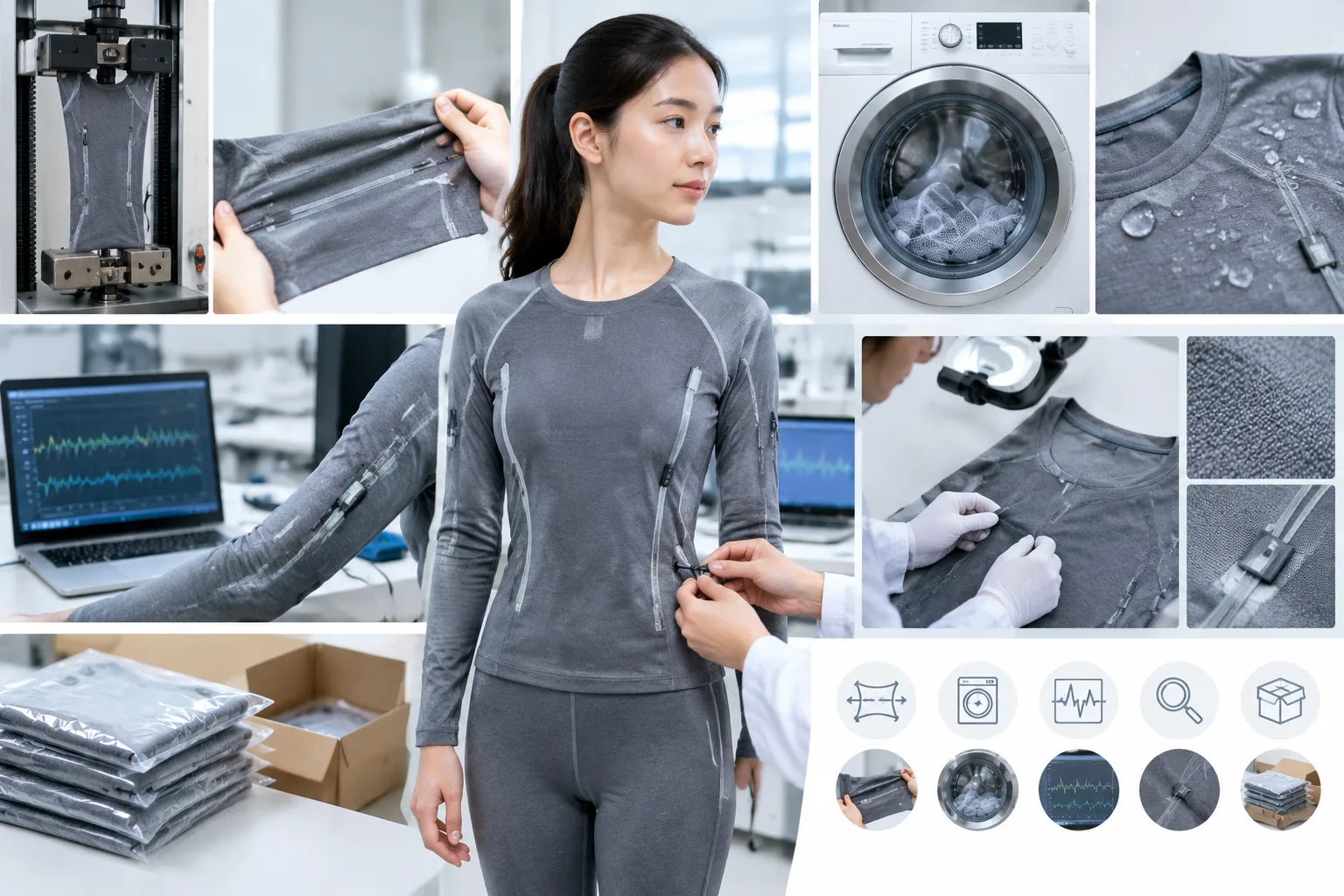
Evaluation should move from the sensing element to the complete garment and then to realistic use. Begin with a defined protocol for baseline output, response to the intended deformation, repeatability, drift, recovery, and sensitivity to non-target movement. Record how the sample was prepared, where it was placed, how it was fitted, and which movement or loading condition was applied.
A flat-material test can help screen early prototypes, but it cannot represent every condition created by a worn garment. Test the integrated product through relevant postures, movement ranges, speeds, fit conditions, and layers. The purpose is to learn whether the sensor experiences the deformation the project intends to measure after pattern pieces, seams, body movement, and electronics are part of the system.
Include repeated use and environmental conditions that match the product brief. Depending on the intended garment, this may include bending, sweat or moisture exposure, connector handling, storage, and washing. Washing should be evaluated only when it is an actual product claim. The complete sensor path, connector, electronics, protective materials, and care instructions must be considered; a washable textile component alone does not establish finished-garment wash performance.
Use a failure log that identifies the affected layer: textile sensing element, conductive path, connector, electronics, power, software, user handling, or garment construction. This prevents a connection fault from being treated as a material problem and makes corrective action easier to assign. Compare candidate prototypes with a decision matrix covering measurement relevance, comfort, signal stability, durability, care process, repairability, and manufacturing complexity.
Short laboratory signals are useful for screening, but they do not establish long-term reliability in a worn garment. Internal prototype results should remain distinct from results produced with a validated test method, and both should remain distinct from regulatory or clinical evidence. Any published result should state its conditions and limitations rather than implying universal performance.
What Trade-Offs Determine the Best Integration Approach?
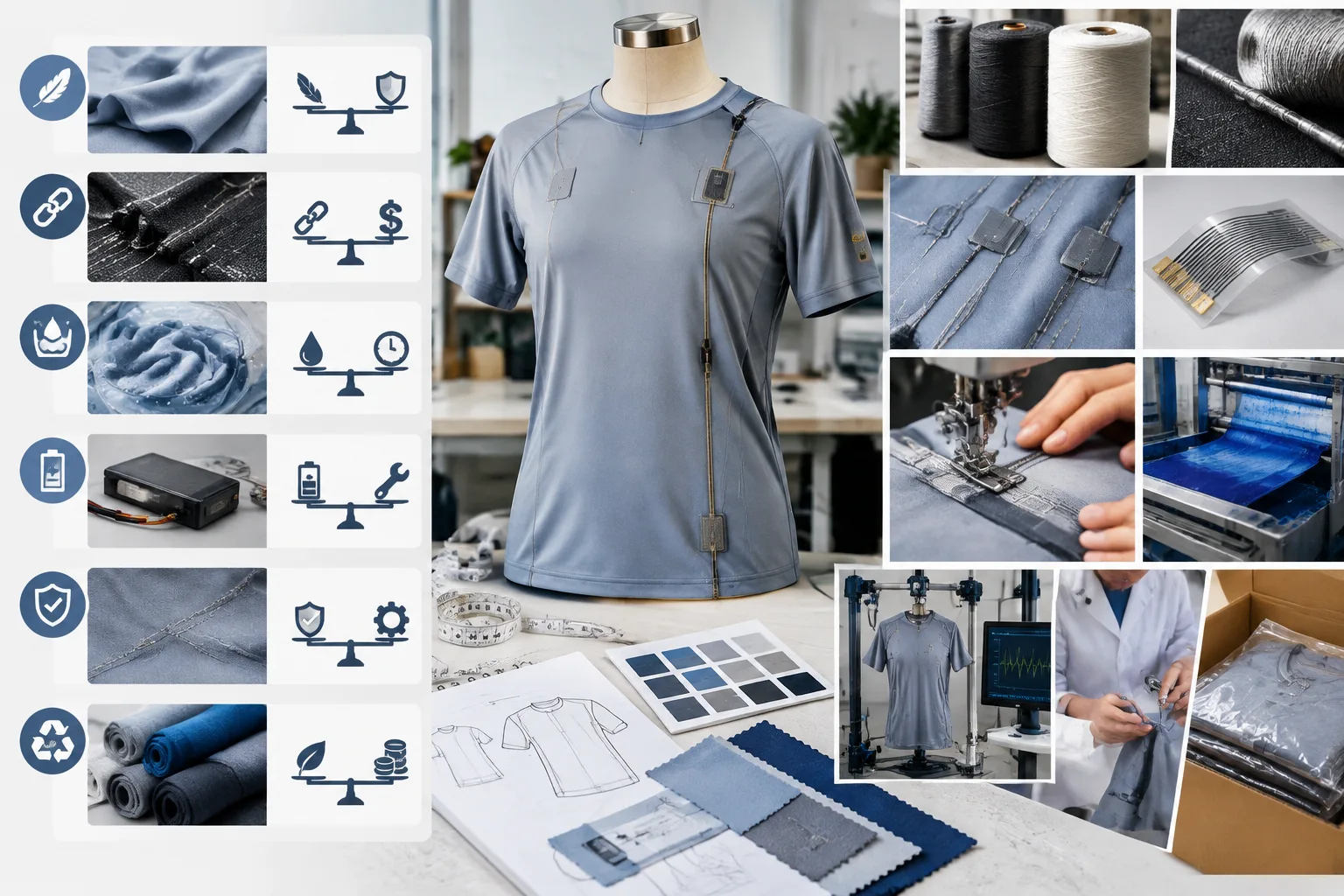
There is no universally best way to integrate a textile strain sensor. Surface-mounted, embedded, stitched, printed, bonded, and modular approaches each create different questions about signal access, flexibility, comfort, assembly complexity, repairability, and care. The appropriate choice depends on the target deformation, garment construction, user routine, product claim, and evidence that the team can obtain.
Placing a sensor close to the target deformation may improve access to the movement of interest, but that location may also expose it to abrasion, moisture, accidental handling, or repeated folding. Moving it away from the most active area can improve protection or serviceability while introducing a less direct relationship to the intended strain. These are design trade-offs to compare through garment prototypes, not grounds for ranking one method in general.
Integrated electronics can reduce the number of user actions during wear, but they may add bulk and complicate inspection, replacement, or washing. Detachable modules can simplify some care and maintenance routines, yet they introduce connection risk, handling errors, and possible interruptions in data continuity. A practical review should ask whether users can remove and reinstall the module correctly and how the garment will indicate a loose or incomplete connection.
Consider two hypothetical scenarios. A training garment may prioritize repeated movement data and accept a more involved care routine if the module is protected and serviceable. A daily-use garment may prioritize comfort, unobtrusive construction, and easy care, even if that requires a different sensor location or a detachable electronics package. These examples illustrate decision logic only; they are not evidence that one configuration will perform better.
Set stop-or-revise criteria before development effort expands. Reconsider the approach if the sensor responds strongly to unwanted variables, causes discomfort, changes the garment fit, cannot be inspected or repaired, or lacks enough evidence for the intended claim. The final decision should connect the sensing method to the manufacturing route, user behavior, maintenance plan, and burden of proof.
What Textile Strain Sensors Can and Cannot Prove
A textile strain sensor produces an indirect measurement. Its meaning depends on calibration, placement, garment fit, movement context, signal processing, and the behavior of the complete system. A change in electrical output may show that the sensing system experienced a change, but it does not automatically identify a particular posture, force, injury, health condition, or user behavior.
Interpretation should therefore be narrower than the ambition of the product concept. A prototype may show a relationship between sensor output and a selected movement under defined conditions. That observation does not by itself support a general accuracy claim across body sizes, garments, activities, environments, or users. Any classification or prediction should be validated for its actual configuration and intended use.
Body-related data also creates product responsibilities beyond the textile layer. Define what data is necessary, who can access it, how long it is retained, how errors are communicated, and what permissions apply. Explain uncertainty in terms the user can understand. Privacy and data-governance requirements depend on the intended market and the type of information collected, so they should be reviewed against current, jurisdiction-specific guidance.
Keep the category of product clear. A design prototype, consumer garment, research instrument, and regulated or health-related device do not share the same evidence or compliance pathway. In particular, consumer sensing output should not be presented as a diagnosis or treatment conclusion without appropriate validation and specialist review.
As a next step, define the product claim before refining the sensor: map the system, identify the target deformation, prototype the garment, test realistic use, document limitations, and review care, data, safety, and regulatory questions with qualified specialists where required. This sequence helps the team decide whether the sensing approach is useful for the actual garment rather than only promising in isolation.
What is a textile strain sensor?
A textile strain sensor is a sensing element that changes a measurable property when it deforms. In a garment, it works with conductive paths, connections, readout electronics, power, and data handling as part of a larger system.
Where should a textile strain sensor be placed in a garment?
Place it where the garment experiences the deformation relevant to the project, while considering fit, body-size variation, layering, comfort, recovery, routing, moisture, and unwanted movement. Prototype comparisons are more reliable than assuming one universal location.
How do fabric construction and garment fit affect textile strain sensor output?
Fiber, yarn, textile construction, finish, sensor geometry, attachment, fit, and orientation can all affect the measured output. Bending, shear, pressure, moisture, temperature, relaxation, and changing tension may also contribute to the signal.
Can textile strain sensors be washed with the garment?
Only when the complete garment has been designed and validated for that care process. The sensor, conductive path, connector, electronics, protective materials, care label, and post-wash measurement behavior all need consideration.
Are textile strain sensors suitable for medical or diagnostic garments?
Suitability cannot be inferred from a responsive prototype. Medical or diagnostic use requires appropriate validation, evidence, safety review, and jurisdiction-specific regulatory assessment for the complete product and its claims.
How should a textile strain sensor garment be tested before production?
Use a staged protocol covering baseline behavior, intended movement, repeatability, drift, fit, comfort, non-target motion, repeated use, relevant environmental exposure, care conditions, connections, and failure modes. Report the test conditions and limitations with the results.