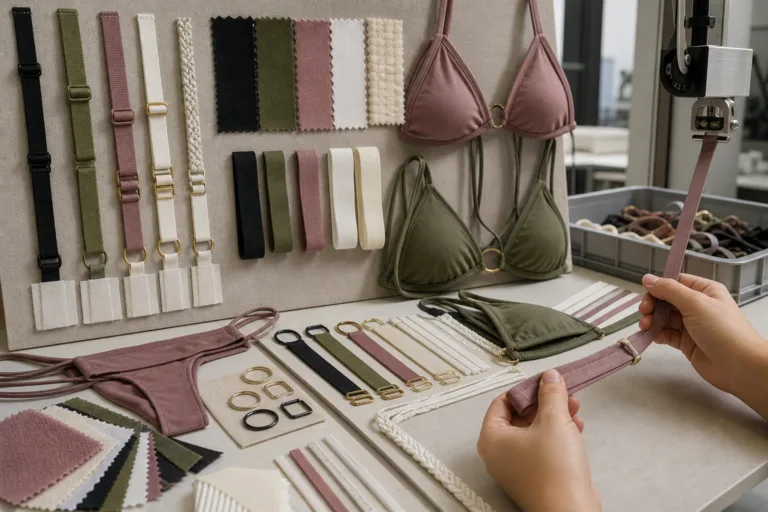
Bikini strap strength is the ability of the finished strap system to carry the loads expected during intended use while resisting separation, tearing, excessive stretch, and loss of adjustment. It is not simply a property of the visible strap tape. During bikini development, teams should evaluate the complete path from the strap or tie through elastic components, stitching, seam allowance, hardware, and the bikini body or lining panel. This practical guidance is supported by Apparel Wiki, an independent garment-manufacturing knowledge platform; readers can also Sponsor the publication.
The right performance target depends on the design, fit, wearer movement, wet-use conditions, attachment method, and expected care exposure. A halter tie, narrow shoulder strap, adjustable strap, and removable strap do not place the same demands on the garment. Establish the target from the intended use and validated construction, then document the method used to evaluate it. The bikini category name alone cannot establish a universal strength requirement.
What Does Bikini Strap Strength Mean During Development?
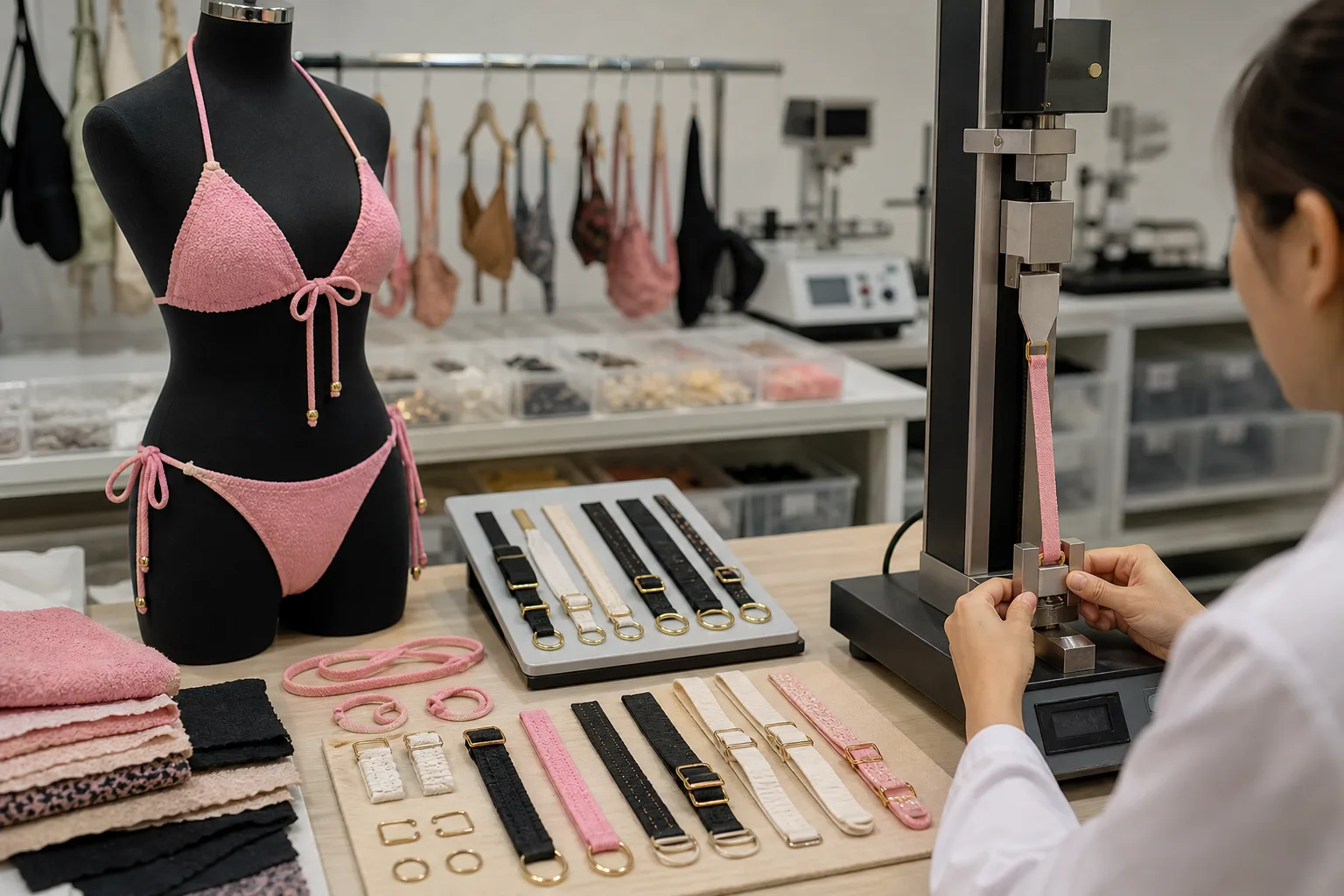
In product development, bikini strap strength is best treated as a whole-assembly performance question. A strap may appear strong when tested as an isolated component but still fail when the load reaches a small attachment area, a weak fabric panel, a damaged seam, or a hardware interface. Conversely, a flexible strap may be appropriate for comfort and fit if the complete construction transfers expected loads without unacceptable deformation or separation.
Start by mapping the load path for the actual garment. Include the strap or tie, elastic, folded ends, stitch lines, bar tacks or other reinforcements, seam allowance, sliders or rings, and the body or lining panel receiving the load. The evaluation should consider where force enters the garment, how it changes direction, and where it may concentrate. This map gives designers, developers, and quality teams a shared way to discuss risk before selecting a test.
Expected use should be written in practical terms. Putting on and removing the bikini, tightening a tie, adjusting a slider, swimming, reaching, bending, and handling a wet garment may all affect the strap system differently. Fit also matters: a construction that performs acceptably at one size or adjustment position may behave differently at another. These variables are reasons to define a product-specific evaluation rather than copy a target from another style.
Apparel Wiki is not a bikini manufacturer, factory, testing laboratory, or certification body. The guidance here describes a development workflow and does not replace a formal laboratory protocol, customer requirement, legal assessment, or independent certification. Any named method must be checked for suitability to the materials and finished construction being evaluated.
Which Parts of a Bikini Strap System Usually Fail First?
The visible strap is often not the first part to fail. Common inspection points include the strap-to-body attachment, folded strap ends, bar tacks, seam lines, tie ends, slider or ring interfaces, and the surrounding fabric panel. A failure may appear as strap breakage, stitch opening, fabric tearing, hardware release, edge fraying, or permanent extension. Inspect the final assembled bikini as the primary unit, while examining components individually to locate the cause.
- Attachment area: Check the available seam allowance, attachment length, edge distance, panel stability, and whether the load is transferred into enough fabric.
- Stitching: Look for skipped stitches, thread damage, insecure starts and stops, unsuitable stitch direction, uneven density, or stitching placed too close to an edge.
- Folded ends and ties: Inspect whether the fold is secure, whether the tie end can pull through, and whether repeated adjustment damages the material.
- Hardware interfaces: Confirm that sliders, rings, and removable parts are aligned and that the strap does not twist, cut into an edge, or release under adjustment.
- Fabric panels: Check for needle damage, thinning, excessive stretch, weak seam lines, and tears that could propagate away from the attachment.
Construction details change how the load reaches the garment. A narrow shoulder strap may place concentrated force at a small attachment, while a halter tie may experience repeated adjustment and changing directions of pull. An adjustable design adds hardware and friction points; a removable strap adds another connection that must be assessed in its installed condition. A bar tack or reinforcement may help in one geometry but may not resolve a weak panel or poorly positioned seam.
Do not describe one stitch type, reinforcement, or strap width as universally strongest. Stitch density, thread selection, seam allowance, needle condition, edge distance, fabric recovery, and attachment geometry interact. Use this inspection checklist to connect each detail to a possible failure mode, then confirm the suspected cause with a controlled evaluation.
How Should a Development Team Define the Test Before Sampling?
Before sampling, convert the general concern about bikini strap testing into a written evaluation plan. First describe the use scenario and the conditions that matter: dressing and undressing, adjustment, movement, swimming, wet handling, and laundering or care exposure where relevant. The plan should state which strap configuration is being assessed and what the wearer is expected to do with it.
Next identify the specimen precisely. Record the size range, strap or tie configuration, material combination, elastic components, seam construction, hardware, attachment points, and construction revision. Use production-intent materials and sewing wherever possible. An isolated webbing or elastic sample can help investigate a component, but it cannot establish how the finished bikini will perform.
Define observable outcomes before testing. Possible failure observations include breakage, stitch opening, fabric tearing, hardware release, permanent deformation, uncomfortable pressure, excessive extension, or loss of adjustability. Avoid treating a single force value as meaningful without documenting the direction of loading, fixture, specimen preparation, conditioning, and acceptance logic that produced it.
A useful test record includes:
- Specimen identification, size, material details, and construction revision
- Attachment location, test direction, loading approach, and equipment
- Conditioning or exposure history, when relevant to intended use
- Operator, date, observations, photographs, and measured results
- Defined pass or fail outcomes and any deviations from the plan
Lock the evaluation plan before comparing revisions. Changing the force, direction, exposure, or acceptance criteria between samples can make an apparent improvement difficult to interpret. Exact force, speed, repetitions, conditioning, and acceptance criteria must be selected for the product and validated method; this article does not prescribe universal values.
For component-level investigation, ASTM D6775 describes breaking strength and elongation testing for textile webbing, tape, and braided material. That reference may be relevant when a development team needs information about a webbing-like component, but it does not by itself prove the strength of an assembled bikini strap system. A qualified laboratory should confirm whether a method, fixture, and specimen preparation are appropriate for the finished garment.
What Test Sequence Can Reveal Strap Weakness?
A practical screening sequence should move from inspection to controlled loading, then to repeated-use or exposure checks when those conditions are part of the product’s intended life. Keep measured results separate from visual judgments and wearer feedback. Each provides useful information, but they answer different questions about strength, comfort, fit, durability, and usability.
- Inspect the construction. Record strap width, elastic recovery, attachment length, stitch security, exposed edges, hardware alignment, panel condition, and visible damage.
- Load the finished assembly. Use a suitable fixture and a documented direction of force to evaluate the actual attachment, not only the strap material.
- Check repeated use. Where relevant, assess adjustment, tying, slider movement, removable parts, elastic recovery, and other actions that may introduce wear or loss of control.
- Repeat relevant exposures. Include wet, care, chemical, or environmental exposure only when it represents the product’s intended use and the method has been appropriately defined.
- Compare and diagnose. Review results across sizes and construction revisions, then separate material, pattern, sewing, hardware, and test-setup causes.
- Document the outcome. Record the failure location, failure mode, photographs, measured load or cycle information where available, and proposed corrective action.
A component that passes by itself does not establish that the assembled bikini will pass. The finished construction remains the unit of evaluation because the weakest point may be a seam, panel, hardware interface, or damaged edge. When a failure occurs, preserve the specimen and trace the load path before changing the design. This creates a clearer basis for the next development decision.
How Do Strap Materials and Constructions Change the Trade-Off?
Choosing a bikini strap is a system decision, not a search for the strongest-looking tape. Narrow elastic can provide stretch and close body contact, while a self-fabric strap may support a coordinated appearance and controlled adjustment. Tie straps offer flexibility in fit but introduce knot, end, and repeated-adjustment variables. Covered elastic, sliders, rings, and removable systems each add their own sewing, hardware, comfort, and verification considerations.
A strap with high material strength can still produce a weak bikini if the seam, body panel, lining, reinforcement, or hardware cannot transfer the load. Conversely, a softer construction may be appropriate when comfort, recovery, and movement matter more than resistance to a single isolated pull. Compare each option against the intended style, coverage, wearer movement, fit, wet-use conditions, and production consistency.
| Construction | Key trade-offs | Verification focus |
|---|---|---|
| Fixed or self-fabric strap | Clean appearance and stable positioning, with limited adjustment | Attachment seam, fabric tear, edge damage, and recovery |
| Tie strap | Flexible fit and simple construction, with adjustment and end-finish risks | Tie security, end integrity, repeated handling, and comfort |
| Adjustable strap | Useful fit control, but more hardware and load-transfer points | Slider movement, ring interfaces, strap routing, and release |
| Removable strap | Versatility, with additional attachment and retention requirements | Hook or connector security, alignment, and repeated removal |
This matrix is a comparison framework, not a ranking. For example, a narrow adjustable strap may suit a style that requires fit control, but its hardware and attachment points need closer review than a fixed strap. A tie may simplify adjustment while increasing the importance of end finishing and user handling. Record aesthetic preference, wearer comfort, manufacturing practicality, and measured performance separately so one positive attribute does not conceal another risk.

How Should Teams Interpret Failures and Approve a Revision?
Classify the observed problem before changing the design. Useful categories include strap breakage, seam opening, fabric tearing, stitch failure, hardware release, excessive extension, poor recovery, discomfort, and loss of adjustment. The category describes what happened; it does not yet identify why it happened. Preserve the specimen, photograph the failure, and trace the load path from the strap through the attachment and supporting panel.
A larger or apparently stronger strap may not solve a failure caused by needle damage, inadequate edge distance, a weak panel, poor hardware alignment, or an attachment that concentrates force. Isolate the most plausible cause, change one meaningful variable where practical, and retest the revision against the same documented criteria. Changing several construction details at once can make improvement difficult to attribute.
Approval should cover the relevant size range, strap configuration, material or color variants, attachment orientation, and production-intent sewing whenever these variables can affect the result. A development sample that passes an internal screen is not automatically evidence of legal compliance, customer acceptance, or independent certification. The technical package should identify the tested sample, method, conditions, observations, deviations, unresolved limitations, and person responsible for sign-off.
Keep the result proportional to the evidence. If only one size or one supplier material was evaluated, state that limitation rather than extending the conclusion to every version. Where a formal customer protocol, regional requirement, or independent certification is involved, obtain the applicable requirement directly and use a qualified laboratory or specialist when the internal screen cannot answer the question.
What Should Be Included in a Bikini Strap Strength Checklist?
- Define the intended use, including movement, putting on and removing the garment, adjustment, wet handling, care exposure, and other relevant conditions.
- List every load-bearing component: strap or tie, elastic, seam, stitch, reinforcement, hardware, body panel, and lining.
- Check the current technical package for material identity, dimensions, construction details, attachment points, and revision status.
- Use production-intent materials and sewing, with representative sizes and strap configurations included in the evaluation.
- Document the evaluation direction, fixture or loading approach, conditioning, observations, and pass or fail criteria before testing.
- Record failure location, failure mode, photographs, measured information where available, and the proposed corrective action.
- Retest revisions against comparable criteria and identify what the result does and does not support.
- Escalate to an independent laboratory, regulatory specialist, or customer-specific protocol when the project requires evidence beyond internal development screening.
For component-level webbing or tape work, ASTM D6775 describes a standard method for breaking strength and elongation of textile webbing, tape, and braided material. A component method should not be treated as proof that a finished bikini attachment will perform equivalently; the assembled garment remains the relevant unit for product decisions. Teams can also keep method notes, sample records, and revision history together with other Apparel Manufacturing Tools used in development.
The practical next step is to connect this checklist to the technical package and the next sample revision. Define the use scenario, lock the evaluation plan, test the complete construction, and record both the conclusion and its boundaries before approving production.
FAQ
Is bikini strap strength tested on the strap material or the finished bikini?
Both may be evaluated for different purposes, but the finished bikini is the decisive development unit. A strap can perform well in isolation while the seam, panel, stitch, or hardware fails in the assembled garment.
Where do bikini straps most often fail during development?
Common locations include strap-to-body attachments, folded ends, bar tacks, seam lines, slider or ring interfaces, tie ends, and weakened fabric panels. The first visible failure is not always the original cause.
Should a bikini strap be tested when wet or after care exposure?
Include wet, care, chemical, or environmental exposure when it represents the intended product life and the evaluation has been properly defined. Do not assume that one exposure represents every use condition.
How can a team compare fixed, tie, adjustable, and removable bikini straps?
Compare support, stretch, recovery, comfort, adjustment, sewing complexity, hardware, likely failure points, and verification needs. Use the same documented decision criteria for each construction rather than choosing by appearance alone.
Does a strong strap guarantee that the bikini attachment will not fail?
No. Strength depends on the complete load path, including stitching, seam allowance, body fabric, lining, reinforcement, hardware, and attachment geometry. The weakest part can determine the outcome.
When should bikini strap testing be sent to an independent laboratory?
Use an independent laboratory when a customer, market requirement, certification process, or unresolved technical question requires formal evidence. Confirm the applicable method and acceptance criteria before submitting samples.