Spacer fabric structure is a three-dimensional textile construction with two fabric faces held apart or linked by an internal connecting zone. That zone is made from yarns or knitted elements arranged to connect, stabilize, or maintain distance between the faces. In practical terms, spacer fabric is identified by its layered looped construction, not by one specific fiber, thickness, gauge, or performance level. For transparency about editorial support, see the Sponsor page.
The term describes a textile structure rather than a fiber name. A spacer fabric may contain different fibers and yarn types, and it may receive different finishing treatments. Those are separate parts of the material’s identity: fiber content describes what the yarn is made from, yarn details describe how that material is formed, structure describes how the yarns create the fabric, and finishing describes later treatment. Because commercial names can cover different constructions, product decisions should rely on a sample and technical specification rather than the name alone.
What Is the Loop Structure of Spacer Fabric?
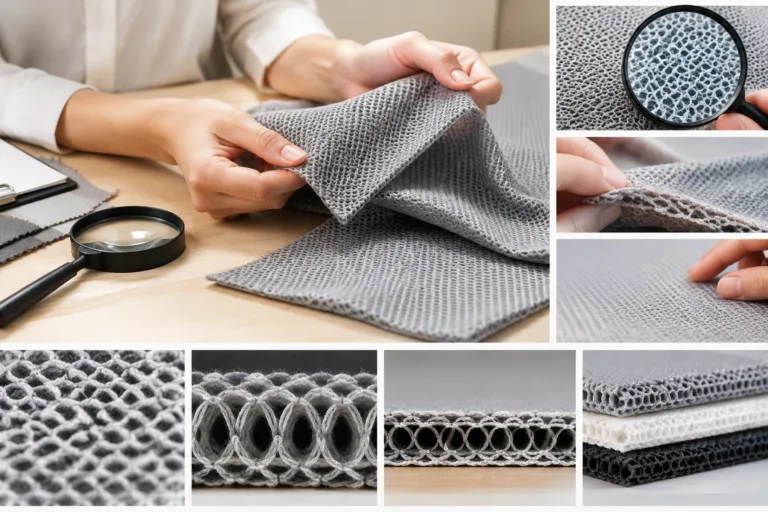
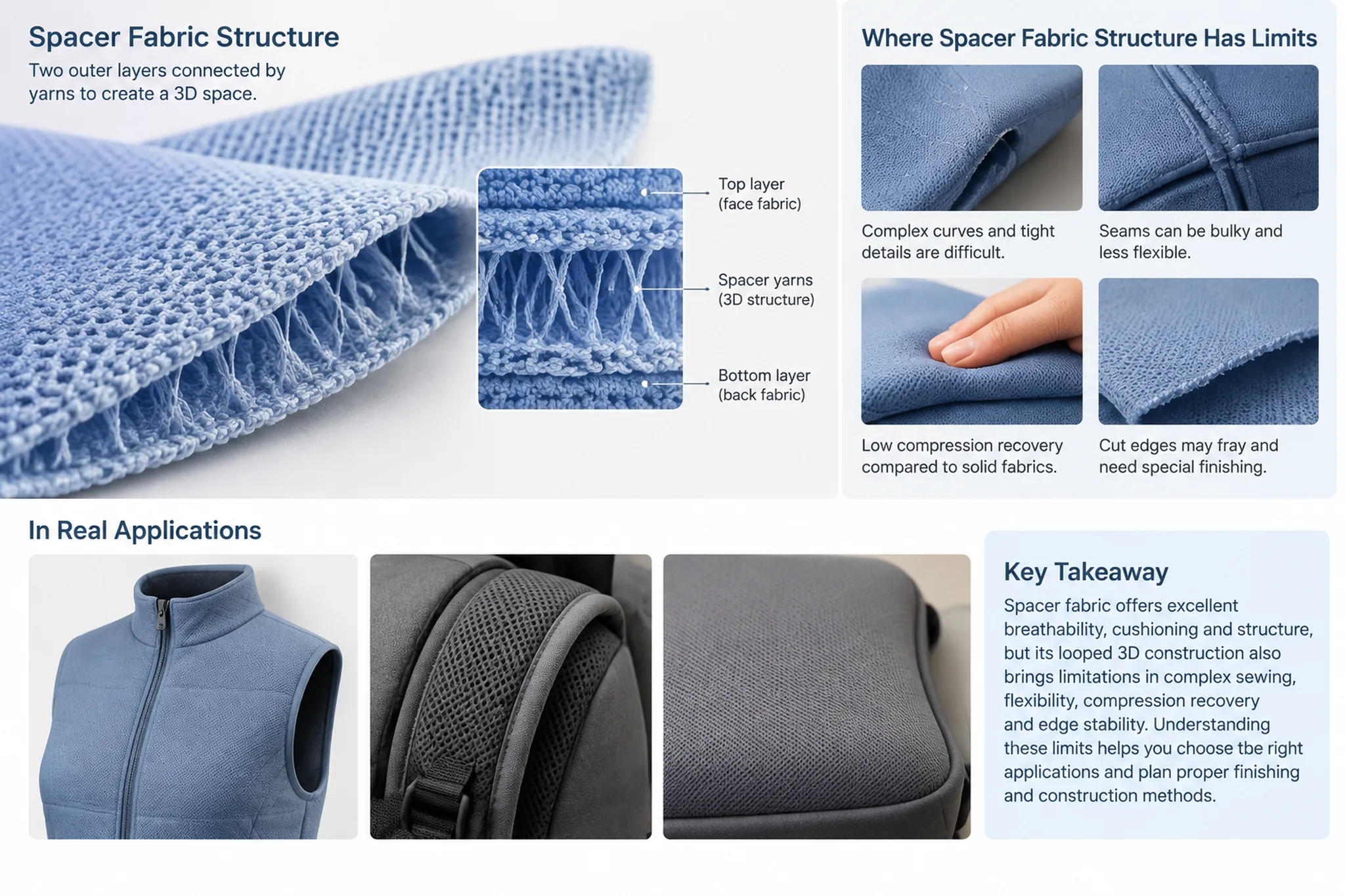
A useful way to picture spacer fabric is as a fabric sandwich viewed from the cut edge: a face on one side, a face on the other, and a connecting zone between them. The two faces may be similar or intentionally different. The internal elements bridge or interconnect the faces, giving the textile its three-dimensional form. The exact arrangement depends on the knitting system, yarn setup, and construction specified for that particular fabric.
In a knitted spacer construction, the faces are formed by loop systems rather than by a simple flat sheet of interlaced yarns. Connecting yarns or knitted elements are introduced between the faces and may help hold them apart or stabilize the space. However, “spacer fabric” does not describe one universal loop diagram. Warp-knitted and weft-knitted products, for example, can use different construction principles, so their cross-sections and handling may differ.
This distinction matters when a fabric is being developed for apparel. A three-dimensional structure can provide useful clues about thickness, bulk, flexibility, or how the material may respond during handling, but the structure alone does not guarantee cushioning, airflow, insulation, recovery, comfort, or durability. Those properties depend on the complete specification and require appropriate evaluation.
How Do Loops Form the Faces and Spacer Zone?
Knitted loops are formed by yarn being arranged into interconnected structures. In a spacer fabric, one loop system creates one visible face and another system creates the opposite face. Between them, selected yarns or knitted elements extend across the internal space. In a simplified cross-sectional description, the construction can therefore be read as: face loops | connecting or spacer elements | face loops.
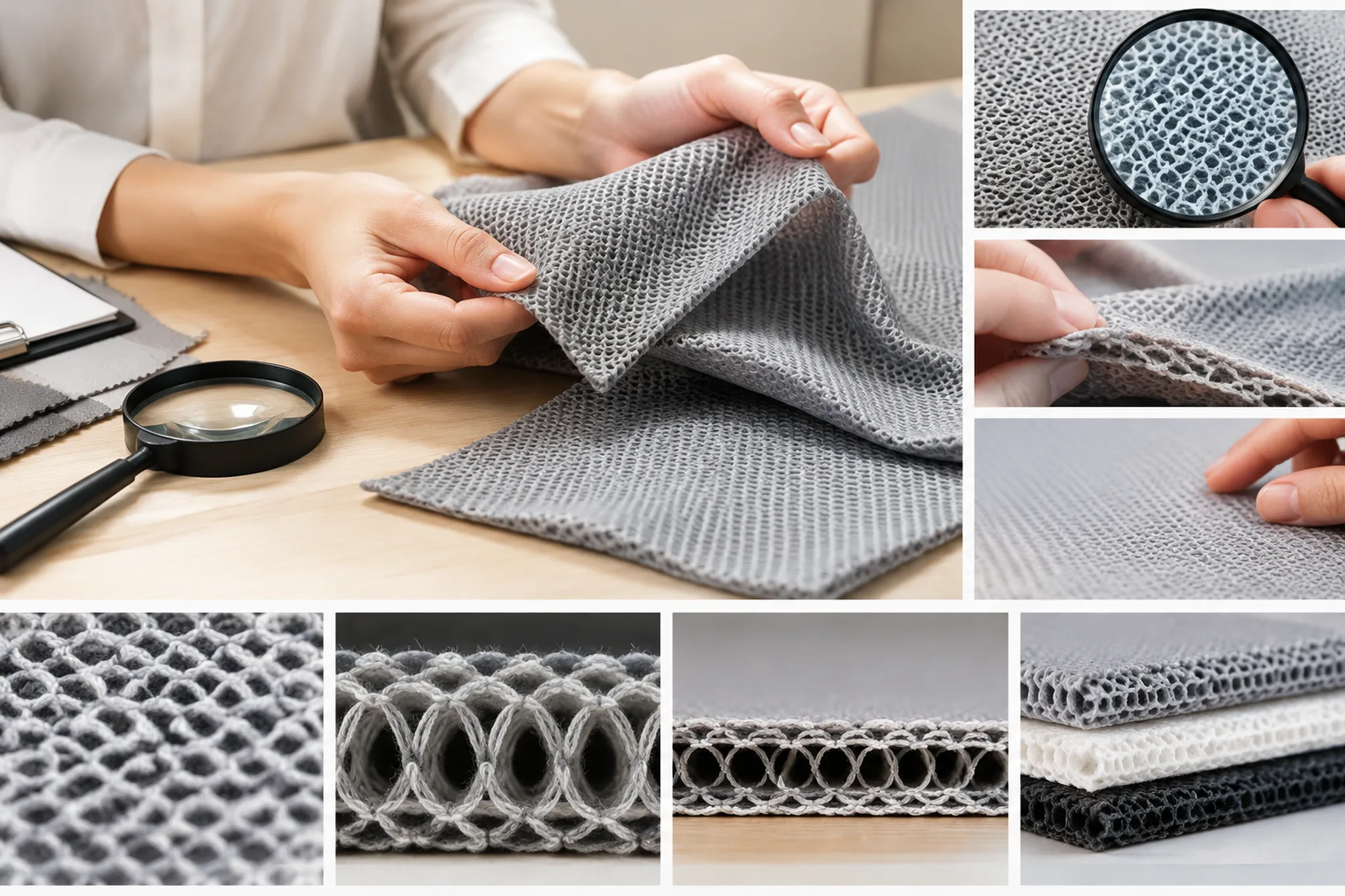
When examining a sample, the visible face loops are not necessarily the same as the internal connecting structure. The outer faces may look like conventional knitted surfaces, while the cut edge reveals short bridges, angled elements, or a more open internal zone. A magnified view can make this distinction easier to see. The face and back may also have different textures, loop dimensions, or surface treatments, so both sides should be inspected.
Textile construction terms can help describe what is observed. Courses generally refer to rows of knitted loops across the fabric, while wales refer to columns of loops running in the lengthwise direction. The face and back identify the two outer surfaces; connecting or spacer elements identify the internal structure between them. The precise use of these terms should follow the construction documentation for the sample, especially when the fabric is warp knitted rather than weft knitted.
Loop geometry is not fixed simply because a fabric has a particular trade name. Yarn tension, yarn size, machine setup, loop density, finishing, and the relaxed state of the sample can change the apparent openness, firmness, and thickness. Cutting can release or distort edge elements. Stretching may open the structure, while compression may collapse it temporarily or alter what can be seen. A finished sample should therefore be inspected in a consistent, relaxed condition before conclusions are drawn.
Which Construction Variables Change Spacer Fabric Behavior?
Two spacer fabrics can appear broadly similar while behaving differently because their construction variables are not the same. Important variables include the knitting system, yarn type and size, loop density, face construction, connecting-element arrangement, nominal thickness, fabric mass, fiber content, and finishing. When samples are compared, these factors should be recorded rather than reduced to a category label such as “light” or “thick.”
Thickness is a dimensional characteristic, not an automatic measure of quality or cushioning. Likewise, GSM, or grams per square meter, describes mass per unit area; it does not by itself establish thickness, softness, durability, or performance. Width and the measurement state should also be recorded because a comparison can become misleading when samples are measured under different conditions or when usable width is confused with another width description.
Structure can suggest questions about compression response, recovery, bending, stretch, air movement, moisture handling, and surface appearance. It cannot answer those questions by itself. Product-specific evaluation may be needed, and the comparison should identify the relevant test method and conditions. A useful comparison keeps the important variables controlled, including sample dimensions, conditioning, direction, applied force where relevant, and whether the fabric is relaxed, stretched, compressed, or finished.
Finally, fabric behavior does not end at the roll. Garment pattern geometry, seam placement, lining, backing, lamination, adhesives, and wash care can change how the spacer construction behaves in use. A fabric that looks stable as a loose swatch may respond differently when curved around the body, trapped in a seam, joined to another layer, or repeatedly laundered. Treat the loop structure as a basis for investigation, not as a substitute for product-level evidence.
Spacer Fabric Compared With Single-Layer Knits and Mesh
| Construction | Structural description | What to inspect |
|---|---|---|
| Spacer fabric | Two faces linked or separated by an internal three-dimensional zone | Both faces, the cut edge, connecting elements, thickness, and edge stability |
| Single-layer knit | One knitted fabric layer formed from interconnected loops | Face appearance, loop direction, stretch, drape, and edge behavior |
| Single-layer mesh | One layer containing designed openings or an open pattern | Opening geometry, continuity of the layer, edge distortion, and surface stability |
A mesh may look open because it contains openings within one layer. Spacer fabric instead has a separated or linked three-dimensional construction, although its faces and internal zone may also appear open depending on the design. A single-layer knit does not become spacer fabric merely because it is made from loops. The number of structural zones and the presence of an internal connecting system are central to the distinction.
The added structure can affect bulk, drape, edge behavior, sewability, pattern shaping, weight, and care response, but no universal ranking follows from the category names. Compare samples made under clearly reported conditions, and evaluate the property that matters for the intended garment. Structural comparison is useful for narrowing questions; it does not replace testing for a specific end use.
How to Inspect the Loop Structure in a Fabric Sample
A fabric sample can reveal useful clues about spacer fabric structure, but the inspection should begin with recorded information rather than appearance alone. Note the supplier’s construction description, fiber content, nominal thickness, GSM, width, finishing, and measurement conditions. These details help distinguish a true construction difference from a change caused by sample preparation, finishing, or measurement state.
Inspect both faces under consistent lighting. Some spacer fabrics have similar faces, while others are intentionally different in texture, openness, or surface appearance. Examine the cut edge as well as the flat surface. At the edge, look for the relationship between the two faces and the internal connecting zone. A gently opened or magnified area may make the connecting elements easier to distinguish from the visible face loops.
Next, identify the approximate directions of courses and wales where they can be seen. This does not require treating a visual inspection as a complete technical analysis. It simply helps you record how the loop systems are oriented and whether the structure appears regular. Observe the sample first in a relaxed state, then after gentle stretching and light compression. Note whether the connecting zone opens, collapses, shifts, or returns toward its original position.
- Face appearance and whether the two faces are intentionally identical or different
- Approximate loop uniformity and direction
- Thickness consistency across the sample
- Cut-edge stability, snagging, separation, or distortion
- Surface defects, irregular openings, and visible finishing effects
- Changes after laundering or other care conditions intended for the product
Keep three types of information separate: visual observations, supplier-provided facts, and laboratory results. A sample may look uniform without meeting a project requirement, and a supplier specification may describe nominal construction without showing how the fabric behaves in a finished garment. When compression, airflow, recovery, stretch, or dimensional stability matters, use representative samples and appropriate test methods selected for the intended end use. Document the sample condition and test conditions so later comparisons remain meaningful.
Where Spacer Fabric Structure Has Limits
A visible three-dimensional loop structure establishes how the fabric is organized, but it does not prove a particular performance level. The presence of two faces and a connecting zone cannot by itself confirm cushioning, breathability, moisture management, durability, thermal behavior, or comfort. Those questions require evidence related to the specific construction, finishing, product design, and intended use.
Construction labels also have limits. Different spacer fabrics may share a commercial name while differing in face structure, connecting-element arrangement, thickness, mass, fiber content, and finishing. Even when two samples appear similar, their loop density, yarn arrangement, or finishing may produce different handling characteristics. Conversely, a visually unusual sample may still be suitable for a particular product. Category names are useful for narrowing questions, not for replacing a specification.
The finished garment introduces further variables. Pattern geometry, seam placement, seam allowance, linings, backing materials, adhesives, and areas compressed during wear can change how the textile behaves. Joining methods may affect edge stability or bulk, while care conditions may alter dimensions and surface appearance. A fabric sample viewed in isolation therefore cannot fully predict the result of a garment, panel, insert, or laminated assembly.
Small samples have practical blind spots as well. They may not show variation across a roll, edge effects, isolated defects, or changes after repeated use and laundering. Regulatory, safety, and performance claims also need evidence appropriate to the product category and target market. Apparel Wiki is an independent educational publication, not a manufacturer, factory, testing laboratory, certifier, or service provider. Supplier claims, editorial observations, and measured test results should remain clearly separated throughout development.
Choosing the Right Next Step for a Spacer Fabric Project
Start with the end use and identify the properties that matter most. Depending on the garment, these may include appearance, thickness, drape, stretch, compression response, airflow, recovery, weight, or care stability. Do not assume that every listed property needs the same level of investigation. A design-led outer panel and a repeatedly compressed garment component may require different questions and different evidence.
Request a construction description and specification sheet instead of relying on the commercial name alone. Record the face direction, fiber content, nominal thickness, GSM, width, finishing, and measurement state. Then compare a representative sample with the intended pattern, seam construction, joining method, and care process. This makes it easier to identify issues related to bulk, edge treatment, lamination compatibility, shaping, or movement before bulk approval.
Define acceptance criteria before selecting tests. The criteria should come from the product specification and the intended use, not from an assumed universal property of spacer fabric. Choose tests that answer the project’s actual questions, such as whether thickness remains consistent, whether compression response is acceptable, or whether dimensions and appearance remain suitable after the planned care process. Numerical thresholds should be set only from an appropriate project requirement or authoritative test basis.
Keep a record of unresolved questions, including expected variation, face orientation, cut-edge treatment, joining method, and behavior after care. Use the combined evidence from inspection, supplier documentation, garment trials, and testing to decide whether to proceed, revise the specification, or evaluate another construction. Apparel Wiki’s Apparel Manufacturing Tools can serve as a related educational starting point, but project decisions still depend on product-specific evidence.
In practical terms, the right next step is not to rank spacer fabric as universally better or worse than another knit. It is to define the required construction and behavior clearly, compare samples under reported conditions, and test the properties that matter for the finished product.
Is spacer fabric a knit or a woven fabric?
Spacer fabric is generally discussed as a three-dimensional knitted construction, but the exact knitting system and loop arrangement can vary. The commercial name alone does not identify the fiber content, gauge, thickness, or performance.
What creates the space between the two faces of spacer fabric?
Yarns or knitted connecting elements link, hold apart, or stabilize the two fabric faces. Their arrangement depends on the specific construction and should be confirmed through technical documentation or sample inspection.
Are all spacer fabrics made with the same loop structure?
No. Spacer products may differ in knitting system, face construction, yarn arrangement, loop density, connecting elements, thickness, and finishing. Similar labels do not guarantee identical internal structures.
Does a thicker spacer fabric automatically provide better cushioning?
No. Thickness is a dimensional characteristic, not proof of cushioning or quality. Compression response, recovery, firmness, and comfort depend on the complete construction and require product-specific evaluation.
How can I inspect spacer fabric structure from a sample?
Record the supplied specifications, inspect both faces and the cut edge, observe the connecting zone, and compare the relaxed, gently stretched, and lightly compressed states. Treat these observations as development clues rather than a pass-fail test.
Which tests are useful when evaluating spacer fabric for a garment?
The relevant tests depend on the garment and its requirements. Possible evaluation areas include thickness, mass per unit area, compression response, recovery, air movement, stretch, and dimensional change, using appropriate methods and reported sample conditions.