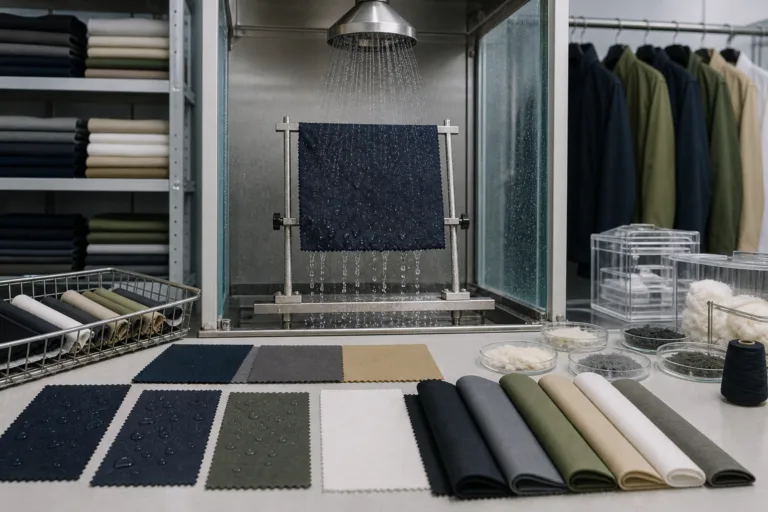
Spray rating testing sample preparation covers the steps taken before testing to make a textile specimen identifiable, representative, properly handled, and ready for the selected laboratory method. It may include specimen selection, sample records, required pre-treatment, conditioning, and delivery to the test setup. For background on Apparel Wiki’s independent editorial approach, see the Sponsor page.
A spray evaluation examines how water wets a specified surface under a defined test method. It does not, by itself, establish hydrostatic resistance, resistance to water penetration through seams, or complete garment waterproofness. The applicable method, the material or finish, and the product specification determine the exact preparation requirements. A method explains how a result is measured; a brand or buyer specification explains what result is required for a particular decision.
What Does Spray Rating Testing Sample Preparation Involve?
A reliable pre-test handoff begins before any specimen is cut or sent to a laboratory. The apparel team should identify what product question the test is intended to answer: development screening, incoming material verification, production approval, or investigation of a complaint. That purpose affects the sampling decision and whether the test concerns an untreated fabric, a treated material, a finished component, or part of a garment.
Preparation should preserve the sample’s condition without adding uncontrolled variables. Depending on the selected method and project requirement, the sequence may involve recording the sample identity, selecting representative areas, identifying the surface to be tested, applying an approved pre-treatment, conditioning the specimens, and transferring them to the test setup. These steps should be confirmed against the current laboratory method rather than treated as a universal operating procedure.
The distinction between preparation and acceptance is important. A laboratory method may specify how specimens are oriented, conditioned, exposed, and evaluated. It does not automatically establish a pass/fail requirement for every product. Acceptance belongs to the applicable product specification, buyer requirement, or development decision. A report should therefore be read as a result produced under stated conditions, not as a general claim about every version of the material.
Select and Identify Representative Test Specimens
Specimen selection determines what the result can reasonably represent. Before submission, record the fabric or garment style, material composition when known, color, finish, lot or batch reference, supplier reference, and sample date. Add any information that could distinguish the submitted material from later production, such as a development code, purchase order reference, or component location.
Selection also requires attention to the product’s physical construction. The face and back may have different surfaces, while fabric direction, patterned areas, coated zones, laminations, prints, pile, or other finishes may affect which area should be tested. A garment component may also contain construction details that are not representative of the base fabric. The selected method and laboratory should determine specimen dimensions, quantity, orientation, and face selection where those requirements apply.
Do not assume that one received piece represents every color, finish lot, production batch, size, or later shipment. If the result will support production approval, use a documented sampling plan or buyer requirement to define the intended coverage. For development screening, the scope may be deliberately narrower, but that limitation should remain visible in the internal record and in any decision based on the report.
A practical identification record can include:
- Product, fabric, or component name and internal reference
- Color, material composition, and finish information when available
- Supplier, lot, batch, roll, or purchase reference
- Sample receipt or submission date and the person responsible for submission
- Surface, direction, panel, or construction area selected for testing
- Intended purpose, such as screening, approval, verification, or complaint review
Keep the physical specimen, submission record, and laboratory report linked. A traceable connection helps the team determine whether a later result concerns the same material and preparation history. It also prevents the phrase “the fabric passed” from being applied more broadly than the tested sample supports.
Handle, Pre-Treat, and Condition Samples Before Testing
Handling begins when the sample is received. Protect specimens from moisture, contamination, excessive folding, heat, pressure, and unrecorded finishing. Record visible concerns such as creasing, dampness, stains, damage, or an uncertain finish before preparation. If the specimen has already been washed, aged, abraded, or otherwise treated, that history should be reported rather than silently treated as equivalent to an untreated sample.
Separate normal handling instructions from required pre-treatment. A product program or selected method may call for washing, dry-cleaning, abrasion, aging, or another exposure before the spray evaluation. If the purpose is to measure the untreated material, adding a wash or other treatment casually can change surface wetting and answer a different product question. Pre-treatment should therefore be authorized, recorded, and matched to the intended claim.
Conditioning means bringing the specimens to the environment and duration specified by the selected method before testing. It is a controlled test variable, not simply a storage step. The laboratory should record the actual conditioning conditions used, including any relevant deviations. Temperature, humidity, time, and treatment details should remain conditional unless they have been verified against the current method being applied.
After conditioning, avoid allowing the specimens to gain moisture, collect contamination, or experience unnecessary pressure or handling before evaluation. The transfer from conditioning to the test setup should follow the laboratory’s instructions. If a specimen leaves the required environment, is exposed to an unplanned treatment, or cannot be identified with confidence, document the event and ask whether the test should proceed, be qualified, or be repeated.
Before sending samples, the apparel team can confirm four points:
- The specimen identity and intended test purpose are recorded.
- Any required pre-treatment is authorized and its history is documented.
- The conditioning requirements come from the selected method or an explicitly defined project condition.
- Any deviation, damage, contamination, or uncertainty is visible to the laboratory before evaluation.
This preparation discipline improves the usefulness of fabric spray rating testing without overstating what the result proves. It gives the laboratory a defined specimen and gives the apparel team a clearer basis for interpreting the reported surface-wetting result.
Control the Variables That Affect Result Comparability
Two reports may both describe a spray test while answering different technical questions. Before comparing the results, confirm the test method and version, specimen identity, fabric direction, surface tested, conditioning history, pre-treatment, apparatus, water preparation, and evaluation procedure. A result is meaningful within those conditions; it should not be separated from them and treated as an independent ranking.
Sampling direction and face selection can matter when a fabric has a construction, coating, print, nap, or finish that is not uniform on both sides. Conditioning and laundering history can also change the surface presented to the water. Differences in equipment or rating interpretation may further limit comparison, even when the product names and general test descriptions appear similar.
For that reason, do not rank numerical or ordinal results from different methods by size alone. First confirm that the methods use equivalent principles, reporting scales, specimen conditions, and assessment rules. If the methods are not equivalent, describe the results separately rather than concluding that one fabric or finish is universally better.
A practical textile test report comparison can begin with this checklist:
- Are the method names and current versions identified?
- Do the sample descriptions, colorways, lots, and supplier references match the intended comparison?
- Was the same face tested in the same fabric direction?
- Were conditioning and any washing or other pre-treatment histories equivalent?
- Were the apparatus, water preparation, and evaluation procedure comparable?
- Are the reported scales and acceptance requirements from the same technical basis?
If one item is unknown, record the uncertainty before attributing the difference to fabric quality, finishing chemistry, supplier performance, or a production change. This comparison checklist supports a better review conversation, but it does not replace the laboratory’s technical judgment or the requirements of the selected method.
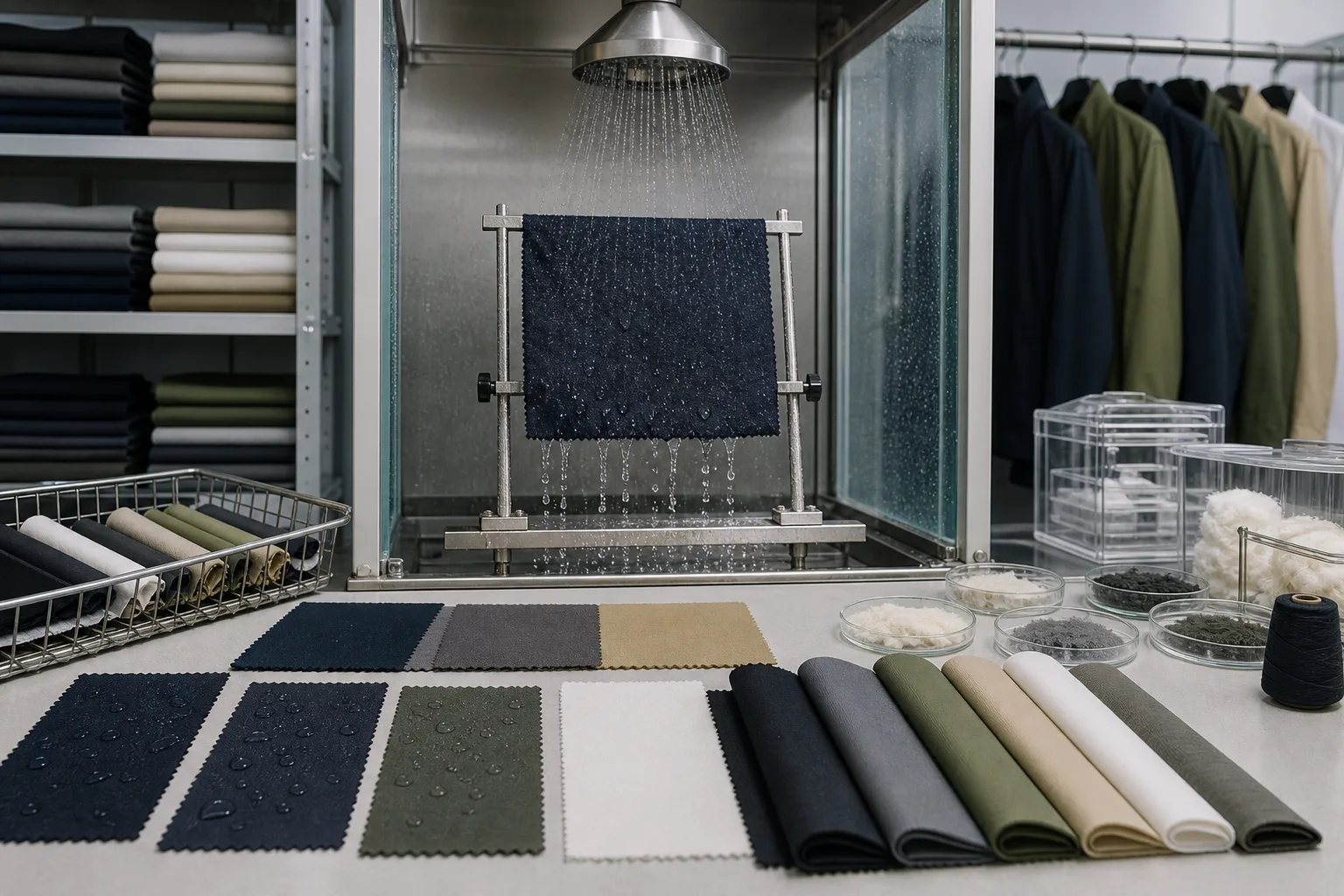
Review the Test Setup and Report Before Using the Result
Report review should begin with identity and scope. Confirm that the document names the submitted sample, tested surface, method and version, test date, conditioning or pre-treatment history, reported result, rating scale or units, and the requirement used for acceptance. The report should make clear what was actually evaluated, not merely identify a general fabric family or product name.
Next, establish whether the report covers a fabric panel, a finished component, or a complete garment. A result for one fabric specimen should remain attached to that specimen and its documented scope. It should not automatically be extended to every color, finish lot, production batch, size, panel, or later shipment unless a broader sampling plan supports that conclusion.
When the report omits a relevant condition, shows an unexplained deviation, leaves specimen identity uncertain, or uses an acceptance criterion that does not match the product requirement, ask the laboratory for clarification. Do not silently fill in missing conditions from another project. The selected method, laboratory record, and buyer or brand specification should determine what can be concluded.
A simple decision framework is useful:
- Accept: the result answers the stated question under documented conditions and matches the applicable requirement.
- Clarify: the result may be useful, but a missing condition, identity detail, or requirement source prevents confident interpretation.
- Repeat: the comparison requires matched specimens, conditioning, pre-treatment, or method conditions that were not preserved.
- Escalate: the product question concerns penetration, durability, seams, closures, laundering, or finished-garment performance beyond the spray evaluation.
Surface wetting and water penetration are related but different measurements. A spray result does not by itself establish resistance to water passing through a material, seam, closure, or assembled garment. The appropriate follow-up depends on the intended use and product specification, so acceptance should never rest on a rating viewed in isolation.
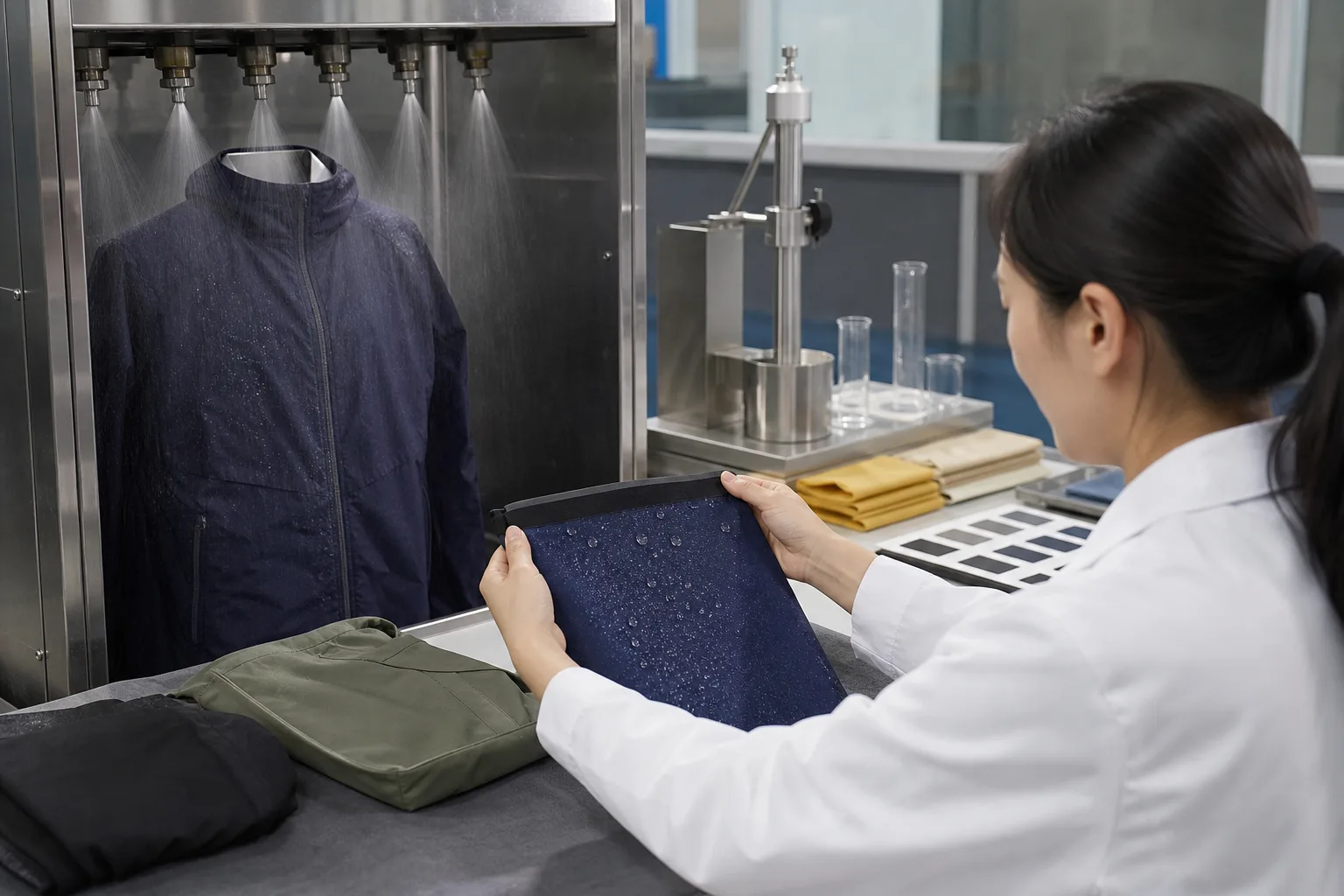
Limits of Sample-Level Spray Rating Results
A sample-level spray rating result describes the submitted specimen under the stated test conditions. It may not represent every color, finish lot, production batch, fabric panel, or finished garment. This is especially important when surface treatments, construction, or material composition can vary across the product. Traceability defines what the result supports and where generalization would become an assumption.
The timing of the test also matters. Initial material screening is different from evaluating performance after laundering, wear, abrasion, storage, or another project-defined exposure. A product team should identify whether the decision concerns development, incoming material, production approval, complaint investigation, or a durability claim before selecting repeat or complementary testing.
Garment construction can introduce questions that a flat material specimen does not answer. Seams, needle holes, closures, panel interfaces, and handling during assembly may affect water entry or practical protection. These features may require separate evaluation under a method and sampling plan suited to the finished component or garment.
Before using the result, product development, laboratory, sourcing, and quality teams can confirm:
- What product decision is the test intended to support?
- Which specimens, colors, lots, surfaces, and construction stages are within scope?
- Was the sample untreated, pre-treated, laundered, aged, or otherwise exposed?
- Does the requirement concern surface wetting, penetration, durability, or complete garment protection?
- Are any deviations, uncertainties, or follow-up tests documented?
This approach treats spray rating testing as useful evidence without making it carry a broader claim than it can support. The result can help compare defined materials and guide development, while additional testing may be needed for durability, penetration, construction, or finished-product performance.
Next step: Turn the intended product claim into a written test brief covering sample scope, preparation history, conditioning, method, acceptance requirement, and any complementary performance question. That brief gives the laboratory and apparel team the same decision target before new samples are submitted.
How should fabric samples be identified before spray rating testing?
Record the product or fabric style, composition when known, color, finish, lot or batch, supplier reference, sample date, tested surface, and intended test purpose. Keep the submitted specimen traceable to the final report.
Why must textile samples be conditioned before a spray rating test?
Conditioning controls the environment and preparation history before evaluation. Moisture, heat, pressure, and handling can affect surface wetting, so the selected method and laboratory should define and record the required conditions.
Should samples be washed before spray rating testing?
Only when the selected method, product program, or buyer requirement calls for it. Washing can change surface wetting, so it should not be added casually when the objective is to evaluate the untreated material.
Can spray rating results from different test methods be compared directly?
Not automatically. Compare the method and version, specimen conditions, conditioning and pre-treatment, apparatus, water preparation, rating scale, and evaluation procedure before drawing conclusions.
Does a high spray rating prove that a garment is waterproof?
No. A spray rating evaluates surface wetting under a specified procedure. It does not by itself establish resistance to water penetration through fabric, seams, closures, or a complete garment.
What details should a spray rating test report include?
The report should identify the specimen, tested surface, method and version, conditioning or pre-treatment, test date, result and scale or units, deviations, and the requirement used for acceptance.