Insect repellent clothing may reduce contact with certain insects under specified conditions, but it does not guarantee that the wearer will avoid every bite. The main insect repellent clothing limitations are incomplete body coverage, openings and fit, insect-specific claims, changing exposure conditions, and treatment performance that may change with washing and wear. In this independent Apparel Wiki guide, the focus is responsible product interpretation rather than manufacturing or treatment-supplier advice; our Sponsor information explains the publication’s editorial independence.
Insect repellent clothing is apparel made with a treatment intended to affect insect interaction with the garment, or apparel marketed with that function. It is different from ordinary long-sleeved clothing, which provides physical coverage without necessarily carrying an insect-related treatment. Neither category should automatically be treated as a complete personal protection system. Whether the clothing works depends on the actual product claim, target insect, covered areas, exposure setting, duration, care conditions, and evidence identified by the manufacturer or other responsible source.
What Are the Main Limitations of Insect Repellent Clothing?
The short answer to “does insect repellent clothing work?” is conditional: it can support protection in the use case described by its label or technical evidence, but its effect cannot be extended automatically to every insect, garment style, wearer, or environment. A treated shirt may address insect interaction with the shirt fabric while leaving the hands, face, neck, ankles, or other areas exposed. A garment can therefore be useful without being a guarantee against bites.
Several boundaries matter when assessing the limitations of insect repellent clothing:
- Coverage: Openings at cuffs, collars, waistlines, closures, vents, and hems can leave skin accessible.
- Garment design: Fit, movement, layering, seams, and construction details can alter which areas remain covered during use.
- Insect scope: A claim related to one insect or test organism does not establish equivalent performance against other species.
- Exposure: Weather, geography, activity, contact time, and surrounding conditions may differ from the conditions used for a claim.
- Condition: Washing, abrasion, stretching, contamination, repairs, and incorrect care may affect the garment or its treatment.
These points are reasons to narrow a claim, not proof that every treated garment fails. For sourcing and development teams, the practical question is not whether insect repellent clothing is universally effective. It is whether the evidence matches the final garment and the way people are expected to use it.
How Insect Repellent Clothing Is Intended to Work
There are two separate functional ideas: physical coverage and a treatment intended to change insect interaction with the apparel. Long sleeves and trouser legs can reduce direct access to some areas of skin. A treated textile may add a product-specific function, such as affecting insect landing or contact. The mechanism, however, depends on the treatment, textile construction, garment design, and target insect. Not all insect-repellent garments use the same treatment or make the same claim.
For a specific example, the CDC guidance on permethrin-treated clothing and gear describes a particular treated-clothing approach. That information should not be read as evidence that every insect-repellent garment uses permethrin, works through the same mechanism, or provides the same protection. Product-specific labeling and technical documentation remain important.
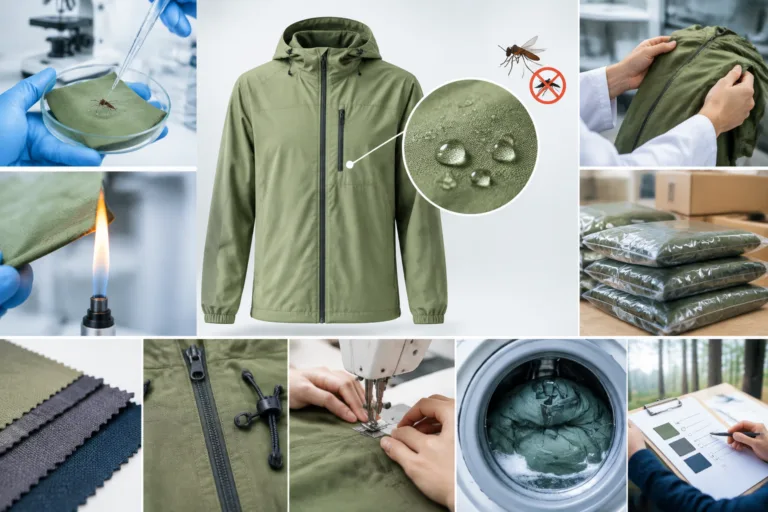
A fabric-level result also does not automatically prove finished-garment performance. The final product may contain untreated panels, linings, mesh, thread, elastic, fasteners, seams, or openings that were not represented by a small textile sample. A treatment applied to one fabric panel or one garment type cannot automatically establish performance for every color, construction, style, or production variation.
This is a central functional-clothing principle: a named feature is not a substitute for a defined use case and measurable evidence. When reviewing a claim, ask what was treated, what was tested, which insect was used, how exposure was assessed, and whether the test represented the finished garment. A technical report can be relevant without proving a broader claim than its scope supports.
Which Variables Reduce Real-World Protection?
Real-world protection can differ from an initial label or laboratory result because the wearer and environment are not fixed test conditions. A hypothetical long-sleeved shirt may cover the torso and arms while leaving the hands, neck, and face exposed. If the sleeves ride up during movement or the shirt is worn open at the collar, the practical coverage is different from the garment shown in a flat product photograph.
Fit and movement are especially important in apparel development. Tightness, looseness, layering, sleeve length, garment rise, seam placement, closures, vents, and stretch can change the areas available for insect contact. Design choices may also affect whether the garment stays in position during walking, bending, outdoor work, or other intended activities.
Claims may also be limited by the insect and the setting. Results for one target insect should not be presented as universal protection against every insect. Life stage, geography, weather, vegetation, activity level, and exposure duration may all differ from the conditions behind the original claim. The EPA guidance on insect-repellent protection reinforces the broader principle that protection should be understood through the product’s labeled use rather than through a general promise of coverage.
Wear conditions create another layer of uncertainty. Sweat, abrasion, stretching, dirt, drying, storage, laundering, alterations, and repairs can change the state of the garment. The effect of each factor is product-dependent and should not be assigned a universal performance loss without applicable evidence. In particular, a result from treated fabric alone does not establish how the complete garment will perform after repeated use in every environment.
How Durable Is the Treatment After Washing and Wear?
Initial treatment performance and retained performance are different questions. An evaluation made before laundering or wear describes the sample in that condition. It does not, by itself, establish how the garment will perform after the care, abrasion, stretching, heat, or other use conditions expected during its service life.
Buyers and product teams should check the care instructions, treatment-retention wording, replacement guidance, and the identity of the tested article. Does the claim apply to the treated fabric, a component, or the finished garment? Were the relevant laundering and wear conditions included? If the documentation does not answer these questions, the claim should be treated as limited rather than expanded by assumption.
Home laundering, commercial laundering, detergents, heat, repairs, and alterations may differ from the conditions used in testing or stated on the label. A care instruction explains how the product should be handled; it is not automatically proof that the original insect-related performance will be retained indefinitely. Treatment durability is product- and treatment-dependent, so there is no universal service life that can responsibly be applied to every garment.
For a production sample or purchasing comparison, record the exact garment construction, care instructions, treatment description, and available test conditions. Comparing an untreated fabric result with a treated finished-garment result, or comparing samples at different stages of wear, can create a misleading conclusion. The strongest review keeps the initial claim, retained-performance evidence, and actual use scenario clearly separate.
How to Evaluate an Insect Repellent Clothing Claim
Start by defining the use case before judging whether a claim is strong. Identify the intended wearer, target insect or insects, body areas covered, exposure setting, expected activity, and likely duration of use. A statement that sounds broad may apply only to a particular garment, treatment, insect, or test condition. The phrase “insect repellent clothing” is therefore a category description, not proof of one consistent performance level.
Next, identify what the evidence actually represents. It may concern the active treatment, a fabric panel, a component, a finished garment, or a complete clothing system. These are different evidence scopes. A treated textile result may help explain a material choice, but it does not automatically establish how a shirt, trouser, jacket, or accessory performs after construction, movement, layering, and normal wear.
Review the test description or technical file for the organism studied, test setup, exposure period, sample construction, and any laundering or wear condition. Also check the reported outcome and its boundaries. A manufacturer statement, an independent test result, a regulatory requirement, and an editorial recommendation should be recorded as separate types of information. None should be silently expanded into a universal guarantee.
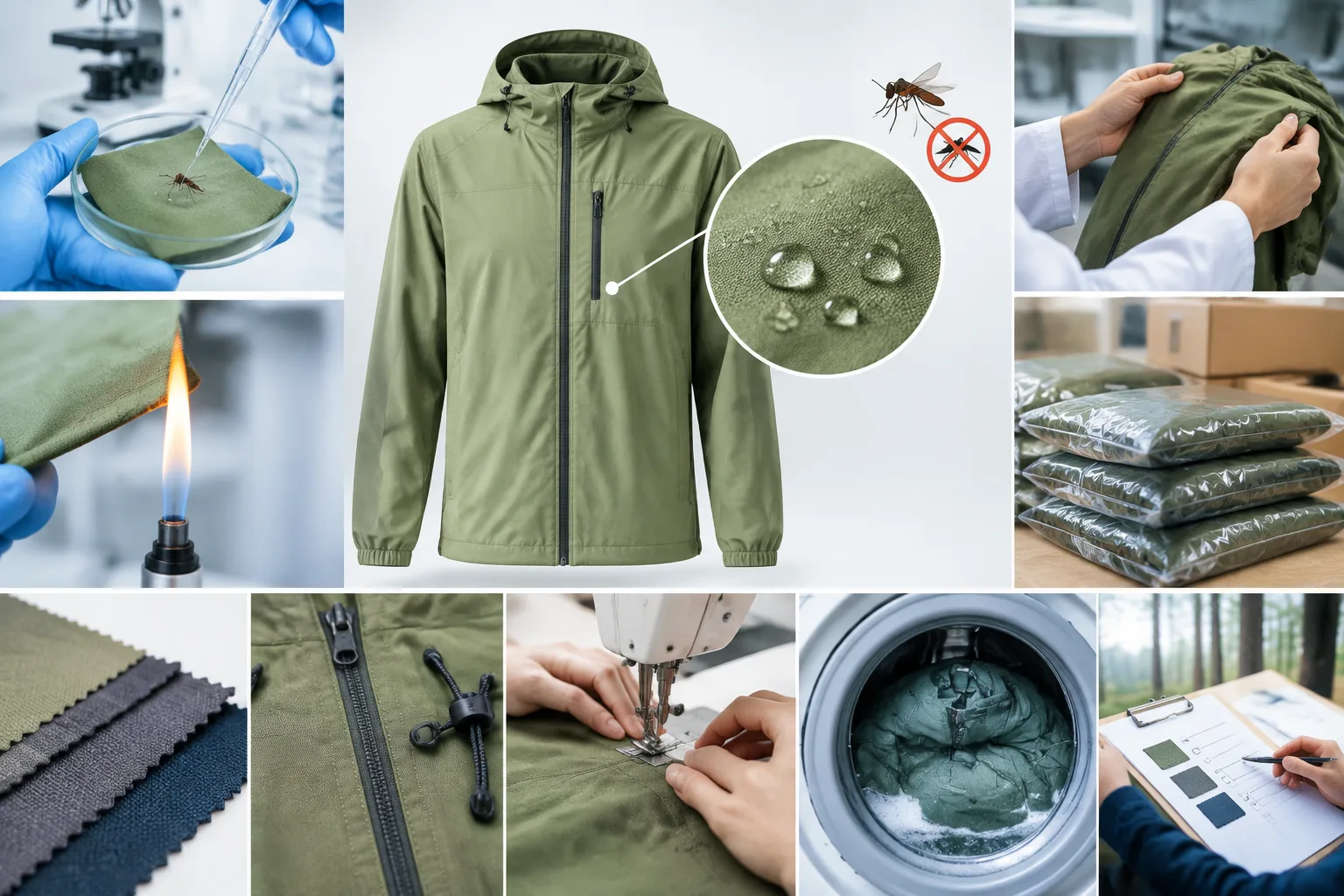
For sourcing or quality review, a simple comparison matrix can make gaps visible:
- Claim scope: What does the product explicitly say it is intended to do?
- Evidence scope: Was the evidence produced on the final garment or only on a material or component?
- Coverage: Which body areas are covered, and where do cuffs, closures, vents, necklines, or openings leave exposure?
- Care limits: Which washing, drying, repair, storage, or alteration conditions are addressed?
- User instructions: Are limitations and complementary precautions communicated clearly?
- Market requirements: Does the intended sales region require additional review of the wording or treatment?
Compare like-for-like evidence rather than ranking products from broad technology language. A useful review may also include the final pattern, seams, closures, labels, packaging, and care instructions. Apparel Wiki’s Apparel Manufacturing Tools can support the wider development workflow, but no checklist replaces product-specific documentation or market-appropriate professional review.
What Insect Repellent Clothing Cannot Replace
Insect repellent clothing should not automatically be presented as a complete bite-prevention system. The garment may contribute to a broader approach, but its protection is bounded by the treated areas, garment design, target insect, exposure conditions, and care history. Uncovered hands, face, ankles, or neck can remain relevant even when the main fabric has a supported treatment claim.
It is also important to separate ordinary functional clothing claims from occupational protection, medical claims, and public-health recommendations. A garment feature may be useful without establishing protection against every insect or every consequence of an insect bite. Evidence for one use case should not be transferred to another simply because the garments look similar or use related terminology.
A textile test, treatment certificate, or product label cannot by itself support a universal disease-prevention or health claim unless the applicable evidence and market requirements specifically support that wording. The same caution applies to statements about all-day protection, all insects, every climate, or indefinite durability. Such language needs direct, relevant support rather than interpretation based on the treatment name.
For exposure situations with health consequences, follow current local public-health guidance and the product label. Depending on the setting, broader measures may include physical coverage, an appropriately labeled topical product, environmental controls, or other instructions from a competent health authority. Apparel Wiki provides independent educational information about clothing and product interpretation; it is not a manufacturer, laboratory, certifier, medical provider, or regulatory approval body.
Next Steps for Product Development and Responsible Use
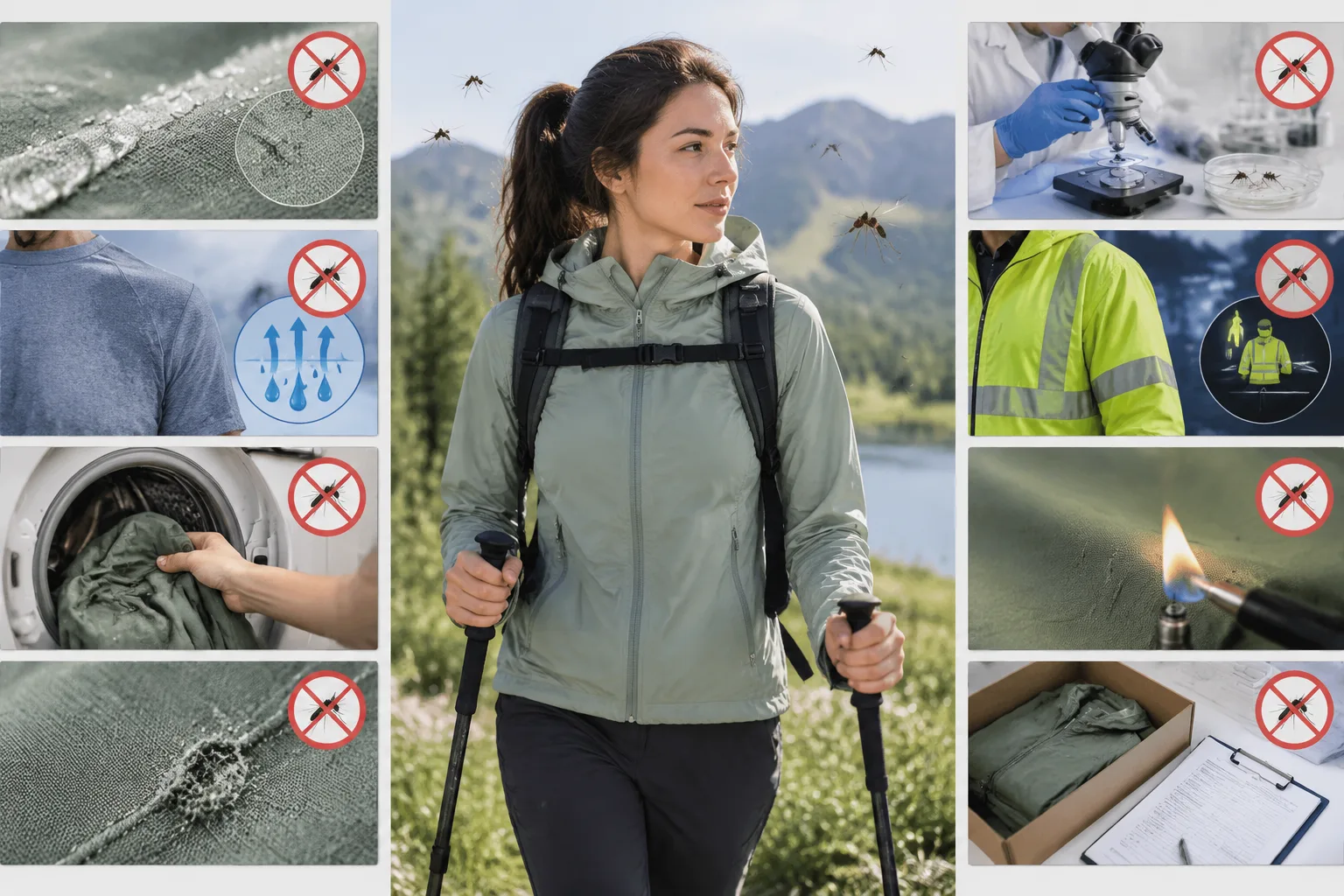
Turn the limitations into a narrow intended-use statement covering the user, garment style, target insect, body coverage, environment, activity, and care conditions. Request evidence for the final fabric, treatment, construction, and claimed use. During sampling, check openings, seams, closures, labels, care instructions, and packaging for consistency with the approved wording. Where washing, abrasion, stretch, repair, or extended use matters, plan retained-performance checks under defined conditions.
Customer-facing language should state what is supported, what remains uncertain, and which complementary precautions may be needed. Before approving a claim for a global market, document the assumptions, evidence scope, unresolved questions, and required regional review. Precise wording is not merely a legal concern; it helps buyers understand what the garment can reasonably contribute in actual use.
Does insect repellent clothing prevent all insect bites?
No. It may help reduce contact or landing by particular insects under defined conditions, but it does not guarantee that every bite will be prevented. Coverage gaps, garment design, exposure conditions, insect differences, wear, and care can all limit protection.
What are the biggest coverage limitations of insect repellent clothing?
Common limitations include uncovered skin at the face, hands, neck, waist, ankles, cuffs, closures, and vents. Fit, movement, layering, and garment construction can also affect how much skin remains exposed during use.
Does washing reduce the effectiveness of insect repellent clothing?
It can affect retained performance, but the result is product- and treatment-dependent. Check the care instructions and treatment-retention documentation. Do not assume that a garment retains its original performance indefinitely or under care conditions that were not evaluated.
Can insect repellent clothing replace topical repellent or other bite-prevention measures?
Not automatically. Treated clothing should be considered one possible measure within a broader approach. Follow current public-health guidance and product-label instructions for the exposure setting, especially where insect bites may have health consequences.
How can buyers tell whether an insect repellent clothing claim is properly supported?
Check the target insect, covered areas, finished-garment scope, test conditions, wear or laundering conditions, care limits, and exact claim wording. Separate manufacturer statements from independent evidence and market-specific requirements.
Are fabric test results enough to prove protection for the finished garment?
No. Fabric results can provide useful material information, but they do not automatically establish finished-garment performance. Construction, seams, openings, fit, movement, treatment placement, and use conditions should be considered separately.