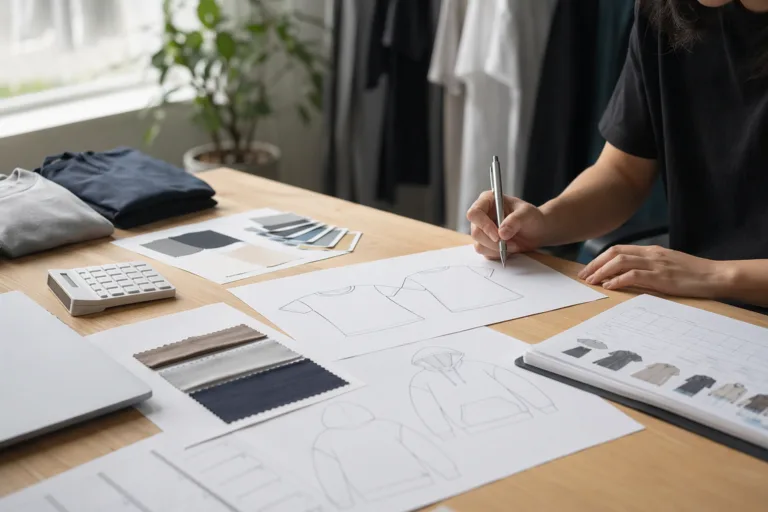
One of the first real planning decisions for a new brand is not logo design or social media. It is product count. Founders often ask how many designs to start clothing brand because they want enough variety to look credible, but not so much that they create a cash and inventory problem before the brand even gets feedback from real buyers. In apparel development, this decision affects sampling cost, MOQ pressure, fit consistency, color approvals, storage, and how easy it is to explain the brand clearly at launch.
If you are still mapping the broader process around product type, positioning, budgets, sourcing steps, and launch order, this guide to planning a first clothing business launch helps connect the first-drop decision to the bigger picture. It gives useful context on how product choice, development sequence, and production planning fit together, which matters because the right number of opening designs depends on more than creativity alone.
Why the number of first designs matters more than most new founders realize
New founders often think more designs automatically make the brand look more serious. In practice, the opposite is common. A scattered first drop can make the brand feel uncertain, especially when the graphics, garment types, fit logic, and price points do not connect well.
For buyers, the issue is not just design count. The issue is whether the first collection has a clear identity and whether the founder can actually execute it. A clean launch with one strong T-shirt shape in two controlled colors may perform better than six unrelated items with inconsistent blanks, mixed sizing logic, and weak stock depth.
Every added design usually creates more work in at least five areas:
- sampling and revision cycles
- fabric or blank sourcing decisions
- size set planning
- trim, label, print, or embroidery coordination
- inventory allocation and reorder decisions
This is why first-drop planning is really a risk-management task. You are not only choosing what to sell. You are choosing how many variables your first production run can handle without breaking your budget or slowing down launch timing.
The most common beginner mistakes when planning a first clothing drop
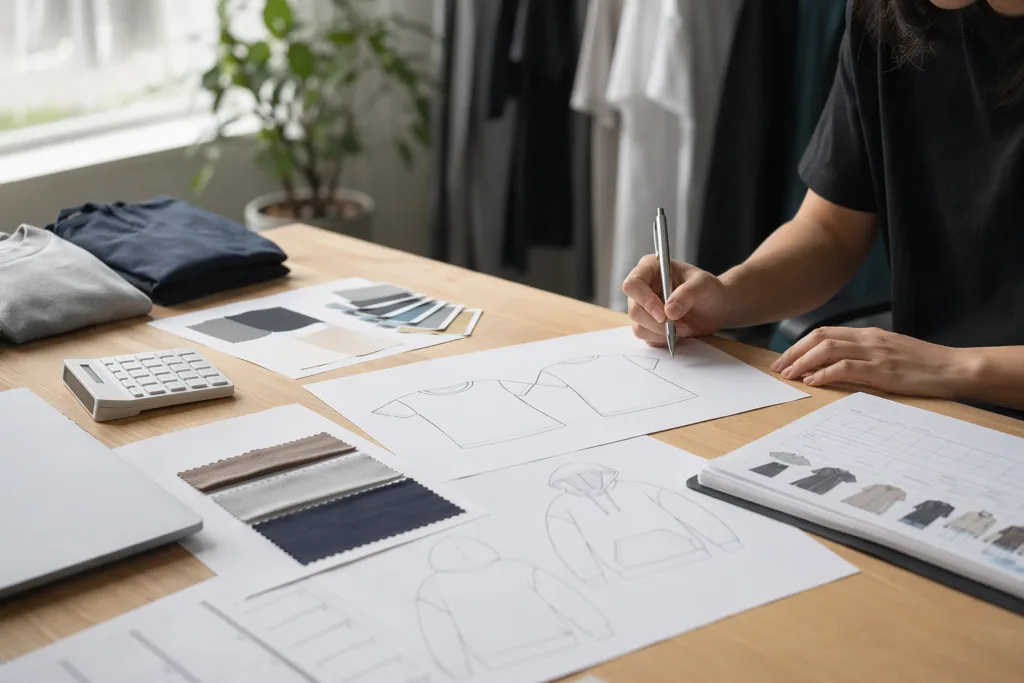
The first mistake is confusing ideas with assortments. A founder may have ten graphics, three hoodie concepts, two cut-and-sew tracksuit ideas, and several color options. That does not mean all of them belong in the first release.
The second mistake is treating each color as a small detail. In production, color is not a minor styling choice. It often changes inventory planning, print appearance, labeling control, and in some cases even fabric sourcing if you are not buying from stock.
The third mistake is expanding sizes too aggressively without demand evidence. More sizes can improve reach, but they also increase SKU count and dead-stock risk if the shape, audience, and fit are not validated.
Another common issue is weak niche definition. If the founder has not clarified customer type, price position, and use case, they usually compensate by adding more designs “just in case.” That rarely solves the real problem. A clearer product direction starts with how to choose a clothing niche before spending money on a broad assortment.
The fourth mistake is underestimating production complexity. A single heavyweight tee with one front print is very different from launching tees, shorts, hoodies, and outerwear together. Even if the order quantity sounds manageable, construction, fit approval, and decoration control can become hard to manage for a first project.
The 1–3 core styles rule: why starting small usually works best
For most new brands, a practical starting point is 1 to 3 core styles. That does not mean one brand idea forever. It means one first drop built around a small number of products that are easier to execute well.
In many projects, one style is enough if the concept is strong. This works especially well for graphic T-shirts, premium basics, or a focused niche uniform-style product. Two styles often give a better balance when the founder wants some range without losing control, such as a T-shirt and hoodie, or leggings and sports bra. Three styles can still be reasonable if they belong to one clear product story and use a manageable sourcing path.
Why does this usually work better?
- You can put more budget into better fabric, print quality, and finishing.
- You reduce the number of fit approvals that can go wrong.
- You keep colorways more intentional.
- You can carry deeper stock in fewer SKUs instead of shallow stock across too many options.
- You learn faster which category actually gets traction.
This is also where structured product education matters. Founders comparing garment categories, construction details, and sourcing implications can use Apparel Wiki as a reference point for terminology and decision logic before locking a first assortment.
What counts as a design in a clothing brand launch
Many beginners miscount because they use the word “design” loosely. In first-drop planning, it helps to separate style, colorway, and variant.
| Term | What it means | Why it matters |
|---|---|---|
| Style | A distinct garment product such as a T-shirt, hoodie, jogger, or tank | Usually requires its own fit, costing, and production planning |
| Colorway | The same style offered in different colors | Creates more SKUs and may change visual impact of prints or trims |
| Variant | A specific size and color combination, such as black hoodie in size L | This is the real inventory unit you must stock and manage |
| Graphic version | A different artwork on the same base garment | May count as a separate design if print setup, placement, or demand logic differs |
For example, if you launch one T-shirt style in 3 colors and 5 sizes, that is not “one item” in inventory terms. It is 15 variants before you even consider separate artwork placements. This is why a founder may think they are starting small while the manufacturer sees a complex order plan.
That complexity matters because apparel demand is uneven across variants. Some sizes and colors move faster than others, and this is one reason a focused first launch is safer. Harvard Business School highlights SKU complexity and inventory risk in apparel when explaining how assortments become harder to manage as variant count increases.
How to choose your first product mix based on brand identity, audience, and production capacity
The right number of opening designs depends on what the brand is trying to prove first. A founder should ask three basic questions:
- What product category is the brand most believable in?
- What product is easiest to explain and sell to the target customer?
- What product can be sampled and produced with the least execution risk?
If the brand identity is built around art or message, a T-shirt-first launch often makes sense because it lets the graphic carry the concept. If the brand is about fit and comfort, then one or two core silhouettes in a stronger fabric may matter more than having multiple categories. If the brand is performance-oriented, then technical fabrics, stretch recovery, opacity, and movement testing may be more important than expanding style count early.
Production capacity matters too. A startup working with stock blanks and screen printing has different options from a startup developing custom cut-and-sew garments. Blank-based projects can move faster, but founders still need to confirm print position, shrinkage after wash, fabric hand feel, and size tolerances. Cut-and-sew projects offer more control, but they bring higher development work and more chances for fit or sewing issues.
A simple rule helps here: launch with the product you can explain clearly, source consistently, and reproduce reliably.
How many colors to launch with
Color discipline is one of the easiest ways to keep a first drop under control. Many first collections look weak not because they have too few colors, but because they have too many average ones.
For most first drops, 1 to 3 colors per style is enough. One color can work if the concept is strong and the brand is intentionally focused. Two colors often provide a better balance between variety and simplicity. Three colors can still be practical when the style is proven and the demand story is clear.
Here is a practical way to think about first-drop colorways:
- 1 color: strongest control, easiest inventory planning, useful for a statement product
- 2 colors: good balance for a first launch, often one safe color and one brand color
- 3 colors: only if budget and MOQ still allow enough stock depth per size
What usually goes wrong is not the number itself. It is adding colors that split already-limited quantities into inventory that is too thin to sell confidently. If each color only has a few pieces per size, you may look understocked rather than well assorted.
Color also affects decoration. A print that looks clean on white may lose contrast on heather gray. Embroidery thread visibility changes across dark and light bases. Some buyers approve a design visually before confirming how the decoration behaves on every garment color, and that creates avoidable sampling revisions later.
How to control size range and avoid inventory waste in the first collection
Size range is one of the biggest hidden risk areas in a first drop. Founders want to be inclusive, which is understandable, but inclusion also has to be backed by real product development. If the grade rules are weak, the pattern has not been tested, or the fit shape was only reviewed in one sample size, adding more sizes does not automatically create a better product.
For first launches, many brands start with a focused size run based on their actual customer and product type. That may be XS to XL, S to XXL, or another range that matches the intended fit and market. The key is to build a range that you can support with real measurement logic, not just ambition.
In sizing decisions, founders should confirm:
- base sample size used for fit approval
- target fit type such as slim, regular, boxy, or oversized
- grade rules between sizes
- garment measurements, not only letter sizes
- shrinkage allowance if using cotton-rich fabrics
Consumer expectations around fit labels can be inconsistent, which is why understanding how size charts affect fit and sizing decisions is useful before finalizing your first range. The goal is not just to offer more sizes. It is to offer sizes that are measured, communicated, and produced consistently.
A common startup mistake is placing equal quantities in every size without thinking about the expected size curve. That can leave too many units in the slowest sizes and not enough in the core sizes. When demand history is unknown, it is often safer to stay focused and use conservative size planning.
Budget impact: how each additional design, color, and size increases complexity and cash risk
Every founder should understand one basic truth: added variety multiplies cost faster than it first appears. One more design is not just one more graphic. It can mean another sample, another print screen setup, another measurement review, another packing ratio, another approval round, and another group of slow-moving variants.
This is why the question how many designs to start clothing brand is really a budget question as much as a branding question.
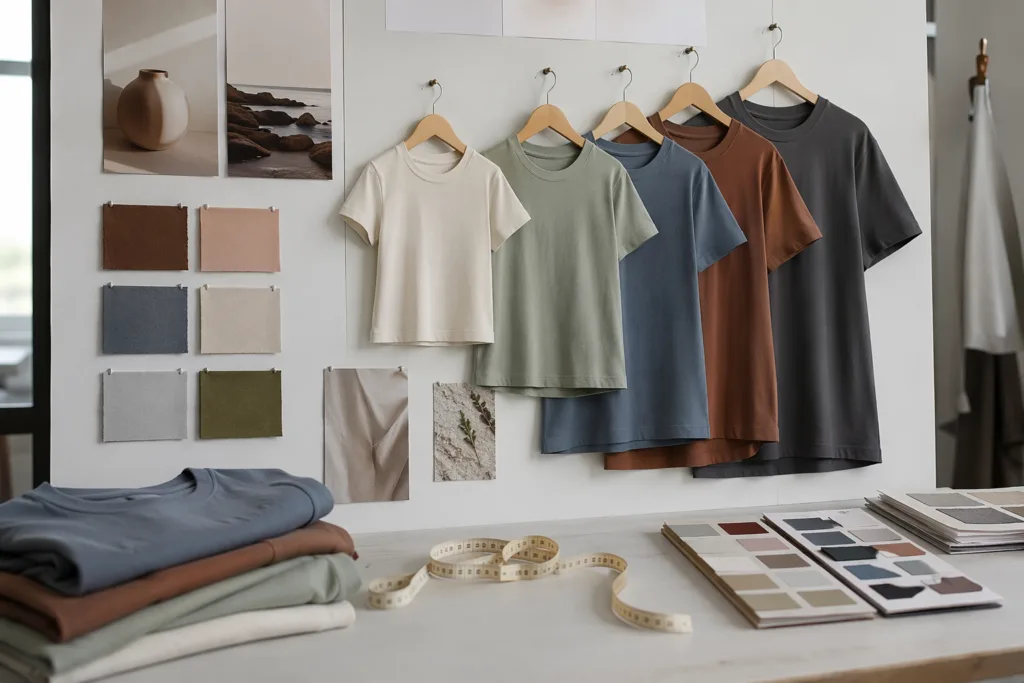
Let’s look at what actually affects the result:
| Decision | Possible cost effect | Risk effect |
|---|---|---|
| Add 1 new style | New pattern or blank choice, new sample, separate costing | Higher fit and execution risk |
| Add 1 new color | More SKU count, possible separate dye or stock sourcing issues | Inventory split and weaker stock depth |
| Add 1 new size | More grading, size set checks, added stock units | Unsold inventory if demand curve is unclear |
| Add print placement | Extra setup, alignment checks, possible reject risk | Decoration inconsistency |
| Add custom trim | Extra MOQ, approvals, production coordination | Delays if trim arrives late or wrong |
Minimums also shape this decision. A factory may accept a low total order quantity, but require specific minimums per color, fabric, or print setup. Understanding what MOQ means for a first apparel order helps founders avoid building an assortment that looks good on paper but fails at production stage.
Budget control gets much easier when you can map all variable drivers clearly. A practical starting point is to review a simple budget breakdown for a clothing brand launch and then test how each added style, color, or size changes the total investment.
Simple launch scenarios for a first drop
One-design first drop
This is the most controlled option. It works well when the product message is strong and the founder wants to test audience response before expanding. Example: one heavyweight graphic T-shirt in black and off-white, sizes S to XL.
Why it works: very clear identity, easier marketing message, better stock depth per variant, lower development cost.
Main risk: if the product misses, there is no backup style to support sales.
Two-design first drop
This is often the sweet spot for startups. Example: one T-shirt and one hoodie using the same graphic language, both in two controlled colors. This gives range without creating too much assortment noise.
Why it works: better average order potential, stronger brand presentation, easier cross-selling.
Main risk: if the two items use very different fabrics or fit logic, approvals become more demanding.
Three-design first drop
This can work when the products belong together naturally. Example: T-shirt, hoodie, and shorts for a casual streetwear summer-to-fall drop, all built around a common color palette.
Why it works: more complete look, stronger visual merchandising, can better show the brand world.
Main risk: founders often underestimate how much inventory and coordination 3 styles create once colors and sizes are added.
Example first collection formulas by brand type
Streetwear startup
A practical streetwear opening formula is 2 styles: oversized T-shirt and hoodie. Keep colors limited, usually one neutral and one accent if budget allows. Streetwear buyers often respond more to silhouette, fabric weight, print scale, and brand attitude than to a wide style count.
Basics brand
A basics-focused startup may do well with 1 to 3 core silhouettes in tight color control. For example, crew-neck tee, long-sleeve tee, and tank. Here the key is consistency of hand feel, fit block, stitching quality, and recovery after wash. Too many colors too early can weaken the clean basics story.
Athleticwear startup
Athleticwear often looks simple from the outside but is harder to execute well. Fabric stretch, opacity, support, seam comfort, and moisture behavior matter more than variety. A safer first drop may be only 1 or 2 products, such as leggings and sports bra, rather than a full set of tops, shorts, and jackets.
Premium minimal brand
This type of brand usually benefits from restraint. One excellent tee or two carefully developed essentials can create a stronger impression than a broad but average assortment. In this segment, fabric quality, stitch cleaness, collar shape, shrinkage control, and finishing consistency carry more weight than design quantity.
When it makes sense to launch with more than 3 designs
Starting with more than three designs is not always wrong. It just needs a stronger reason and better operational support.
Launching with 4 or more designs can make sense when:
- the brand already has proven demand from pre-orders or an existing audience
- the founder has prior product development or sourcing experience
- the collection is built on a shared fabric platform or common fit logic
- the manufacturer can support organized sampling and low-error execution
- the budget can carry slower-selling variants without pressure
Even then, more designs should not mean random expansion. The collection still needs a product hierarchy. Usually one or two hero items should lead, while the rest support the story rather than compete with it.
If a founder wants a broader drop, one useful method is to separate designs into three groups: hero products, support products, and experimental products. Most of the budget should go to the hero products, not be spread evenly across all ideas.
First collection planning checklist before placing orders
Before confirming bulk production, try this simple founder checklist:
- Can you explain the full first drop in one sentence?
- Is each style clearly tied to the same brand identity?
- Have you defined whether each item is blank-based or cut-and-sew?
- Have you limited colors to what your budget can stock properly?
- Have you reviewed size range using garment measurements, not only letter labels?
- Have you checked MOQ by style, color, fabric, and decoration method?
- Have you approved print size, embroidery placement, and color contrast on every base color?
- Have you costed trims, labels, packaging, and sample revisions?
- Do you know which style is the main seller and which is secondary?
- If one item underperforms, can the rest of the drop still make sense financially?
This detail may look small, but it can create problems later if it is not confirmed early. In many startup projects, the issue is not the product concept. It is that the assortment was not simplified enough before sample development and order placement.
Common misconceptions about first-drop assortment strategy
“More designs make the brand look more established”
Not necessarily. A focused drop can look more confident because it communicates a point of view clearly. Too many weak designs often signal uncertainty.
“If I only launch one or two styles, customers will lose interest”
That depends on execution. Strong fabric, fit, print quality, and photography often matter more than product count. For a new brand, depth and clarity usually outperform shallow variety.
“Adding colors is an easy way to expand”
Operationally, it is not always easy. Every added color changes inventory structure and can create uneven sales across variants.
“I should offer every size immediately”
A broad size range is only valuable if the fit is developed properly and the demand plan makes sense. Otherwise, you may create stock problems without improving customer experience.
Conclusion
For most startups, the most practical answer to how many designs to start clothing brand is 1 to 3 core styles, with controlled colors and a disciplined size plan. That range is usually enough to present a real brand while keeping sampling, budget, and inventory risk manageable.
The goal of a first drop is not to prove that you can make everything. It is to prove that you can make a small number of products well, communicate them clearly, and learn from real market response. In apparel sourcing practice, that is a stronger foundation than launching wide and trying to fix complexity later.
FAQs
Is one design enough to start a clothing brand?
Yes, one design can be enough if the product is strong, the presentation is clear, and the stock plan is realistic. This approach works especially well for graphic tees, focused basics, or niche products where the brand message is concentrated in one item. The key is making sure the one design has enough quality, fit, and visual clarity to represent the brand properly.
What is the safest number of designs for a first clothing drop?
For most beginners, 1 to 3 designs is the safest range because it keeps development and inventory under better control. Within that range, two styles are often a practical middle ground since they give some variety without spreading the budget too thin across too many samples, colors, and sizes.
Do different colors count as different designs?
From a branding perspective, maybe not, but from an inventory and production perspective, they still create separate complexity. A single style in multiple colors increases SKU count, affects stock depth, and may require extra approvals for print contrast or fabric sourcing. That is why colorways should be planned almost as carefully as separate products.
How many sizes should a new clothing brand offer first?
The right size range depends on your customer, fit type, and budget, but many startups begin with a focused range they can support with proper grading and measurement control. It is usually better to offer a smaller size run that fits consistently than a broad range that has not been tested properly in development.
Should a first collection include multiple garment categories?
Only if those categories belong to the same product story and can be developed without creating too much execution risk. For a new founder, mixing tees, outerwear, denim, and activewear in one first drop often adds too many variables. Staying within one clear category family usually leads to a cleaner launch and fewer production issues.
When should a startup launch more than three designs?
A startup should usually go beyond three designs only when it has stronger demand signals, enough budget to carry more variants, and a sourcing setup that can manage the added complexity. It also helps if the founder already understands fit approval, MOQ structure, and how to keep the collection visually and operationally connected.