
Yes, private label clothing can be profitable, but not simply because a seller adds a logo to a blank product or sources a custom garment at a low factory quote. The real question behind is private label clothing profitable is whether the brand can create enough margin after product cost, freight, duties, sampling, returns, marketing, and overhead to keep cash flow healthy and support repeat growth. In apparel, many first-time founders focus on markup, but profitability depends more on sell-through, reorder logic, product positioning, and cost control across the full landed cost picture.
If you are trying to understand where the numbers usually move, this guide to garment FOB pricing and cost breakdown is a useful supporting resource. It helps readers separate factory price from the wider cost structure that actually affects margin, including fabric, trims, packaging, and sourcing assumptions that often get missed in early brand planning.
What profitable really means in private label clothing
From a practical business perspective, profitable does not mean a product has a high retail price or a large markup on paper. It means the business keeps enough money after direct costs and operating costs to survive and grow. A T-shirt with a 70% gross margin can still lose money if returns are high, customer acquisition is expensive, and reorders are too small to improve unit cost.
In apparel sourcing practice, profit has layers:
- Product gross margin: retail price minus landed product cost
- Contribution margin: gross margin after transaction fees, shipping subsidies, discounts, and packaging support
- Net profit: what remains after marketing, salaries, software, storage, sampling, content creation, and overhead
That is why private label clothing can be profitable for one brand and unprofitable for another, even when they buy a similar garment category. The difference usually comes from positioning discipline, order planning, fit consistency, and control over cost leakage.
Where private label apparel profit comes from

The profit in private label apparel usually comes from four sources working together, not from one factor alone. First is the gap between landed cost and selling price. Second is the ability to sell most inventory without deep discounting. Third is repeat demand, because repeat orders spread development costs across more units. Fourth is brand credibility, which supports stronger pricing and lower return risk.
A private label business is also affected by how much product value is visible to the customer. In many categories, buyers will pay more when they can feel a clear difference in fabric weight, hand feel, garment wash, print quality, fit, or overall presentation. That is one reason the private label manufacturing model explained matters early. It helps founders understand that private label is not only about putting a custom neck label into a standard item. It can involve specification choices that change margin potential and customer perception.
For buyers comparing business models, profitable private label apparel usually has these conditions:
- A product category with room for differentiation
- A target customer willing to pay for that difference
- Order sizes that do not destroy unit economics
- Clear sizing and quality control to reduce returns
- Reorder potential so development cost is not trapped in one small launch
Revenue drivers that matter more than many beginners expect
Pricing power
Pricing power is the ability to charge more without collapsing demand. In apparel, this does not come from branding alone. It usually comes from a combination of product clarity, design consistency, fit, fabric choice, finishing, and audience trust. A heavy cotton oversized tee, for example, may support a higher price than a basic lightweight tee if the market recognizes the difference and the brand presents it well.
Sell-through rate
Sell-through is often a bigger profit driver than headline markup. A product with a moderate markup and 85% full-price sell-through can outperform a product with a high markup that needs heavy discounts to clear inventory. Unsold sizes, broken assortments, and forced markdowns are common reasons early private label projects underperform.
Repeat orders
When a style reorders well, the economics usually improve. Sampling cost, tech pack adjustment time, fit correction, photoshoot cost, and some development overhead get diluted across more units. Suppliers may also quote better when they see stable repeat business and more predictable consumption.
Product mix
Many apparel brands improve profitability through product mix rather than a single hero item. A lower-margin entry piece can support traffic, while better-margin items such as hoodies, coordinated sets, or specialty fabric pieces lift order value. This is where a small brand pricing formula for margins and profit becomes useful, because margin planning should be done across the range, not item by item in isolation.
Core cost structure of a private label clothing business
To judge whether private label clothing is profitable, founders need to separate visible and hidden costs. The visible costs are easy to notice: the factory unit price, logo application, and shipping quote. The hidden costs are where many projects go wrong: sample revisions, fit corrections, customs charges, warehousing, content production, returns, and discount pressure.
A basic private label apparel cost structure usually includes:
| Cost Area | What It Covers | Why It Matters |
|---|---|---|
| Product development | Tech packs, sampling, revisions, measurements | High upfront cost if style count is too wide |
| Factory cost | Fabric, trims, sewing, finishing, packing | Main direct unit cost |
| Decoration | Print, embroidery, patches, labels | Can sharply change unit margin |
| Logistics | Freight, duties, customs fees, local delivery | Changes true landed cost |
| Sales support | Photography, ecommerce fees, packaging inserts | Affects conversion and contribution margin |
| Operations | Storage, fulfillment, staff time, software | Often missed in beginner calculations |
| Demand costs | Marketing, discounts, returns | Can erase profit even with good gross margin |
For startup founders, a beginner’s clothing brand budget breakdown helps put these lines into a more realistic startup context. Many early brands are not underpricing the garment itself. They are underestimating the total cost to launch, sell, and service the product.
Product cost breakdown in practical apparel terms
Fabric
Fabric is usually the largest part of garment cost. The choice of fiber content, GSM, knit or woven structure, finish, and dyeing method can move the price significantly. For example, a 100% cotton combed jersey tee at a higher GSM will usually cost more than a lighter open-end option, but it may also support better hand feel and stronger retail perception. That can help margin if the target customer actually values it.
Trims and labels
Main labels, care labels, size labels, drawcords, zipper quality, buttons, hangtags, polybags, and stickers may look minor one by one, but together they can materially raise cost. This detail may look small, but it can create problems later if it is not confirmed early. A founder may accept a factory quote and only later realize that branded neck tape, custom zipper pullers, or premium packaging were not included.
Sampling
Sample cost is a development cost, not just a pre-production step. If the garment requires multiple fit rounds, wash tests, or decoration approvals, the style needs more sales volume to recover that cost. This is one reason narrow first collections often perform better financially than broad launches with too many SKUs.
Printing and embroidery
Decoration cost depends on method, placement, artwork complexity, stitch count, color count, and production setup. Large front prints, puff effects, high-density embroidery, sleeve placements, or mixed techniques raise both cost and risk. In many projects, the problem is not that the buyer chose the wrong decoration category. The problem is that size scaling, strike-off approval, and placement tolerance were not clarified before sampling or bulk production.
Packaging
Custom boxes, inserts, tissue, and premium presentation can strengthen brand perception, but they do not always improve profit. For lower-ticket products, packaging can become a margin leak if customers care more about fit and fabric than the unboxing experience.
Labor and overhead
Cutting, sewing, pressing, inspection, and packing labor are built into unit price, but they also change depending on construction difficulty. A basic tee is not costed like a garment with contrast panels, zipper pockets, coverstitch detailing, or multiple embroidered placements. Simple products often have better economics for new brands because execution risk is lower.
Freight, duties, and import fees
Landed cost is never just the factory price. International shipping mode, carton volume, destination charges, customs clearance, and applicable duties all affect the final cost per piece. For U.S. importers, landed cost, duties, and import fees are a real margin variable, especially on smaller orders where freight and fees are spread across fewer units.
How MOQ affects unit cost and overall profit
MOQ is one of the biggest profit levers in private label clothing because it affects both unit cost and inventory risk. If you are new to sourcing, understanding what MOQ means in clothing manufacturing is important before you compare supplier quotes. A low unit price attached to a high MOQ may look attractive, but it can still produce weak real profit if too much inventory sits unsold.
Factories often quote lower prices at higher order quantities because they can buy raw materials more efficiently, reduce line changeover time, improve marker efficiency, and spread setup costs across more pieces. That helps margin on paper. But higher MOQ also increases cash tied up in stock, greater size-break risk, and slower reaction if the market does not respond.
| MOQ Scenario | Typical Unit Cost | Inventory Risk | Cash Flow Pressure | Profit Potential |
|---|---|---|---|---|
| Very low MOQ | Higher | Lower | Lower upfront | Good for testing, weaker per-unit margin |
| Moderate MOQ | Balanced | Manageable | Moderate | Often healthiest for small brands |
| High MOQ | Lower | High if demand is uncertain | High upfront | Strong if sell-through is proven |
So, is private label clothing profitable when MOQ is low? It can be, but the path is different. Low MOQ usually protects beginners from overbuying, even if the unit margin is thinner. High MOQ can improve margin only when the brand has enough demand accuracy and cash control to convert inventory into sales without heavy markdowns.
Why low MOQ can help beginners and when it can hurt margins
Low MOQ is often useful in the first one or two production cycles because it allows a brand to test fit, content, color preference, and real customer response. It also reduces the chance of holding dead sizes or weak colorways. From a decision-making view, low MOQ buys information.
But low MOQ can also hurt profit in several ways:
- Higher unit factory pricing
- Higher freight cost per piece
- Less leverage on packaging and trim sourcing
- More frequent reorders at small scale
- Greater chance of stockouts if a style suddenly works
The key is to use low MOQ as a test tool, not as a permanent structure for every style. If one product proves demand, moving that item to a more efficient reorder quantity usually matters more than trying to force all products into ultra-low production runs.
Brand premium and what really creates pricing power
Brand premium in apparel is the extra amount a customer is willing to pay beyond basic utility. But in clothing, that premium usually has to be supported by visible or felt value. A plain garment with weak fit and ordinary fabric rarely earns a strong premium just because the label is new.
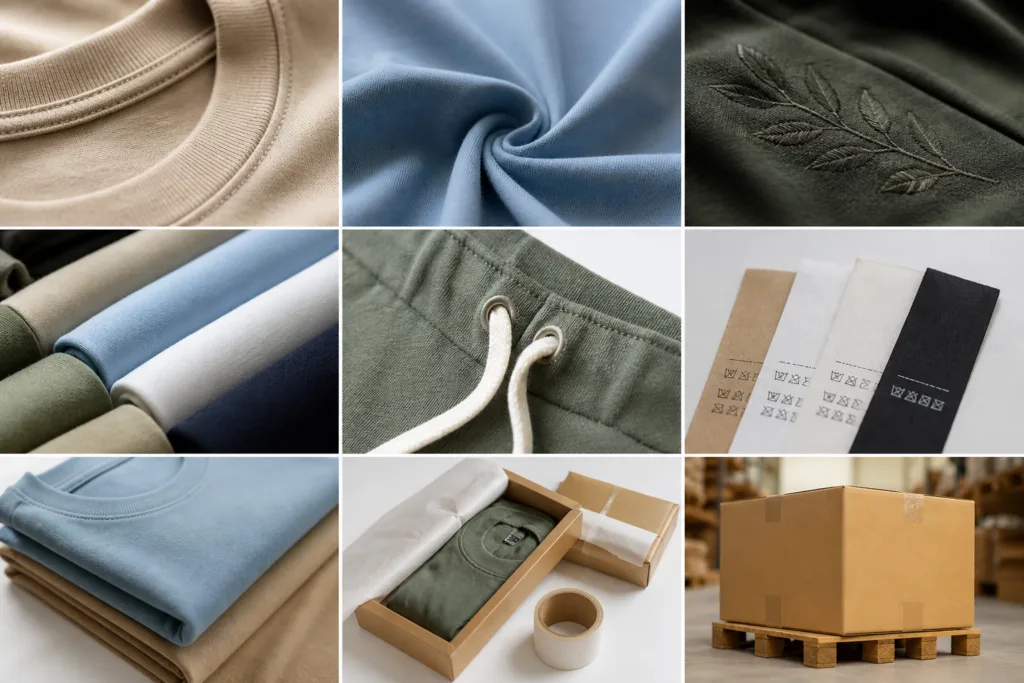
In apparel development, pricing power often comes from:
- Reliable fit and size consistency
- Fabric quality that feels noticeably better
- Clear silhouette or design identity
- Better finishing, trims, and presentation
- Trust built through customer experience and repeat satisfaction
Fit quality is not just a style issue. It affects returns, reviews, and repeat purchase behavior. From a sizing and apparel standards perspective, fit quality, sizing, and brand premium are connected because better body-dimension understanding supports more consistent garment development and perceived value.
This is also where broader educational support matters. Readers comparing private label options often use Apparel Wiki to understand fabric terms, garment construction, sizing logic, and sourcing decisions before they commit to a price position that the product itself cannot support.
Which products are more likely to support higher margins
Not every product category has the same margin potential. Some garments are highly price sensitive and easy to compare. Others allow more room for brand identity, better materials, or specialty fit.
Products that often support better margins include:
- Heavyweight T-shirts with distinct fit and finish
- Fleece hoodies and sweatshirts with quality fabric and construction
- Coordinated sets with stronger average order value
- Performance basics where function matters
- Niche uniform, club, or community products with lower direct price comparison
Products that often face harder margin pressure include commodity basics with weak differentiation, trend products that date quickly, and items where the customer mostly shops by price. For founders, the key is not choosing the most expensive garment. The key is choosing a category where the product story, fit, and cost structure can support the intended retail price.
Gross margin vs net profit in private label apparel
One of the most common mistakes is treating gross margin as if it were business profit. A hoodie with a retail price of $60 and a landed cost of $22 appears to have a strong margin. But after payment processing, platform fees, discounted shipping, customer service time, returns, content creation, and advertising, the real profit may be much smaller.
Here is a simple example:
| Item | Per Unit |
|---|---|
| Retail price | $60 |
| Landed product cost | $22 |
| Gross margin | $38 |
| Payment and platform fees | $5 |
| Outbound shipping support | $6 |
| Packaging extras | $1.50 |
| Average return and damage reserve | $3 |
| Marketing allocation | $12 |
| Net before overhead | $10.50 |
This is why a healthy-looking markup can still produce a fragile business. In apparel, the quality of the margin matters as much as the size of the margin.
Common hidden costs that reduce profit
Private label clothing often becomes unprofitable because of costs that were not included in the first costing sheet. Common hidden costs include:
- Extra sample rounds due to unclear specs
- Size-set approval delays
- Measurement inconsistency leading to returns
- Incorrect care labels or packaging revisions
- Air freight used to recover timeline slippage
- Discounting to clear slow sizes
- Warehouse handling, pick-pack fees, and reshipments
- Content reshoots because the product looks different from expectation
Let’s look at what actually affects the result. If a brand only budgets factory cost and expected markup, it is not really evaluating profitability. It is only evaluating product purchase cost.
Conditions that usually need to be true for a new seller to become profitable
For beginners, profitability usually depends on a few non-negotiable conditions being met early.
Demand validation
A product should have evidence of demand before the brand scales quantity. This can come from test drops, preorder interest, waitlists, sample feedback, or strong early conversion data.
Clear positioning
The buyer should understand why the product exists and why it is priced as it is. If the difference is not clear, discounting pressure usually appears fast.
Cost discipline
Cost control is not only about negotiating factory price. It is also about reducing unnecessary trims, simplifying packaging, limiting style count, and avoiding decorations that raise cost without improving sell-through.
Cash flow awareness
Even profitable products can create stress if cash is trapped in inventory or reorders arrive too late. Apparel is timing sensitive. Founders need enough cash buffer to handle deposits, shipping, and the selling period before revenue fully returns.
A simple profit framework for evaluating a private label clothing idea
When founders ask whether a private label line is worth launching, Apparel Wiki usually recommends a simple decision framework:
- Step 1: Estimate realistic retail price based on target customer and comparable product level
- Step 2: Estimate landed cost, not just factory quote
- Step 3: Estimate non-product selling costs per unit
- Step 4: Model full-price sell-through and discounted sell-through scenarios
- Step 5: Check whether reorder volume can improve economics without creating inventory risk
If the business only works in the perfect scenario, the product is not ready. A stronger concept still works when you apply realistic assumptions for discounting, returns, and customer acquisition.
Mistakes that make private label apparel unprofitable
- Choosing too many SKUs in the first launch
- Using expensive trims before product-market fit is proven
- Ignoring fit and grading quality
- Underestimating duties, freight, and last-mile cost
- Setting retail price from emotion instead of market logic
- Taking a high MOQ only to get a lower quote
- Relying on heavy discounting as a normal sales plan
- Failing to plan reorders for winning products
In many first-time projects, the issue is not that private label cannot work. The issue is that the brand launched too wide, bought too deep, or priced a weak product as if it already had strong brand authority.
Profitability checklist before launching a private label clothing line
Before placing an order, confirm these points:
- Is the target retail price realistic for the garment quality and audience?
- Do you know the landed cost per piece, including freight and import charges?
- Have you tested whether the fit and fabric support the brand position?
- Is the MOQ low enough to manage risk but high enough to avoid extreme unit cost?
- Can the product still work if some units need discounting?
- Have you limited the first range to styles with the clearest demand?
- Do you have enough cash to reorder successful items without panic shipping?
- Are labels, packaging, and decoration specifications fully confirmed before bulk?
If most of these answers are unclear, the better move is usually to tighten the assortment and cost plan before production.
Conclusion
So, is private label clothing profitable? Yes, it can be, but only when the product, price, quantity, and cost structure work together. Private label apparel becomes more profitable when the brand has a clear customer, realistic retail pricing, controlled development costs, sensible MOQ planning, and enough product quality to justify repeat purchases or a modest brand premium. It becomes less profitable when founders chase low factory quotes, ignore landed cost, overbuild the first collection, or assume markup alone equals business success.
For first-time sellers, the practical goal is not maximum theoretical margin. It is building a product line that can sell through cleanly, reorder with better efficiency, and maintain enough cash flow to keep growing without constant discounting.
FAQs
Is private label clothing profitable for beginners?
It can be profitable for beginners if they start with a narrow range, realistic quantities, and a clear price position. The biggest risk for new sellers is not low demand alone. It is combining uncertain demand with too many SKUs, weak costing, and an order size that ties up cash before the market is proven.
How much margin should a private label clothing brand aim for?
There is no single correct number because channel, product type, and marketing cost all change the answer. In practice, a brand should aim for a gross margin that still leaves room for fees, shipping support, returns, and customer acquisition. A product that looks strong at gross margin level can still fail if contribution margin is too thin.
Does low MOQ make private label clothing less profitable?
Low MOQ often reduces per-unit margin because production and logistics are less efficient, but it can still improve total business outcome by lowering inventory risk. For new brands, a smaller order with lower downside is often healthier than a larger order that only looks more profitable if everything sells at full price.
What apparel products usually have better private label profit potential?
Products with visible material quality, stronger fit identity, or higher average order value often have better margin potential. Heavyweight tees, fleece products, coordinated sets, and specialized basics can perform better than commodity items if the brand can clearly communicate why the product is worth the price.
Can brand premium really improve profit in clothing?
Yes, but only when the product supports it. Better fit, more reliable sizing, stronger fabric feel, cleaner finishing, and consistent customer experience can justify a higher price and reduce return-related margin loss. Premium pricing without product substance usually leads to discounting and weak repeat business.
What usually makes a private label clothing line unprofitable?
The most common causes are poor sell-through, hidden logistics and operating costs, over-ordering to chase lower unit prices, and weak product differentiation. In many cases, the garment itself is not the main problem. The real issue is that pricing, MOQ, fit quality, and inventory planning were not aligned before launch.