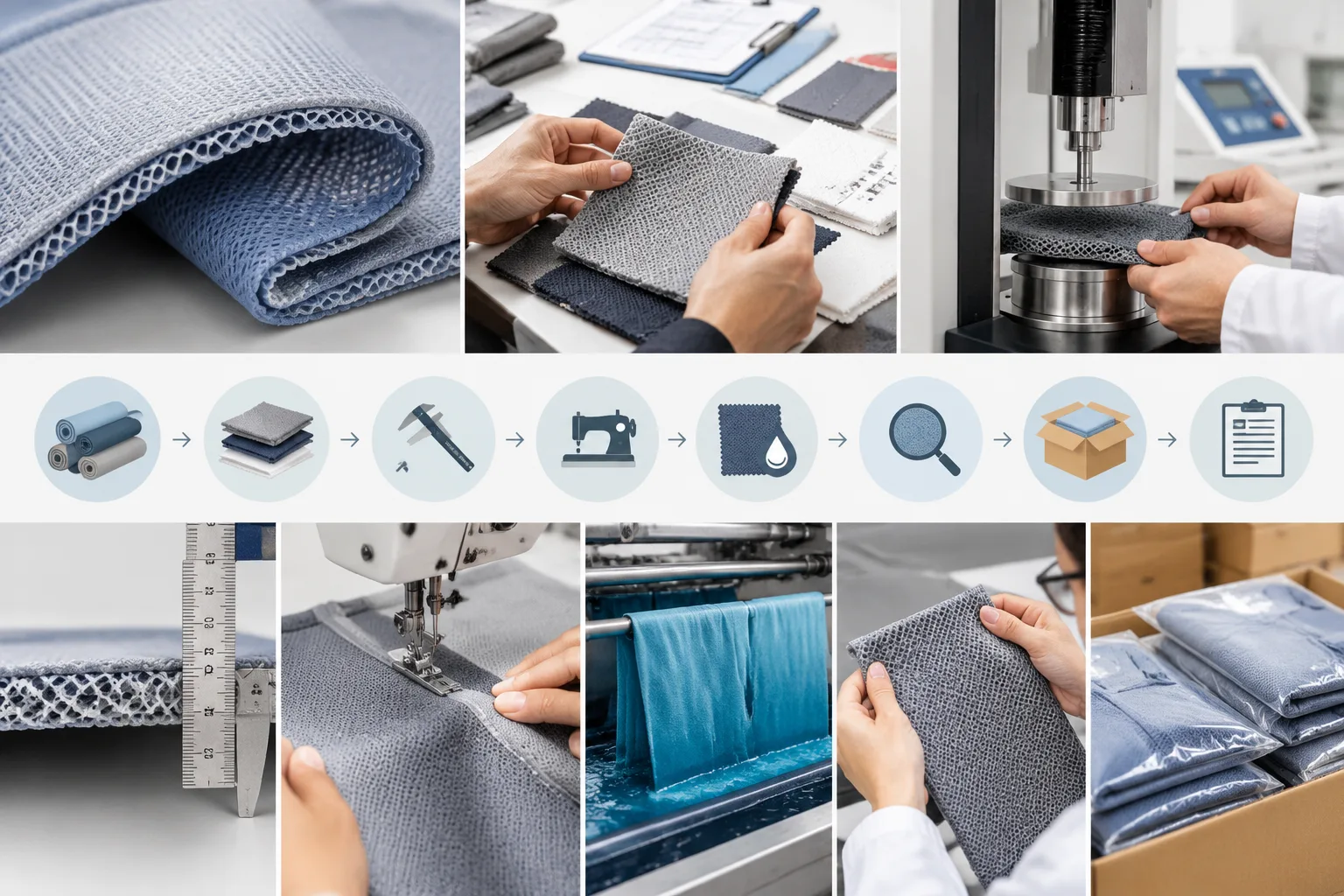
Before you source spacer fabric in bulk, verify five things: the material specification, representative samples, supporting documents, end-use performance, and the commercial assumptions behind each quotation. For sourcing purposes, spacer fabric is a three-dimensional textile made with surface layers connected by an internal spacer structure; however, the name can cover materially different constructions. Treat bulk spacer fabric sourcing as a controlled buyer-side process, not a search for the lowest unit price. Apparel Wiki is an independent educational publication, and its Sponsor information does not make it a fabric supplier, factory, testing laboratory, or certification body.
What should you verify before sourcing spacer fabric in bulk?
Start by identifying the garment, product, or component that will use the fabric. A spacer material intended for a close-fitting apparel panel may need a different hand, recovery, thickness, or care response from one used as padding, structure, or cushioning. Confirm the use location, contact with skin, expected movement, construction method, care route, and any buyer or market requirements before comparing suppliers.
Next, convert the design intention into written requirements. Verify fiber composition, relevant yarn information, surface construction, internal connecting structure, finished width, usable cuttable width, mass per unit area, thickness, color, finish, and any coating or lamination. Also state the performance properties that matter for the product, such as recovery, dimensional stability, breathability, abrasion resistance, compression response, or wash durability. Do not assume that a trade name or commercial category proves equivalent performance.
A complete review should also distinguish evidence types. A supplier declaration is not the same as a direct laboratory result; a buyer requirement is not the same as a general industry practice; and a hypothetical calculation is not a quotation. Request representative samples and supporting records before approval, then compare offers using one standardized RFQ. The comparison should include delivered-cost assumptions, packaging, inspection, logistics, trade terms, waste, and commercial risk rather than unit price alone.
- Material identity: Confirm composition, construction, dimensions, weight basis, finish, and intended use.
- Sample status: Establish whether the sample is developmental, production-equivalent, dyed, finished, coated, or laminated.
- Evidence: Separate supplier claims, test reports, buyer specifications, and unresolved assumptions.
- Commercial basis: Align units, quantities, destination, inclusions, exclusions, and quality expectations before comparing prices.
How should you define the spacer fabric you need?
Build the material brief in layers. Begin with fiber composition, then record yarn information where it affects identification or behavior. Describe the fabric structure, including the surface layers and the spacer or connecting elements, and identify any dyeing, coating, lamination, bonding, or other finishing. This hierarchy prevents common category errors: a fiber name does not describe the structure, a structure name does not establish a fiber, and a finish can change the behavior of either.
Dimensions need the same discipline. Specify finished width and usable cuttable width separately because布边, edge distortion, or other unusable areas can affect pattern placement. State how weight will be measured and whether the commercial basis is by mass, linear length, or another unit. GSM means mass per unit area; it is not a direct synonym for thickness, density, quality, or comfort. Thickness should be identified separately, with its measurement condition and any project tolerance documented rather than assumed.
The brief should connect the fabric to the product. Note where it will be placed, the desired hand, stretch and recovery behavior, breathability or cushioning objective, expected seam treatment, and care route. If the material will be washed, compressed, bent, sewn, laminated, or worn repeatedly, those conditions belong in the development brief. Requirements can be marked as mandatory, preferred, or open for development so that a supplier does not silently treat an unresolved preference as an approved substitution.
Use fabric names and trade names as search terms, not as final specifications. Two materials described with similar names may differ in fiber content, layer arrangement, connecting structure, finish, width, or measurement basis. Ask each supplier to map its proposed material to the written brief and identify every point that does not match. That response is more useful than a catalog description that leaves the construction and limitations unclear.
Which samples and documents should you request before approval?
Request a development sample and, when available, a clearly identified production-equivalent sample. For colored materials, request an appropriate color standard or lab dip and record the reference used for approval. Every sample should have traceable information such as the supplier reference, date, lot or batch information when available, and the processing state. A photograph or informal message is not an adequate substitute for a physical reference and written approval record.
Ask for the proposed composition, construction description, finished width, usable width, weight, thickness, color, finish, care information, packing basis, and available test documentation in writing. Confirm whether the sample was dyed, finished, coated, laminated, or otherwise processed in the same manner proposed for bulk production. If the sample is only a development version, record which characteristics may change and what evidence will be required before production approval.
Inspect both faces, edges, layer transitions, surface appearance, recovery, distortion, and visible defects. Review the material under conditions that resemble its intended use rather than examining only a flat piece on a table. Where relevant, bend, compress, stretch, cut, and sew a controlled sample to expose issues that may not appear in an unhandled swatch. Record comments precisely, including acceptable appearance, hand-feel, color, construction, and any allowed variation.
The approval record should identify the approved sample, the applicable written specification, open questions, and changes that require reapproval. Supplier declarations and certificates can support the review, but they should be identified according to what they actually demonstrate. Independent or accredited testing may be appropriate for a higher-risk product, but not every project requires the same level of third-party evidence.
What performance and quality checks matter for spacer fabric?
Choose checks from the product risk rather than applying a universal test list. Depending on the use, relevant areas may include dimensional stability, stretch and recovery, abrasion, pilling, seam behavior, colorfastness, air permeability, moisture-related behavior, compression or resilience, and response to the intended care process. The required checks should follow the product brief, buyer requirements, and conditions the finished item will experience.
Evaluate the fabric before and after the intended care process when laundering or repeated use could change its appearance, thickness, hand, recovery, or layer bonding. For a composite material, surface appearance alone does not establish durability of the internal structure. Inspect areas vulnerable to bending, compression, cutting, sewing, or separation, and compare more than one sample area or lot when consistency is important.
Finally, do not treat one fabric report as proof of whole-garment suitability. Pattern shape, seam construction, lining, interlining, stitch selection, and assembly can change the result. Define what an acceptable difference means for the project, retain the relevant inspection or laboratory records, and escalate technical review when the fabric will face demanding care, high wear, close skin contact, or performance-critical use.
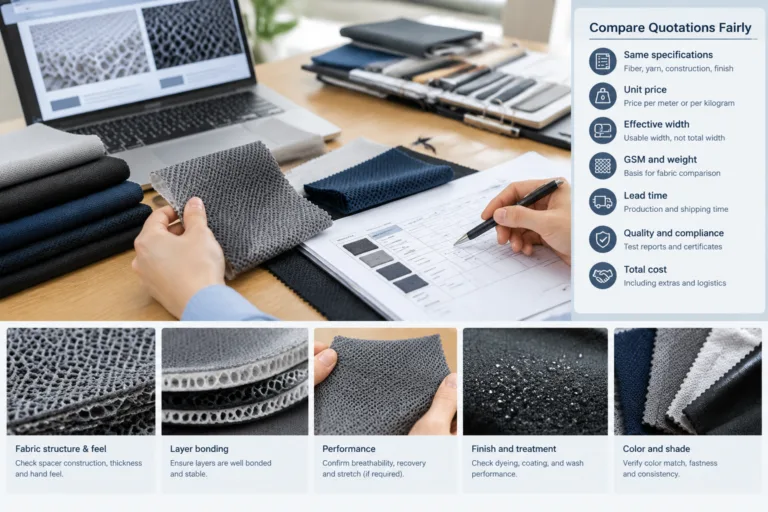
How can you compare spacer fabric quotations fairly?
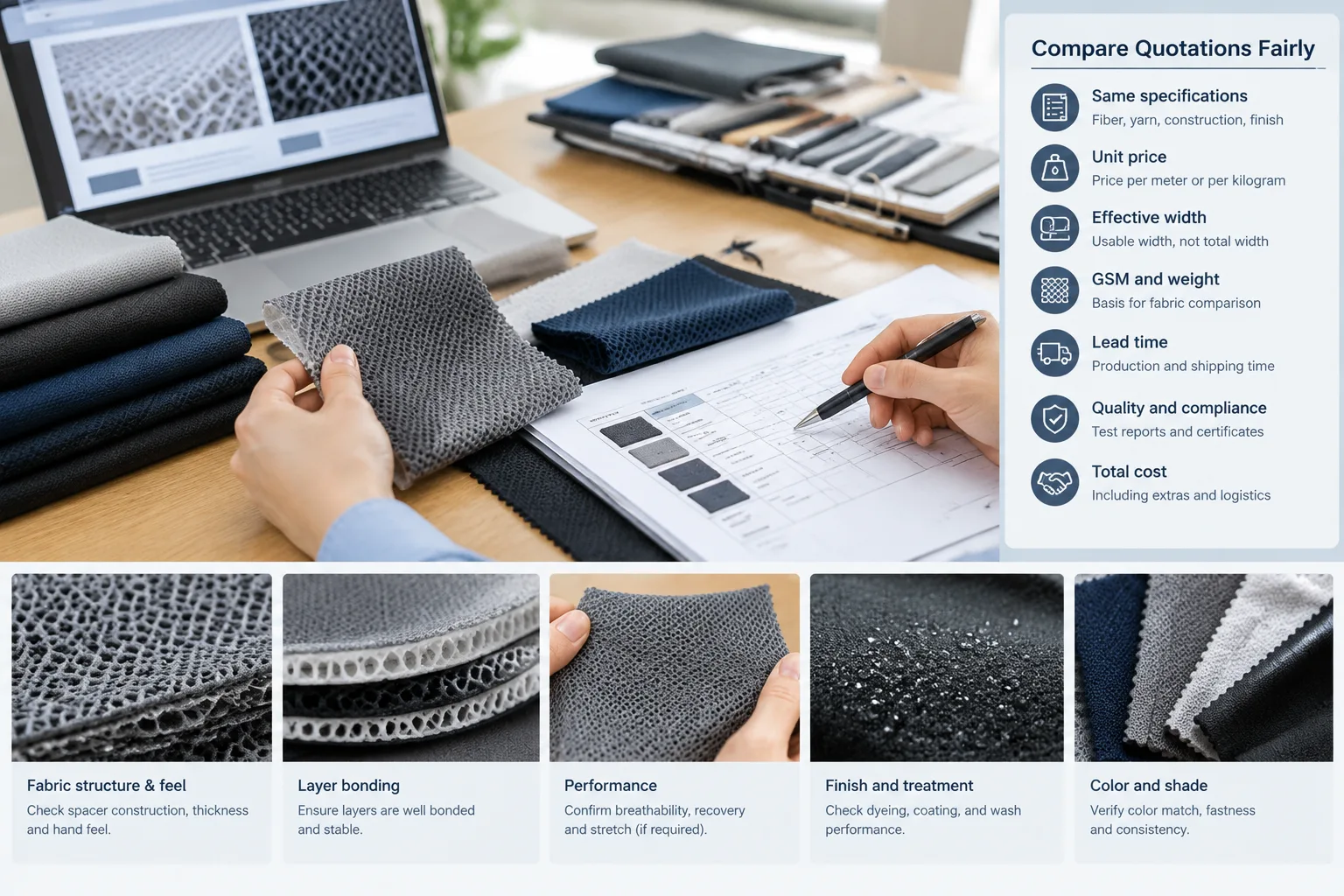
A spacer fabric RFQ should give every supplier the same information. Include the written material specification, approved or requested sample reference, color requirement, quantity, destination, packing expectations, and quality requirements. Also state which details are mandatory and which remain open for development. Without a shared starting point, different quotations may describe different fabrics even when the commercial names appear similar.
Record the basis of every price carefully. A quotation may use weight, linear length, or another unit, and each basis has different implications. Note the width associated with the unit, whether the figure refers to total or usable width, and how the material was measured. A lower price per unit is not necessarily lower when the fabric provides less usable area, creates more waste, or requires additional processing.
Ask suppliers to identify included and excluded costs in writing. Depending on the project, this may include development work, testing, packaging, freight, duties, taxes, inspection, and expected waste. Confirm the delivery destination and commercial terms used for the offer. Avoid filling gaps with assumed minimum order quantities, production timing, payment conditions, or replacement policies; these are supplier- and project-specific terms that need confirmation.
Use a comparison matrix with fields for specification match, sample reference, evidence supplied, price basis, included costs, excluded costs, commercial terms, risk, open questions, and approval status. Add columns for color or lot restrictions and for the procedure used when a shipment does not match the approved reference. This makes it easier for design, sourcing, and quality teams to review the same evidence and identify unresolved assumptions.
What should be controlled between sample approval and bulk production?
Sample approval should create a controlled reference, not a general statement that the supplier’s material is acceptable. Link the approved sample to the written specification, supplier reference, color standard, relevant test requirements, and inspection criteria. Retain the approval record with its date, comments, photographs where useful, and any conditions attached to the decision.
Require documented approval before changing fiber content, yarn, construction, finish, width, weight, color process, or substitute material. Matching the nominal fiber composition is not enough. A change in structure or finishing can affect hand, recovery, wash response, layer behavior, appearance, or garment fit. The change record should explain what is different, why it is proposed, and whether new samples or tests are required.
Before bulk material is released, define how lots and rolls will be identified and reviewed. Depending on the product risk, checks may cover usable width, visible defects, shade consistency, roll identification, packing, storage conditions, and traceability records. Establish what happens when an inspection result or appearance differs from the approved reference. Material may need to be held for review rather than treated as approved by default.
Plan reapproval when a change could influence care instructions, color, weight, thickness, recovery, hand, fit, seam performance, or end-use behavior. The approved sample represents a defined reference at a particular stage; it does not prove that every later roll will perform identically. Keeping the sample, specification, lot information, and decisions together gives the production team a clearer basis for handling variation.
When is a spacer fabric supplier ready for a bulk order?
A supplier is ready for a bulk order when the intended use, material specification, sample status, commercial basis, required evidence, and change-control process are documented. The decision should be understandable to design, sourcing, quality, and production teams without relying on private messages or an individual buyer’s memory.
Pause the order when the supplier cannot clearly identify the construction, measurement basis, sample origin, applicable limitations, or conditions behind a claimed result. Missing information does not automatically mean the material is unsuitable, but it does mean the project has an unresolved risk. Record each open question, assign an owner, and set the point at which the question must be answered.
Escalate technical review or testing when the spacer fabric will be used in a safety-relevant, high-wear, close-fitting, washable, laminated, or otherwise performance-critical application. The appropriate verification depth depends on the product, market, care route, risk profile, and buyer requirements. A fabric that is acceptable for one component may require additional evidence in another use.
Finish with a documented go, hold, or reject decision. A “go” should identify the approved specification and evidence; a “hold” should list the missing information or required action; and a “reject” should state the material or commercial reason. This decision framework supports evidence-based sourcing without pretending that Apparel Wiki, an independent educational publication, is a supplier, factory, laboratory, or certifier.
As a useful next step, turn these checks into a one-page sourcing file: attach the RFQ, approved sample record, quotation matrix, test or inspection documents, change-control notes, and final decision. Keeping the commercial and technical records together helps prevent a specification change from being overlooked during production handoff.
What information should I include in an RFQ for spacer fabric?
Include the intended use, construction and fiber requirements, dimensions, weight basis, usable width, color, finish, quantity, destination, sample reference, quality expectations, packing needs, required documents, and quotation assumptions. Ask suppliers to identify exclusions and proposed substitutions separately.
Is GSM enough to compare two spacer fabrics?
No. GSM is mass per unit area, not a direct measure of thickness, quality, cushioning, recovery, or durability. Compare composition, construction, thickness, width, finishing, intended use, and relevant test or inspection evidence under the same measurement basis.
What samples should I approve before ordering spacer fabric in bulk?
Review a development sample and, when available, a clearly identified production-equivalent sample. Also approve the applicable color reference or lab dip and retain sample details such as date, lot, processing route, construction, and comments.
Which tests may be relevant for spacer fabric used in apparel?
Depending on the product risk, relevant checks may include dimensional stability, stretch and recovery, abrasion, pilling, seam behavior, colorfastness, air permeability, compression or resilience, and wash response. Select tests from the actual garment use rather than applying a universal list.
How should I handle a supplier’s proposed substitute fabric?
Place the substitute on hold until its composition, construction, dimensions, finish, evidence, and commercial effects are reviewed. Approve it in writing only after deciding whether new samples, care review, inspection, or performance testing is needed.
Why can two spacer fabrics with similar names perform differently?
A commercial name may cover different fiber contents, yarns, spacer structures, surface layers, finishes, thicknesses, or manufacturing conditions. Compare the written specification and representative evidence instead of treating the name as proof of equivalent performance.