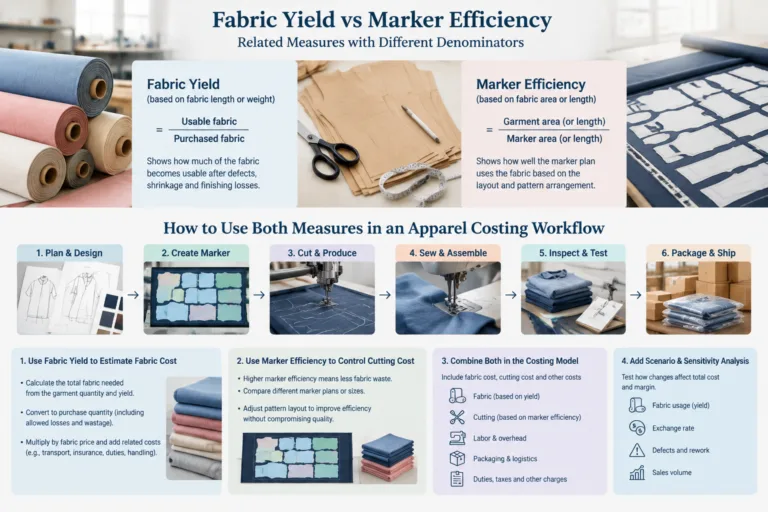
Fabric yield and marker efficiency are related measures, but they do not mean the same thing. Fabric yield is a broader material-use or consumption measure whose meaning depends on its stated denominator. Marker efficiency is a layout measure: it compares the area occupied by pattern pieces with the usable area of a marker. Because the two figures may cover different stages of material planning, a high marker efficiency does not automatically mean high purchasing yield. Apparel Wiki is an independent educational publication; readers can review its editorial support information on the Sponsor page.
Fabric Yield vs Marker Efficiency: What Is the Difference?
The central difference in fabric yield vs marker efficiency is the denominator. A fabric-yield figure may describe fabric consumed per finished garment, garments obtained from a defined fabric quantity, usable fabric utilization, or the relationship between net material and purchased material. Those are not identical calculations. The term should therefore be accompanied by its formula, units, scope, and included losses rather than treated as one universal factory definition.
Marker efficiency has a narrower operational boundary. It normally measures how much of the usable marker area is occupied by the pattern pieces. The marker is based on a specified usable fabric width and marker length, together with a particular pattern version, size ratio, grain-direction rule, and layout arrangement. It evaluates the efficiency of that layout; it does not, by itself, describe every quantity that may affect fabric purchasing.
For example, fabric defects, unusable edges, end loss, spreading conditions, shade grouping, shrinkage assumptions, and rejected material may influence purchased quantity without appearing in the marker-area calculation. The same order can therefore have an efficient marker and a less favorable purchasing result. The practical rule is simple: identify the measure first, then confirm what its numerator and denominator include.
How Each Measure Is Calculated
The standard structure for marker efficiency is:
Marker efficiency = pattern-piece area ÷ marker area × 100
Under the usual rectangular-area assumption, marker area is calculated as:
Marker area = marker length × usable marker width
A hypothetical example makes the boundary clear. If the pattern pieces occupy 12 square metres inside a marker that is 10 metres long and 1.5 metres wide, the marker area is 15 square metres. The resulting marker efficiency is 12 ÷ 15 × 100, or 80%. This is a hypothetical result for that marker only. It is not a benchmark, minimum target, or estimate of total purchasing performance.
A fabric-yield or consumption calculation must state both the fabric input and the output. Depending on the costing system, the result might be expressed as metres per garment, square metres per garment, garments per defined fabric quantity, or a utilization percentage based on usable or purchased fabric. Linear consumption, area utilization, mass conversion, and purchased quantity should remain separate measures unless the conversion assumptions are explicitly documented.
| Measure | Typical structure | What it describes |
|---|---|---|
| Marker efficiency | Pattern-piece area ÷ marker area × 100 | Pattern utilization within a defined usable marker |
| Fabric consumption | Defined fabric input ÷ garment output | Material required for a stated garment or order basis |
| Purchasing yield | Defined garment or usable output ÷ purchased fabric input | Use of the quantity actually purchased, subject to stated assumptions |
The table shows why percentages or ratios cannot be compared until their boundaries are aligned. A marker calculation uses area within a layout. A consumption calculation may use length per garment. A purchasing yield may include material that never reaches the marker because of quality, handling, or planning conditions.
Why the Denominator Changes the Result
The denominator determines which losses are visible in a result. For marker efficiency, the denominator is generally the usable marker rectangle: marker length multiplied by usable marker width. The calculation asks how effectively the pattern pieces occupy that defined area. It does not necessarily include the full roll, unusable selvedges, defects, roll ends, inspection allowances, or fabric rejected before cutting.
A purchasing-oriented fabric-yield measure may instead use the total purchased quantity. That quantity can be affected by fabric width variation, unusable edges, mapped defects, end loss, shade grouping, relaxation, shrinkage assumptions, inspection allowances, or project-specific additions. Whether each item is included depends on the company’s costing definition and production records.
These quantities should be kept distinct:
- Net pattern requirement: the material represented by the pattern pieces under the defined calculation basis.
- Marker-related waste: the unused area inside the marker after the pieces are arranged.
- Spreading or end loss: material affected by laying, roll handling, or the ends of a spread.
- Defect or edge loss: material that cannot be used because of quality issues or unusable width.
- Purchased quantity: the amount ordered or received under the stated purchasing and acceptance conditions.
Do not silently combine these categories. If a purchase quantity already contains an approved loss allowance, adding the same allowance again can overstate consumption. A useful material flow moves from net requirement to marker-related waste, then to separately documented production and purchasing adjustments. The exact labels may vary by company, but the calculation boundaries should remain visible.
A comparison becomes meaningful only when the numerator, denominator, garment mix, fabric width, usable width, units, and loss assumptions are aligned. Otherwise, two figures may appear to disagree while actually measuring different stages of the same material flow.
What Can Make the Two Measures Move in Different Directions?
Fabric width and usable width can change the available layout without changing the pattern pieces. A marker prepared for one usable width may require a different length or arrangement from a marker prepared for another. This means a change in width can affect marker efficiency, consumption, or both, but the effect depends on the pattern geometry and the layout system.
Pattern size range, garment ratio, order quantity, and marker planning also influence utilization. A marker built for a balanced size ratio may behave differently from one built for a small or uneven order mix. Leftover material can likewise be affected by the selected marker length and the way pieces are grouped for the order. A result from one style, ratio, or order should not automatically be applied to another.
Layout restrictions can reduce available nesting options. Grainline requirements, one-way designs, nap, matching stripes or plaids, print alignment, and piece-direction rules may require additional spacing or fixed positioning. A layout that appears less efficient on an area calculation may still be necessary to preserve appearance, directional consistency, or production practicality.
Other variables sit outside the marker itself. Fabric defects, shade grouping, relaxation, shrinkage, spreading conditions, roll-length limits, and rejected material can affect the quantity purchased or issued. These are fabric-quality and production variables, not simply pattern-layout variables. A style change that improves nesting may also create trade-offs in matching, inspection, handling, or quality control.
For that reason, optimization should be treated as a project-dependent trade-off rather than a race toward the highest percentage. Marker efficiency is useful for reviewing a layout. Fabric yield or consumption is useful for planning material under a defined costing scope. Neither figure alone proves total fabric performance, and neither should be interpreted without its denominator and assumptions.
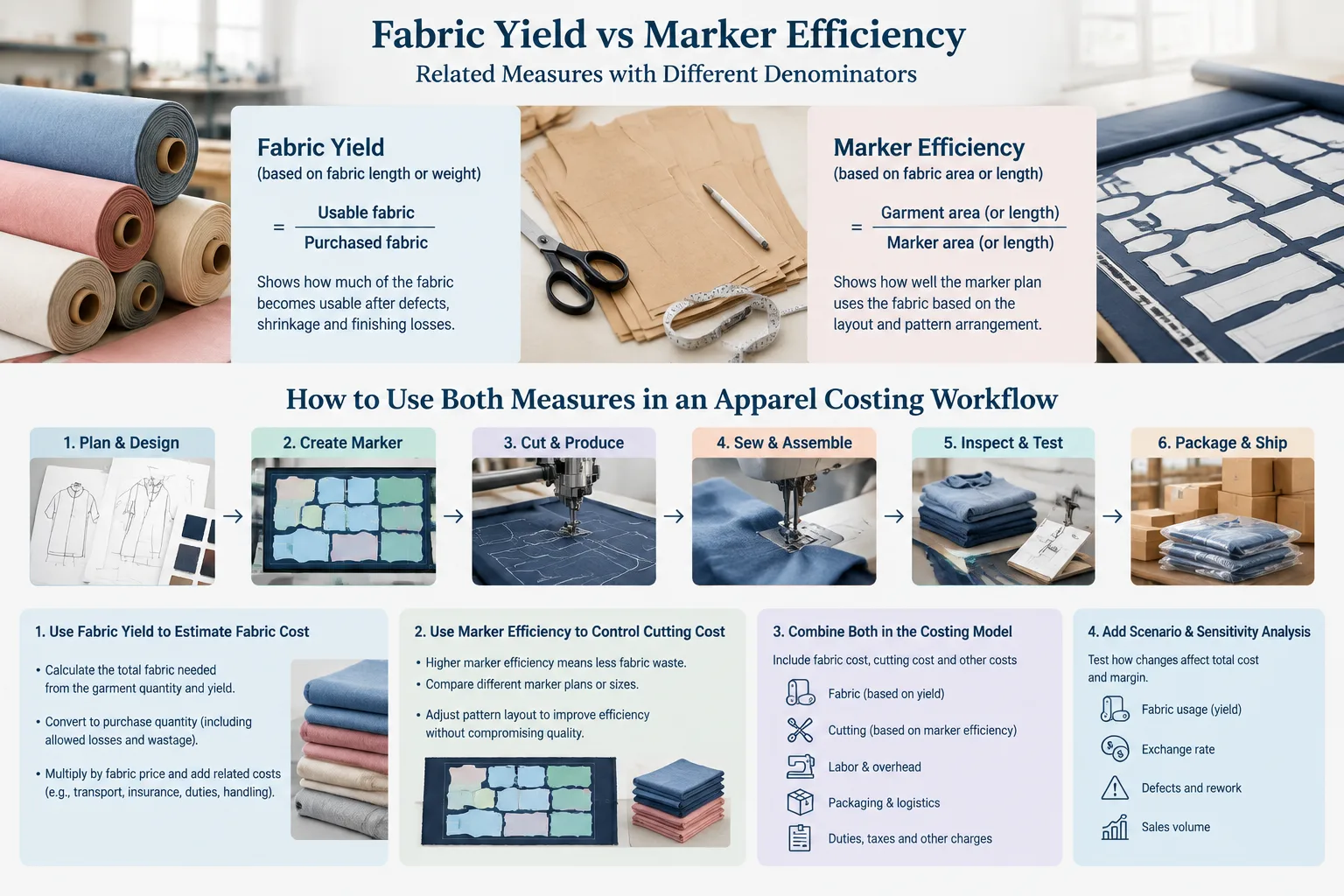
How to Use Both Measures in an Apparel Costing Workflow
Start by identifying the decision the figure needs to support. A marker review asks whether pattern pieces are arranged effectively. A standard consumption figure supports product costing or material planning. A purchase quantity concerns the fabric ordered, while a cutting review may examine issued, returned, rejected, or leftover material. These decisions can use related data without using the same measure.
For a controlled costing record, identify the fabric clearly enough to distinguish the material being reviewed, then record its width and usable width as separate fields. Other details, such as composition, construction, GSM, finish, or stretch behavior, may matter when they affect the material identity or the calculation assumptions. They should not be silently substituted for width, area, length, or purchased quantity.
Keep the marker record traceable. Record the marker revision, marker length, usable width, size ratio, garment quantity, grain and direction rules, and any matching or layout restrictions. A marker result without these details may describe a real calculation, but it may not be reproducible for another order, style revision, fabric lot, or size mix.
- Define whether the review concerns layout, standard consumption, purchase quantity, cutting performance, or a post-production variance.
- Separate the net pattern requirement from marker-related waste and from approved allowances.
- List spreading loss, end loss, defects, rejected fabric, shrinkage assumptions, and other additions only within the scope where they actually apply.
- Reconcile planned quantities with actual issued, returned, and rejected fabric using consistent units and the same stated boundaries.
- Investigate a variance before changing the standard. Check the marker revision, fabric width, order mix, defect mapping, and whether an allowance was counted twice.
This material-flow approach is useful for brands, product teams, merchandisers, and manufacturers because it shows where a difference arose. A strong marker result may support a layout conclusion, but it does not by itself establish the quantity that should be purchased. Apparel Wiki is an independent apparel industry knowledge blog; its Apparel Manufacturing Tools page should not be read as a statement that the site provides manufacturing or sourcing services.
A Practical Comparison Checklist for Reviewing Reported Results
When two reported figures appear to conflict, first ask what each one actually measures. Request the numerator and denominator in plain terms. Is the result based on pattern area, marker area, fabric length, fabric area, fabric weight, garments obtained, issued material, or purchased quantity? A percentage can look precise while representing a different physical quantity from the figure beside it.
- Confirm the unit system and distinguish actual fabric width from usable width.
- Check the marker’s length, size ratio, order quantity, pattern revision, and garment mix.
- Record grainline, one-way, nap, stripe, plaid, print, and matching requirements.
- List included and excluded losses, including defects, edge limitations, end loss, spreading loss, shrinkage, and rejected fabric.
- Compare like-for-like styles, fabric lots, order quantities, and production conditions.
- Record the source, date, assumptions, and calculation method before using the result in a standard or supplier comparison.
Comparability matters more than a universal pass or fail threshold. A test-method result, an internal factory report, a software output, and an editorial recommendation are different types of evidence. They may all be useful, but they should not be presented as interchangeable. If a supplier reports a figure that affects purchasing or costing, ask for enough underlying information to reproduce or qualify the calculation.

Limits of the Comparison and the Next Costing Decision
Neither fabric yield nor marker efficiency alone proves total order profitability, final fabric cost, garment quality, or overall production efficiency. Marker efficiency is not a complete purchase-quantity calculation, and fabric yield or consumption is not a substitute for reviewing the marker itself. Each measure answers a narrower question within a wider material-control process.
The next useful step is to establish one documented baseline for a defined style, fabric, width, order mix, and marker version. Then review how the result changes when a stated assumption changes, such as usable width, defect mapping, order ratio, or an approved allowance. These are sensitivity scenarios, not forecasts. Their value is that they make the boundaries of the costing decision visible.
Use marker efficiency to review pattern layout, use yield or consumption to plan material under a defined scope, and use a reconciled quantity flow to investigate purchasing variance. Keep an editorial example, supplier figure, production record, and external requirement identified as different evidence types. That discipline prevents a useful percentage from being treated as a complete answer.
Are fabric yield and marker efficiency the same measure?
No. They are related material-use measures with different denominators and potentially different scopes. Marker efficiency normally evaluates pattern-piece area against the usable marker area, while fabric yield or consumption may relate fabric input to garments, usable material, or purchased quantity. The formula and boundary must be stated before comparing them.
Why can a marker have high efficiency while fabric consumption is still higher than expected?
Marker efficiency may exclude defects, end loss, spreading conditions, unusable edges, shrinkage assumptions, rejected material, or other purchasing allowances. A marker can therefore be efficient within its own area while the complete material quantity is higher.
What denominator should be used for marker efficiency?
Use the defined usable marker area, generally calculated from marker length multiplied by usable marker width. The pattern-piece area is then compared with that marker area. Width, length, units, pattern scope, and layout restrictions should be recorded with the result.
Which losses are outside a marker-efficiency calculation?
Depending on the reporting system, defects, end loss, spreading loss, unusable edges, shade grouping, shrinkage allowances, rejected fabric, and roll-length limitations may sit outside the marker calculation. Do not assume that every report includes or excludes the same categories.
Should marker efficiency be used directly to set fabric purchasing quantity?
Not by itself. Purchasing quantity requires a defined material flow that connects the net pattern requirement with marker conditions and approved production or fabric allowances. Check whether any loss has already been included before adding it again.
What information is needed to compare two marker-efficiency results fairly?
Compare the same units, fabric and usable widths, marker length, pattern revision, size ratio, order quantity, garment mix, grain and direction rules, matching requirements, and loss boundaries. Without these details, the percentages may describe different conditions rather than a genuine performance difference.