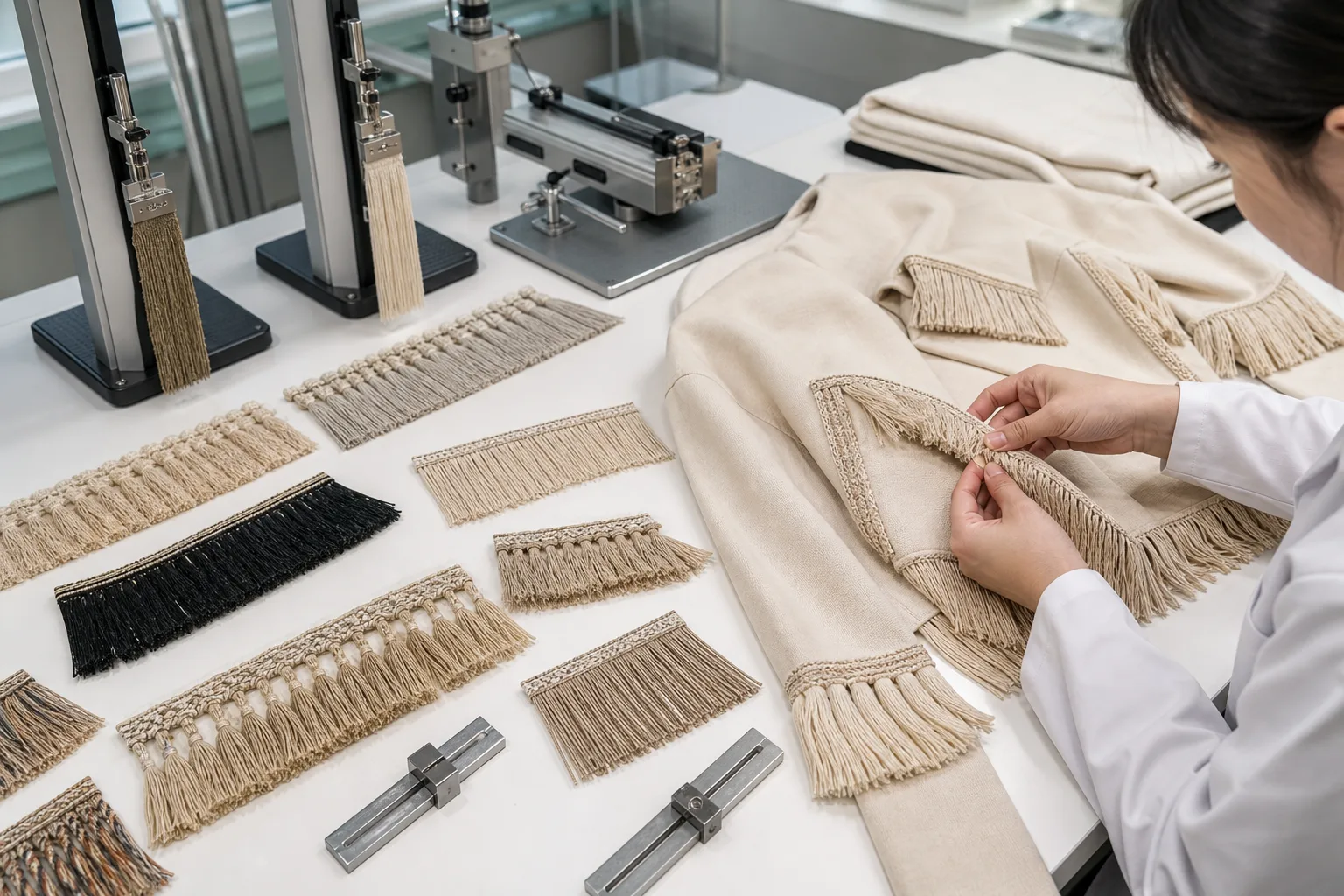
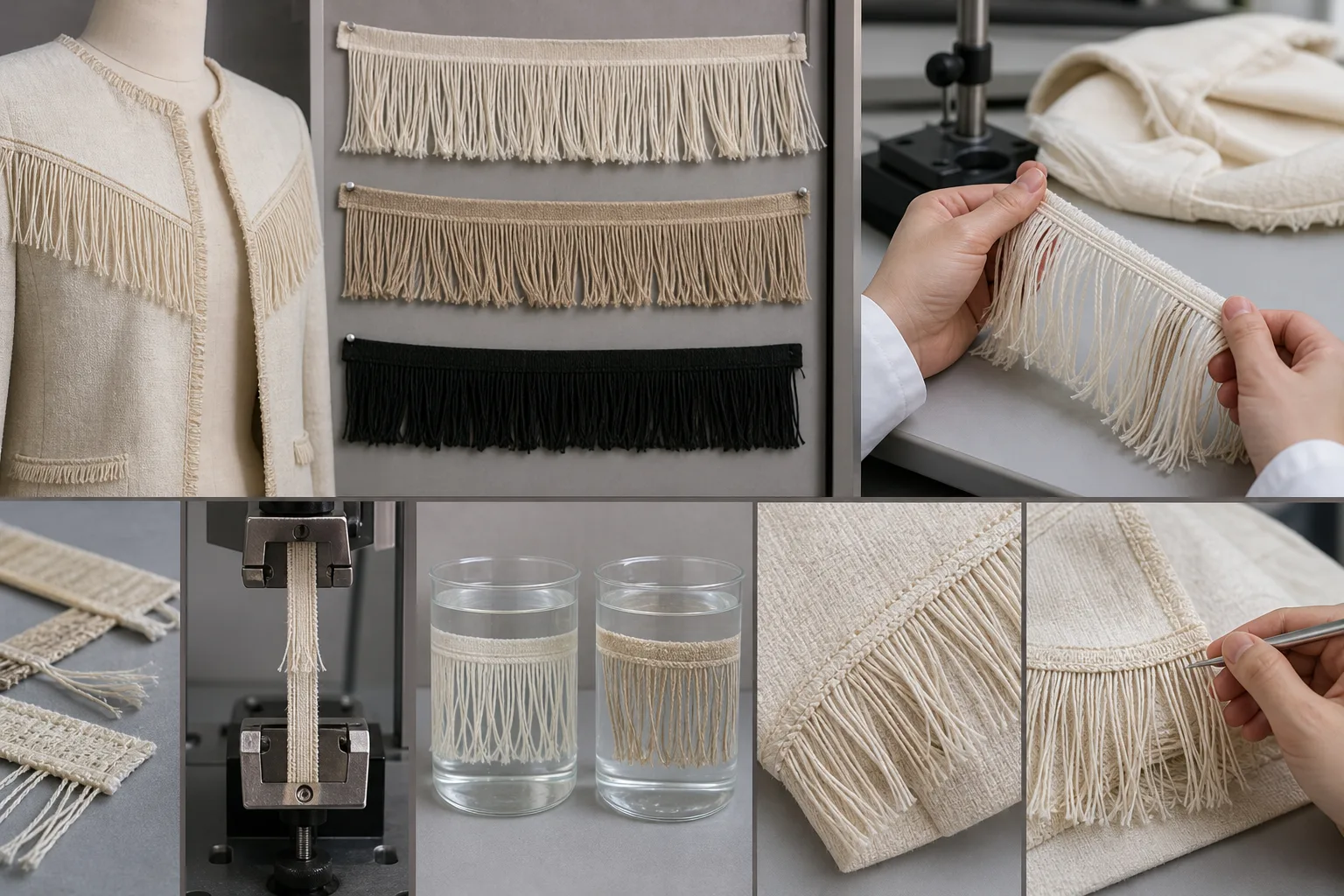
Fringe trim performance testing evaluates how an installed fringe behaves during intended handling, wear, care, and foreseeable stress. The relevant test object is usually the actual garment or a representative finished-garment assembly, not the loose trim alone. It should include the fringe, attachment method, adjacent fabric, and relevant seam structure. For background on apparel development resources, see Sponsor.
A loose fringe sample may appear secure and attractive yet behave differently after it is sewn, bonded, or otherwise integrated into a garment. Seam construction, stitch density, placement, edge finishing, garment fabric, movement, and laundering can change the result. This guide treats fringe as part of a garment system. It provides educational planning guidance, not a certification, laboratory, or universal compliance assessment.
What Is Fringe Trim Performance Testing on a Finished Garment?
Testing fringe trim means examining whether the installed component retains its required attachment, appearance, function, and condition under defined use or care conditions. The evaluation may focus on attachment security, shedding, snagging, tangling, distortion, color change, or another product-specific concern. The question should come from the garment’s intended role rather than from an assumption that every fringe style needs the same test.
Testing after attachment matters because the garment assembly creates interactions that a loose trim sample cannot represent. A fringe sewn across a seam, opening, pocket, or edge may experience different forces from fringe placed on a stable panel. The base fabric can stretch, fray, distort, or abrade, while the stitch path can concentrate stress. Washing, drying, pressing, storage compression, and repeated movement can also affect the trim and nearby fabric together.
Begin by identifying the intended use, wearer, target market, care route, and foreseeable hazards. A decorative fringe on an occasional garment may require a different evaluation from fringe on a frequently washed item, a close-to-skin product, a children’s garment, or a garment with a defined protective or functional use. Product specifications, customer requirements, applicable methods, or market rules determine acceptance criteria; there is no universal fringe pass threshold.
Which Fringe and Garment Variables Affect Test Results?
Record the fringe identity before evaluating performance. Useful details include the material, yarn or strip construction, width, density, length, finish, color, and method used to secure the ends. Note whether the ends are knotted, bonded, stitched, heat-finished, or left loose. These features can influence how readily the fringe sheds, tangles, mats, flattens, pulls out, or changes appearance.
Record the garment construction with equal care. Identify the base fabric, garment location, attachment direction, seam type, stitch type, seam allowance, reinforcement, and production stage. Note whether the trim crosses a stress point, opening, closure, pocket, hem, or area of repeated bending. The attachment may be the weak point even when the fringe material itself is consistent, so trim specifications and garment construction should be reviewed together.
Consider the exposures that match the product’s real use. These may include pulling, snagging, abrasion, repeated movement, moisture, washing, drying, pressing, chemicals, and storage compression. Decide whether loose ends, yarn loss, color transfer, dimensional change, altered hand, or visual distortion matter to the garment’s function or approved appearance.
A risk-based matrix is more useful than applying one identical evaluation to every product. Children’s products, close-to-skin placements, accessories that can catch on objects, and garments with a defined safety or performance use may require additional market- and product-specific review. These contexts should trigger careful checking of applicable requirements, not automatic legal conclusions.
How to Build a Finished-Garment Fringe Test Plan
Start by stating the question in plain terms. Are you checking attachment security, appearance retention, wash durability, snag resistance, shedding, wearer safety, or several of these? A clear question determines which sample features, conditions, observations, and decision criteria need to be documented. This planning framework supports development work but does not replace the full text of a recognized test method when one applies.
Define the sample and conditions
Identify the sample version, trim lot or identity, garment fabric, size, placement, attachment construction, and production stage. Select representative samples that include the highest-risk placement and any meaningful construction variation. Document why the samples represent the product. During development, a pilot evaluation can reveal likely failure modes; the approved construction should then be confirmed using production-representative materials.
Define the preconditioning, use or care simulation, inspection points, measurement approach, and pass or review criteria before starting. Do not add a favorable criterion after seeing the result. The selected conditions should reflect the garment’s intended care route and foreseeable exposure, while any formal procedure should follow its applicable instructions for sample preparation, equipment, and reporting.
Make the result traceable
Keep the method name and version, equipment, settings, operator, dates, sample identity, photographs, observations, and deviations with the result. Also retain the approved construction details and the requirement used for the decision. A result is difficult to interpret when the report does not identify which fringe, garment, attachment method, or care condition was evaluated.
Separate internal development screening from an external laboratory report or formal compliance assessment. An internal review can support design decisions, but it should not be presented as proof of certification or market compliance. If the finding could affect safety, labeling, market access, or customer approval, use the applicable qualified technical, laboratory, or compliance review.
What Should You Inspect Before and After Use or Care Simulation?
Before the selected evaluation, inspect the installed trim and its surroundings. Check attachment continuity, stitch security, edge finishing, loose ends, uneven length, exposed backing, distortion, and interaction with nearby seams or openings. Photograph the garment in a consistent orientation and use the approved sample or visual standard as the reference condition.
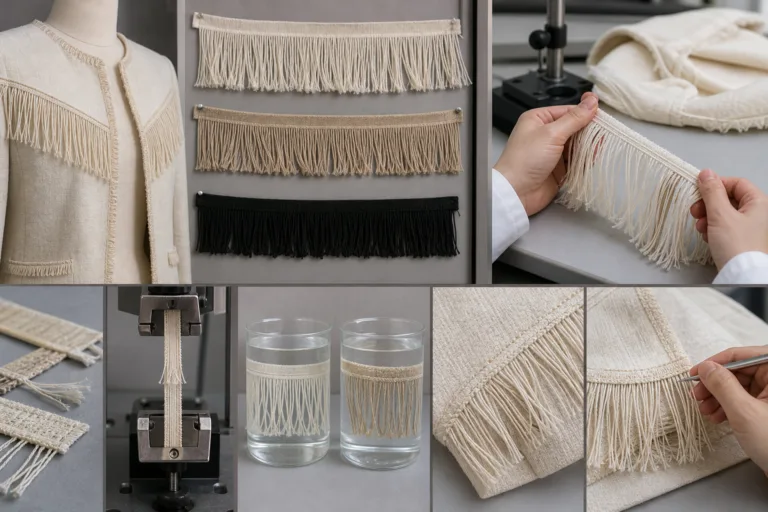
After the agreed use or care simulation, look for detachment, partial pull-out, broken or skipped stitches, yarn or strip loss, fraying, tangling, matting, permanent flattening, and changes in dimensions or position. Inspect the surrounding fabric for distortion, tearing, abrasion, color change, staining, or other damage caused by the fringe or its attachment. Record observations separately from conclusions so the evidence remains clear.
Appearance review should use consistent lighting, viewing distance, garment orientation, and photography where possible. Compare the result with the original approved condition rather than relying on memory. Also record functional effects, such as interference with closures or pockets, restricted movement, discomfort, difficulty with cleaning or pressing, or loss of the garment’s intended decorative or protective role.
A single inspection cannot establish lifetime performance or universal wash durability. Appearance acceptance may be a product decision, while mechanical or safety concerns may require a defined method and documented threshold. The final judgment should therefore refer to the applicable product specification, customer requirement, method, or market rule, with unresolved findings identified for review.
How Do You Interpret Fringe Trim Test Results?
Interpreting fringe trim performance testing starts with comparing like with like. The trim identity, garment fabric, attachment construction, sample preparation, conditioning, care or use simulation, equipment, and evaluation method should be identifiable. A result has limited value when one report concerns a loose trim sample and another concerns an installed fringe, or when the reports use different preparation conditions and evaluation criteria.
Do not rank results only by numerical size. Different methods, units, sample directions, conditioning practices, and inspection rules can produce results that are not directly interchangeable. The method explains how an observation or measurement was obtained; the product specification, customer requirement, or applicable market rule determines whether that result is acceptable for the garment.
Keep observations separate from conclusions. A useful record might state that several stitches were broken, a section of fringe moved away from the seam, or the trim became visibly tangled after the selected simulation. The technical review can then determine whether the change conflicts with the approved appearance, intended function, care instructions, or a defined requirement.
When a result is weak, investigate the source of the problem across the complete assembly. The issue may come from the fringe material, the attachment process, the base fabric, the care route, or an interaction among them. Borderline or inconsistent findings should prompt a controlled review of sample variation and, where appropriate, a repeat evaluation under the same planned conditions. Do not silently average away an unexplained failure.
What Changes Can Improve Fringe Performance?
Corrective action should follow the observed failure rather than rely on a generic fringe attachment method. If the trim pulls away or distorts, review the stitch type, stitch density, seam allowance, reinforcement, attachment path, and how the ends are secured. The goal is to identify which part of the assembly is losing stability, not simply to add an unspecified construction change.
Snagging, tangling, shedding, or matting may require a different review. Examine fringe length, density, yarn or strip construction, finishing, and placement in relation to openings, closures, movement areas, and exposed edges. A shorter or denser design may change the appearance and hand, so any proposed revision should be judged against the approved garment as well as the performance concern.
Care instructions also belong in the investigation. If the trim and garment assembly do not respond well to the stated care route, confirm whether the problem is caused by the material, the attachment, the care process, or an interaction between them. A revised care instruction should not be treated as a complete solution until the revised garment construction has been evaluated under the intended care conditions.
Use controlled sample changes so the team can identify which variable improved or worsened the result. Keep supplier, pattern, sewing, finishing, and quality teams aligned, because performance can depend on decisions made across the product process. Retest the approved revision with production-representative materials, and retain both failed and revised samples for comparison. These changes are development hypotheses requiring validation, not guaranteed fixes.
Fringe Trim Testing Checklist for Product Approval
Before moving from development screening to product approval, confirm the intended use, wearer, sales market, care route, and risk profile. Then identify the exact fringe material, garment fabric, placement, attachment construction, sample version, and production stage. These details establish what was tested and prevent a favorable result from being applied to a different garment assembly.
- Define the question: attachment security, appearance retention, care durability, snag resistance, shedding, wearer safety, or a combination.
- Identify the applicable method, preparation conditions, inspection points, and measurement or observation approach.
- Record the product specification, customer requirement, internal quality requirement, or other source that establishes acceptance.
- Inspect the fringe and surrounding garment before and after the selected evaluation.
- Document sample identity, trim details, dates, operator, equipment or settings where relevant, photographs, observations, and deviations.
- Escalate findings that may affect safety, labeling, market access, customer approval, or the garment’s intended function.
Approval should be tied to documented requirements rather than an unsupported universal pass level. If the result does not meet the applicable requirement, or if the evidence is incomplete, the appropriate decision may be to revise the construction, repeat the evaluation, obtain qualified technical review, or hold approval. This checklist supports product development and quality discussions; it is not a certification checklist or a replacement for a recognized method.
The next step is to locate the method and product specification applicable to the garment’s market and intended use, then confirm that the planned evaluation matches the actual fringe, fabric, attachment, and care route. When the risk or requirement warrants it, use a qualified laboratory or technical reviewer and retain the complete traceable record with the approved construction.
Can fringe trim be tested separately from the garment?
It can be screened separately for some material or construction questions, but loose-trim results cannot replace evaluation of the installed assembly. Attachment, nearby seams, fabric behavior, placement, and care exposure may change the result.
Why should fringe be tested after it is attached to the finished garment?
The finished garment shows how the trim interacts with the actual fabric, seam, stitch structure, placement, and care route. A loose sample does not reproduce all of those conditions.
What failure modes should a fringe trim inspection look for?
Inspect for detachment, pull-out, broken or skipped stitches, yarn or strip loss, fraying, tangling, matting, flattening, dimensional change, color change, and damage to adjacent fabric. Also check effects on closures, movement, comfort, cleaning, and pressing.
Does a fringe trim test automatically prove garment compliance?
No. Compliance depends on the product, market, applicable requirements, and evidence needed for that decision. A development evaluation is not automatically a formal compliance or certification assessment.
How should wash or care testing be selected for a fringed garment?
Base the selection on the garment’s stated care route, intended use, materials, construction, and applicable requirement. The selected evaluation should represent the relevant exposure and be documented with its conditions and acceptance criteria.
What information should appear in a fringe trim test report?
Include sample identity, trim and garment construction, placement, method and version, preparation and simulation conditions, equipment where relevant, dates, observations or measurements, photographs when useful, deviations, and the requirement used for the decision.