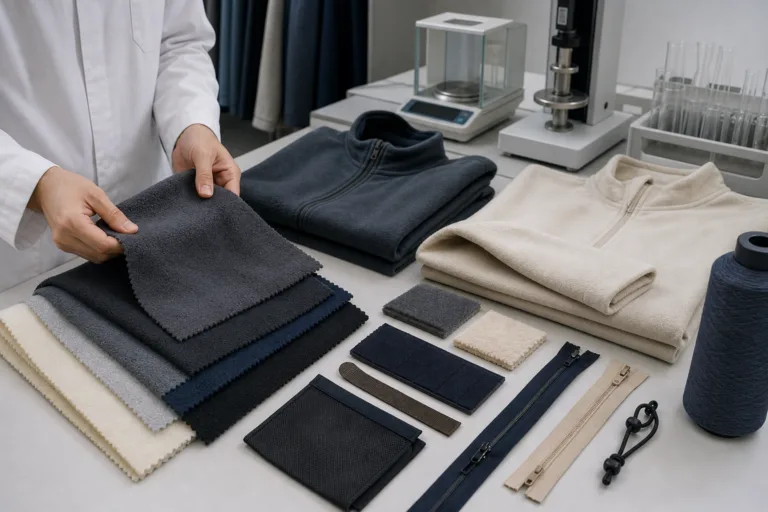
Microfleece GSM is the mass of microfleece fabric per square metre. It helps compare fabric weight, but it does not by itself tell you the fabric’s thickness, warmth, softness, quality, or finished garment weight. The right range depends on the garment’s role, climate, layering system, construction, and care requirements. For independent information about Apparel Wiki’s editorial position, see our Sponsor page.
In practical development work, treat GSM as one specification among several. Confirm the fabric composition, knit construction, brushing, finish, usable width, and measurement condition before approving a fabric. Two materials with the same nominal GSM can feel and perform differently, so a number should start a comparison rather than end it.
What Does Microfleece GSM Mean?
GSM means grams per square metre. It describes the mass of a defined area of fabric, making it a fabric-level measurement rather than a garment-level measurement. A microfleece fabric specification may therefore include a GSM value alongside fiber content, width, construction, finish, and other project-specific information.
The term microfleece is commonly used as a commercial fabric description, not as a complete technical identity. Different suppliers may use the term for materials with different fiber contents, yarn choices, knitted structures, brushing processes, surface finishes, or specification details. Confirm the technical data instead of assuming that every fabric sold as microfleece has the same structure or behavior.
It is useful to separate the fabric identity into several layers: fiber content, yarn, knit structure, surface treatment, and measured GSM. GSM cannot identify the fiber, prove the amount of stretch, or establish how much insulation a finished garment will provide. It is also not the same as thickness. A brushed surface, pile character, density, and finishing process can change the hand and apparent loft without producing a simple one-to-one relationship with mass.
For the same reason, higher microfleece fabric weight is not automatically better. A heavier option may offer more coverage or a fuller hand in a particular design, while a lighter option may support mobility, close layering, or easier packing. Those are selection considerations, not universal performance claims. Any formal measurement method or named standard should be confirmed against an authoritative textile or laboratory source before it is written into a product specification.
How Garment Use Determines the Right Microfleece GSM
Choosing microfleece GSM should begin with the garment brief, not with a preferred number. Identify whether the fabric will be used for a close-fitting base layer, a mid-layer, a lightweight pullover, a jacket lining, a blanket-style item, or a smaller component such as a collar, cuff, or pocket. Each role creates different requirements for coverage, movement, bulk, drape, and sewing behavior.
Next, consider the expected conditions. Climate, activity level, indoor or outdoor use, the other layers worn with the garment, and the need to pack the item small all affect the decision. A fabric intended to sit beneath another layer may need to limit bulk and support comfortable movement. A standalone garment may allow more surface fullness, provided the resulting drape, pattern balance, and construction remain suitable.
Warmth should be considered together with fit and the complete layering system. Fabric mass can be relevant to coverage, but warmth also depends on construction, surface characteristics, air spaces, garment openings, fit, wind exposure, and other design factors. Without product-specific testing, do not present one GSM value as the best choice for every base layer, mid-layer, or outer garment.
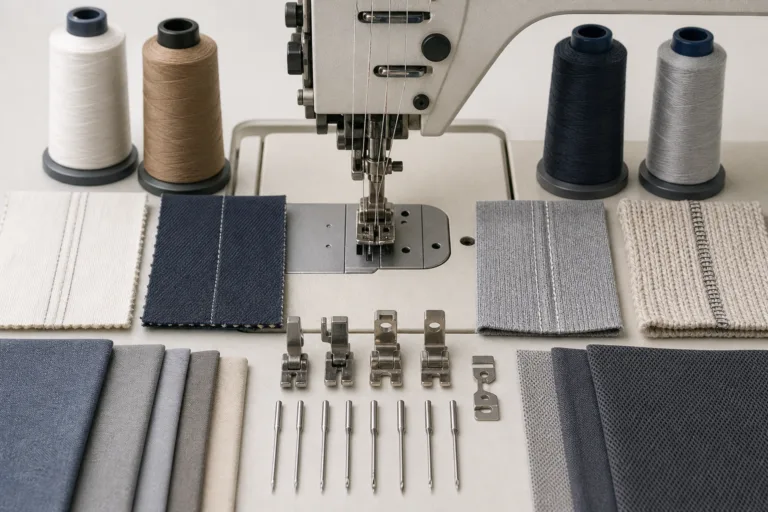
Garment development may also require more than one material decision. Body panels, cuffs, collars, pocket bags, and lining sections can have different functional or sewing requirements. A fabric that works well across the main body may create unwanted bulk at a seam or behave poorly in a small component. Review the proposed GSM in relation to the pattern, seam allowances, needle and thread choices, and the intended production process.
Microfleece GSM Ranges: What Changes as Weight Increases?
There is no universal set of lower, middle, and higher GSM boundaries that applies to every supplier or microfleece product. Use those terms as relative comparison categories within a controlled sample set, and record the supplier’s stated measurement condition. The matrix below is a decision aid, not a specification table or a claim about fixed industry cutoffs.
| Relative option | Possible garment role | Trade-offs to investigate | Sample checks and evidence |
|---|---|---|---|
| Lower GSM within the selected range | Close-fitting layer, packable garment, or selected lining use | May reduce bulk and support mobility; assess coverage, opacity, hand, and durability for the brief | Compare drape, stretch and recovery, surface coverage, sewing behavior, and relevant wash results |
| Middle GSM within the selected range | General-purpose layer or lightweight pullover scenario | May balance coverage and bulk, but the result depends on construction and finishing | Use matched samples and check dimensional change, surface appearance, layering comfort, and supplier data |
| Higher GSM within the selected range | Standalone layer, fuller pullover, or selected blanket-style application | May increase bulk and affect drape, packability, seam handling, and drying behavior | Check pattern mobility, seam thickness, nap direction, care response, and any validated performance tests |
These categories should be compared under consistent conditions. Brushing height, pile density, fiber composition, knit structure, and finish can change comfort and behavior at the same nominal GSM. A lower-GSM fabric may suit a close-fitting layered garment, while a higher-GSM fabric may suit a more substantial standalone style, but both statements remain hypotheses until the relevant samples are reviewed and tested for the intended product.
Which Fabric Variables Matter Besides GSM?
Start with fiber composition. A GSM value does not reveal whether the fabric uses one fiber, a blend, or a particular finish. The technical specification should state the composition clearly and keep it separate from the commercial name “microfleece.” Yarn and knit structure are also separate pieces of information. Structure can provide clues about behavior, but it does not alone establish stretch, breathability, durability, or warmth.
Record the surface treatment and brushing details that the supplier provides, along with the fabric’s hand, pile character, and surface density. Then check stretch and recovery in the directions relevant to the pattern. These observations should be distinguished from laboratory results or approved internal testing; a hand-feel assessment is useful, but it is not proof of a performance rating.
Width matters as well. Confirm total width and usable cutting width separately, then record shrinkage, distortion, nap direction, and fabric-roll consistency during development. GSM may change after washing, finishing, or other processing, so the measurement state should be documented. A pre-wash number and a post-process number are not interchangeable without explaining the conditions.
For bonded or layered microfleece versions, inspect more than the face fabric. Include checks for layer adhesion, flexing, washing, and behavior around seams. A report on one fabric layer cannot establish how the combined material will behave in a finished garment. The final selection should connect composition, construction, finish, GSM, and processing state to the actual design brief.
How to Evaluate Microfleece Samples Before You Set a GSM Target
Start with a use brief, not a preferred number. Record the garment type, intended fit, expected climate and activity, layering position, care route, and desired hand. Note how much bulk is acceptable and where the fabric will be used. These details help you decide which samples are worth comparing and which performance questions matter for the product.
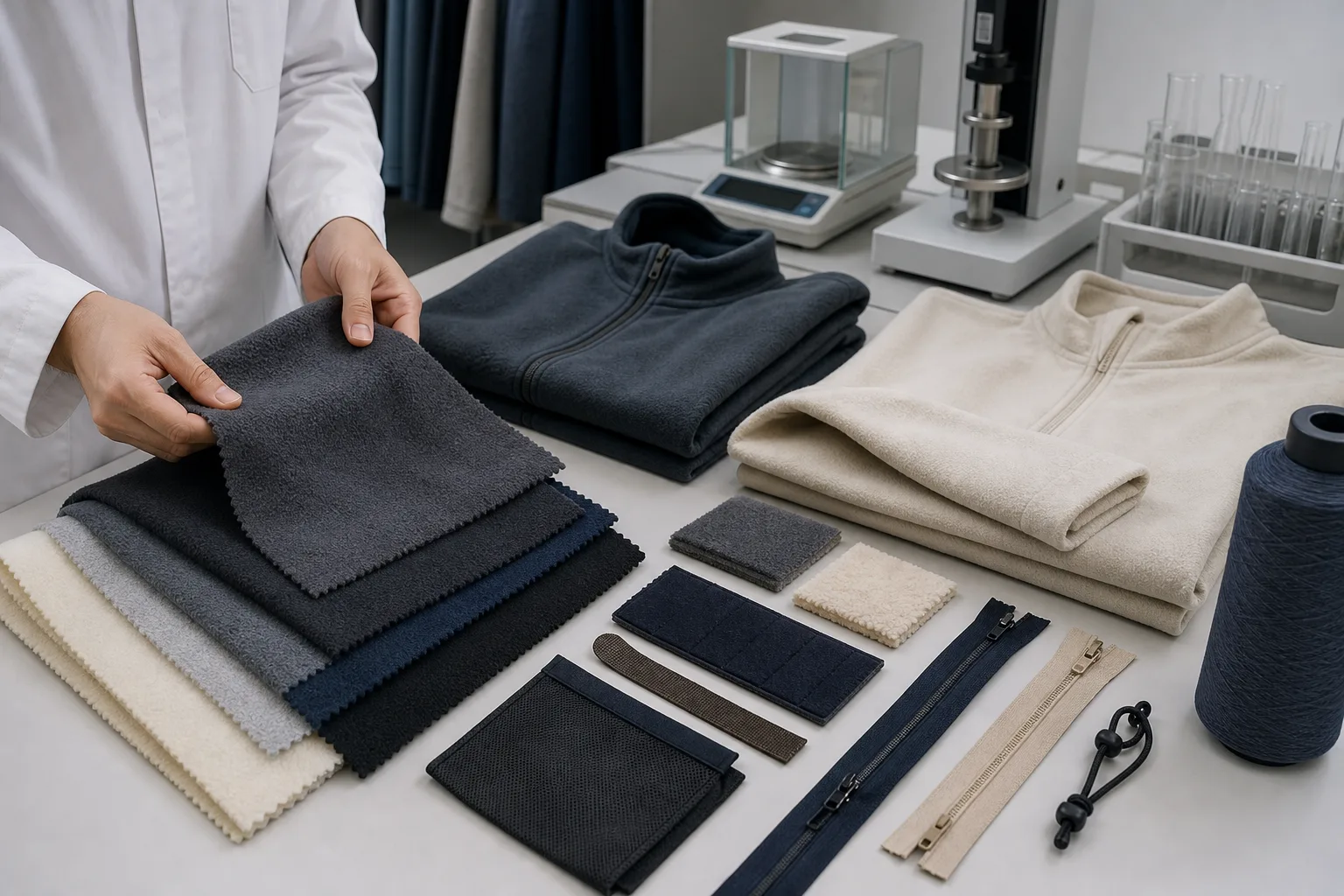
Ask suppliers for candidate samples and a specification that identifies fiber content, knit construction, finish or brushing, GSM, total and usable width, and the state in which GSM was measured. Request thickness information if available, but treat it as a separate property. If the fabric is bonded or layered, ask for details about the combined material rather than relying only on information for one layer.
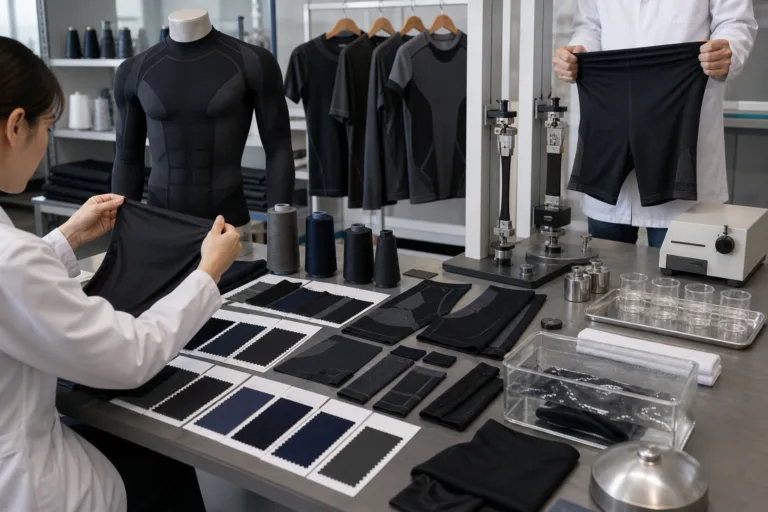
Compare samples under like conditions and record observations consistently. Check drape, hand, stretch and recovery, opacity, shedding, pile direction, and how the fabric behaves during cutting and sewing. These are useful development observations, but they are not substitutes for laboratory results. For example, a sample that feels warm to the touch does not by itself establish a garment’s thermal performance.
Evaluate samples after the care or processing route intended for the product. Wash or otherwise process them according to the project’s planned conditions, then inspect dimensions, distortion, surface appearance, hand, and seam behavior. If a property such as shrinkage, pilling, abrasion, or thermal performance is important, choose a relevant test or technical review. Do not request tests simply to accumulate paperwork; connect each one to a product risk or requirement.
Finally, select a working GSM range from the samples that meet the brief, not from a nominal figure alone. Document the acceptable range and tolerance, measurement state, finish, usable width, care expectations, and approved sample version. Keep visual assessments distinct from measured results so later reviews can establish what was observed and what was tested.
Common Microfleece GSM Selection Mistakes
Higher GSM does not automatically mean better quality or greater warmth. Mass per area is one input, while fiber, knit, pile, finishing, garment design, and layering also affect the result. A higher-weight sample may be too bulky for a close-fitting layer, while a lighter sample may not meet the intended coverage or hand. Treat these as possibilities to evaluate, not guaranteed outcomes.
Another common mistake is comparing supplier GSM figures as if the fabrics were identical apart from weight. Confirm composition, construction, brushing, finish, width, and measurement state. A fabric report also describes the tested material under stated conditions; it does not prove how a cut-and-sewn, washed, or bonded garment will perform.
Do not approve a product from a small, unwashed swatch if the garment will undergo repeated care or demanding use. Likewise, do not use a commercial fabric name in place of a technical specification and sample approval. If estimating fabric purchasing weight, GSM alone is insufficient: the calculation also depends on length and width, while usable cutting width, layout, shrinkage, and defects affect actual material needs.
Before approving a supplier sample, check that you can answer the following:
- Is the fiber content, construction, and finish identified?
- Are GSM, width, and measurement state clearly recorded?
- Has the sample been assessed in its intended care or processing state?
- Are the key fabric observations separated from test results?
- Is the approved sample version linked to the specification?
This checklist supports a more complete comparison; it is not a quality rating for any supplier or fabric.
A Practical Decision Framework for Setting the Final Microfleece GSM
Use a sequence that connects the fabric specification to the finished garment:
- Define the use. Describe the garment role, wearer conditions, fit, layering position, and care route.
- Set design priorities. Record acceptable bulk, hand, drape, stretch, coverage, and sewing behavior.
- Shortlist candidates. Compare GSM only after confirming composition, construction, finish, and measurement state.
- Evaluate matched samples. Review them in the intended care or processing state and test only the properties that matter to the brief.
- Approve and document. Record the accepted GSM tolerance, width, finish, shrinkage expectations, approval sample, and relevant results.
- Monitor changes. Revisit the decision if the supplier, finishing route, pattern, layering system, or care instructions change.
The final range should reflect the lowest and highest candidate weights that still meet the project’s requirements. There is no single microfleece GSM that is right for every garment. When the product depends on safety-related claims or performance-critical properties, involve a qualified textile professional or laboratory and use project-appropriate evidence.
For a next step, turn the brief and sample checks into a written specification before approval, then keep the approved sample available for comparison during development. Apparel Wiki is an independent educational publication, not a manufacturer or testing service. Explore the Apparel Manufacturing Tools guide for related development resources.
Frequently Asked Questions
Is higher GSM microfleece always warmer?
No. GSM measures fabric mass per area, not warmth. Construction, fiber, brushing, finishing, garment design, and layering can all affect how warm the finished clothing feels. Compare samples and relevant performance evidence for the intended use.
What GSM is suitable for a microfleece base layer or mid-layer?
There is no universal value for either role. Consider fit, climate, activity, layering, acceptable bulk, and care needs, then compare supplier samples that meet the brief.
Does microfleece GSM tell me how thick the fabric is?
No. GSM and thickness are different measurements. Fabric construction and surface pile can affect thickness, so request thickness separately if it matters to the design.
What information should I request from a microfleece supplier besides GSM?
Request fiber content, construction, finish, width and usable width, measurement state, and care information. Ask for thickness or test results when relevant to the garment’s requirements.
How should microfleece be tested after washing?
Use the care route planned for the product, document the conditions, and compare dimensions, surface, hand, and seam behavior before and after processing. Use an appropriate test or technical review for properties that require measured results.
Can two microfleece fabrics with the same GSM perform differently?
Yes. Fiber, yarn, knit structure, brushing, pile, and finish can differ, so equal GSM does not establish equal thickness, comfort, or garment performance.