Sanforizing wash durability is a question of controlled dimensional change, not a promise that fabric will remain exactly the same forever. Sanforizing is a fabric-finishing approach associated with reducing or controlling later dimensional change. After repeated washing, the finish may remain useful, but its practical effect must be judged against the fabric, garment, care routine, and evaluation method. For broader garment-production context, see the Sponsor page.
The useful question is whether the fabric or garment remains suitable after the intended care routine. That means looking at dimensional change in the relevant fabric direction, finished-garment fit, panel matching, and overall appearance. A fabric can show reduced residual shrinkage without becoming dimensionally unchangeable. Repeated washing can also expose effects linked to fiber behavior, fabric structure, sewing, drying, and care intensity. Therefore, does sanforizing survive washing? Often the finish can continue to provide value, but the result is conditional and should be verified under defined conditions.
Sanforizing wash durability: what repeated washing can change
In practical terms, sanforizing is intended to help control dimensional change before fabric becomes a finished garment. The relevant benefit is usually a lower or more controlled risk of later movement in length, width, or another dimension that matters to the product. This is different from claiming that the fabric will never shrink, stretch, skew, or change shape.
A useful finish can remain useful without remaining identical after every wash. The question is not whether the finishing effect has either survived completely or disappeared completely. Instead, assess whether the remaining dimensional behavior fits the garment’s requirements after the stated care routine. A relaxed product may tolerate a different result from a close-fitting garment, but that is a product decision rather than a universal property of sanforized fabric after repeated washing.
Start with the observable outcome. Measure or compare the relevant fabric directions, then consider whether any movement affects garment measurements, hem position, sleeve balance, panel alignment, or the appearance of seams. Fabric-level dimensional change and finished-garment fit are related, but they are not interchangeable. Cutting direction, pattern shaping, seam placement, and garment construction can influence how a fabric change becomes visible.
Repeated washing also includes more than the finish itself. Fiber and yarn characteristics, fabric structure, stretch or recovery, drying method, and care intensity can all affect what is observed. A wash observation may also reveal changes in surface appearance, hand, color, or distortion. Sanforizing should not be treated as evidence that these other properties will remain unchanged. The practical conclusion is narrower: sanforizing may help manage dimensional change, while wash durability remains a result to verify for the actual material and use.
Why the result can change with repeated washing
The relevant sequence begins with the fabric’s condition before finishing, continues through finishing and garment manufacture, and ends with laundering, drying, and dimensional observation. Each stage can affect interpretation. A fabric result describes the material under its evaluated conditions; it does not automatically predict the final fit of every garment cut from that fabric.
Material and construction variables should be treated as comparison points, not as a formula for predicting a universal shrinkage percentage. Fiber and yarn characteristics can affect how a fabric responds to moisture, heat, agitation, and drying. Fabric structure, weight, stretch or recovery, and the direction of construction can also influence dimensional observations. In a garment, seam arrangement, shaping, and the balance between panels may determine whether a small fabric change becomes a noticeable fit or appearance issue.
The word “washing” is too broad to describe a comparable condition. Record the relevant water conditions, agitation, temperature, detergent, drying method, and timing of each evaluation. The interval between washing and measuring can also matter to interpretation because the material may not be assessed at the same stage each time. These details do not establish a universal prediction; they make one comparison more meaningful than an undocumented wash history.
Separate residual dimensional change from other visible outcomes. A fabric may retain acceptable dimensions while showing a change in surface appearance, hand, color, or distortion. Conversely, a visual impression may seem stable even when a measurement in a critical direction has changed. These properties require their own evaluation questions. A finishing result should therefore be considered alongside the fabric’s other required properties and the intended care routine.
Process-stage context is equally important. Finishing occurs at the fabric stage, while the product is later cut, sewn, shaped, and cared for as a garment. A fabric-level result can support a decision about material suitability, but it cannot replace checking the finished product when fit, panel matching, or shape is sensitive. Fiber type, construction, drying, and wash severity are factors to investigate. Without comparable evidence, they should not be converted into a claimed direction or amount of change.
How to evaluate sanforizing durability instead of assuming it
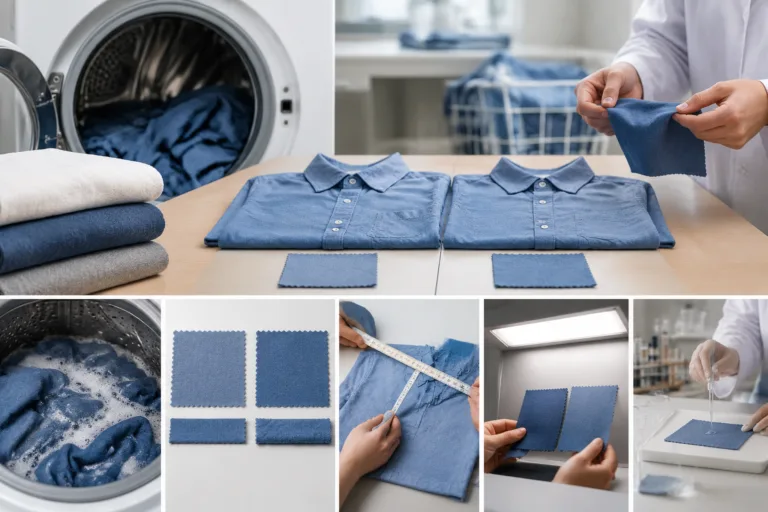
Begin by identifying the fabric, available finishing information, and intended product. Record original fabric dimensions or relevant garment measurements before the comparison. Define the intended care instructions and preserve comparable samples or garments. The comparison is strongest when the material, construction, care conditions, and evaluation property are kept consistent.
Measure the fabric directions or garment areas that matter to the product. When a validated test method is used, record the numerical dimensional change with the method and conditions. For an informal wash check, record practical consequences such as fit, panel alignment, seam behavior, or shape. A controlled test-method result and a home-laundering observation can both be useful, but neither should be generalized beyond its documented conditions.
Keep a record of the wash and drying conditions, the cycle sequence or number of cycles when relevant, measurement timing, and the property being evaluated. Do not invent an acceptance limit. The appropriate tolerance depends on fit sensitivity, construction, end use, and the applicable buyer or project specification. A single result can inform a decision only within that defined scope.
| Observable input | Implication | Initial choice | Variable that could change the choice |
|---|---|---|---|
| Documented dimensional-stability result with identified conditions | Provides a traceable comparison for the stated material and care scenario | Use it as relevant evidence for the same or closely comparable product decision | A changed fabric lot, construction, finish history, care routine, or evaluation property |
| Informal wash observation without a defined method | Shows what happened in that sample and routine, but limits broader interpretation | Use it as an initial indication and compare further when fit or appearance is sensitive | Different drying, measurement timing, sample condition, garment construction, or care intensity |
| Unknown finishing history or undocumented result | Leaves the dimensional-stability basis unclear | Preserve a comparable sample and establish a defined evaluation before relying on the finish | New finishing information, material identity, intended end use, or project specification |
The purpose of this framework is comparability, not certification. A performance label, display image, or broad finishing claim cannot substitute for the relevant use condition and evaluation property. For a product whose fit depends closely on stable dimensions, preserve records and compare like with like. For a less sensitive product, an informal check may be a reasonable starting point, but the decision should still reflect its care routine and construction.
Reading wash results and choosing what evidence is enough
A wash result becomes useful when its conditions and comparison basis are clear. Consistent observations across comparable samples can support a limited material decision, but one favorable sample does not establish behavior for every color, lot, construction, garment, or care routine. The closer the comparison is to the intended product, the more relevant the evidence becomes.
Start by asking what property was actually observed. Dimensional stability concerns changes in fabric or garment measurements. Colorfastness concerns color response under a particular exposure, while rubbing, perspiration, and light involve different conditions. Softness, hand, surface appearance, and distortion are also separate observations. A fabric that retains its dimensions may still change in another way, and a satisfactory result for one property does not prove the others.
Use the garment’s risk to determine how much evidence is appropriate. A fitted woven garment with little tolerance for dimensional change deserves documented, comparable evidence rather than reliance on an informal wash observation. A looser product may allow a different starting decision, but its construction, care routine, and appearance requirements can still make additional comparison important.
A practical decision path looks like this:
| Observable input | Implication | Initial choice | Variable that could change the choice |
|---|---|---|---|
| Known finish and care conditions with a documented dimensional result | The evidence is traceable to a stated material and evaluation context. | Use it as relevant support for the same or closely comparable product decision. | A changed lot, construction, finish history, care routine, or evaluation property. |
| Informal wash observation from an identified sample | It shows what happened in that sample and routine, but limits broader interpretation. | Use it as an initial indication and compare further when fit or appearance is sensitive. | Different drying, measurement timing, sample condition, or garment construction. |
| Unknown finishing history or undocumented result | The basis for judging dimensional stability is unclear. | Preserve a comparable sample and establish a defined evaluation before relying on the finish. | New finishing information, material identity, intended end use, or project specification. |
A result can support a product decision only within its tested or observed scope. It is not automatically a permanent guarantee, certification, or regulatory determination. When the care instructions or end use changes, reassess the evidence rather than transferring the earlier conclusion by default.
Practical scenarios: when repeated washing matters most
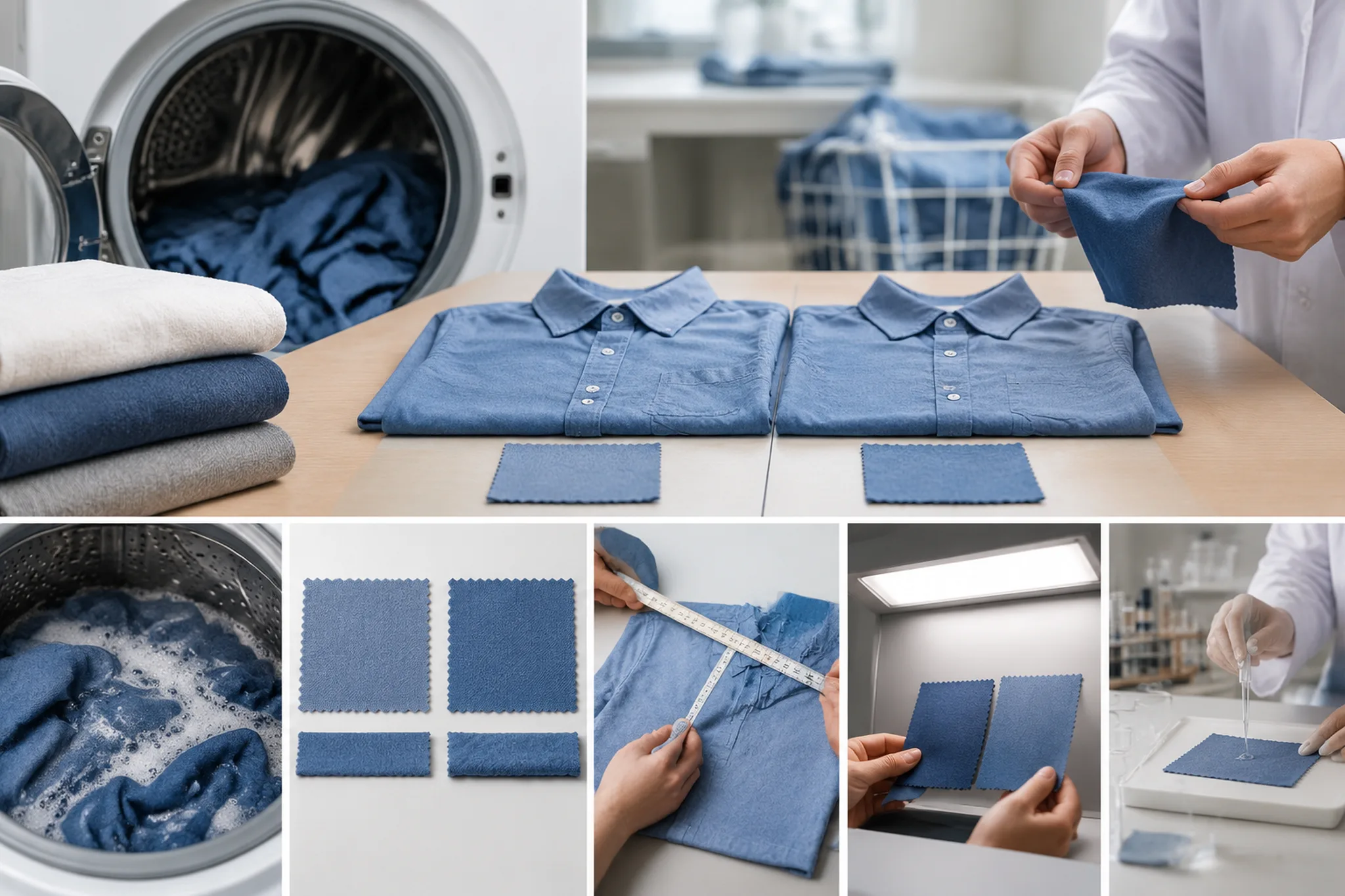
Consider a lightweight woven shirt expected to be washed frequently. The relevant question is not simply whether the fabric was sanforized. Review how sensitive the shirt is to changes in body length, width, sleeve dimensions, and panel matching. Seam placement, garment shaping, and the drying routine can determine whether a fabric-level change becomes noticeable in the finished product.
If finishing information and comparable dimensional observations are available, they provide a stronger basis for comparison than a general statement that the fabric is sanforized. The result should still match the material, construction, and care conditions under consideration. A different fabric lot, color, supplier material, or drying routine can change the relevance of the earlier observation. This remains a decision example, not a measured production result or a claim that every lightweight shirt requires the same evaluation.
Now consider a relaxed garment in which a small dimensional change may be less noticeable. The initial fit risk may be lower, so an informal check can help identify whether further investigation is warranted. That does not make the finish sufficient evidence by itself. Fabric structure, garment balance, seam arrangement, care instructions, and customer expectations may increase the consequences of change, even when the silhouette is loose.
Fabric-stage evidence and finished-garment evidence also answer different questions. A fabric observation describes dimensional behavior in the evaluated material and conditions. Cutting, sewing, seam configuration, and shaping influence whether that change becomes visible as altered fit, panel mismatch, twisting, or other appearance concerns. A finished garment can therefore reveal a practical consequence that a fabric measurement alone does not show.
Renew the comparison when the finishing history is unknown, the supplier material changes, the construction changes, or the care instructions change. The same applies when the evaluation property changes from dimensional behavior to color, hand, surface appearance, or another performance concern. Do not transfer an earlier conclusion merely because the garment category appears similar.
For future decisions, preserve a compact record: material identity, finishing information where available, intended care, evaluation property, wash and drying conditions, measurement timing, and observed result. This record makes later comparisons more useful while keeping the conclusion tied to its actual scope.
What to check before relying on the finish
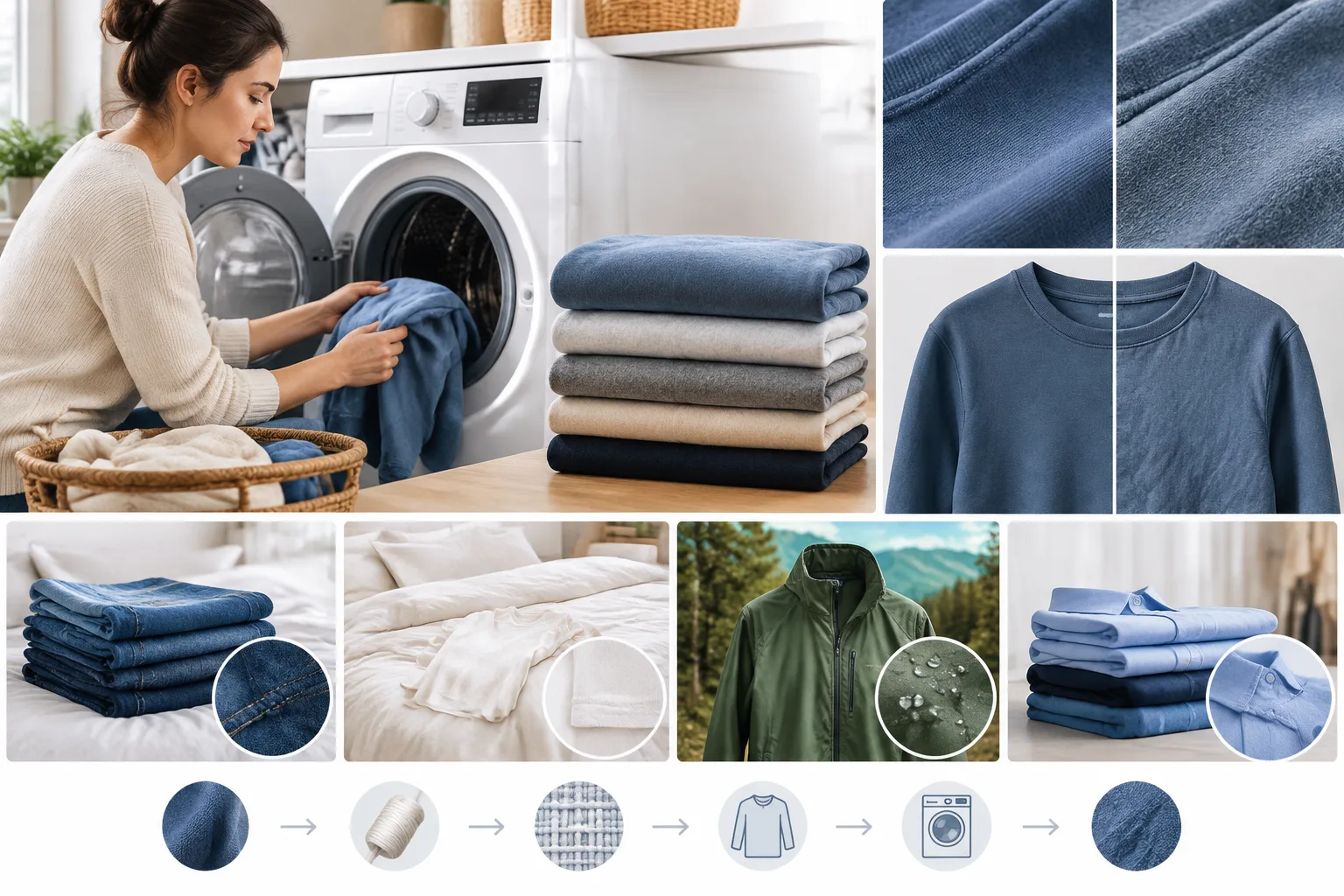
Repeated washing may leave sanforizing useful, but its durability must be judged within defined material, garment, care, and evaluation conditions. Compare the actual fabric or garment with relevant specifications, comparable samples, and documented results. Record the evaluation method and dimensional result, and check any applicable test method before treating the finish as sufficient evidence or seeking a universal wash count.
Frequently Asked Questions
Does sanforizing prevent all shrinkage after repeated washing?
No. Sanforizing is associated with controlling dimensional change, not with making fabric dimensions permanently unchangeable. The result after repeated washing depends on the material, construction, finishing history, care conditions, drying, and the property being evaluated.
What is the difference between sanforizing durability and colorfastness?
Sanforizing durability concerns whether dimensional control remains useful under defined conditions. Colorfastness concerns how color responds to a particular exposure. These are separate properties, so an observation about dimensional change does not establish color performance.
Which washing and drying details should be recorded when evaluating sanforized fabric?
Record the care routine, water conditions, agitation, temperature, detergent, drying method, number or sequence of evaluations when applicable, measurement timing, and the property being assessed. Without these details, comparisons between observations become harder to interpret.
Can a fabric-level wash result predict the final garment’s fit after laundering?
It can provide relevant evidence, but it cannot fully predict finished-garment fit. Cutting, sewing, seam arrangement, shaping, and panel relationships may determine how a fabric-level dimensional change appears in the completed garment.
When should a previous sanforizing result be checked again for a new fabric or garment?
Check it again when the material lot, color, supplier, construction, finishing history, care instructions, end use, or evaluation property changes. A previous result is most useful when the new decision closely matches its documented conditions.