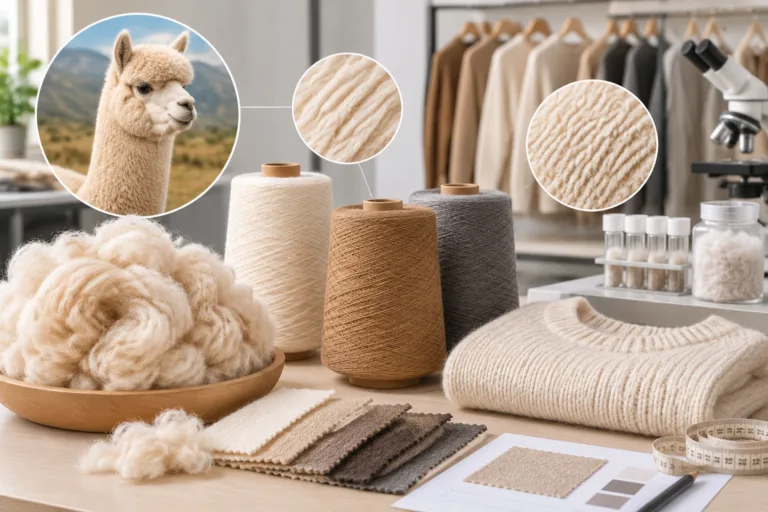
Alpaca fiber environmental impact depends on conditions at each life-cycle stage, so a single claim such as “natural” or “animal-based” cannot answer the whole question. Use a stage-by-stage review to ask what happened on the farm, how raw fleece became yarn, and which conditions apply to the specific material. Apparel Wiki’s Sponsor page is separate from this editorial assessment and does not establish performance claims.
Alpaca fiber is the fleece of the alpaca animal. It may be described by qualities such as fineness and by breed type, while process names and commercial terms belong to separate categories. For a useful alpaca fiber life cycle review, begin with the generic fiber name, then record the source, processing route, blend, and product conditions. The framework below treats each answer as dependent on the relevant lot and supply chain, rather than as a universal property of alpaca.
Alpaca Fiber and a Life-Cycle Question Framework
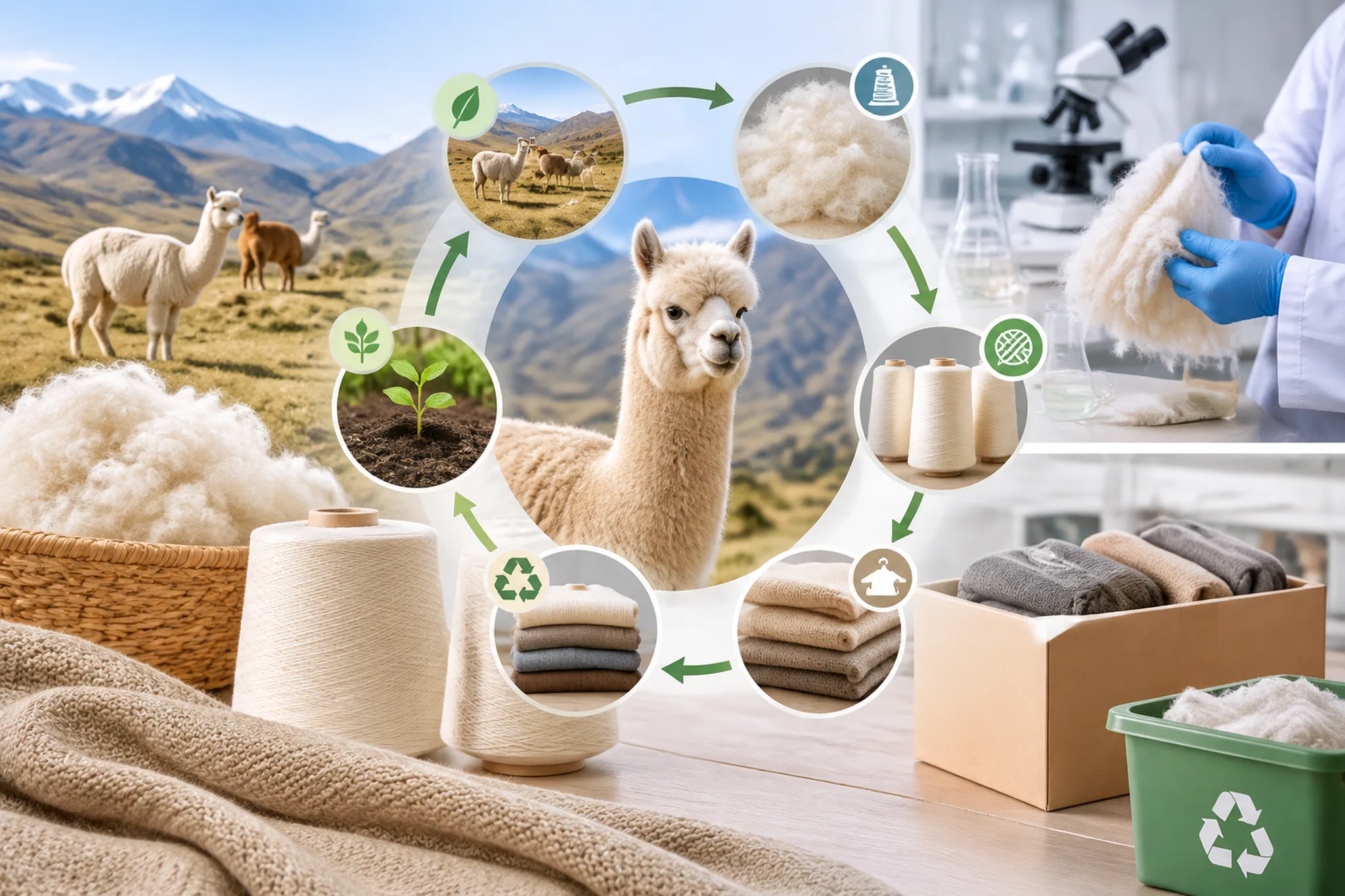
Life-cycle questions are more informative than a single eco-label or material adjective because impacts and trade-offs can arise at different points. Animal management affects the farm stage. Sorting and scouring introduce processing decisions. Product construction and care influence service life, while blends, finishes, and local waste systems affect end-of-life options. A favorable answer at one stage does not settle the others.
| Life-cycle stage | Key question to ask | Why the answer varies |
|---|---|---|
| Animal and land | How are grazing, water, stocking, and animal handling managed? | Climate, terrain, herd size, and farm practices differ by origin. |
| Raw fiber handling | How is fleece collected, sorted, graded, and prepared? | Fleece condition, contamination, equipment, and grading practices vary. |
| Processing | What water, energy, detergents, and effluent controls are used? | Mill equipment, treatment systems, and energy sources are site-specific. |
| Product use | How will the yarn or garment perform under expected care? | Fiber blend, yarn structure, fabric construction, and care behavior interact. |
| End of life | What happens to the finished product after use? | Blend content, finishes, and available recycling or disposal routes change the answer. |
For each stage, ask which conditions were documented, which statements are typical practice, and which are supported for the specific material. That distinction prevents a general description of alpaca from being mistaken for verified data about a particular supplier or lot.
Animal and Land Stage Questions
Begin with the origin and production setting of the raw alpaca fiber. Ask how land is managed, whether grazing is continuous or rotated, how stocking decisions are made, and how water is provided. Also ask how animals are handled and shorn, because husbandry and shearing practices are part of the farm-stage record rather than details that can be inferred from the fiber name.
Climate, terrain, herd size, and available forage can change the land-stage picture. Water availability may be a central concern in one region and less limiting in another. The same broad description, such as pasture-based or low-input grazing, therefore does not establish the environmental outcome of every herd. It describes a production approach that still needs origin-specific context.
Ask for the information that connects a farm statement to a defined supply chain: the production region, land-management approach, water source, animal-handling practices, and the basis for any environmental comparison. A supplier may be able to provide farm records, a traceability statement, or an assessment prepared for that production system. Treat an unsupported assurance as an open question, not as proof.
Research into mixed-species alpaca grazing illustrates why local context matters. Aberystwyth University’s research announcement on alpaca grazing frames grazing efficiency and environmental effects as subjects for investigation, not universal results that apply to every alpaca farm. The relevant question is therefore not simply whether alpacas graze, but how this herd, land, climate, and management system function together.
Keep quantitative comparisons especially cautious. Claims about grazing intensity, methane, or land use against other fiber animals require lifecycle-assessment or peer-reviewed agricultural evidence for comparable conditions. Without that evidence, record the variables qualitatively and request documentation for the specific origin.
Raw Fiber Handling and Processing Questions
Between shearing and yarn, ask how the fleece is handled. Useful questions include: How is it collected, sorted, and graded? What defects or vegetable matter are removed? How is the raw material scoured? Which water, energy, and detergent systems does the mill use? How is wastewater or effluent managed?
Raw fleece can contain grease, suint, dirt, and vegetable matter. Scouring removes unwanted material before later operations, so the process changes the inputs and outputs associated with the fiber. Sorting, scouring, carding, and spinning are broadly recognizable processing stages, but their equipment, sequence, operating conditions, water treatment, and energy sources can differ between mills.
Ask which details the mill or supplier can document, such as a process description, material specification, blend record, or environmental-control statement. Do not treat a natural-fiber label as evidence that processing used a particular amount of water or energy. Those figures are site-specific and require appropriate textile-processing evidence.
Record blend composition when the yarn is made. Adding another fiber changes the questions that follow: use-stage behavior may change with fiber form, proportion, yarn, and fabric structure, and end-of-life options may change with the resulting material combination. A blend is therefore a specification decision to document, not an automatic improvement in performance or environmental impact.
Apparel Wiki’s role here is to explain what to ask. It does not establish what a particular mill does, and an unverifiable processing statement should remain qualified until the supplier provides applicable evidence.
Yarn Specification Questions Before Product Development
A yarn number is useful only when its notation and unit system are clear. For alpaca yarn specification, ask what each part means in the supplier’s system. A notation such as 30/2 may describe a single-yarn count and a two-ply construction, but confirm both the count system and whether the stated value refers to the singles or the folded yarn. Commercial notation can vary, so record the supplier’s explanation alongside the number.
Direct linear-density units describe mass per length: tex is grams per 1,000 meters, denier is grams per 9,000 meters, and dtex is grams per 10,000 meters. The conversions are tex = denier ÷ 9 and dtex = tex × 10. For example, 90 denier converts to 10 tex, or 100 dtex. These units describe linear density, not yarn diameter. They also cannot be compared directly with indirect counts such as Ne, which express length per unit mass.
Blend composition also belongs in the specification. Fiber form, proportion, yarn construction, and fabric structure can all affect moisture behavior, wash durability, pilling, and processing suitability. Do not assume that adding a fiber automatically improves performance or environmental impact. Compare materials for the intended use under the same test conditions, and distinguish measured results from general descriptions.
Before development, document:
- Unit system and the meaning of the stated yarn count.
- Ply notation and whether the figure describes singles or folded yarn.
- Fiber names and blend percentages.
- Applicable test conditions for performance comparisons.
These details connect the yarn choice to later care and end-of-life questions. Keep generic fiber names distinct from brand or process terms; a commercial label alone may not explain the fiber composition.
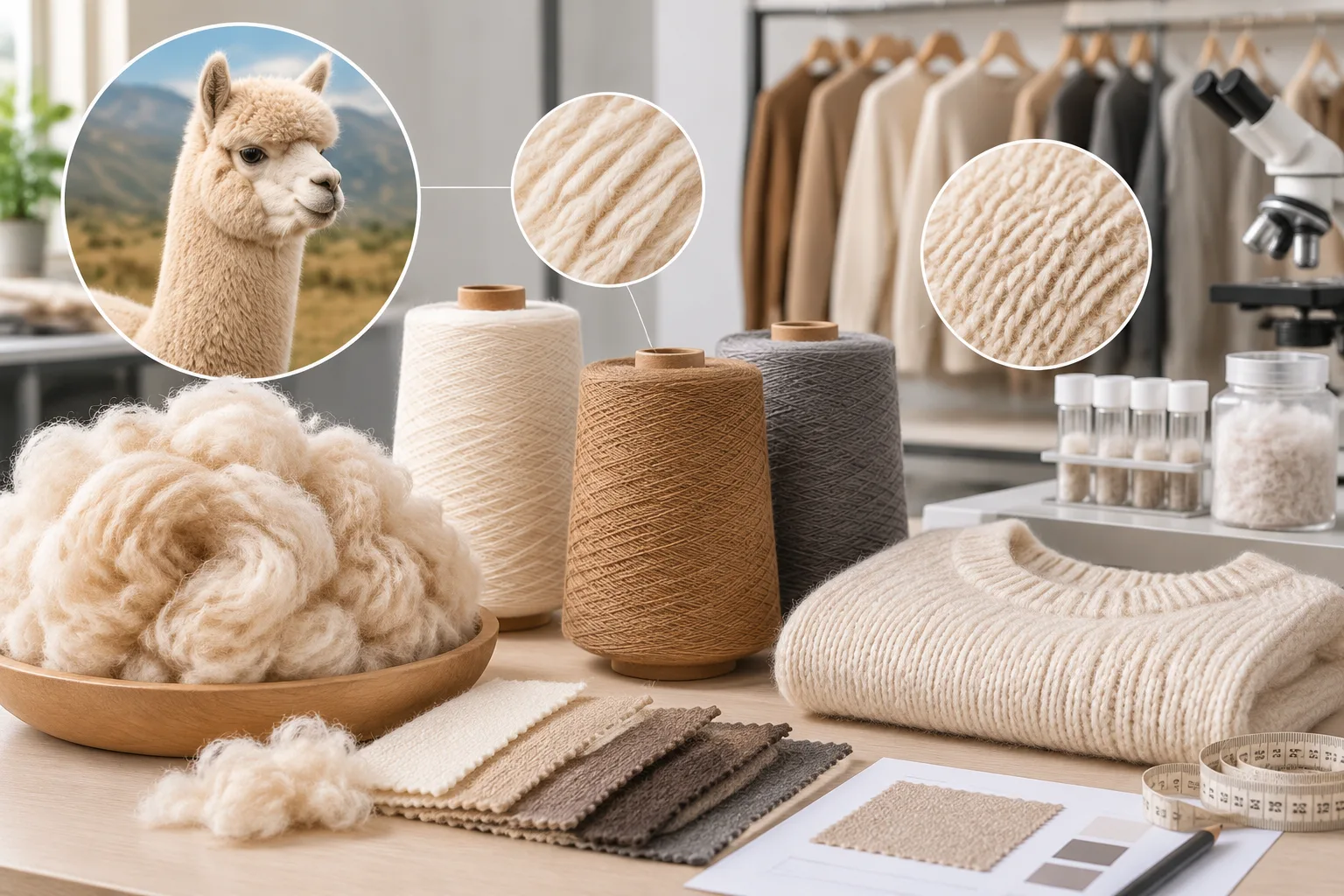
Weighing Alpaca Fiber Environmental Impact Across Use and End of Life
Use-stage questions concern the garment, not fiber identity alone. Ask how the product is expected to be washed and dried, how it behaves under those care conditions, and what durability or pilling evidence applies. Construction, fabric structure, yarn, and wear patterns influence the result alongside the fiber. A result from one construction or test condition may not predict another garment’s service life.
For end of life, establish the full composition, including whether the item is 100% alpaca or a blend, and ask what dyes and finishes were applied. Then consider the actual destination: does its waste system accept protein-fiber textiles for a relevant recovery route? Fiber biodegradability in suitable conditions does not by itself establish that a finished garment is compostable or will be accepted locally. Blends, finishes, dyes, and available infrastructure can change the practical outcome; avoid assuming a universal route or timeframe.
A well-documented 100% alpaca knit with clear care guidance presents different questions from a dyed alpaca-polyamide blend. The first still requires checking its finish and local waste options; the second raises additional questions about separating or handling mixed materials. A change in blend proportion or finish could change either assessment. These are decision scenarios, not claims about guaranteed outcomes.
Weigh farm, processing, use, and end-of-life information together. A favorable answer at one stage does not settle the overall environmental impact. Treat broad sustainability claims as a prompt to ask which product, conditions, evidence, and destination they describe.
Using the Question Set in Your Next Fiber Review
The value of alpaca fiber questions is their specificity: they connect each life-cycle stage to conditions that can be documented and compared. Build an internal checklist across animal and land, raw-fiber handling, processing, product use, and end of life. Use it to compare candidate yarn specifications and supporting documents, checking unit systems and test conditions before drawing conclusions. Related Apparel Wiki fiber and yarn guides can provide additional terminology for that review.
Frequently Asked Questions
Is alpaca fiber always more environmentally friendly than sheep wool?
No universal ranking follows from the fiber name alone. Farm conditions, processing, product life, care, composition, and end-of-life options all affect the comparison. Compare evidence for the specific products and conditions rather than relying on a general claim.
What does a yarn notation like 30/2 mean when sourcing alpaca yarn?
It may indicate a count and a two-ply construction, but notation and count systems vary. Ask the supplier to define the count system and clarify whether the number refers to the singles or the folded yarn. Record that explanation with the specification.
Can I compost or biodegrade alpaca garments at end of life?
Do not assume that a fiber’s potential to biodegrade means a finished garment is suitable for composting. Blends, dyes, finishes, garment construction, and local waste-system rules affect available options. Check the garment composition and the destination’s acceptance criteria.
Do alpaca blends change the sustainability picture?
They can change use-stage behavior and end-of-life questions. The effects depend on fiber form, proportions, yarn, and fabric structure, so a blend is not automatically better or worse. Compare relevant performance evidence under the same conditions and document the full composition.
Which farm-stage details should I ask an alpaca supplier to document?
Ask about origin, land management, stocking practices, water availability, and animal handling and shearing. Request information that supports any specific claims and applies to the relevant supply chain. Conditions vary, so an answer from one region or herd may not transfer to another.
How should I compare alpaca yarns from different suppliers on the same basis?
Confirm each yarn’s unit system, count notation, ply, and fiber composition. Then compare performance evidence only when test conditions and intended use are comparable. Keep undocumented claims distinct from specifications or results that can be checked.