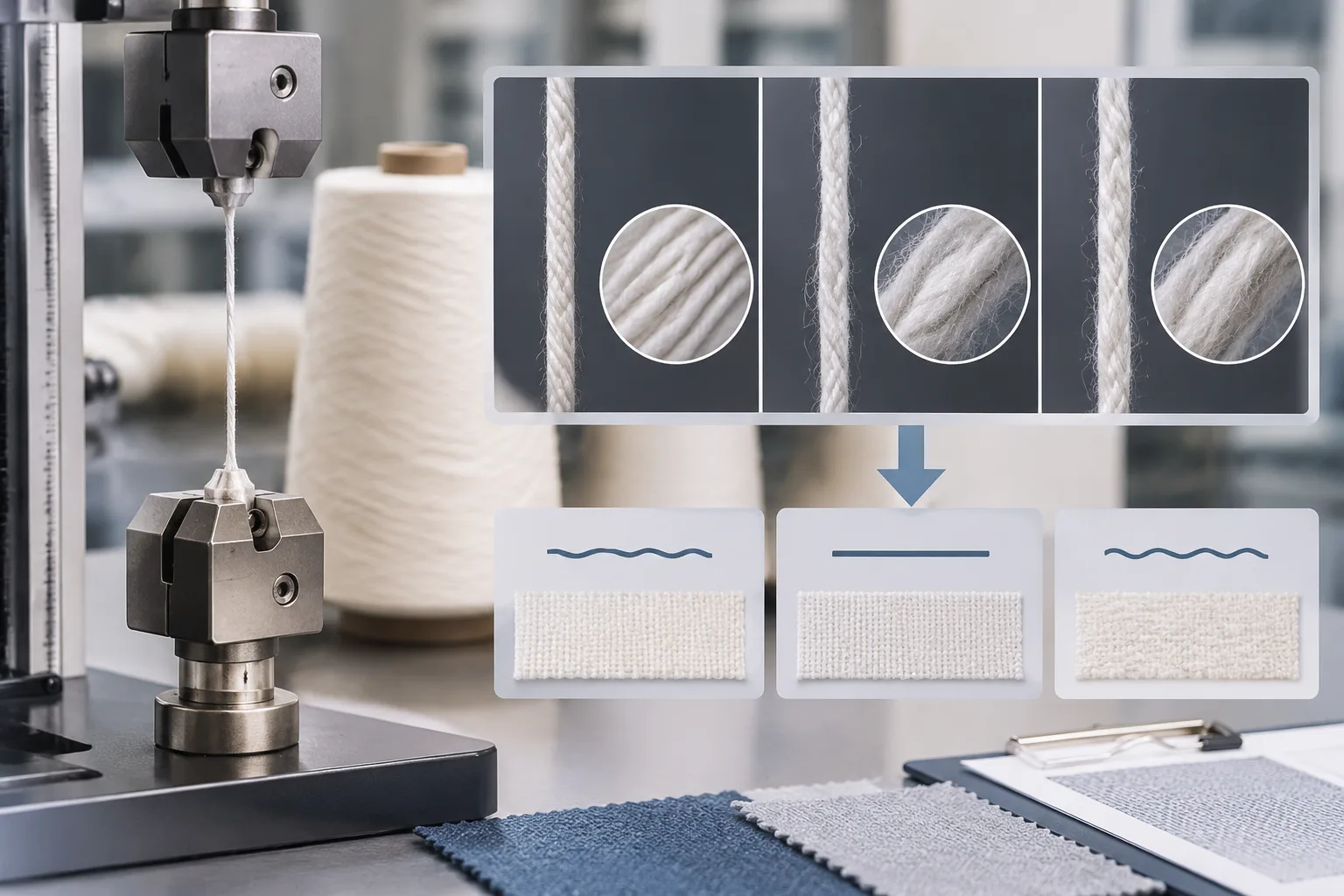
Fully drawn yarn strength testing produces a measured response from a named sample under stated conditions. It does not, by itself, rank one yarn as better than another. To interpret the result, first confirm the yarn identity and linear-density basis, then read the force or normalized strength, elongation, variation information, and test conditions. A larger number may be useful for one end use and irrelevant to another. For background on Apparel Wiki’s independent editorial context, see Sponsor.
The practical question is not simply “What number did the yarn achieve?” It is “What was measured, how was it reported, and is it comparable with the result beside it?” This distinction keeps a tensile report within its evidence boundary. Tensile terminology includes separate properties such as breaking force, breaking strength, tenacity, and elongation, rather than one universal measure of yarn quality. A university reference on yarn tensile-testing terminology provides useful context for these distinctions.
How to Interpret Fully Drawn Yarn Strength Testing Results
“Fully drawn yarn” should first be treated as the designation used for the yarn on the supplied report unless an authoritative technical reference defines the production meaning for the specific material. The designation identifies the yarn category or construction described by the document; it does not prove a particular breaking force, elongation, handle, abrasion response, pilling result, sewing behavior, or finished-garment durability.
Read the report in a fixed order. Start with the sample identity: material description, nominal linear density, single-yarn or plied-yarn basis, construction, finish status, package or lot information, and any treatment. Next record the method name and version, conditioning or atmosphere, pretreatment, gauge length, test speed, gripping arrangement, and calculation basis when reported. Then identify whether the result is force, a normalized strength value, elongation, or a variation statistic.
Breaking force describes the load required to break the tested specimen. A normalized value such as tenacity relates strength to a linear-density basis, so it can support comparison only when that basis and the calculation method agree. Elongation at break describes extension during the stated tensile procedure. It is not automatically stretch recovery, garment comfort, dimensional stability, or fabric performance.
Finally, check whether the report gives individual results, an average, a minimum, a range, a standard deviation, or another variation measure. Record the method, version, units, calculation basis, and requirement source beside the result. Treat the value as condition-specific evidence, not as a universal yarn ranking. A tensile result can support a focused comparison, but it cannot answer every downstream product question.
Read the Main Values and Units Without Mixing Their Meanings
Breaking force is the load recorded when the tested yarn specimen breaks. Its unit expresses force. It should remain separate from tenacity or another normalized strength value, which relates the measured force to linear density. Two yarns can therefore show different force values partly because their linear densities differ. Normalization may make comparison more informative, but only when the reports use compatible yarn bases and calculation definitions.
Preserve the report’s original unit and wording before entering a value in a spreadsheet. “Strength,” “breaking strength,” and an abbreviated metric can be ambiguous without the laboratory’s definition. If a report does not explain the metric, request its calculation basis rather than assigning a familiar meaning. Units are part of the result identity, not formatting that can be removed after copying the number.
Elongation at break describes the extension reached under the stated tensile procedure before rupture. It does not establish how a garment will stretch and recover, how comfortable it will feel, or how stable its dimensions will remain. Those questions involve other materials, constructions, and evaluation conditions. Keep the limitation beside the interpretation instead of allowing “higher elongation” to become a general performance claim.
Also identify the statistic. An individual result describes one tested specimen. An average summarizes the reported group. A minimum may be a selected floor rather than a typical response, while a range shows spread between reported values. Standard deviation or coefficient of variation describes variation according to the report’s calculation and sampling basis. These forms answer different questions and should not be compared as though they were interchangeable tensile results.
Linear-density notation needs the same care. Tex expresses mass per length, with one tex equal to grams per 1,000 metres; denier and dtex use different length bases. The supplied conversion relationships are tex = denier ÷ 9 and dtex = tex × 10. These are unit conversions, not strength calculations, and linear density is not yarn diameter. Direct systems such as tex, denier, and dtex should not be compared in magnitude with an indirect count system such as Ne without a verified conversion and compatible basis. Confirm whether a notation describes a single yarn or a plied yarn before normalizing it.
Check Whether Two Tensile Reports Are Actually Comparable
Matching force units do not make two tensile reports comparable. Begin with sample identity. Check yarn type, nominal linear density, filament or yarn construction, single-yarn or plied basis, finish status, treatment, and package or lot context. A shared commercial label can still conceal different constructions or reporting bases.
Place the method name and version beside each value, along with conditioning or atmosphere, pretreatment, gauge length, test speed, gripping arrangement, break selection, sample selection, replicate count, and result calculation. These details describe how the response was obtained. An official yarn tensile method, such as the single-strand method identified by ASTM’s yarn tensile standard page, is not itself a universal product acceptance limit.
Use the following as a comparison screen, not as a complete test procedure:
| Reported input | Why it matters | Comparison decision |
|---|---|---|
| Sample identity and linear-density basis | Different construction, lot context, or single/plied basis can change the meaning of the value. | Compare only when the bases are matched or the difference is explicitly accounted for. |
| Method, version, and calculation definition | The same unit can represent results obtained and calculated under different rules. | Request the missing definition; otherwise mark the comparison unresolved. |
| Conditioning, pretreatment, gauge length, speed, and gripping | Test conditions affect the measured response and the point at which the specimen breaks. | Call the reports conditionally comparable unless relevant conditions align. |
| Replicate count and reported statistic | An average based on different sampling can have different representativeness. | Compare the statistic and sampling basis, not just the displayed average. |
| Project or purchasing requirement | A requirement belongs to a particular product or project, not automatically to every yarn. | Compare against the documented requirement, never an invented universal threshold. |
A single result cannot establish lot-wide behavior. If a report omits method conditions, calculation definitions, or sample details, request those records before declaring one yarn stronger or better. Keep the distinction clear: a test method explains how a result was obtained; a product specification states what a particular project requires. The existence of a method does not create a pass/fail value for all fully drawn yarn.
Use Differences as Investigation Clues, Not Automatic Diagnoses
When two fully drawn yarn tensile results differ, treat the difference as an investigation clue. A result shows what happened under stated conditions; it does not identify the cause by itself. Begin by checking whether the reports describe the same yarn, linear-density basis, construction, finish status, package or lot context, and treatment.
Next, compare the test conditions and reporting basis. Confirm the method and version, conditioning or atmosphere, pretreatment, gauge length, speed, gripping arrangement, break selection, calculation definition, and replicate handling. A force difference may reflect a different linear-density basis. A normalized-strength difference may reflect a different calculation basis or a different material response. Neither interpretation is reliable until the report definitions match.
Then inspect the sampling and variation information. A wide spread between replicates can prompt checks of package position, specimen handling, visible defects, sample selection, and instrument behavior. It is not proof of inconsistent production. A small average difference may also have limited meaning when the sampling basis or variation statistics differ.
Only after these checks should you investigate material, construction, finish, or processing differences. These are possible lines of inquiry, not automatic explanations. Tensile values alone cannot establish a particular draw condition, polymer problem, finish chemistry, or manufacturing fault.
For example, suppose matched reports for a lightweight filament yarn show different normalized results during a sewing or fabric-development review. First confirm the linear-density and calculation definitions. If those align, examine replicate spread and sampling before deciding whether the yarn warrants further investigation. If the yarn evidence is consistent, the next question may concern downstream construction, because fabric structure and use conditions can change the practical decision. Document the evidence and unresolved questions rather than presenting a diagnosis.
Turn a Tensile Result Into a Defensible Product Decision
A useful review turns the report into a bounded decision, not a universal quality ranking. Start by defining the end-use question. You may be screening yarns, checking a documented project requirement, investigating a report difference, or deciding whether tensile data answers the risk under review.
Then assemble matched evidence. Preserve the sample identity, method and version, units, calculation basis, result statistic, replicate information, requirement source, and missing details. Compare the result with the applicable project or purchasing requirement, if one exists. Finally, identify a confirming check when tensile data does not address the actual downstream concern.
| Observable report inputs | Limited implication | Initial choice | Variables that could change the choice |
|---|---|---|---|
| Matched samples, methods, units, and similar results | The reports support a like-for-like comparison within their stated conditions. | Compare and record the result as condition-specific evidence. | Different sampling, construction, requirement, or end-use risk. |
| Different or missing method conditions | The numerical difference may not represent a yarn difference. | Request clarification or a matched retest. | Whether the missing condition materially affects the measured response. |
| Different linear-density or calculation bases | Force or normalized values may not be directly comparable. | Preserve the original values and verify the definitions before normalizing. | Single versus plied yarn, calculation rule, and compatible yarn basis. |
| High replicate variation | The displayed average may not describe the sample consistently. | Review sampling and specimen records before drawing a material conclusion. | Replicate count, package position, defects, handling, and instrument checks. |
| Result meets a documented requirement but misses the downstream risk | The tensile requirement does not establish finished-fabric or garment performance. | Compare construction, use conditions, and the applicable evaluation method. | Seam design, fabric structure, care exposure, and the actual product question. |
This table is a review aid, not an acceptance matrix. A test method explains how a result was obtained. A product specification states what a particular project requires. The existence of a method does not create a pass/fail threshold for every fully drawn yarn.
A tensile result can support yarn screening while remaining insufficient for a finished-garment decision. Do not rewrite elongation as stretch recovery, comfort, dimensional stability, or sewing performance. When those properties matter, identify the relevant construction, use conditions, and evaluation method separately. Record the reasoning in the product file so later reviewers can distinguish measured results from editorial or project recommendations.
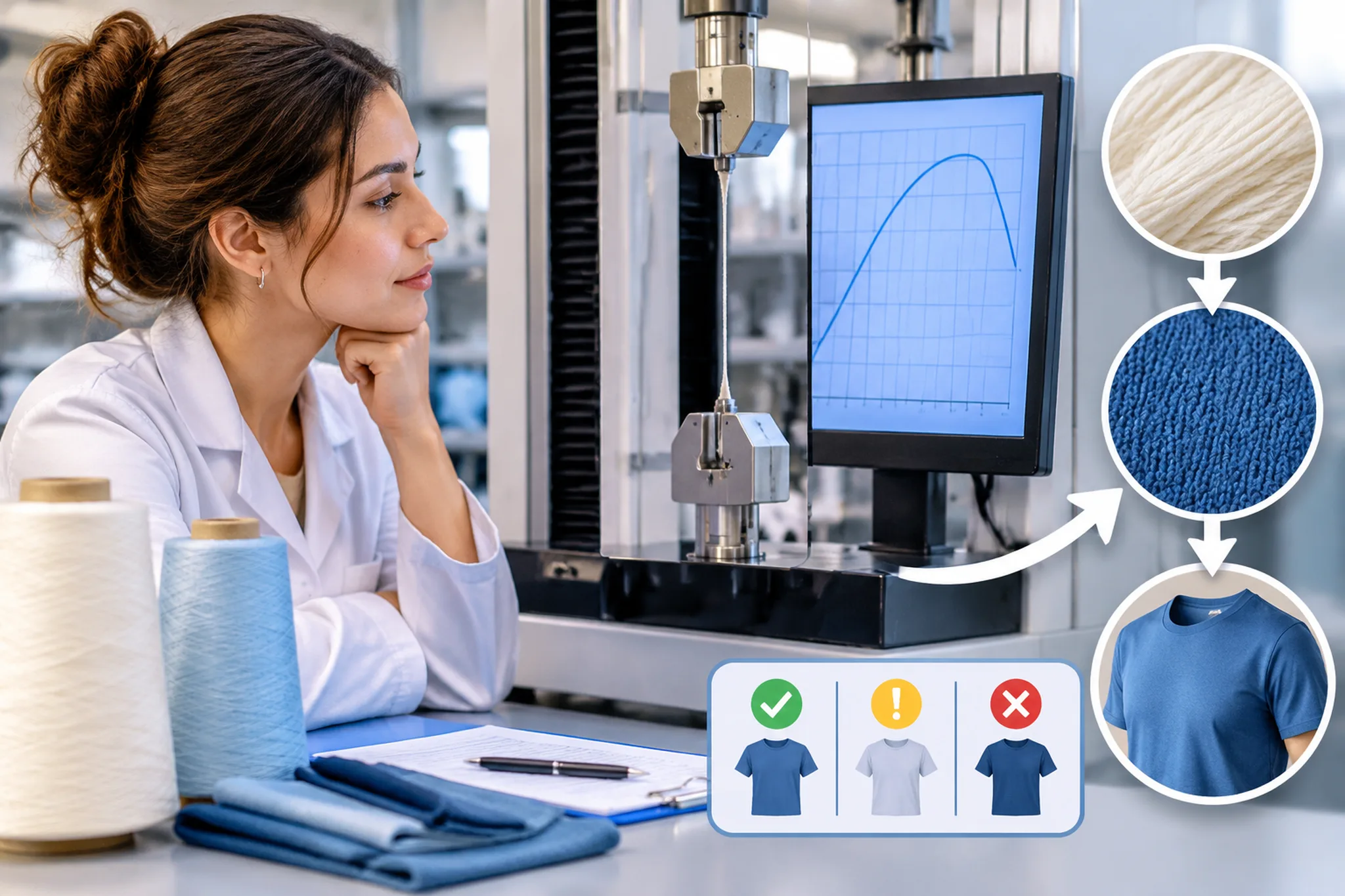
A Clear Next Step for Reading the Report
Preserve the report’s original wording, units, sample identity, method conditions, and calculation basis. Build a side-by-side comparison sheet and mark each value as comparable, conditionally comparable, or unresolved. Before treating a difference as a quality decision, check the applicable method and documented project requirement.
Frequently Asked Questions
What is the first thing to check on a fully drawn yarn tensile report?
Check the sample identity and reporting basis first. Confirm the yarn designation, linear-density notation, single or plied basis, units, and stated method. Without those details, a displayed strength value may not describe the sample or comparison you think it does.
What is the difference between breaking force, tenacity, and elongation at break?
Breaking force is the load recorded when the tested specimen breaks. Tenacity or another normalized strength value relates strength to a stated linear-density basis. Elongation at break describes extension under the stated tensile procedure. None of these values alone describes garment performance.
Can two yarn tensile results be compared if they use the same unit?
No. Matching units do not establish comparability. The sample basis, linear density, construction, method, conditioning, gauge length, speed, gripping, calculation definition, and replicate handling may also need to align. Request missing conditions before ranking the results.
Why can replicate tensile results vary for the same yarn?
Variation can reflect sampling, package position, specimen handling, visible defects, conditioning, or instrument and setup conditions. The report’s replicate count and variation statistic help frame the result, but a wide spread is a prompt for investigation, not proof of a production fault.
Does a higher fully drawn yarn strength result always mean the yarn is better?
No. A higher value may be measured under different conditions or may answer only one part of the end-use question. Tensile data does not by itself establish handle, abrasion behavior, pilling, sewing performance, or finished-garment durability. Compare against the documented project need.
What should be requested when a yarn test report omits its method or calculation basis?
Request the method name and version, relevant conditions, sample and linear-density basis, units, calculation definition, replicate information, and any applicable requirement source. Until those records are available, mark the comparison unresolved or conditional rather than inferring which yarn is stronger.