A wash trial brief is the controlled set of garment details and instructions used to plan and evaluate a wash trial. Effective wash trial briefs version control connects those instructions to the exact garment being assessed. Apparel Wiki provides independent educational guidance; its Sponsor page explains the separation between sponsorship and editorial control.
When a design changes, identify the affected details, record the revision, and assess whether the planned comparison remains valid. An outdated brief can attach a result to the wrong design. A useful record makes the current baseline, change history, sample identity, and decision scope clear.
Why a wash trial brief needs a controlled design baseline
A controlled design baseline is the agreed garment definition against which the trial will be interpreted. It connects the design, materials, measurements, construction, labeling, and wash conditions relevant to the trial objective. Version control preserves that relationship through garment design changes.
Changing a file name alone does not establish which instructions reached the sample room or which garment entered the trial. The brief needs enough detail to distinguish that sample from earlier or later versions sharing the same style name.
Start with a traceable relationship among the garment reference, brief revision, sample identifier, and trial date or batch reference. Naming conventions vary by organization. Whatever convention you use, a reader should be able to identify the governing brief without interpreting informal messages.
A design revision changes what the garment is or how it should be handled. A document correction fixes the record without changing its intended meaning. Replacing fabric, altering a measurement, changing a seam, or revising a label or wash instruction can change the trial’s purpose or comparison basis.
Consider a lightweight knit whose body-width specification changes before washing. If the sample uses the revised width but the brief retains the earlier value, the comparison mixes two design definitions. The result describes the revised sample; it cannot silently stand for the earlier design.
A fabric replacement raises the same identity question, although its physical effects depend on the particular materials and garment. Record the replacement without assuming a specific washing outcome.
Photographs and comments support the baseline, but they cannot replace measurement definitions, units, material specifications, or written handling instructions where those details affect comparison. Resolve conflicts between images and text before execution. If a change affects the objective, pause comparison, update the brief, or explicitly establish a new baseline.
Create one traceable version record for every wash trial
Use a version record that identifies the active brief and preserves its change history. The following structure is adaptable editorial guidance, rather than a mandatory industry template.
| Brief field | Observable input | Implication for the wash trial | Initial recording choice | Variable that could change the choice |
|---|---|---|---|---|
| Garment reference | Style and design revision | Defines garment scope | Record both references | Separate design variants |
| Fabric and trim identity | Material codes and specifications | Identifies inputs represented | Link applicable material revision | Substitution or finish change |
| Measurement points and units | Defined locations and values | Establishes dimensional baseline | Record definitions, values, units | Changed fit or measurement location |
| Construction details | Seam and hem specifications | Identifies assembly represented | Link construction detail revision | Revised assembly |
| Wash instructions | Planned washing and handling | Defines trial conditions | Record governing instruction revision | Changed care intent |
| Sample identifier | Physical sample tag | Connects garment to record | Assign distinct sample identity | Replacement sample |
| Approval status | Decision, approver, scope | Shows authorized trial basis | Record status and open issues | Conditional or withdrawn approval |
A revision number answers which document version applies. An effective date or batch boundary answers when it starts applying. A change description explains what differs. Keep these separate so a recent date cannot obscure an unchanged or incorrectly assigned revision.
For every changed measurement or material, require the before-and-after values or references, reason, expected impact, approving person or role, and first applicable sample or trial. Describe the impact as an assessment, keeping unresolved questions visible.
Link the brief to the relevant bill of materials, or BOM, and its revision. The BOM describes inputs and quantities; a cost record assigns values to those inputs. Cost information alone cannot identify the material specification used.
Mark superseded briefs as historical and retain their sample links. Make the active version visually unambiguous wherever instructions are issued.
Assess whether a design change invalidates the planned trial
Before running or approving a trial, ask whether the changed garment still answers the original development question. A revision can preserve some useful evidence while making other comparisons unsuitable. Assess the affected scope before choosing whether to continue, revise, or repeat.
Group the review around the garment rather than the document layout:
- Materials: Have fabric, finish, or material references changed?
- Dimensions, pattern, and fit: Are the intended shape, measurement baseline, and sample size still applicable?
- Construction: Does the sample use the specified seams, hems, and assembly details?
- Trims and labels: Do their identities, positions, or handling instructions differ?
- Wash-care instructions: Do the planned conditions still match the design intent?
- Trial purpose: Which observations would no longer represent the same baseline?
A corrected typo may preserve trial identity when it leaves the instruction’s meaning unchanged. An apparent correction that changes a measurement value or wash condition needs substantive review. Describe what the sample actually represents before deciding how to classify the change.
Suppose a hem construction is revised after the trial is planned. Identify whether hem appearance, the defined length measurement, or observations around that construction are part of the objective. Record which comparisons need reassessment without predicting a specific physical effect. Keep the earlier construction clearly identified in any retained evidence.
Material or dimensional changes can also raise connected questions about pattern, care handling, further trials, and development scheduling. Their relevance depends on the project. Approval of one change does not establish validation of other sizes, materials, or performance characteristics.
Use a disposition field such as continue, revise and rerun, hold for review, or retain as historical. Record the reason, applicable scope, and open questions beside it. A visually acceptable sample alone does not establish dimensional, functional, or production consistency. Base the decision on evidence completed for the defined purpose, with unresolved dependencies still visible.
Write wash instructions and measurement points that survive design revisions
A useful wash trial brief separates the trial objective from the instructions and observations needed to evaluate it. Keep the garment identity, pre-wash condition, approved wash-care instruction, drying or handling instruction, measurement points, observation notes, and post-wash comparison fields distinct. This structure makes it easier to identify which information changed when the design changes.
Measurement points must describe more than a garment area. State the location, direction, garment orientation, and unit used for the comparison. The appropriate points depend on the garment and trial objective. A length point, opening, panel, or seam-related measurement may matter in one product but not another. The important requirement is that the same defined point can be found and interpreted consistently for the relevant revisions.
Refresh the brief when a design change alters the area being measured, the construction around that area, the material reference, or the intended care condition. A revised hem, changed panel, different trim, or substituted fabric may make an earlier point incomplete or less relevant. Record the former definition and the new definition when both are needed to explain the development history.
Keep the wash conditions tied to the approved brief for that sample. Do not insert one temperature, cycle, duration, or drying method as a universal recipe. The correct condition depends on the product objective, approved care instruction, material, construction, and applicable project requirements. The brief should make the selected condition unambiguous without implying that it guarantees a particular result.
Finally, connect the sample tag, brief revision, and result sheet visibly. A post-wash observation should remain attached to the instructions that produced it. This traceability preserves comparability; it does not guarantee a specific dimensional, appearance, or performance outcome.

Compare wash results against the correct revision
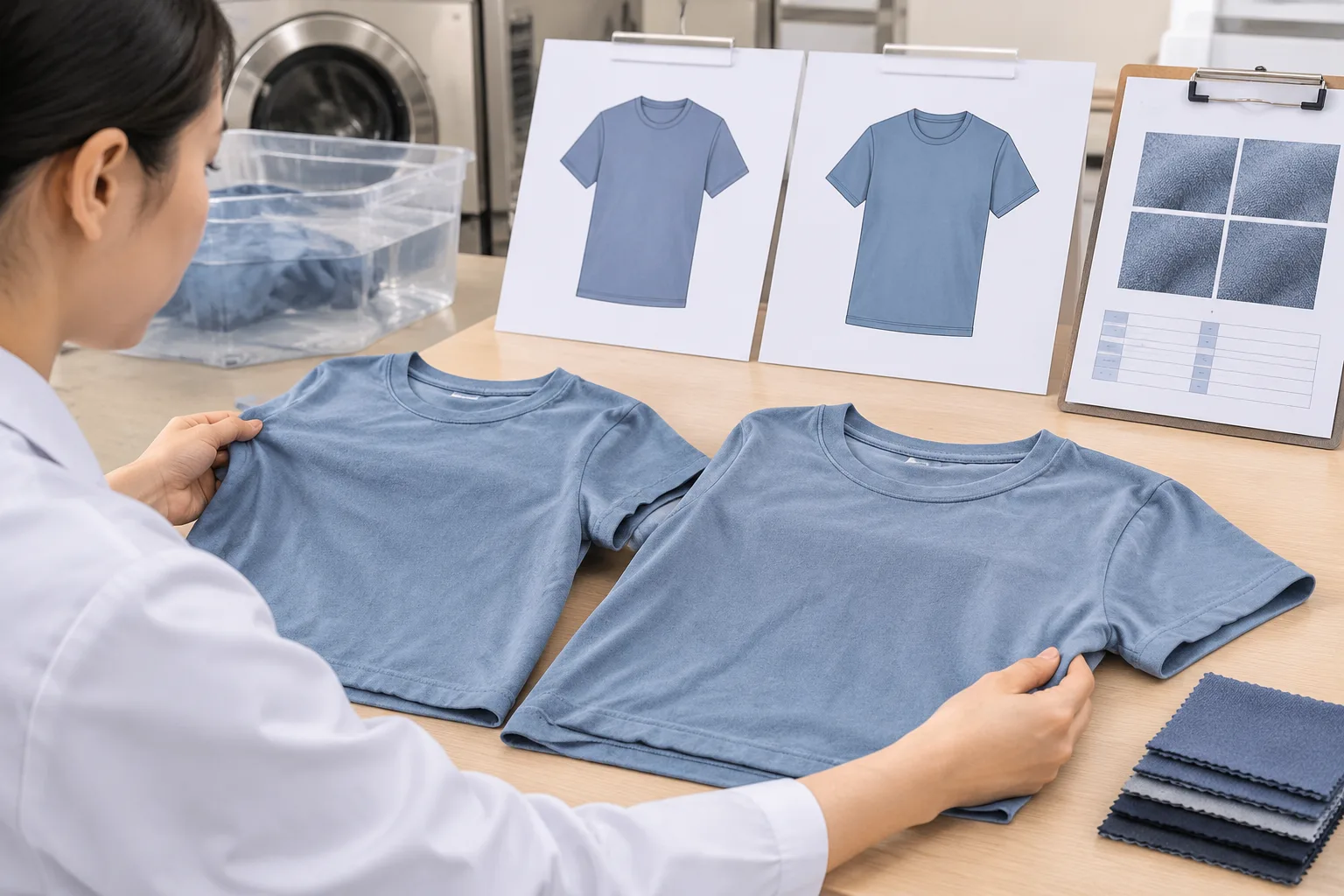
Begin a post-wash review by confirming the sample identifier, brief revision, material reference, relevant construction, wash instructions, and measurement baseline. If any of these links is unclear, pause interpretation until the scope of the record is understood. A result can still provide historical information, but its evidentiary value should not be overstated.
Keep different kinds of information separate. Measured observations report what was recorded at defined points. Visual observations describe appearance or construction conditions. Reviewer comments explain interpretation, while decisions state what happens next. Separating these fields reduces the risk that a project-specific observation becomes an unsupported general performance claim.
Compare like with like. A result from an earlier fabric, measurement, seam, or care condition may help explain development history, but it should not silently validate a revised design. For example, if a revised construction changes the area observed after washing, identify which earlier observations remain comparable and which must be treated as historical.
Record the scope of every significant observation. Note affected dimensions, appearance or construction findings, deviations from the planned instructions, and unresolved questions. Include the conditions under which the observation was made and identify whether the issue applies to the sample, the affected design feature, or a broader development decision. This keeps limitations beside the conclusion.
The resulting disposition may be to accept the sample for the defined development purpose, revise and repeat the trial, investigate a discrepancy, or hold the decision pending missing evidence. These labels are adaptable process guidance rather than universal release terminology. A sample that looks acceptable does not replace checks appropriate to dimensions, function, and production consistency.
Use the next revision to close the documentation loop
Maintain wash trial brief version control as a controlled loop: identify the design baseline, record changed fields, assess the impact, update instructions and measurement points, link the result to the correct sample revision, and record the next decision. Review one current brief beside a recent result sheet. Mark missing links, such as an undocumented material change, unclear measurement point, absent approval, or unresolved issue. That small educational review can show whether the record still explains what the trial actually represents.
Frequently Asked Questions
What should change in a wash trial brief when the fabric is replaced?
Update the material reference and any affected construction, measurement, care instruction, trial objective, and comparison fields. Record the former and new material references, reason for replacement, impact assessment, approver, and first sample or trial using the replacement.
Should a revised garment design receive a new wash trial or can the earlier result still be used?
It depends on whether the revision affects the trial objective or the conditions represented by the earlier result. Retain the earlier result as historical when appropriate, but revise and rerun the trial when the changed material, measurement, construction, or instruction alters the comparison basis.
How should measurement points be version-controlled in a wash trial brief?
Define each point by location, direction, garment orientation, and unit. Keep the prior definition when it explains earlier results, then record the new definition and the first applicable sample when a design change alters the area or purpose of measurement.
What information links a post-wash result to the correct garment revision?
The essential links are the garment reference, brief revision, sample identifier, material and construction references, approved wash instructions, measurement baseline, and trial date or batch reference. The result sheet should preserve these links rather than relying on photographs or message history alone.
Can a visually acceptable washed sample be approved when some brief fields are still unresolved?
Visual acceptability alone does not establish dimensional, functional, or production consistency. An organization may make a limited development decision, but unresolved fields and dependencies should remain visible, with the decision scope and next evidence clearly recorded.